If I had very little money and no kids I would take one of these house sitting opportunities for 4-6 months and just grind until I built something. My friend Bonnie and her husband slow traveled the world for a decade at $20K a year because they took tons of these house and pet sitting opportunities.
Love this idea from Shannon. I tell people all the time just test things out. Especially when you have to ask others for permission for something just say let’s do a test. If it works no one will say anything and you can keep going. If it doesn’t, it was just a test anyway.
Most people don’t chase their dreams.
Not because they’re lazy.
But because deep down, they don’t think they deserve them.
Or they’re scared they’ll fail trying.
Shift your mindset:
Treat every dream like an experiment.
Experiments aren’t about winning.
They’re about learning.
Some fail. Some succeed.
But either way, you grow stronger.
Just had a super fun conversation with my Airbnb guests from last night. He is in his twenties and in the middle of an exit from his window cleaning business and planning on using the money to roll into real estate and add to his own AirBNB portfolio.
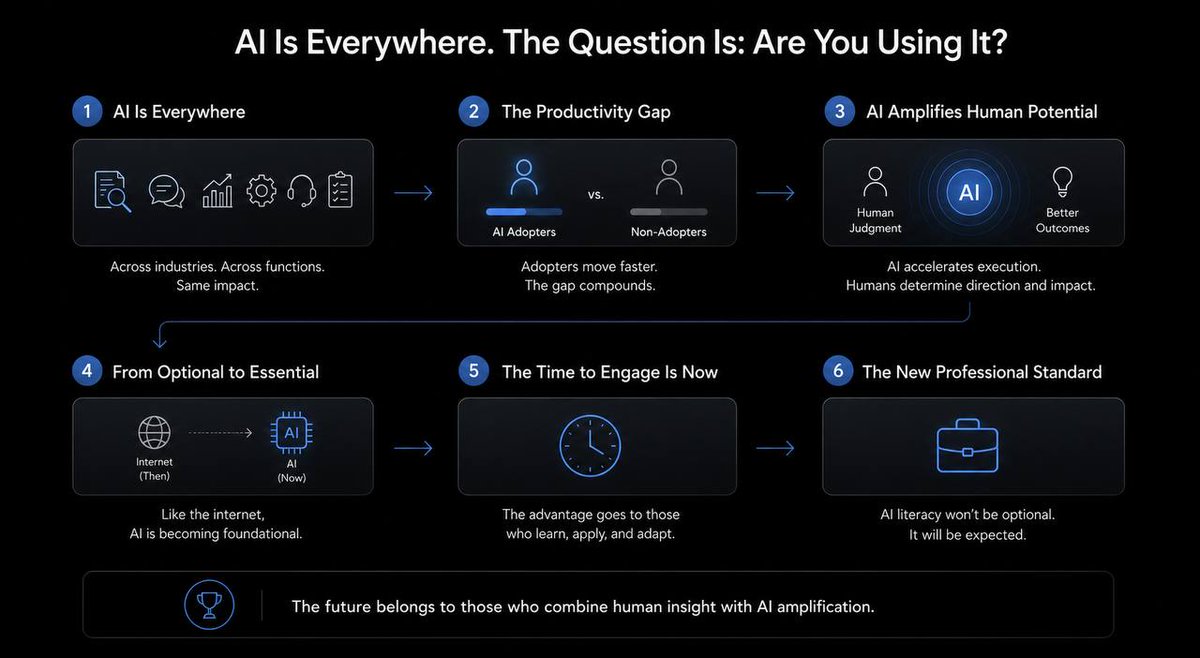
AI isn’t replacing judgment, creativity, or relationships.
It is amplifying them.
The gap between those who adopt thoughtfully and those who don’t is widening fast.
It’s increasingly difficult to ignore how deeply AI is integrating into everyday work and decision-making.
We’ve moved past the stage where AI is viewed as a niche tool for developers or tech enthusiasts.
Today, it’s being used across industries to improve research, communication, analysis, automation, customer experience, and operational efficiency.
What stands out most is the productivity gap beginning to form between individuals and organizations that actively use AI and those that don’t.
Tasks that once required hours of manual effort can now be completed in minutes with the right systems and prompts. That shift compounds quickly over time.
The comparison to the early internet era feels increasingly accurate. At one point, internet adoption was optional. Eventually, it became foundational.
AI appears to be following a similar trajectory not as a replacement for human capability, but as an amplifier of it.
The most effective users of AI are not necessarily the most technical people. They are often the ones with strong judgment, creativity, communication skills, and the ability to ask better questions.
AI accelerates execution, but human direction still determines quality and impact.
What’s surprising now is not that AI exists, but that many people still choose not to engage with it despite its growing relevance across education, finance, media, healthcare, software, and business operations.
Over the next few years, AI literacy may become less of a competitive advantage and more of a basic professional expectation.
@noahkagan@ericries I’d love to have a copy to sit next to this bad boy in the book shelf. Plus, you already have my address from when you sent me smart kitty litter.🫡🚀💪