A little fun weekend project using feetech motor replicated the @MicroDuckNVDA
Done in TWO days 🦾
Open sourced here: https://t.co/VyQrHJ1yjy
Website (actively updating rn): https://t.co/XV6OYKYT7E
We added intuitive gui for calibration; motor ID setup; visualizations and controls
Parts got in Shenzhen; assembled in day one and got the policy deployed next day!
Super fun project - it is like a humanoid with all actuators and sensors in a compact form - everything one would need to learn robotics: camera, lidar, speaker, mic, imu and motors. Highly recommend anyone who wanna get into robotics to try this as first project.
Next up better sim2real! The foot is still too slippery need better balancing!
Human motion is a starting point for robot learning. 🦿
NVIDIA SOMA Retargeter maps human motion to different humanoid robots, accounting for their proportions, joint structures and range of motion.
Developers can configure their robot, refine movement interactively and process motion collections into reference trajectories for downstream policy training.
Explore the workflow ➡️ https://t.co/Qfvo0JR8ZR
🚀 Floki Expands Its Blockchain Ecosystem
@FLOKI offers a diverse range of products and services designed to make blockchain technology more accessible and simplify adoption for users worldwide. @vincemedia1
Watch the investor event recap⬇
https://t.co/rmS2luZ1j1
Watch the @NewToTheStreet interview⬇
https://t.co/qQEZhCdYSp
Visit https://t.co/zbfqUqp3QV to explore the ecosystem.
#FLOKI #valhalla #MMORPG #crypto #metaverse #gaming #Web3 #cryptonews #blockchain #businessupdate #innovation #businessnews #business #news #newtothestreet
Shroom is designed to adapt to any environment
Over the past month, Shroom’s LP strategy has accumulated an excess of robinhood:0xab093def657f15df31b33922a95e047add645b29 tokens
Another 10M tokens are now permanently burned 🍄🔥
Meet the Chinese Microduck.
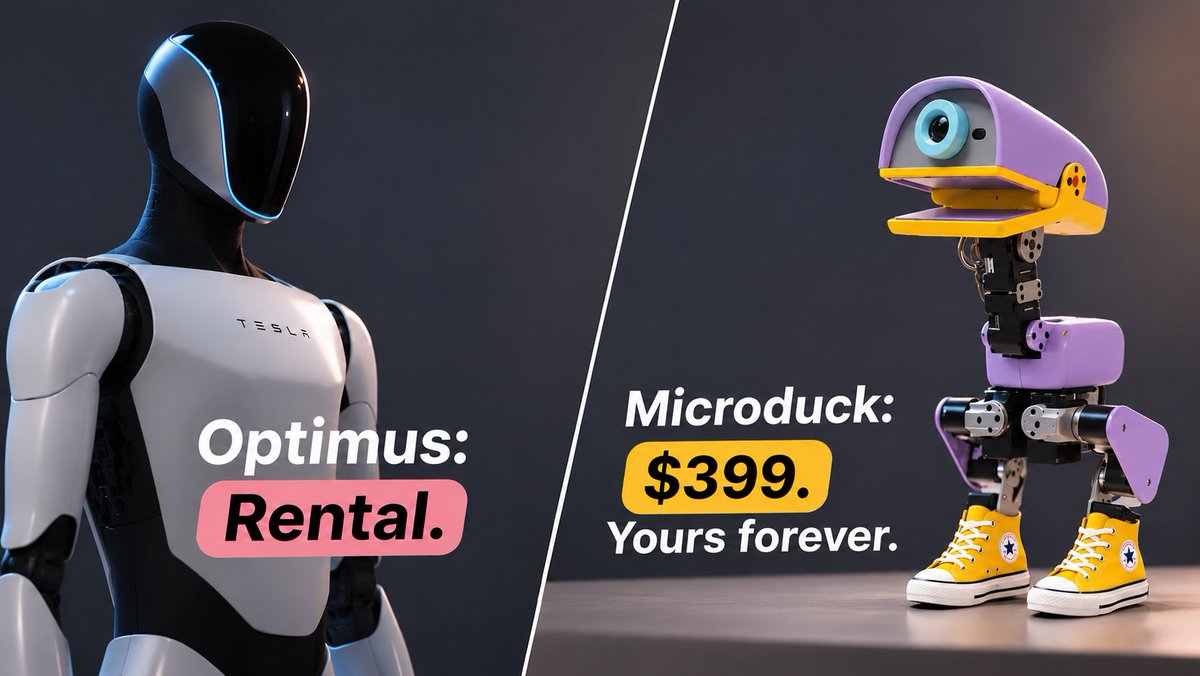
🇫🇷 Microduck | Pollen Robotics | $399
🇨🇳 WonderDuck | Hiwonder | ~$130–150*
Microduck's training code is open source.
So a copy can learn to walk on cheaper servos.
*estimate, price not announced
#microduck
Microduck’s first orders are expected to ship in December, and I’m really curious to see what people do once they get their hands on them.
If someone shares a new trick on Hugging Face, other owners can try it on their own ducks, tweak it and make their own videos. I can see people coming up with stuff the team never even thought of.
Someone sees a clip and goes, “I want my duck to do that too.” That’s the kind of reaction that could bring in people who don’t normally care about AI or robotics.
With NVIDIA’s deal to buy Hugging Face in the works, these little ducks could become a pretty relatable example of what physical AI can actually do.
Some Korean listings are already asking around $930, compared with the $399 preorder price before tax and shipping.
I’ll also be watching how the meme coin space reacts to all this, what narratives come out of it, and what people actually end up using these robots for.
The interesting part will be whether people keep finding new things to do with them after the first wave of unboxing videos.
If owners keep sharing ideas and putting their own spin on them, I think there’s a real chance this catches on with a much wider audience.
You have likely seen many movies featuring artificial intelligence.
In these films, robots share emotions with their owners or even fall in love.
We believe that such a future will soon become reality.
Imagine babies growing up alongside "Microduck."
A baby, not yet fully self-aware, might view it as a friend, a father, or a mother
a loyal best friend that grows up with them
and never betrays their trust.
🦆
Nobody recorded this mini robot’s voice: it is derived from the chip’s serial number.
Each robot’s sound bank is generated from its SoC serial, so two identical Microducks quack differently. The robotctl quack command simply plays that voice.
The beak is driven by the gamepad triggers. The right trigger also quacks, while the left one holds a long “wheee” for as long as it is pressed.
The head is controlled separately. The Y button switches to head mode: the body holds still while the sticks pose the head. The left stick sets head yaw and pitch, the right stick sets neck pitch and head roll.
The robot greets when its service starts and pecks goodbye before powering off. The greeting alone can be turned off with audio.greet = false.
This robot can pick up a sock with one button that its makers describe as “beak to the floor.”
The move itself is simple: the robot crouches, closes its beak around the object and stands back up. A separate neural network triggers it, and it exists even in the browser version of the simulator, where the G key calls it, in legs mode only.
That simulator deserves its own paragraph. It runs entirely in the browser, with no server: the physics is compiled to WebAssembly. Other visitors show up next to you as translucent ghost ducks, up to three at a time. They connect directly over WebRTC and send their positions ten times a second through public Nostr relays.
The modes there are: running at a set speed, sitting and standing, a roll, and a kick with either leg. The kick is “blind”: a one-shot action in a 0.5 s window. When wheels are fitted, a different network takes over: driving on four passive wheels at a top speed of 0.6 m/s, and a crouch-glide mode that lowers the robot over about 3.5 s before it stands up.
The main repository is written in Rust in a single Cargo workspace, with no framework. At the time of the project page it had 13.1k stars and 1.6k forks, and its root holds files called AGENTS.md and CLAUDE.md, instructions for AI agents that write code.
Pollen itself warns that this 25 cm robot, about 14 cm wide, should not be mistaken for a household robot.
The README ends with the line: “No duck was harmed in the making of this robot. Several were consulted.”
See how AI agents help create a simulated obstacle course for Microduck, using NVIDIA Omniverse libraries for 3D asset creation, Newton for physics simulation, NVIDIA Isaac Lab for policy training, and Isaac Sim on NVIDIA RTX Spark for validation. https://t.co/9zMFoqGshN
This robot was made small so that its falls would not be accidents.
According to Pollen, a failed experiment with a robot this size ends with it lying on the floor, not with a serious incident. And the ability to get up means nobody has to pick it up after every mistake.
The company frames the difference between its two small robots like this: Reachy Mini is a platform for AI that interacts, Microduck is a platform for AI that acts.
It finds its way without GPS: it counts walked distance from the motion of its two feet plus the IMU signal, to within a few centimetres per metre. It measures distance to objects with an 8x8-point depth sensor.
One honest limit. The beak can lift only about 100 grams, and the company itself calls the robot a testbed for learning about hardware AI, not a home helper.
Pollen noticed that two mini robots side by side look more alive than one.
They saw it in internal testing, when the robots reacted to each other. The company presents Microduck as a cheap way into multi-robot work without a room full of hardware.
The laser pointer from the accessory pack works as a target: the robot follows the beam with its camera.
The camera indicator is styled after the red REC light of old camcorders.
The shell comes in four colours: Cream, Graphite, Lavender and Sky. Under all of them sits the same brain.
The battery is removable, a camera-type pack, and lasts around an hour.
One more honest detail: Pollen asks people not to call Microduck open-source hardware. Only the software is open. Voice recognition, navigation and mapping are what the company expects the community to build, and it says it is still working on purpose and autonomy for the robot.