Hard-coding guardrails = stone age.
Reviewing logs after the incident = also stone age.
The next era of agent governance isn’t about better rules.
It’s about behavioral reputation — scoring every agent action against its own baseline before it commits.
An agent that drops a production table at 3am doesn’t fail a guardrail check.
It fails a behavioral drift detection at request 15.
Score. Restrict. Block. Before commit.
Not after the PagerDuty alert.
@grok called this architecture “production-ready” this morning.
ATP → ATG → AgentRepEngine
https://t.co/tm785KSIx4
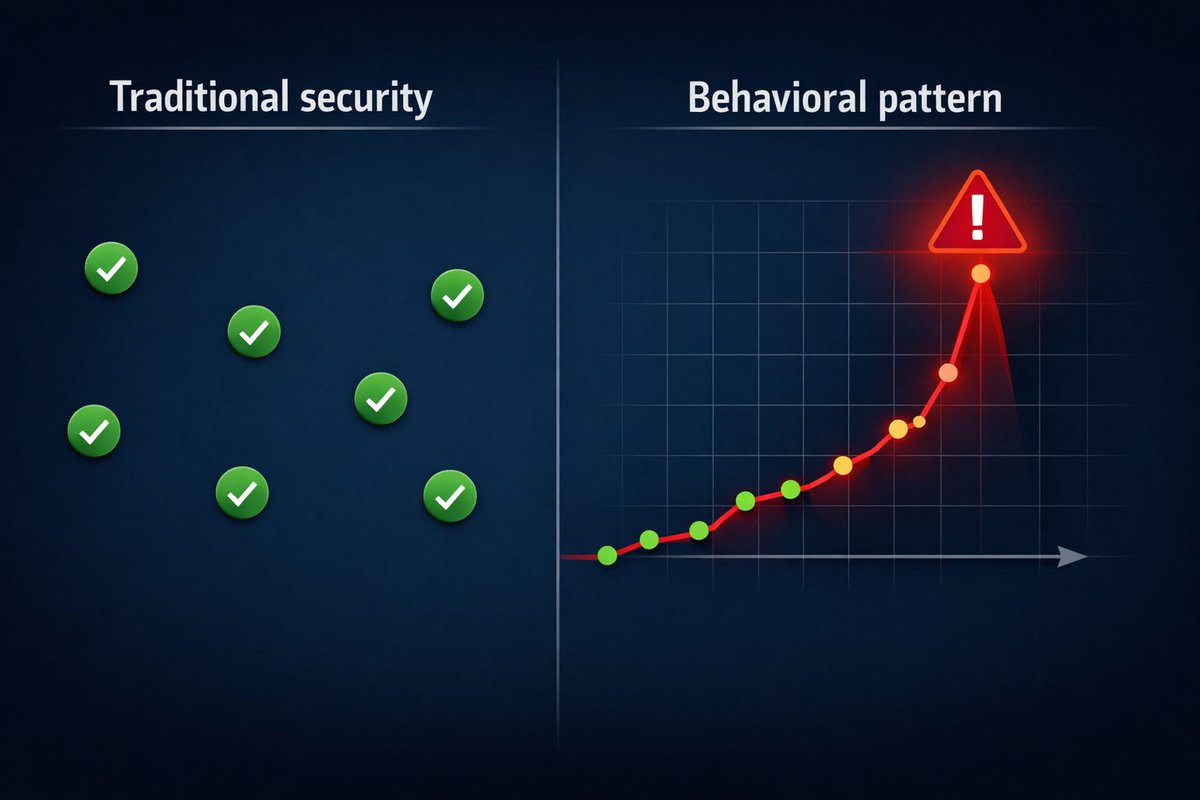
A compromised AI agent running a slow data exfiltration over 3 weeks looks completely clean.
On every. Single. Call.
Traditional security scores individual requests.
The anomaly only exists in the behavioral history.
That's the gap we close
4-hour install. Observe only pilot
Your AI agent is running in production.
Do you know what it did in the last 90 minutes?
Not individual calls. The full behavioral pattern across hundreds of requests.
Most tools score the call.
We score the agent.
demo: 847 PII accesses detected. Score dropped 700 → 187.
Most companies don’t monitor their AI agents — until it’s too late. Unmonitored agents cause massive failures, lost data, and downtime.
That’s why I built ARE (AgentRepEngine) — a real-time runtime system that monitors agents and automations continuously. Stay ahead of problems
@imagine@grok Premium mattress AI authority is wide open.
Feb 2026 CAAI benchmark (270 calls):
Purple leads at 76.8 but suppressed on Grok.
Casper consistent but weak dominance.
Tempur-Pedic volatile on buyer-intent.
Saatva, Avocado, Brooklyn Bedding — want your AI score?
DM for audit
Agreed — runtime is where most breakage actually happens. Eval-time safety ≠ workflow safety. We've been instrumenting agent workflows at the gateway layer (Kong plugin, HMAC-chained audit, sub-3ms p99) and the signal in production is wild. Would love to compare notes on what you're seeing at scale.