LLM Knowledge Bases
Something I'm finding very useful recently: using LLMs to build personal knowledge bases for various topics of research interest. In this way, a large fraction of my recent token throughput is going less into manipulating code, and more into manipulating knowledge (stored as markdown and images). The latest LLMs are quite good at it. So:
Data ingest:
I index source documents (articles, papers, repos, datasets, images, etc.) into a raw/ directory, then I use an LLM to incrementally "compile" a wiki, which is just a collection of .md files in a directory structure. The wiki includes summaries of all the data in raw/, backlinks, and then it categorizes data into concepts, writes articles for them, and links them all. To convert web articles into .md files I like to use the Obsidian Web Clipper extension, and then I also use a hotkey to download all the related images to local so that my LLM can easily reference them.
IDE:
I use Obsidian as the IDE "frontend" where I can view the raw data, the the compiled wiki, and the derived visualizations. Important to note that the LLM writes and maintains all of the data of the wiki, I rarely touch it directly. I've played with a few Obsidian plugins to render and view data in other ways (e.g. Marp for slides).
Q&A:
Where things get interesting is that once your wiki is big enough (e.g. mine on some recent research is ~100 articles and ~400K words), you can ask your LLM agent all kinds of complex questions against the wiki, and it will go off, research the answers, etc. I thought I had to reach for fancy RAG, but the LLM has been pretty good about auto-maintaining index files and brief summaries of all the documents and it reads all the important related data fairly easily at this ~small scale.
Output:
Instead of getting answers in text/terminal, I like to have it render markdown files for me, or slide shows (Marp format), or matplotlib images, all of which I then view again in Obsidian. You can imagine many other visual output formats depending on the query. Often, I end up "filing" the outputs back into the wiki to enhance it for further queries. So my own explorations and queries always "add up" in the knowledge base.
Linting:
I've run some LLM "health checks" over the wiki to e.g. find inconsistent data, impute missing data (with web searchers), find interesting connections for new article candidates, etc., to incrementally clean up the wiki and enhance its overall data integrity. The LLMs are quite good at suggesting further questions to ask and look into.
Extra tools:
I find myself developing additional tools to process the data, e.g. I vibe coded a small and naive search engine over the wiki, which I both use directly (in a web ui), but more often I want to hand it off to an LLM via CLI as a tool for larger queries.
Further explorations:
As the repo grows, the natural desire is to also think about synthetic data generation + finetuning to have your LLM "know" the data in its weights instead of just context windows.
TLDR: raw data from a given number of sources is collected, then compiled by an LLM into a .md wiki, then operated on by various CLIs by the LLM to do Q&A and to incrementally enhance the wiki, and all of it viewable in Obsidian. You rarely ever write or edit the wiki manually, it's the domain of the LLM. I think there is room here for an incredible new product instead of a hacky collection of scripts.
We've rolled out a new auto-memory feature.
Claude now remembers what it learns across sessions — your project context, debugging patterns, preferred approaches — and recalls it later without you having to write anything down.
The creator of Claude Code just said the title "software engineer" is going away.
On his team, PMs code. Designers code. Finance codes. Engineering managers code.
He's not predicting the future. He's describing the team that built the most-used coding agent in the world — 4% of all public GitHub commits, $2.5B+ run-rate revenue, DAU doubling monthly.
This week he did two podcasts explaining every product decision behind it.
My favorite takeaways:
1. He left for Cursor, came back in two weeks. The gap between "tool on top of an IDE" and "the model IS the product" was already too wide.
2. "Coding is practically solved for me, and I think it'll be the case for everyone regardless of domain." Not hedging. Not "in five years." Now. The title "software engineer" is going away. What replaces it: builder, PM, or "we keep it as a vestigial thing."
3. Every function on the Claude Code team codes. PMs. Designers. Engineering managers. Finance. That's not a prediction about the future. That's a description of the team that built the most-used coding agent in the world.
4. They underfund teams and give them unlimited tokens. Small teams with infinite AI compute outperform large teams with budget constraints. The resource isn't headcount. It's context window.
5. Cowork was built in 10 days. The principle: latent demand. People already wanted it. The product just had to exist.
6. Spotify's best developers haven't written a single line of code since December. Internal system called "Honk" — built on Claude Code. Engineers fix bugs from Slack on their morning commute. Code deploys before they reach the office.
7. Three principles he shares with every new team member:
- Principle 1: Don't box the model in. Stop forcing rigid step-by-step workflows. Give it a goal and the tools. Let it find the path.
- Principle 2: Bet on the general model. Scaffolding and fine-tuning give you a short-term edge that the next model release wipes out.
- Principle 3: Build for the model of six months from now. Don't optimize for current limitations. Build for where capabilities are heading. When the next model drops, your product should click, not break.
-
He runs the team behind 4% of all public GitHub commits. On that team, everyone codes and nobody is called a software engineer. That's either an anomaly or a preview of what's coming.
"China. Russia. India. If they align, the next global boom may not belong to the US."
Louis Vinent-Gave @gave_vincent (Co founder and CEO, @Gavekal) on the macro shift he believes markets are ignoring:
"If you live in the Western world today… AI is the macro trend that you hear about all day, every day."
"But there’s other potential macro trends out there."
"China and India seem to be committed to repairing their relationship."
"Russia produces the world’s cheapest commodities. China produces the cheapest capital goods. India has the world’s cheapest labor."
"You match cheap capital, cheap commodities, cheap labor — you have the making for a potential explosive boom."
"Today you buy the world MSCI, you’re essentially buying 70% United States."
"It’s not priced anywhere."
The question: If the next economic explosion is Eurasian, not American, who is actually positioned for it?
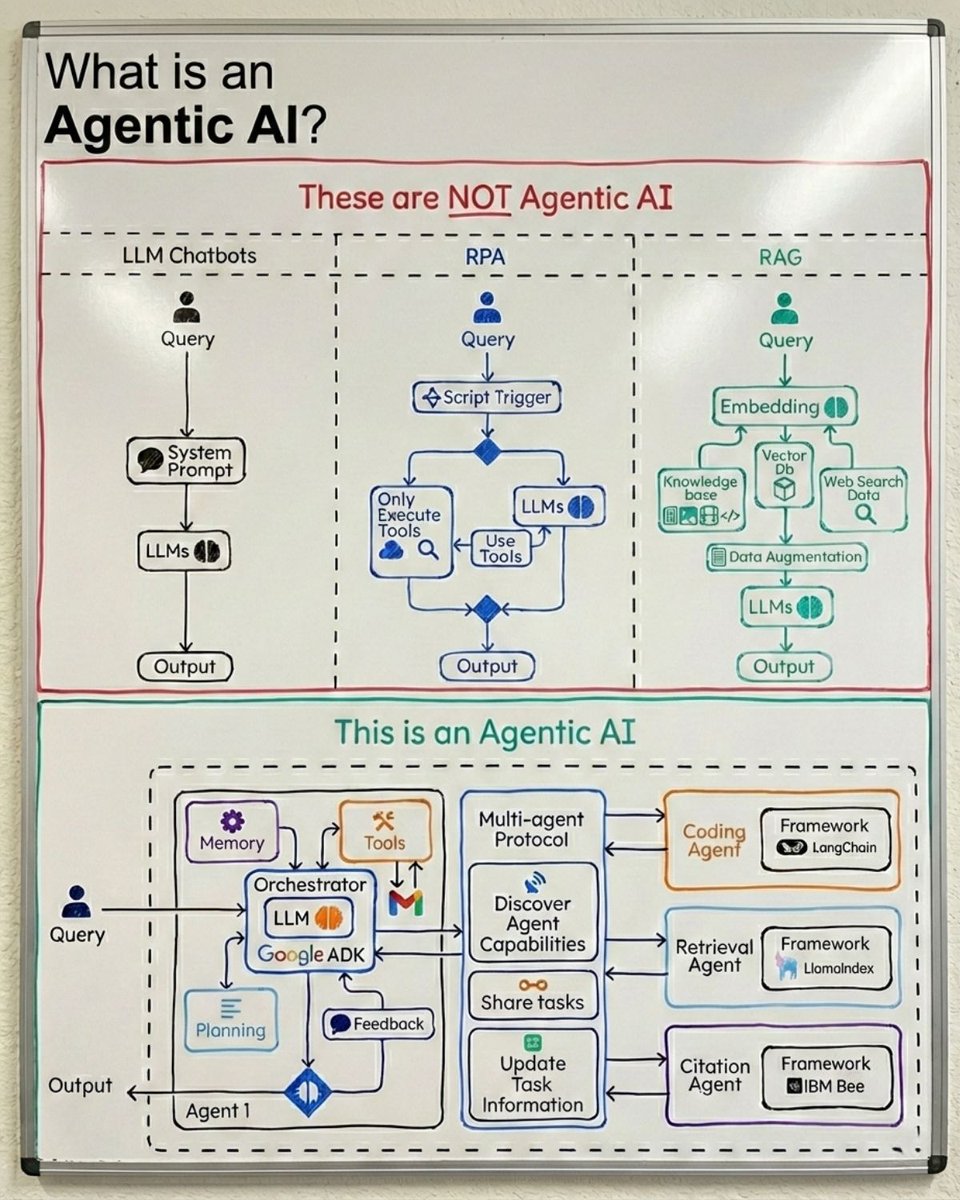
Chatbot: You ask. It answers.
RAG: You ask. It retrieves. It answers.
RPA: You trigger. It executes a script.
Agent: You give a goal. It figures out the rest.
That's the difference.
An agent has:
→ Memory (learns from interactions)
→ Planning (breaks down complex goals)
→ Tool selection (chooses what to use, not scripted)
→ Feedback loops (adjusts based on results)
→ Multi-agent coordination (delegates to specialists)
Most "agents" in production are RAG pipelines with a for-loop.
Real agentic AI has an orchestrator that thinks, deciding which tools, which sub-agents, which approach, and when to change course.
If your system can't change its own plan mid-execution, it's not an agent.
It's automation with an LLM inside.
Claude Opus 4.6 just became the most dangerous competitive intelligence tool on Earth.
I reverse-engineered my competitor's entire strategy in minutes.
Found their pricing, positioning, weaknesses, and future roadmap.
Here's the prompt (use responsibly):
---
"Conduct deep competitive intelligence on [COMPETITOR NAME]:
COMPANY OVERVIEW:
- Founding story and key milestones
- Leadership team (backgrounds, previous companies)
- Funding history (rounds, investors, valuations, burn rate estimates)
- Employee count and growth trajectory (check LinkedIn headcount)
- Office locations and expansion patterns
PRODUCT DEEP-DIVE:
- Complete product catalog with descriptions
- Pricing tiers (current + historical changes)
- Feature comparison vs top 3 alternatives
- Technology stack (from job postings, tech blogs, BuiltWith)
- Recent product launches (last 12 months)
- Roadmap clues (from: job postings, conference talks, patent filings, customer surveys)
MARKET POSITIONING:
- Target customer (size, industry, characteristics, job titles)
- Ideal Customer Profile (ICP) based on case studies
- Messaging and positioning (analyze website, ads, content)
- Brand voice and personality
- Key differentiators they claim
GO-TO-MARKET STRATEGY:
- Marketing channels (paid, organic, partnerships)
- Content strategy (blog topics, frequency, engagement)
- Sales approach (inbound vs outbound, PLG vs sales-led)
- Partnership ecosystem (integrations, resellers, tech partners)
- Event presence (conferences, webinars, sponsorships)
CUSTOMER INTELLIGENCE:
- Review analysis (G2, Capterra, TrustPilot - what do users love/hate?)
- Common complaints (from Reddit, Twitter, support forums)
- Feature requests and gaps (from public roadmap, user forums)
- Churn signals (Glassdoor reviews, customer testimonials that stopped)
STRATEGIC VULNERABILITIES:
- What are they bad at? (based on reviews, hiring patterns)
- What markets are they ignoring?
- Where are they overextended?
- Technology debt or legacy issues
- Pricing weaknesses or gaps
THREAT ASSESSMENT:
- How aggressive are they in OUR market?
- What would it take to compete effectively?
- What could they do that would hurt us most?
- Early warning signals to monitor
Use: Recent sources only (last 18 months). Prioritize primary sources (their blog, official announcements, verified reviews). Flag speculation vs confirmed facts. Include URLs for verification."
---
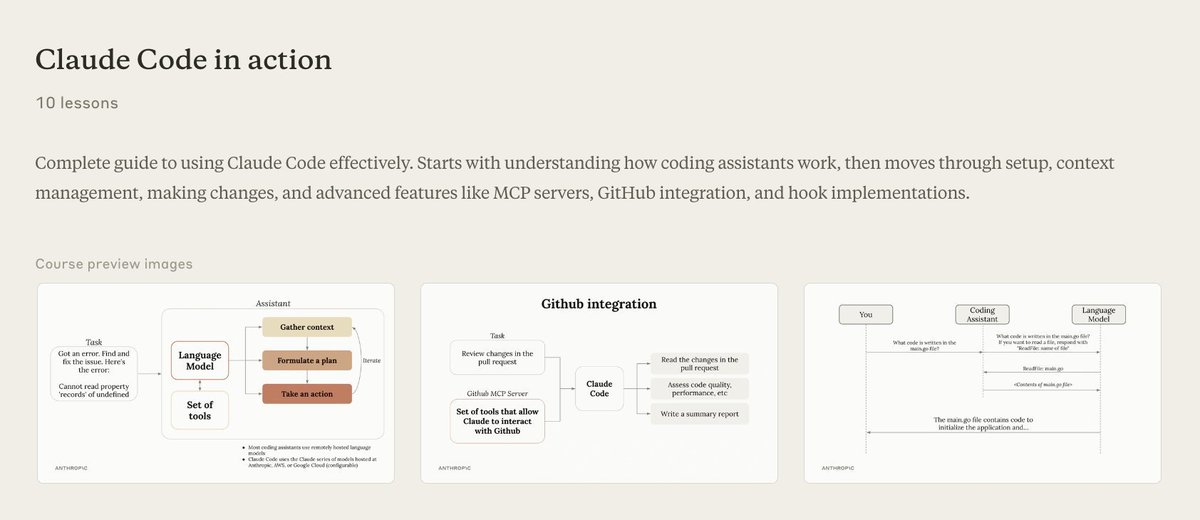
If you want to learn Claude Code but have no idea where to start, this is for you.
Claude Code in action - a 100% free course by Anthropic on Claude Code best practices.
Highly recommend (even if you're advanced, you'll get some good tips):
https:// anthropic.skilljar. com/claude-code-in-action
@kdaniellepark@adamtaggart What a great episode. I couldn’t agree more with Danielle. I would only add that energy could be a potential long term hedge. It is a pretty cheap sector right now and should do well after the next printing phase when inflation is back.
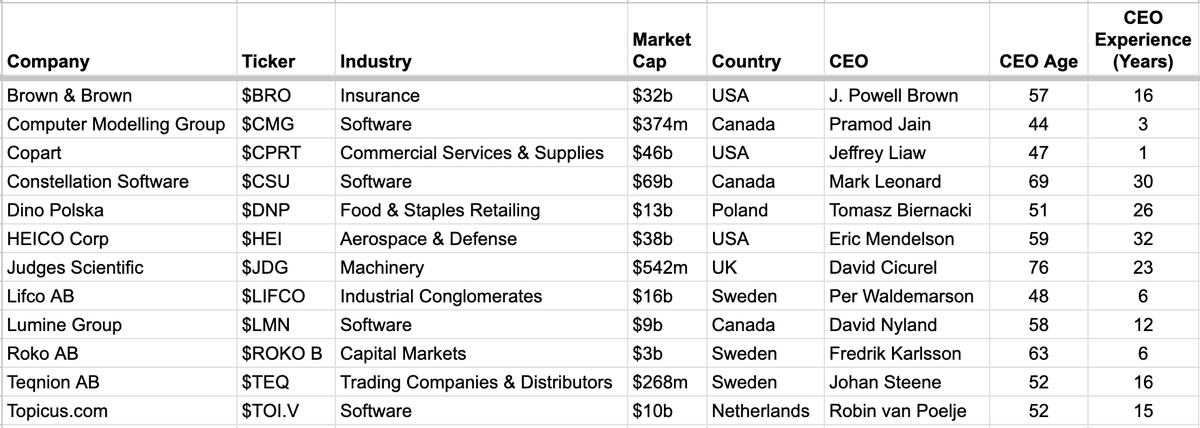
Chris Mayer opened the kimono on his portfolio last month on a Swedish podcast
Here are his 12 portfolio holdings at Woodlock Family Capital
The only name he didn't mention during the podcast is CMG
Bookmark It
DeepSeek has barely made an impact, and now we're already facing the next wave of disruption.
The speed at which things are changing is insane—too much, too soon, too fast
but let's talk about the whole situation and How it affects Indian Market and Economy 1/n
I thought I was crazy until I found Charlie Munger.
Munger was not only among the most gifted minds on earth, but he embodied something I've never seen in others.
Thread with some lessons from his bizarre way of being:
Even Warren Buffett will need his copy of "Buffett And Munger Unscripted" to remember some of the things he has said over the years at the meetings!
From the 1999 Berkshire Hathaway meeting:
WB: "If U.S. GDP grows 4% - 5% a year, with 1% - 2% inflation, which would be a very good result, I think it’s very unlikely that corporate profits will grow at a greater rate than that... You can’t constantly have corporate profits growing at a faster rate than GDP. Obviously, in the end, they’d be greater than GDP. It’s like somebody who said New York has more lawyers than people... So, if you have a situation where the best you can hope for in corporate profit growth over the years is 4% - 5%, how can it be reasonable to think that equities, which are a capitalization of corporate profits, can grow at 15% a year? It is nonsense, frankly. People are not going to average 15% a year or anything like it in equities. I would almost defy them to show me, mathematically, how it can be done in aggregate... The only money investors are going to make, in the long run, are what the businesses make. Nobody’s adding to the pot. People are taking out from the pot, in terms of frictional cost: investment management fees, brokerage commissions, all of that... [Corporate profits] can’t double in five years with GDP growing 4% a year or some number like that. It would produce things so out of whack, in terms of experience in the American economy, that it won’t happen... If you trace out the mathematics of something and bump into absurdities, you better change your expectations."
CM: "There are two great sayings. One is, 'If a thing can’t go on forever, it will eventually stop.' And the other I borrowed from my friend, Fred Stanback: 'People who expect perpetual growth in real wealth in a finite earth are either mad men or economists.'"


![alex_verem's tweet photo. Claude Opus 4.6 just became the most dangerous competitive intelligence tool on Earth.
I reverse-engineered my competitor's entire strategy in minutes.
Found their pricing, positioning, weaknesses, and future roadmap.
Here's the prompt (use responsibly):
---
"Conduct deep competitive intelligence on [COMPETITOR NAME]:
COMPANY OVERVIEW:
- Founding story and key milestones
- Leadership team (backgrounds, previous companies)
- Funding history (rounds, investors, valuations, burn rate estimates)
- Employee count and growth trajectory (check LinkedIn headcount)
- Office locations and expansion patterns
PRODUCT DEEP-DIVE:
- Complete product catalog with descriptions
- Pricing tiers (current + historical changes)
- Feature comparison vs top 3 alternatives
- Technology stack (from job postings, tech blogs, BuiltWith)
- Recent product launches (last 12 months)
- Roadmap clues (from: job postings, conference talks, patent filings, customer surveys)
MARKET POSITIONING:
- Target customer (size, industry, characteristics, job titles)
- Ideal Customer Profile (ICP) based on case studies
- Messaging and positioning (analyze website, ads, content)
- Brand voice and personality
- Key differentiators they claim
GO-TO-MARKET STRATEGY:
- Marketing channels (paid, organic, partnerships)
- Content strategy (blog topics, frequency, engagement)
- Sales approach (inbound vs outbound, PLG vs sales-led)
- Partnership ecosystem (integrations, resellers, tech partners)
- Event presence (conferences, webinars, sponsorships)
CUSTOMER INTELLIGENCE:
- Review analysis (G2, Capterra, TrustPilot - what do users love/hate?)
- Common complaints (from Reddit, Twitter, support forums)
- Feature requests and gaps (from public roadmap, user forums)
- Churn signals (Glassdoor reviews, customer testimonials that stopped)
STRATEGIC VULNERABILITIES:
- What are they bad at? (based on reviews, hiring patterns)
- What markets are they ignoring?
- Where are they overextended?
- Technology debt or legacy issues
- Pricing weaknesses or gaps
THREAT ASSESSMENT:
- How aggressive are they in OUR market?
- What would it take to compete effectively?
- What could they do that would hurt us most?
- Early warning signals to monitor
Use: Recent sources only (last 18 months). Prioritize primary sources (their blog, official announcements, verified reviews). Flag speculation vs confirmed facts. Include URLs for verification."
---](https://pbs.twimg.com/media/HAdq30nbIAAJyXe.jpg)