Our internal data shows Claude is accelerating AI development—a possible path to recursive self-improvement, or AI autonomously building a more capable successor.
It’s happening faster than we thought, and the implications deserve greater attention. https://t.co/OVVPJO7VQx
I believe the majority still doesn't understand the momentous threshold humanity is facing.
Anthropic itself states quite clearly that even if development ceased entirely, if all development were frozen, they would still witness massive societal changes:
"Even if model capabilities were frozen at today’s level, we would expect major changes to occur in the world. (...) And we are still early in the diffusion of today’s models into the wider economy, where a 100-person company can increasingly do the work of a 1,000-person one, because each employee will sit atop a pyramid of agents."
But there's no question of stagnation. Anthropic itself still maintains that development has exceeded its own internal assumptions. Take that statement seriously for a second and consider it. Although Anthropic models internally and assumes exponential development, even this trajectory lags behind actual development, which is even faster.
"It's happening faster than we thought, and the implications deserve greater attention."
and
"The rate at which AI models improve is accelerating. The length of tasks that they can reliably complete on their own has been doubling roughly every four months, up from an earlier trend of doubling every seven months. In March 2024, Claude Opus 3 could complete software tasks that take humans about four minutes to complete. A year later, Claude Sonnet 3.7 managed tasks that took about an hour and a half. A year after that, Claude Opus 4.6 managed 12-hour tasks.1 If this trend holds, tasks that take a skilled person days could come into range this year.
So again: there can be no question of standing still.
The models are not only getting better, they can also work autonomously for longer. Certainly numerous breakthroughs are still needed, context window is still a problem. But the most likely direction is that the models themselves will find the solutions to the underlying problems. This opens up unforeseen possibilities, and Demis Hassabi's statement that the golden age of science is not a dream, not a utopia, but a purposeful reality, is now confirmed.
And finally, it's not just Anthropic, but also OpenAI, that sees this development, considers it feasible, and is moving forward.
Most people don't know what's coming. But one thing is certain: it's coming even faster than expected. And it will be even bigger.
Myth was just the beginning.
With Codex at 5 million users, they’ve hit about 0.6% of ChatGPT’s roughly 900 million users. We are so, so early. The vast majority of people have no idea what’s already possible to do with AI, while a tiny minority is automating their personal lives and work.
It should be pretty obvious at this point that AI is a "force multiplier" not a "labor substitute".
It helps experts be better at things they are already good at. It doesn't let beginners match experts.
If you can't write, anything you write with AI will be unmitigated slop.
If you aren't a software engineer, anything you vibecode with AI will have security holes and won't be able to scale past a toy demo.
If you blindly trust AI to deliver on a research task without knowing the subject matter, you won't be able to fact-check it.
There's this weird misconception of AI as something that completely levels the playing field. I don't see it that way at all. There are mathematicians deriving novel lemmas with off-the-shelf models. Normal people can't do that.
AI is a tool that makes experts better. It doesn't make everyone into an expert.
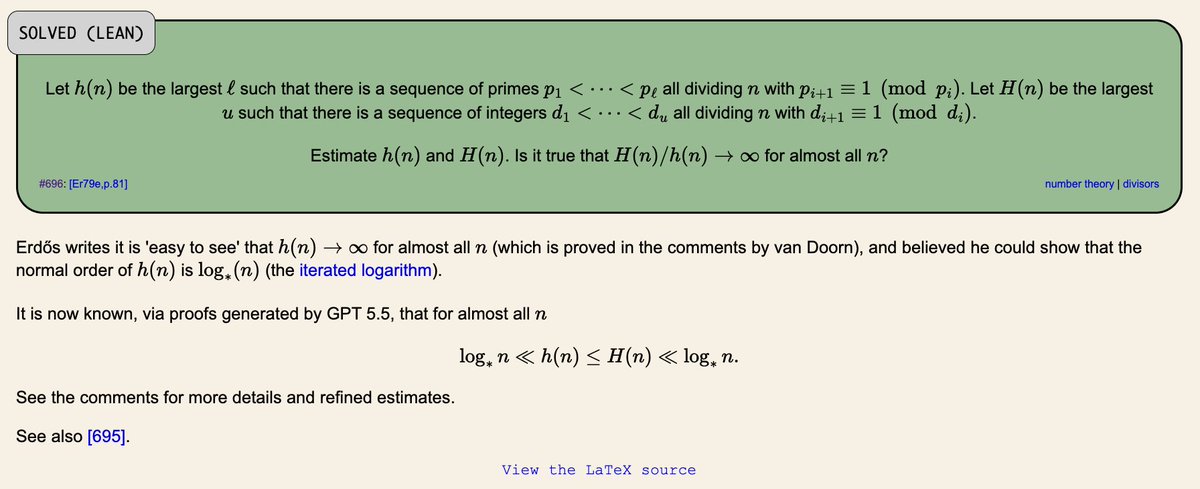
I fully solved my 2nd Erdős Problem using ChatGPT-5.5-Pro - and then I verified the solution by formalizing it!
Less than 2 days after solving my first Erdős Problem, after running Pro for a few hours I was able to elicit the solution, this time in analytic number theory! 🧵1/n
@EpochAIResearch Human hallucination benchmark just dropped: humans wrote the problems, humans verified the problems, then AI found fatal errors in ~1/3 of them 😭
The future of marketplace commerce is on Polygon.
@Meta launched stablecoin payouts for creators on the Polygon Chain.
Live in Colombia and the Philippines, with 160+ markets coming, users now get faster settlement with USDC while gaining access to dollar denominated assets.
the wildest gpt-5.5 example is buried in the announcement
openai says gpt-5.5 helped improve the infrastructure that serves itself — analyzing weeks of production traffic and writing gpu load-balancing heuristics that made token generation >20% faster
ai is starting to recursively compress its own bottlenecks
1. We believe in iterative deployment; although GPT-5.5 is already a smart model, we expect rapid improvements. Iterative deployment is a big part of our safety strategy; we believe the world will be best equipped to win at the team sport of AI resilience this way.
2. We believe in democratization. We want people to be able to use lots of AI; we aim to have the most efficient models, the most efficient inference stack, and the most compute. We want our users to have access to the best technology and for everyone to have equal opportunity. We have been tracking cybersecurity as a preparedness category for a long time, and have built mitigations we believe in that enable us to make capable models broadly available.
3. We love you and we want you to win. We want to be a platform for every company, scientist, entrepreneur, and person. (My whole career has largely been about the magic of startups, and I think we are about to see that magic at hyperscale.)
GPT-Image-2 had a 93% win rate in Image Arena.
Arena rankings come from blind, pairwise battles where voters pick between two anonymized image outputs for the same prompt.
GPT-Image-2 from @OpenAI was preferred 93% of the time, resulting in a record-breaking +242 point leap ahead of the competition on Arena's Text-to-Image leaderboard.