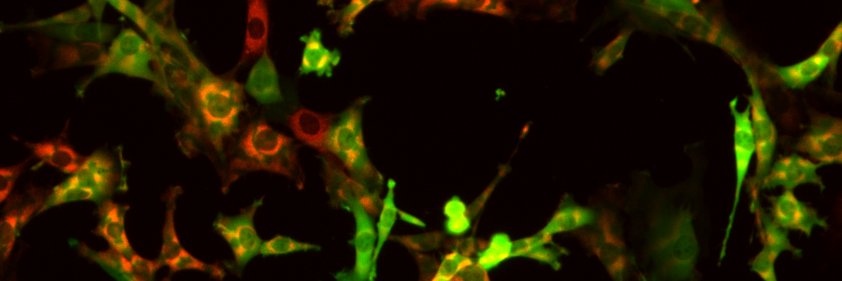
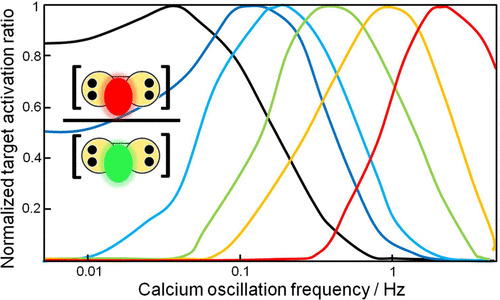
Our first paper is out in @CellCellPress! Led by @born2raisecell, we present a programmable reaction-diffusion system that generates synthetic protein waves, oscillations, and patterns for spatiotemporal circuit design and FM data-encoding in human cells. https://t.co/lNRtRdJAxx
Excited to share a new paper from the super creative and talented @EdenChang_! Eden engineered droplet-forming sequences to act as regulatable glues for stitching microtubules together inside living cells 🧫🧪
I'm thrilled to share my first project in @CellRaiser_ 🤩we found that MTs-assembly can be tuned at both MTBD and condensates. This project highlights my past(microtubule), present(SynBio), and future(LLPS): https://t.co/Hx2yZY8V8m
Thrilled to share our collaborative study led by Brent Aulston and @Musing_Naiad in my lab! 👇This work is a pivotal proof-of-concept in mice showing that in vivo #CRISPR editing in the brain has potential to treat Alzheimer’s disease. 🌟🧠 @NIGMS@somaticediting
Some say hybrid comp/expt labs, where dry lab meets wet lab, are "at the beach".
Hbt "the shore of Lake Mendota" ?
I'm thrilled to join Biochemistry at UW-Madison!
Starting 2025, the Wayment-Steele lab will unite AI & experiment to transform how we study biomolecular dynamics.
Ingenious strategy to repurpose a bacterial E1-like enzyme to emulate ubiquitin-like cascades for ATP-driven protein ligation. Its like a battery pack for powering bioconjugation reactions 🔋!
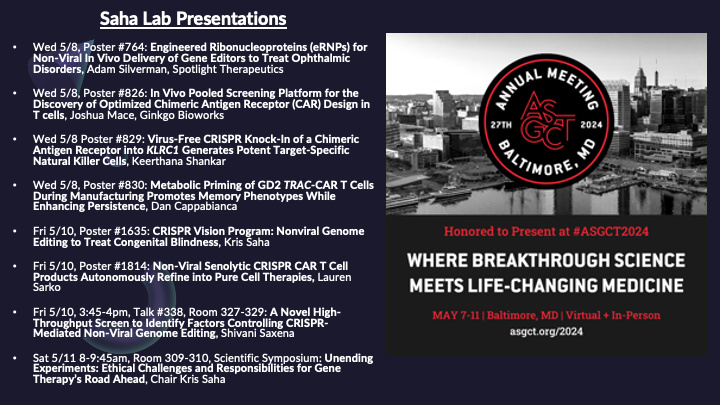
At #ASGCT2024, we're showcasing advances in non-viral gene editing, CAR T cell therapies, & high-throughput screening. Explore our work on vision restoration, cancer therapy, and ethical challenges in the field. Join us to learn about the latest progress in #GeneTherapy research
Following our field's inspiring history of building synthetic receptors, here we share our lab's first attempt at a post-transcriptional one. Based on ADAR-editing and compatible with various inputs/outputs.
Happy to share that work led by grad students Zack Harmer and Jaron Thompson, with significant contributions from David Cole, is now out in the journal @ACSSynBio. This work developed out of a productive collaboration with the research groups of Zavala and Venturelli.
Imaging the entire course of tissue regeneration requires transparent animals, efficient transgenesis & microscopes that can image free-behaving animals. Here we present a toolkit and reveal dynamic cellular processes during regeneration of Macrostomum. https://t.co/adA2O2CaBn
ASCB MEMBER NEWS
Judith Kimble & Others Wins the 22nd Annual Wiley Prize in Biomedical Sciences
Congrats to ASCB Member Judith Kimble & colleagues who won the 22nd annual Wiley Prize in Biomedical Sciences for their discovery of the stem cell niche.
https://t.co/govLd8cso3
Excited to present PHAGEPACK for quantifying genome-wide which bacterial host factors impact phage infectivity. PHAGEPACK combines CRISPRi with phage packaging. Reveals phage-host interactions, evolution, & host resistance. Great work by @chuchitboonthav!
https://t.co/huGFOVcf39
Congratulations to Assistant Professor Monica Neugebauer (@NeugMonicaElena), who is a 2024 recipient of the Shaw Early Career Research Award! The $200,000 award is sponsored by @GrMKEFdn. Learn more about Neugebauer's research: https://t.co/V4kAU9Jt5V
Incredibly honored to be selected as one of the 2024 @SchmidtFellows! Excited to join the SSF community and collaborate with so many inspiring individuals. Looking forward to this journey ahead!
The regulatory capacity of dynamic systems is rich & fascinating.
They can enable a common regulatory hub to differentially regulate diverse physiological processes.
https://t.co/PGiBrvYpRp
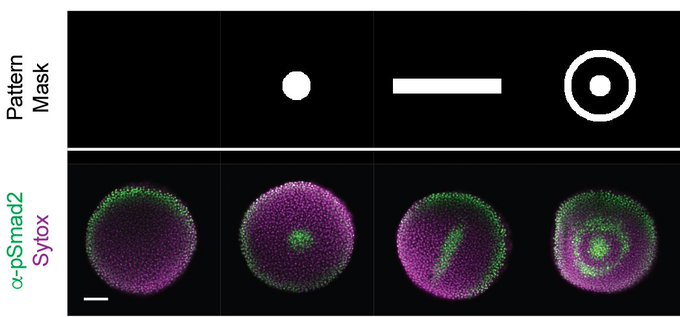
We have a new preprint on optical patterning of Nodal signaling in zebrafish embryos: using light to sculpt embryonic development!
https://t.co/y2V5dtJml4
Beautiful work led by @LordLab_Pitt and @h4rrymcnamara
We made the cover of @CellSystems! Elementary landscapes for two fitness functions reveal that combining them creates a more rugged landscape. This highlights the demand on a DNA-binding domain to evolve affinity for distinct half-sites @Jackson_Lab
https://t.co/vJ3GLyQJqI