More atomic force microscopy videos. These show Cas9 "searching" through DNA and then cutting it.
It's surprising how long the DNA cut takes. It'd be cool to see similar videos for bridge recombinases.
These were published by the great @hnisimasu in 2017.
Autoinhibitory calcium ATPases regulate the calcium gradient required for rapid polarized growth. From Samantha Ryken, Magdalena Bezanilla and colleagues: https://t.co/PNh2h7tWb0
📕 Part of “Collective Behaviors and Self-Organization in Cells”: https://t.co/0aoG2AeZPd
Lipid exchange at ER–trans-Golgi contact sites governs polarized cargo sorting. From Dávid Kovács, Bruno Antonny and colleagues: https://t.co/OBHH0JdIeA
📕 Part of “Collective Behaviors and Self-Organization in Cells”: https://t.co/Lc1mgKwmzT
Drug candidates that form covalent bonds with their targets were historically avoided because of toxicity concerns. However, covalent drugs with controlled reactivity are now recognized as promising agents that combine manageable safety with substantial advantages, including enhanced potency, prolonged target residence times, and access to challenging targets.
This shift is reflected in recent covalent drug approvals, particularly those targeting protein-phosphorylating enzymes (kinases) and cancer drivers such as the oncogenic protein KRAS. A central feature of these drugs is a “warhead” reacting with an amino acid residue in the target protein to form a covalent bond. Yet the repertoire of drug-like, chemically accessible reactive moieties remains limited.
In a new Science study, researchers report streamlined access to an underexplored warhead type with well-tempered reactivity that can be appended to complex scaffolds late in synthesis, enabling practical use in drug discovery.
Learn more in a new #SciencePerspective: https://t.co/zvnUNfkBNP
Antibody therapies now make up ~25% of all new FDA approvals. ESMFold2 is especially strong at modeling antibody-antigen interactions — hit rates of 15–29% for scFvs across five targets. No target-specific tuning. https://t.co/8Mh2eyJF1s
It's really cool to see some of these recent papers from @davidrliu lab and Doudna lab using generative models for protein sequence design (a.k.a. "inverse-folding" AI models) in combination with evolutionary insights and techniques.
In the Liu lab paper, https://t.co/KDdhqzclUd they used proteinMPNN (my beloved) to improve important properties like thermostability and expression, and enhance enzymatic activities for proteases. Critically, they redesigned regions were not allowed to touch the active site so the mutations are expected to improve the structural stability of the overall fold. They did this to "polish" evolutionary starting points and also to seed laboratory evolution trajectories. Both approaches improved nontrivially on what would have been sampled through evolution alone.
In the Doudna lab paper, https://t.co/OhEjirSSvx they used ESM-IF1 to make a synthetic Cas12 variant with improved activity compared to the native. Critically, they avoid mutating the most evolutionarily conserved positions. They suggest the structure structure aware ESM-IF is able to explore much more diverse areas of sequence space than standard sequence-only pLMs.
In both of these cases, generative models for protein sequence design added genuine value when combined with expert scientific intuition on which problems to apply them to and how to configure ("prompt") them.
These papers coming out is kind of a full circle moment for me; I worked on this older paper, https://t.co/VdSwuw4FJR with Doudna on Cas12a which is the same Cas family they chose to make a synthetic version of, right before I went to @UWproteindesign and got to help with proteinMPNN.
Congrats to the authors
@NicholasKrasnow et al. and
@PetrSkopintsev@isabelesain@evandeturk et al.
#ProteinDesign #CRISPR #ArtificialIntelligence
Advances in AI coding / ability to produce software has exposed the chasm between the hardware world and the software world. It is time to invest into making matter programable. My company @ChemifyX & my research team @UofGlasgow using chemputation is leading the charge.
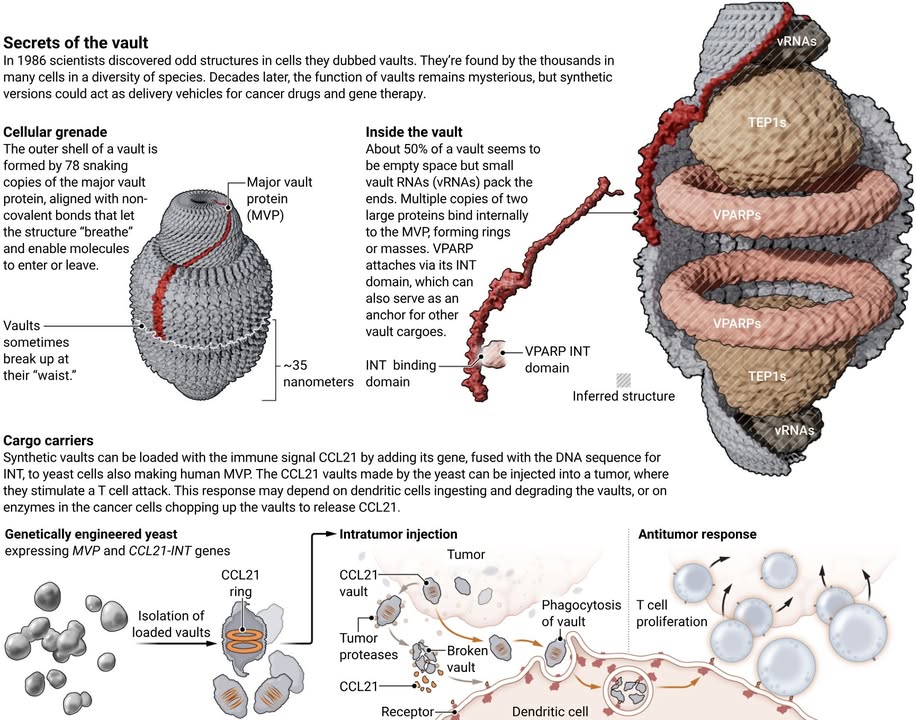
Leonard Rome’s lab discovered an odd, abundant component of cells in the 1980s—and he’s still trying to figure out what it does.
Learn more: https://t.co/IeKolH7PK9 #ScienceMagArchives
Infuse energy into a conductive system, and energy drives organization.
Quite similar to what happens in biological system with their metabolic circuitry. The flow of energy doesn’t just keep the lights on, it organizes life.
In 1926, Erwin Schrödinger introduced the equation that became the dynamical law of non-relativistic quantum mechanics:
iℏ ∂ψ/∂t = [−ℏ²/(2m)∇² + V]ψ
It does not describe a particle following one definite path. It describes how the wavefunction evolves and therefore how the probabilities of possible experimental outcomes change with time.
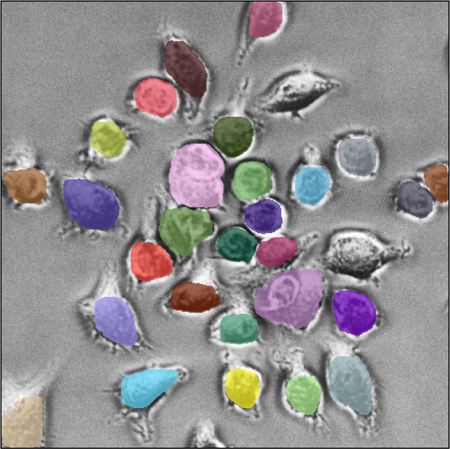
A new AI algorithm from #FreemanHrabowski Scholar David Van Valen & @Caltech colleagues speeds up image analysis & enables tracking of millions of cells across many conditions, helping overcome a longtime bottleneck for scientists: https://t.co/FagPxvKlhD.
I finally got an open model to do structural biology by itself 🔥
GLM-5.2 drives the Mol* viewer, judges its own render through Qwen3-VL, and refines until the drug pops in its pocket. Then I spun it in 3D.
All open, on @huggingface. What should it build next?
The first ever machine learning enabled fully autonomous discoveries in organic chemistry were presented here https://t.co/UKtbhxknio and here https://t.co/OTsoAjFY2L This work laid the foundation of chemputation being used by @ChemifyX for chemical & materials discovery at scale
I'm rebuilding AlphaFold2 from scratch in pure PyTorch.
No frameworks on top of PyTorch. No copy-paste from DeepMind's repo. Just nn.Linear, einsum, and the 60-page supplementary paper.
The project is called minAlphaFold2, inspired by Karpathy's minGPT. The idea is simple: AlphaFold2 is one of the most important neural networks ever built, and there should be a version of it that a single person can sit down and read end-to-end in an afternoon.
Where it stands today:
- ~3,500 lines across 9 modules
- Full forward pass works: input embedding → Evoformer → Structure Module → all-atom 3D coordinates
- Every loss function from the paper (FAPE, torsion angles, pLDDT, distogram, structural violations)
- Recycling, templates, extra MSA stack, ensemble averaging — all implemented
- 50 tests passing
- Every module maps 1-to-1 to a numbered algorithm in the AF2 supplement
The Structure Module was the most satisfying part to build. Invariant Point Attention is genuinely beautiful — it does attention in 3D space using local reference frames so the whole thing is SE(3)-equivariant, and the math fits in about 150 lines of PyTorch.
What's next:
- Build the data pipeline (PDB structures + MSA features)
- Write the training loop
- Train on a small set of proteins and see what happens
The repo is public. If you've ever wanted to understand how AlphaFold2 actually works at the level of individual tensor operations, this is meant for you.
Repo: https://t.co/k25vl5th1y
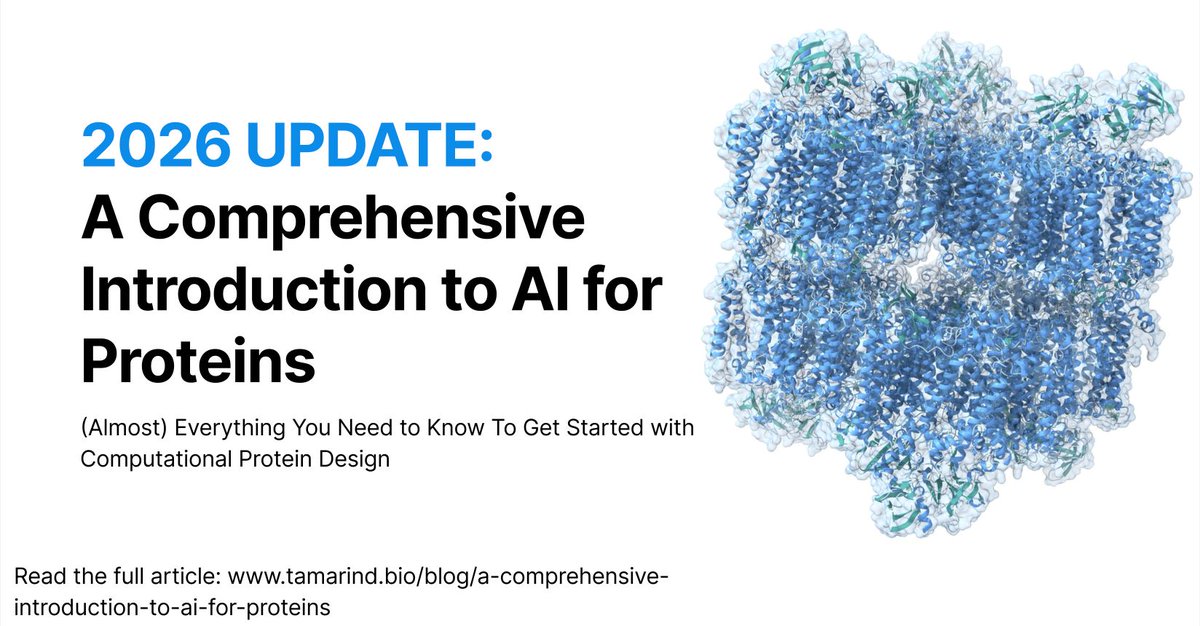
Everything you need for AI in Proteins, updated for 2025!
1/🧵
We've expanded our comprehensive AI protein design guide to include all the cutting edge tools on the rise this year. Some highlights:
Have you heard about the Night Science Podcast, where we talk about the creative process of doing science? We explore this with discussions with brilliant scientists & philosophers and artists, to figure out the tricks of the creative scientific trade.
https://t.co/nHsk2htGNv
RFdiffusion2 now available! Atomic-level scaffolding for complex active sites
Available on @tamarindbio now.
RFdiffusion2 shows state-of-the-art atomic-level scaffolding that generalizes to complex, multi-island active sites, and it reliably yields active enzymes with modest screening, though activities are still below the best native enzymes and should improve with richer theozymes and sequence/pocket co-design.