My doctoral advisor @UWMolES / @UWproteindesign (and current scientific advisory board membe @Xaira_Thera) David Baker won the nobel prize!! So stoked and extremely determined to deliver on the promise of this tech! https://t.co/jWl7ExL9uy
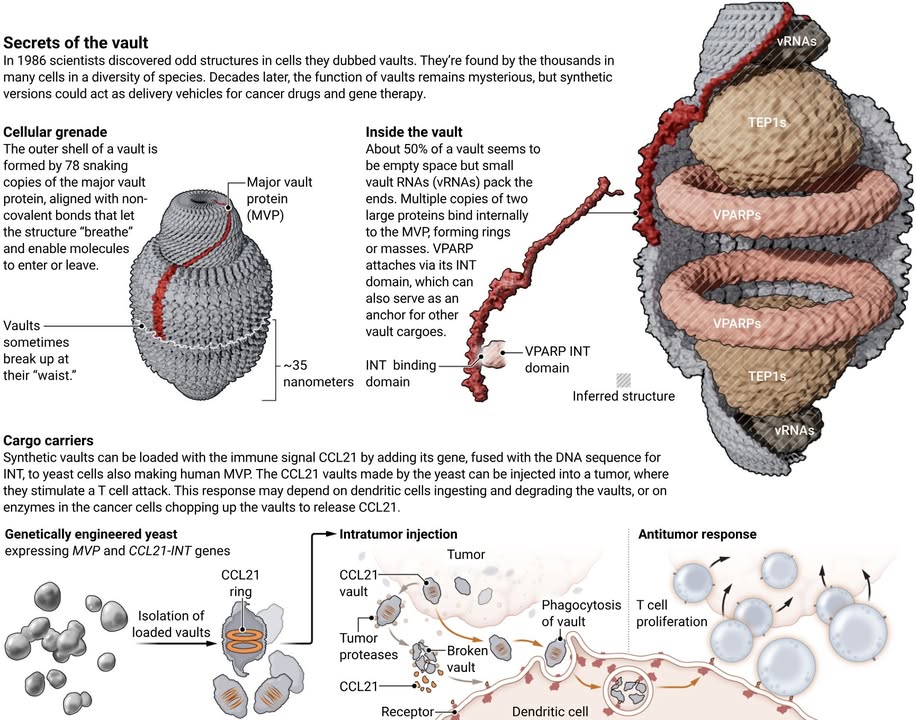
Gonna start rating random proteins today we have "major vault protein". TLDR: S tier 10/10 protein
- Literally MVP
- D39 symmetry is giving main character energy
- Doesn't just look cool, also does useful stuff (a bonus imo)
- If there was a @ContainerStore for proteins it would probably be available there
Leonard Rome’s lab discovered an odd, abundant component of cells in the 1980s—and he’s still trying to figure out what it does.
Learn more: https://t.co/IeKolH7PK9 #ScienceMagArchives
@anthonygitter I read this as just a hard subset of this benchmark, which is often reported for protein language modeling papers: https://t.co/djFroZ3Zho
General LLMs are starting to get close to pLMs
Today, we’re announcing Claude Opus 5. Opus 5 is now our most capable generally available model for biology and chemistry. It shows better performance than Opus 4.8 on all of our bio evals, and is especially good at organic chemistry and protein design.
Opus 5 feels smarter than any previous Opus-class model on biology and drug discovery, and is great as a daily driver for hours-long research tasks.
It's really cool to see some of these recent papers from @davidrliu lab and Doudna lab using generative models for protein sequence design (a.k.a. "inverse-folding" AI models) in combination with evolutionary insights and techniques.
In the Liu lab paper, https://t.co/KDdhqzclUd they used proteinMPNN (my beloved) to improve important properties like thermostability and expression, and enhance enzymatic activities for proteases. Critically, they redesigned regions were not allowed to touch the active site so the mutations are expected to improve the structural stability of the overall fold. They did this to "polish" evolutionary starting points and also to seed laboratory evolution trajectories. Both approaches improved nontrivially on what would have been sampled through evolution alone.
In the Doudna lab paper, https://t.co/OhEjirSSvx they used ESM-IF1 to make a synthetic Cas12 variant with improved activity compared to the native. Critically, they avoid mutating the most evolutionarily conserved positions. They suggest the structure structure aware ESM-IF is able to explore much more diverse areas of sequence space than standard sequence-only pLMs.
In both of these cases, generative models for protein sequence design added genuine value when combined with expert scientific intuition on which problems to apply them to and how to configure ("prompt") them.
These papers coming out is kind of a full circle moment for me; I worked on this older paper, https://t.co/VdSwuw4FJR with Doudna on Cas12a which is the same Cas family they chose to make a synthetic version of, right before I went to @UWproteindesign and got to help with proteinMPNN.
Congrats to the authors
@NicholasKrasnow et al. and
@PetrSkopintsev@isabelesain@evandeturk et al.
#ProteinDesign #CRISPR #ArtificialIntelligence
Great article from @biospace about our thinking on pharma deals here at @Xaira_Thera . From the beginning we've focused on solving hard problems in AI drug design, excited to see what the next few years hold: https://t.co/av8L4HWbOa
A colleague of mine posted this great short read from @ScottWRobinson
I've felt similarly for the last several months. As 🤖 for codegen becomes the norm it's increasingly important to adhere to best implementation practices and tidy patterns, LLMs tend to elevate or drop to the level of the context they see in the codebase there working in:
https://t.co/8GDfsGUsUV
Can we program a kinase like a switch? Inspired by natural autoinhibitory complexes, we designed miniproteins against active- and inactive-like conformations of Focal Adhesion Kinase. Depending on the targeted state, the resulting binders either activated or inhibited the kinase.
Glad to see our antibody design paper finally out in @Nature (and congrats to lead authors and everyone involved )!
At @Xaira_Thera we are excited about pushing antibody design further to bind harder targets and make drugs for unmet medical needs.
Paper:
https://t.co/h2bXGOvuGW
Showcase of #proteindesign possibilities+why they matter!
- minibinders (rigid fusions; composability with other denovo designs)
- tunable biophysical properties (modulate k_off, flexibility, strain)
- #crispyshifty hinges (allosteric control of binding kinetics to native target)
We sought to make proteins both potent and FAST. We used #proteindesign to design precise control over protein interaction lifetimes, enabling us to construct rapid-response circuits, biosensors, and switchable cytokines. Now published @Nature! Links to paper and tutorial below.
We searched for Bigfoot using CRISPR. DNA storage meets CRISPR search: AI maps the data, Cas9 slices it, nanopores read it. Multiplexed molecular search with semantic retrieval across a database of DNA-encoded images. Off-targets = a feature, not a bug. https://t.co/l7FLfxnBPL
Thrilled to share our latest publication in Nature: https://t.co/GDbQL0fUIO. This work reflects a fantastic collaboration—special thanks to David Baker and @TimothyPJenkins. Hoping it sparks attention to this neglected health issue and drives solutions in the years ahead!
Excited to announce our new #proteindesign strategy for allosterically controlling the kinetics of protein-protein interactions! Read on for cool applications in cytokine signaling, biosensing, and protein circuits. https://t.co/jBIHq10Ykd
Excited to announce our new #proteindesign strategy for allosterically controlling the kinetics of protein-protein interactions! Read on for cool applications in cytokine signaling, biosensing, and protein circuits. https://t.co/jBIHq10Ykd