We’re sharing today how redesigning proteins with AI enhances their evolution. Redesign raises the fitness that proteins evolve for new function, expands the solution space, and even accelerates adaptation. We harness this finding to reprogram more potent, precise, and stable proteases for therapeutics. Out in @Nature:
Today in @Nature we report how AI-guided redesign enhances protein evolution. Integrating ProteinMPNN sequence design with autonomous laboratory evolution, we establish a workflow to engineer enzymes with improved properties over those evolved from natural proteins. Redesigned starting points consistently evolve an expanded fitness landscape, reaching new function with higher activity, specificity, and stability than their natural counterparts.
https://t.co/pNlw6z1zvU
1/14
It's really cool to see some of these recent papers from @davidrliu lab and Doudna lab using generative models for protein sequence design (a.k.a. "inverse-folding" AI models) in combination with evolutionary insights and techniques.
In the Liu lab paper, https://t.co/KDdhqzclUd they used proteinMPNN (my beloved) to improve important properties like thermostability and expression, and enhance enzymatic activities for proteases. Critically, they redesigned regions were not allowed to touch the active site so the mutations are expected to improve the structural stability of the overall fold. They did this to "polish" evolutionary starting points and also to seed laboratory evolution trajectories. Both approaches improved nontrivially on what would have been sampled through evolution alone.
In the Doudna lab paper, https://t.co/OhEjirSSvx they used ESM-IF1 to make a synthetic Cas12 variant with improved activity compared to the native. Critically, they avoid mutating the most evolutionarily conserved positions. They suggest the structure structure aware ESM-IF is able to explore much more diverse areas of sequence space than standard sequence-only pLMs.
In both of these cases, generative models for protein sequence design added genuine value when combined with expert scientific intuition on which problems to apply them to and how to configure ("prompt") them.
These papers coming out is kind of a full circle moment for me; I worked on this older paper, https://t.co/VdSwuw4FJR with Doudna on Cas12a which is the same Cas family they chose to make a synthetic version of, right before I went to @UWproteindesign and got to help with proteinMPNN.
Congrats to the authors
@NicholasKrasnow et al. and
@PetrSkopintsev@isabelesain@evandeturk et al.
#ProteinDesign #CRISPR #ArtificialIntelligence
Research from @davidrliu lab shows that using AI to redesign proteins for stability before evolving them creates more powerful enzymes than either lab-directed evolution or AI alone. https://t.co/RBk9fPtuSp
Lab-evolved proteins often sacrifice stability to gain function. @broadinstitute's @davidrliu & @NicholasKrasnow used AI to stabilize proteins before evolving them — and got results 79x better than when they started with a natural protein. https://t.co/PzMlIxdsMT
Also see our application of the evolution+redesign synergy to build more efficient gene editors, reported in our recent @NatureBiotech paper:
https://t.co/ozjOxVDSs7
We’re sharing today how redesigning proteins with AI enhances their evolution. Redesign raises the fitness that proteins evolve for new function, expands the solution space, and even accelerates adaptation. We harness this finding to reprogram more potent, precise, and stable proteases for therapeutics. Out in @Nature:
Today in @Nature we report how AI-guided redesign enhances protein evolution. Integrating ProteinMPNN sequence design with autonomous laboratory evolution, we establish a workflow to engineer enzymes with improved properties over those evolved from natural proteins. Redesigned starting points consistently evolve an expanded fitness landscape, reaching new function with higher activity, specificity, and stability than their natural counterparts.
https://t.co/pNlw6z1zvU
1/14
We’ve developed new prime editors by finding and addressing a stability bottleneck to gene editing. AI-redesigned reverse transcriptases give PE8 enhanced expression and activity across edit, delivery, and cell types. Congrats @Allentaoyz , @HoltSakai , @AllenYJiang , and co!
Today in @NatureBiotech we report a new suit of PE8 prime editor proteins. PE8 variants were developed from laboratory-evolved PE6 proteins using AI-guided protein redesign. This approach combines recent advances in computational protein design and directed evolution to increase prime editing efficiency, especially in transient therapeutically relevant delivery settings such as mRNA+pegRNA electroporation into primary cells, eVLP delivery of prime editing RNPs, and LNP-mediated mRNA+pegRNA delivery in mice.
https://t.co/bz6PalFvc4
1/11
My colleagues @Sarah_E_Pierce and @stevenerwood show us how it’s now possible to address premature stop mutations that cause disease with a single precision gene edit, which enables the rescue of a variety of genes with one composition of matter.
Today in @Nature we report a new prime editing strategy that can rescue a common cause of many genetic diseases in a disease-agnostic manner. This approach converts a redundant endogenous tRNA into an optimized suppressor tRNA, enabling a single prime edit to rescue premature stop codons across different diseases.
(1/15)
https://t.co/zs0qu5bhXx
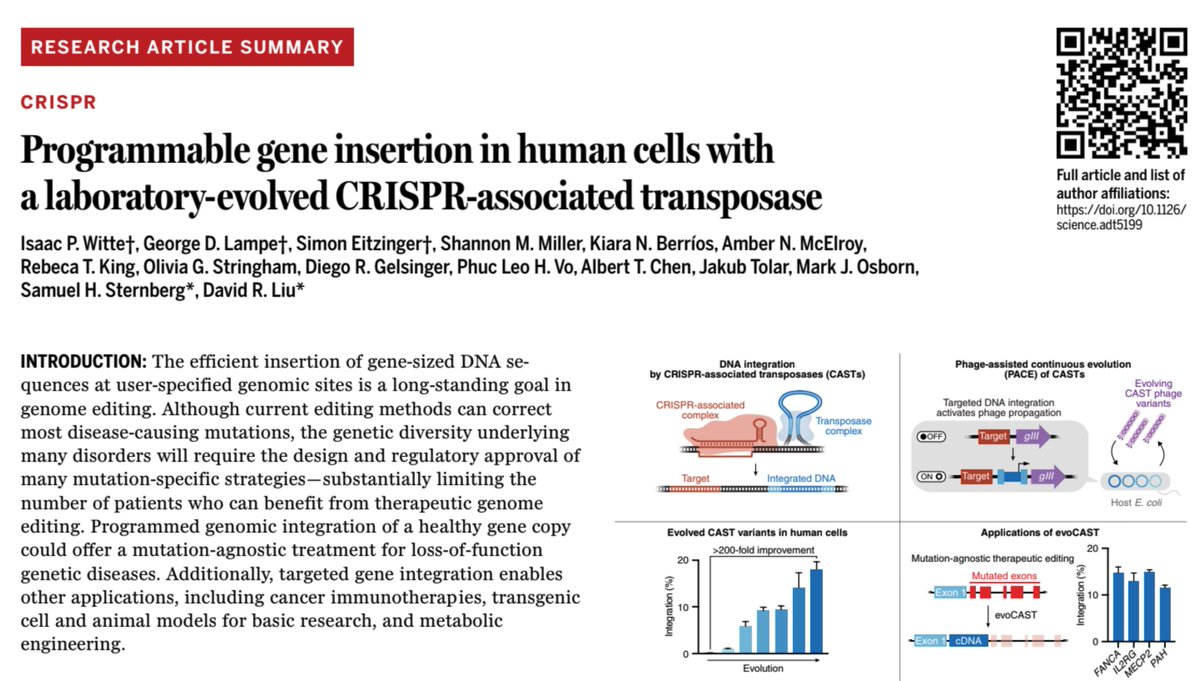
Today in @ScienceMagazine we report the development of a laboratory-evolved CRISPR-associated transposase (evoCAST) that supports therapeutically relevant levels of RNA-programmable gene insertion in human cells, a collaboration with @SternbergLab.
1/13
https://t.co/ZLHtZm5Gmw
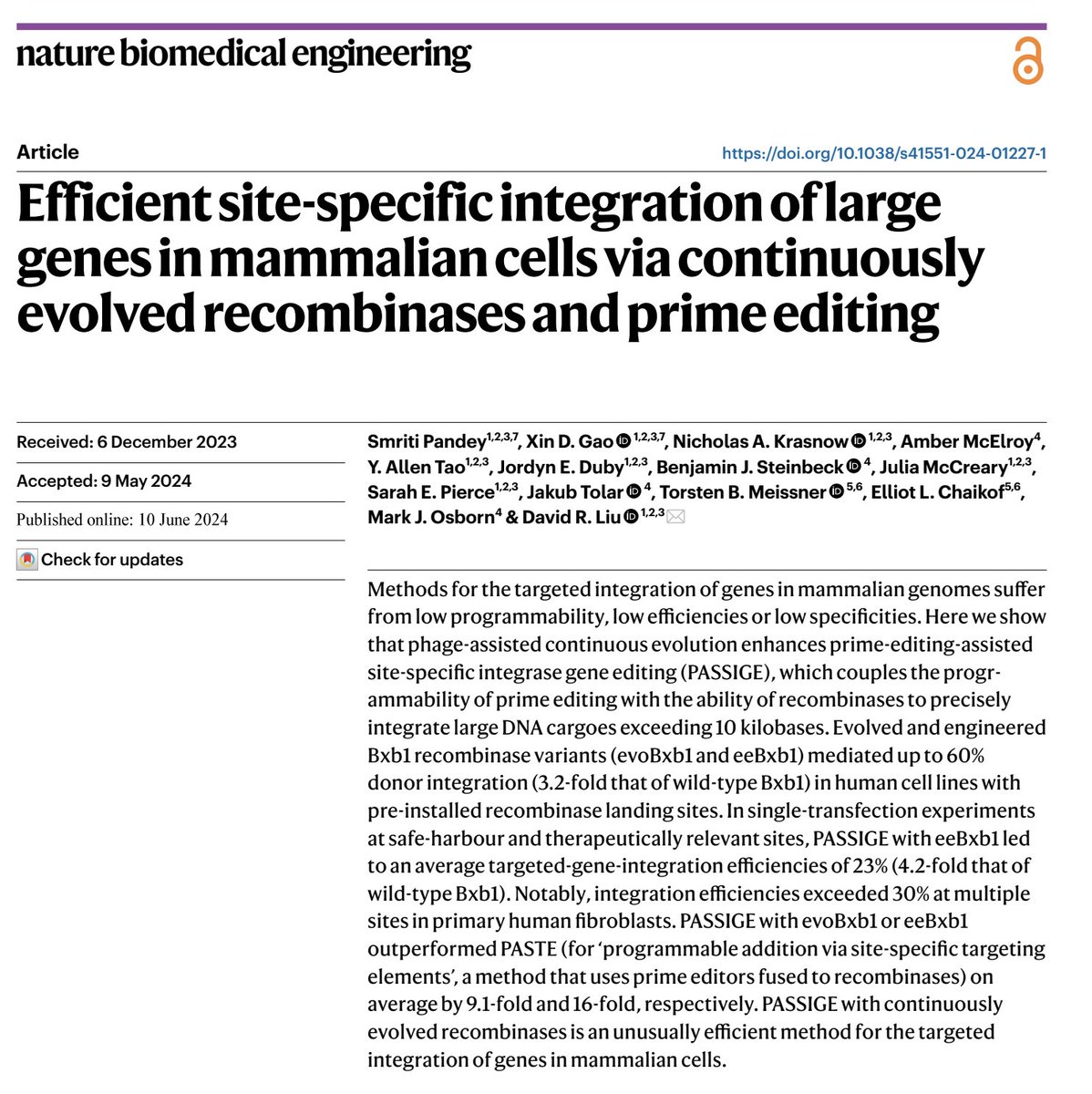
Check out this new development to gene-sized DNA integration technology, led by @Smriti__Pandey and @danielxingao in the Liu Lab. Their PACE-evolved and engineered recombinase enables precise, highly efficient insertion when coupled with prime editing in the eePASSIGE system.
Today we report in @natBME the eePASSIGE system, which uses evolved and engineered recombinases and prime editing to integrate large gene-sized DNA cargoes into the mammalian genome in an efficient, precise, and targeted manner. (1/13)
https://t.co/xvjTwgApde
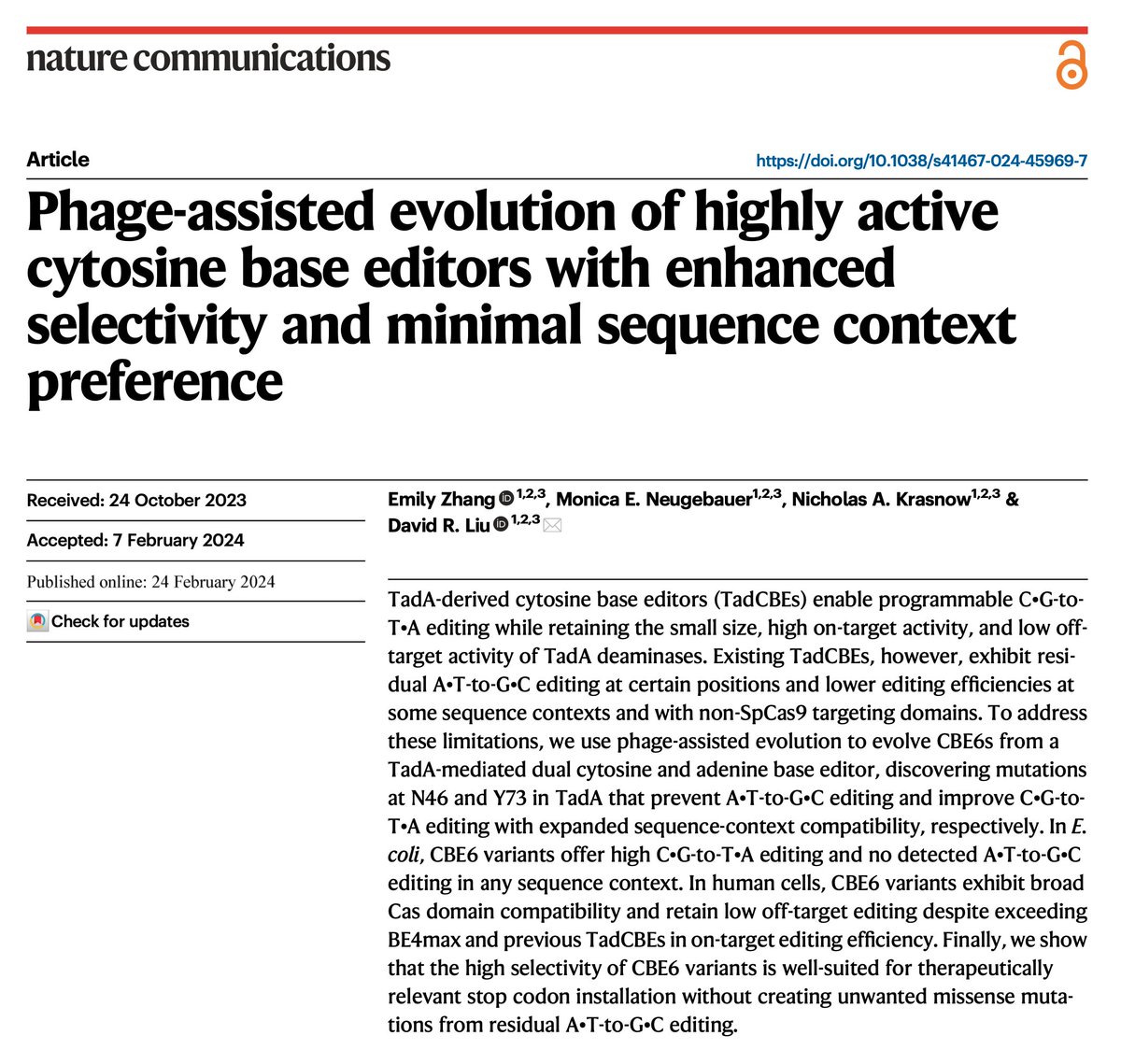
The latest generation cytosine base editors are out— evolved in PACE for high activity, base selectivity, and target sequence compatibility. Congrats, Emily and team!
Today we report in @NatureComms the development of laboratory-evolved CBE6 cytosine base editors that offer high on-target C•G-to-T•A editing, virtually no A•T-to-G•C editing, low off-target editing, broad sequence context compatibility, and compatibility with multiple Cas domains.
/1
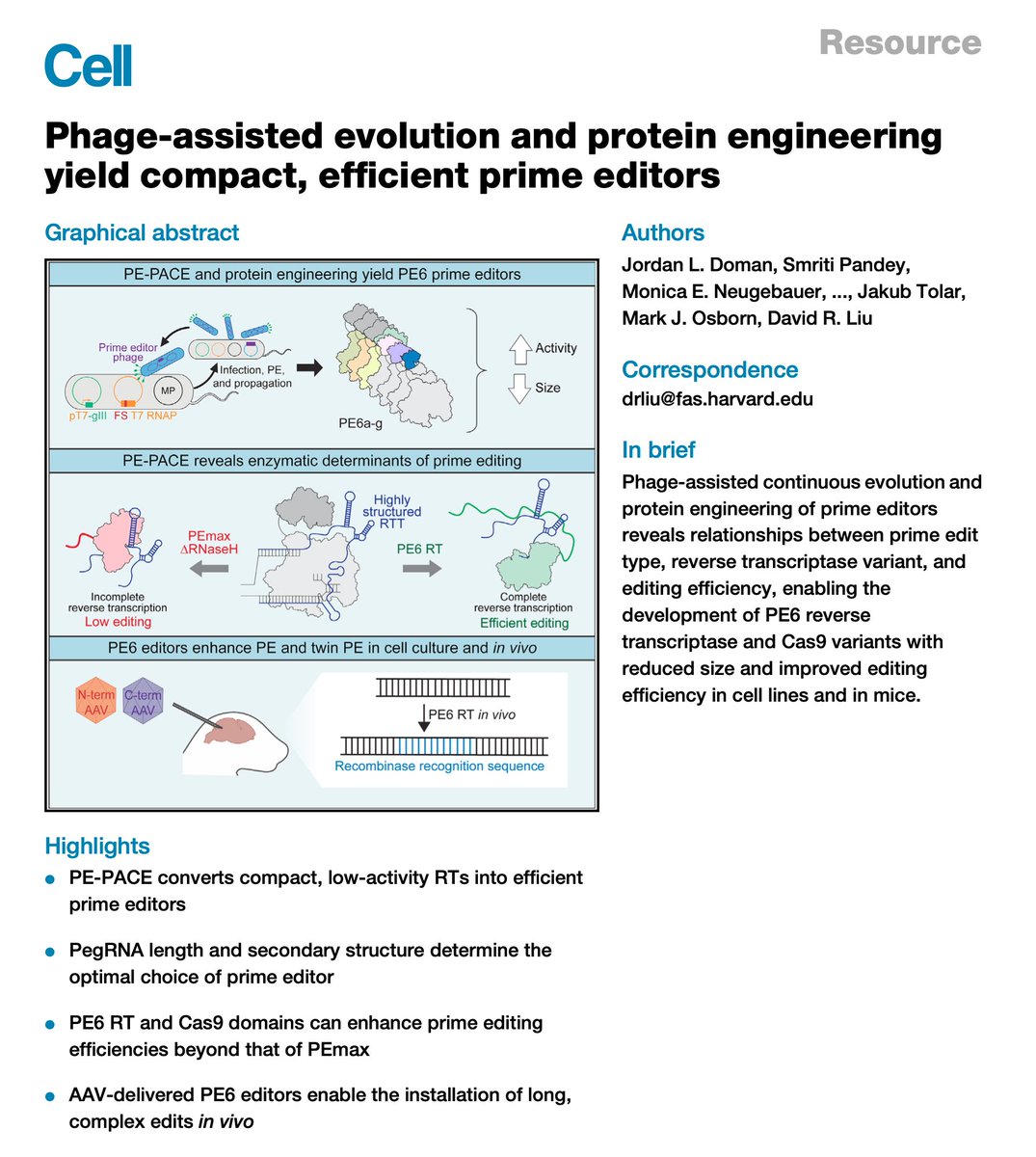
Today we report in @CellCellPress a suite of engineered and PACE-evolved prime editor variants PE6a-g. These new prime editors improve the activity, in vivo deliverability, and in vivo editing efficiency of prime editing.
https://t.co/xdF6j0zn8Y
PDF:https://t.co/iRegR74CKg
(1/15)
Stress rapidly increases your biological age, but this effect can be reversed if allowed time to recover.
@DukeMPI Jame White, @gladyshev_lab
Read more in @Cell_Metabolism