Augustine of Hippo, On the Trinity, Book II, Ch 11
Clearly misinterprets Genesis 18-19. He claims three angels represent the Trinity (not One represents the Son!). Para. 21 he doesn't hold the heiarchy of the two angels in Sodom being below the One worshiped by Abraham.
@rootcausesleuth@Romans8_32@ReturnOrthodoxy Orthodoxy considered Calvinism in error from 1672. Arminianism is a Calvinism branch.
Calvinism (God) & Pelagianism (Man) are 1 energy salvations. The 6th Council condemns 1 energy in Christology. The symmetry of this is seen in Orthodoxy to condemn 1 energy in anthropology too.
@reclaim_rainbow@rootcausesleuth Here's an early Christian commentary on Romans 9
https://t.co/RZADaZoiNy
and John 6:41-52
https://t.co/BPKyskQ1W7
As you can tell from critical verses like Jn. 6:44 and Rom. 9:22-23, the early Christian perspective proactively rejects typical, heretical interpretations.
@reclaim_rainbow@rootcausesleuth Because you don't care about getting basics, like the Trinity, right. You have an ideology that gives you comfort. If you don't mind having a twisted theological foundation, then you won't care about having a disordered theological house. Evidence won't change your disposition.
@reclaim_rainbow@rootcausesleuth Calvinism is a downstream doctrine. My point is upstream metaphysics.
If you start with the wrong foundation in your systematic theology (doctrine of God), you'll end up with a wrong soteriology (Calvinism). Reformers inherited Roman Catholic error and built off of it.
@reclaim_rainbow@rootcausesleuth You are simply assuming a position that is counter to the first 400 years of Christian commentaries.
The first commentaries that teach Unconditional Election, first start from a different trinity model than what was originally affirmed at the first 2 Ecumenical Councils.
@mugjudge@BostonConvert Usually, it's the Catechcumin specifically who are barred from teaching. The Orthodox anthropological position is a rejection of the guilt of original sin while affirming Ancestral Sin.
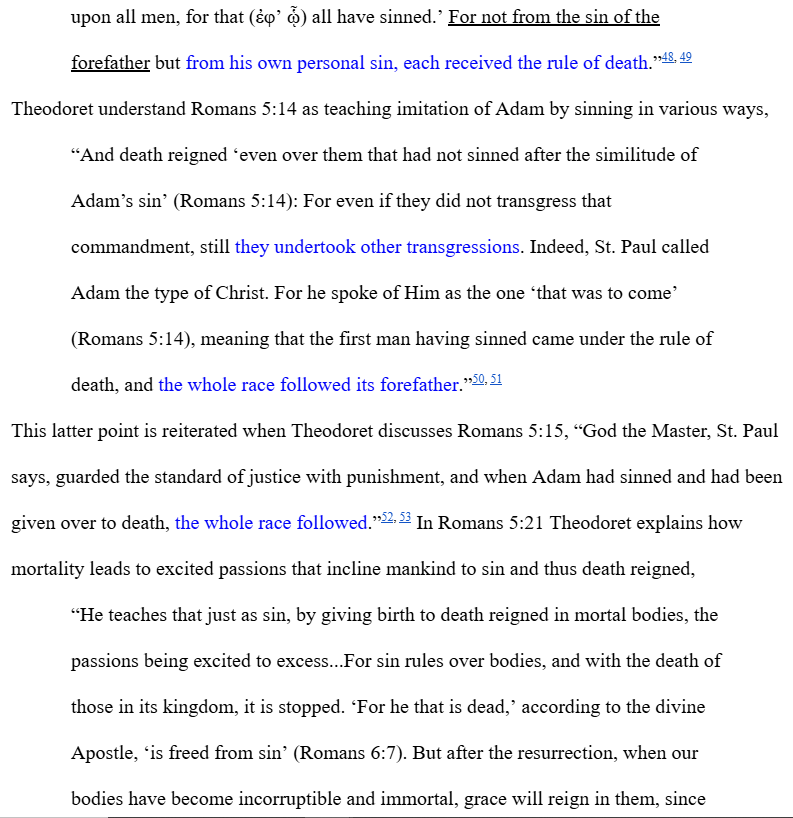
@The_Idol_Killer James would disagree vehemently with Theodoret's historic and orthodox view on Romans 5 which begins at the bottom of column 98 of Patrologia Graeca Volume 82: https://t.co/s4HbyR26Z7
@pedanitic@nicholasofronto@GojoNecluribus@Flammiferrus You should agree the Cappadocians affirm hypostatic causality from One. Aquinas modifies the idea to say "from two as 'one' principle."
Getting a little bored too. If you'd like to end the conversation, I understand and wish you well in your dealings with prots. Peace unto you.
@pedanitic@nicholasofronto@GojoNecluribus@Flammiferrus We must distinguish the Cappadocian understanding of hypostatic causality from energetic procession. Concerning the former, the Spirit proceeds from the Father. Concerning energy, from the Father through the Son. The Father is Monarch (the One Source) as the Cappadocians affirm.
@pedanitic@nicholasofronto@GojoNecluribus@Flammiferrus Augustinian ADS causes a metaphysic problem. These writers uphold the Cappadocian Trinity model where the Son and Spirit are from the Father alone. If ADS is imposed, the model merges the Son and Spirit. Thus, a Binity results. So we can know they held a different simplicity view
@pedanitic@nicholasofronto@GojoNecluribus@Flammiferrus Compare De Trinitate's conception of the Trinity to Basil's letters 32, 38, and 234, or Nazianzen's Orations 27-31 and also 35 Section 10. Chrysostom's Homily XV on John is informative too. The Christophanies are just one piece of evidence in a larger tapestry.
@pedanitic@nicholasofronto@GojoNecluribus@Flammiferrus The OT manifestation exegesis I've been citing acts as an 'output' revealing a change to the understanding of divine simplicity, the 'input.' NewAdvent agrees an 'output' change occurred at Augustine. Other downstream 'outputs', like filioque, also reveal a change to the 'input.'