Pakistani Defence Minister Khawaja Asif’s @KhawajaMAsif statement is nothing more than an attempt to spread propaganda against the indigenous national movement of Baloch nation.
Everyone knows that, at various times, Pakistan’s rulers have blamed India, Afghanistan, the United States, Russia, and Iran for supporting the Baloch struggle, just in an effort to justify their occupation of Balochistan and conceal their own failures. In reality, such accusations are an admission of the failure of their own policies.
We have repeatedly made it clear that this is a national liberation struggle being waged for the restoration of freedom of Balochistan. This struggle will continue until it reaches its ultimate objective.
Khawaja Asif should understand that he represents an occupying state. Neither the power of the Pakistani state nor its claims can outweigh the legitimate national rights of the Baloch people. Nor can such propaganda eliminate our indigenous national movement.
History has repeatedly shown that national liberation movements cannot be permanently suppressed through force. Khawaja Asif should learn from the history of his ally, the United States, which itself emerged from a struggle against colonial rule. In the same way, Balochistan will continue its struggle for the restoration of its national identity and freedom, and will ultimately achieve its rightful destination.
The State of Pakistan Wants to Punish Dr. Mahrang Baloch and Her Companions Through a Sham Judicial System: BNM Spokesperson
Sunday, June 14, 2026 | #BNMSpokesperson
Hashtags: #EndUnfairTrialOfBYCLeaders
https://t.co/M0UrgM7lkf…
The spokesperson for the Baloch National Movement (BNM) has expressed deep concern over the state's attempts to punish Dr. Mahrang Baloch and her companions through sham judicial proceedings. In a statement, the spokesperson said that the State of Pakistan is attempting to punish the imprisoned leader of the Baloch Yakjehti Committee (BYC), Dr. Mahrang Baloch, and her comrades through a fabricated judicial process. Pakistan's judicial system is merely a puppet subordinate to Pakistan Army authorities; the cases of Mahrang Baloch and her associates are being heard through an unjust 'Faceless Court' established inside Hudda Jail (Shaal), which is a ridiculous mockery of justice by the state.
Providing details, the spokesperson stated that 51 fabricated cases were registered against BYC leaders Dr. Mahrang Baloch, Sibghatullah Baloch, Bebagr Baloch, Bibo Baloch, and Gulzadi Baloch for demanding the restoration of human rights in Balochistan. This is an attempt to suppress their peaceful political activities and freedom of expression. These leaders were arrested on March 22, 2025, and as of today (June 14), they have been imprisoned for one year, two months, and 23 days. These arrests are part of the State of Pakistan's continuous denial of Baloch national rights and a continuation of oppression and tyranny. Despite facing the worst conditions and continuous state atrocities, Baloch political activists have chosen a peaceful and political path, but the state is using all its institutions, backed by its oppressive system, to suppress the political voice of the Baloch nation.
The BNM spokesperson further added that across the world, courts are established to ensure justice and to prevent the misuse of law by powerful forces, but Pakistan has staged a farce in the name of justice through devices like the 'Faceless Court.' Under this draconian law, the identities and names of everyone—from the judge, lawyers, and witnesses to the investigating officers—are kept hidden from the accused. The protest by Dr. Mahrang, her companions, and their lawyers against this unconstitutional process is entirely justified. International organizations must stop Pakistani authorities from using state institutions as tools of oppression. The imprisoned BYC leaders are not terrorists but peaceful political activists whom the State of Pakistan is targeting out of lawlessness, injustice, and vendetta.
Concluding the statement, the spokesperson said that in the eyes of the Baloch nation, Pakistan as a state has lost its moral credibility. We have no hope in any Pakistani institution, including the courts, because all institutions in Balochistan are subordinate to the Pakistan Army establishment and operate solely on its dictation. There is no longer any ambiguity in the state's policies; it is actively pursuing an agenda of Baloch genocide. We gravely fear that Dr. Mahrang Baloch will be subjected to the same inhumane treatment that has been meted out to other Baloch leaders in the past. The Baloch nation appeals to the international community for immediate and effective intervention to protect the political and human rights of Dr. Mahrang Baloch and her companions, and to restore human rights in Balochistan.
The oppression, violence, and use of state power that the people of Jammu and Kashmir are facing today is not something new to us. Since 1948, the Baloch nation has endured similar forms of persecution, military aggression, political repression, enforced disappearances, and human rights violations. Therefore, we understand the pain, suffering, and sense of deprivation experienced by the Kashmiri people better than anyone.
I would like to tell the people of Kashmir to stand firm in protecting their historical status, national identity, and collective existence. The history of the Pakistani state and its military establishment shows that it has never voluntarily recognized the legitimate political, national, and human rights of any oppressed nation. Today, the ruthless suppression of public voices in Kashmir, the arrests, and the attempts to crush political demands through force are visible to the entire world.
As far as negotiations, agreements, and state promises are concerned, the experience of the Baloch nation has been deeply bitter. We were deceived through promises made under oath on the Holy Quran. The agreements made with Shaheed Nawab Nauroz Khan, Shaheed Agha Abdul Karim, Shaheed Nawab Akbar Khan Bugti, and other Baloch leaders, and the treatment they subsequently received, are part of history. These realities remain a part of the collective memory of the Baloch nation.
We believe that the people of Kashmir should continue their struggle for their freedom national identity, their political rights, and their right to determine their own future. The protection of national identity and national dignity is not only a guarantee of a nation’s survival but also the foundation of lasting peace in the region. Until the fundamental rights of nations are recognized, peace and stability will remain nothing more than a dream.
As an oppressed nation, the Baloch people feel deeply connected to the suffering and struggle of the Kashmiri people. We support the national and human rights of the people of Kashmir and assure them that the Baloch people will continue to express their moral and political solidarity with them.
The right to national survival, freedom, and self-determination is the fundamental and natural right of every nation. No power can permanently deprive a people of this right. We can survive as a nation when we get rid of Pakistan.
#PoK #Kashmir #BalochistanIsNotPakistan
Enforced disappearances of Mujahid Habib
Location: Panjgur, Balochistan
Date: 5 June 2026
Paank strongly condemns the reported enforced disappearance of Mujahid Habib, who was abducted in Panjgur, Balochistan, on 5 June 2026.
According to available information, he was forcibly taken by personnel associated with state-backed forces and FC personal raising serious concerns regarding his safety and well-being.
Enforced disappearances continue to be a grave human rights violation in Balochistan, leaving countless families in anguish and uncertainty.
Paank demands the immediate and unconditional release of Mujahid Habib and calls on the authorities to disclose his whereabouts without delay.
#EndEnforcedDisappearances
Zakir Majeed: A Student Leader, an Unresolved Disappearance and a Call for Accountability
Writer: @BZBaloch
Published By: @EU_today#ReleaseZakirMajeed
https://t.co/teTKjXYD7S
“For 17 long years, his family has waited for answers, justice, and his safe return. Yet, like thousands of other Baloch missing persons, Zakir remains a victim of a systematic policy of enforced disappearances in Balochistan.”
@DrNaseemBaluch#ReleaseZakirMajeed
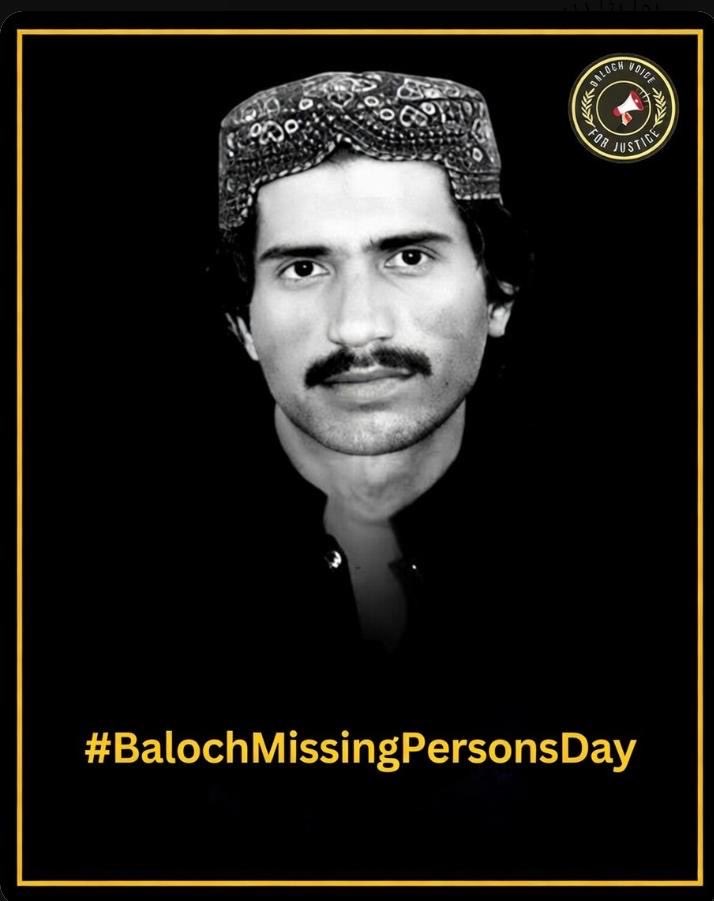
Today, 8 June, is #BalochMissingPersonsDay.
I am still waiting for my brother.
He was allegedly abducted by Pakistani intelligence agencies in 2015 and has been forcibly disappeared ever since. After all these years, we still do not know his whereabouts or what happened to him.
I appeal to international human rights organizations to take notice & help save the thousands of Baloch missing persons. Their families deserve answers, justice, and the safe return of their loved ones.
@hrw@amnesty
Seventeen years have passed since Zakir Jan was forcibly disappeared on 8 June 2009, yet for his family time has never moved forward. The day he was taken remains an open wound one that has never been allowed to heal. What began as the disappearance of a young man became a lifetime of uncertainty for those he left behind.
A mother still waits at the threshold of every passing day holding onto the belief that her son will return. The years have etched sorrow into her heart, but they have not diminished her determination to seek the truth. Each sunrise brings another day of waiting each sunset another day without answers.
The seasons have changed countless times. Children have grown, years have faded into decades and life has moved forward for the world around them. Yet for Zakir’s family time remains suspended on the day he was taken. The wound of uncertainty continues to deepen nourished by silence and the denial of justice.
His name lives in every protest, every photograph raised in the air, every tear shed in the darkness of unanswered nights. Though seventeen years have passed the family’s hope refuses to disappear. It survives in remembrance, in resistance and in the enduring belief that truth cannot remain buried forever.
And so they continue to wait, not because waiting is easy but because love does not surrender to time. A mother’s prayers still rise with the dawn, a family’s voice still echoes through the years and the call remains unchanged.
#ReleaseZakirMajeed
#BalochMissingPersonsDay
بلوچستان میں جبری گمشدگیاں ایک المناک حقیقت بن چکی ہیں، جہاں شاید ہی کوئی خاندان ایسا ہو جو اس دردناک مسئلے سے متاثر نہ ہوا ہو۔ بین الاقوامی قوانین اور انسانی حقوق کے اصولوں کے مطابق جبری گمشدگی ایک سنگین جرم ہے، کیونکہ اس میں افراد کو حراست میں لے کر ان کے بارے میں معلومات خفیہ
A daughter has been waiting for her father’s return for 16 long years,
since the day Pakistani security forces took him away, leaving a void no words can fill !!!
#BalochMissingPersonsDay
Seventeen years ago today, Zakir Majeed was disappeared.
There are people in Balochistan today who are younger than his absence.
They have grown up seeing his face on posters, at protest camps, in the hands of a family that has had to keep proving, year after year, that he existed, that he was loved, that he was taken, that someone must know where he is.
Seventeen years is not a number. It is hair turning white. It is a mother learning the sound of every knock and still looking toward the door. It is Eid after Eid with one place in the house that no one knows how to fill. It is a family forced to live beside an unfinished sentence.
Today, on Baloch Missing Persons Day, we remember Zakir Majeed and all those whose names have been dragged through years of silence. But remembrance is not enough when a person has been missing long enough for a generation to inherit his absence.
Where is Zakir Majeed?
Seventeen years later, that question remains exactly where his family first placed it: before the authorities, before the courts, before the conscience of a country that has learned to scroll past the disappeared.
A disappearance does not end because the public gets tired of hearing about it or because the state has decided to alter its own narrative on ‘missing persons’ again.
It ends when the truth is returned. At this point, most are only asking for the indication of their loved ones’ graves.
#BalochMissingPersonsDay
#ReleaseZakirMajeed
BNM Demonstration in Germany Against Pakistan’s Nuclear Tests in Chagai, Balochistan
#BNMinGermany | Saturday, 30 May 2026
Hashtag:
#NukeAftermathInBalochistan
https://t.co/X7I1qGLJsY
Köln, Germany — The Baloch National Movement (BNM) organized a demonstration in Köln, Germany, to protest against the nuclear tests conducted by Pakistan in Chagai, Balochistan, on 28 May 1998, and to highlight their long-term environmental, humanitarian, and political consequences.
Members of the Baloch diaspora participated in the protest and raised awareness about the devastating impacts of the nuclear tests on the people, environment, and future generations of Balochistan.
During the demonstration, speakers delivered speeches in both English and German, emphasizing the environmental destruction, health crises, political oppression, and humanitarian challenges faced by the residents of Chagai and surrounding areas following the nuclear tests conducted by Pakistan.
Addressing the gathering, speaker Akbar Baloch stated that the people of Balochistan remember 28 May not as a day of celebration but as a painful chapter in their history. He said that the mountains of Chagai still bear witness to the suffering caused by the nuclear explosions, whose consequences continue to affect generations. He paid tribute to Baloch martyrs, forcibly disappeared persons, political prisoners, and families enduring years of pain and uncertainty. He emphasized that nations survive through sacrifice, justice, and humanity rather than through weapons.
Mujeeb Abdullah Baloch, speaking in German, highlighted that the nuclear tests brought fear, disease, and long-term suffering to many families in Balochistan. He stressed that the environment and natural landscape of the region were severely damaged.
Speaker Asif Baloch stated that 28 May is observed in Balochistan as a day of mourning. He criticized Pakistan’s continued expansion of its nuclear weapons program and warned that such policies pose a serious threat to regional and global peace. He stated that the nuclear tests were carried out in a neglected and impoverished region without adequate safety measures, evacuation plans, or long-term health studies. According to him, local communities continue to suffer from cancer, congenital illnesses, environmental degradation, climate-related hardships, and economic devastation. He urged the international community to take a principled stand on nuclear accountability and to support efforts aimed at maintaining regional and global peace through nuclear disarmament.
Luqman Baloch stated that the people of Balochistan continue to suffer from the consequences of the nuclear explosions conducted in the Chagai Mountains. He said that the tests not only damaged the environment and natural resources but also exposed local communities to serious health risks and long-term humanitarian challenges. He stressed that nuclear weapons pose a threat not only to Balochistan but also to regional and global peace. He called for independent investigation teams from the European Union and the United Nations to be granted access to Balochistan in order to examine the humanitarian, ecological, and health impacts of the nuclear tests.
Participants chanted slogans against the Pakistani state and urged international and European organizations to conduct independent investigations and scientific research into the climatic, environmental, and humanitarian conditions in Chagai and other affected regions of Balochistan.
The organizers also distributed informational pamphlets in English and German among members of the public to further raise awareness of the issue.
The speakers reiterated their call for international attention to the suffering of the people of Balochistan and urged global human rights and environmental organizations to play an active role in addressing the consequences of nuclear testing in the region.
Four months ago, on February 2, Pakistani army, along with the so-called Counter Terrorism Department (CTD) of police, attacked our home in Hub Chowki, Occupied Balochistan. During this attack, my father Muhammad Bakhsh Sajidi, my two uncles Muhammad Rafiq Baloch, and Muhammad Naeem Sajidi were forcibly abducted and taken away.
Since that day, no information about their whereabouts, condition, or well-being has been received. They have now been subjected to enforced disappearance in secret torture cells of Pakistan.
It is one among thousands of cases where the Baloch people are being systematically subjected to enforced disappearances, extrajudicial killings, and collective punishment. This has turned to be a genocide happening since occupation in 1948.
We demand international community to intervene immediately to #StopBalochGenocide #EndEnforcedDisappearances