O Genevans, your ministers are strange people; one does not know what they believe, nor what they do not believe; one does not even know what they pretend to believe. Their only way of affirming their faith is to attack that of others. - Rousseau
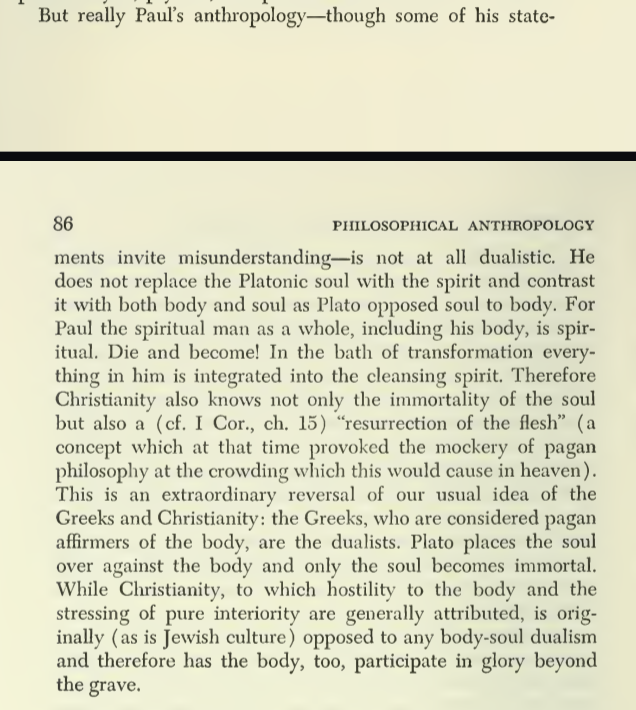
Contra Nietzsche's interpretation, Michael Landmann argued that the Apostle Paul did not take up Plato's mind-body dualism.
Far from being a "despiser of the body", Paul's anthropology viewed man as composed of a single substance. Soul and body were one, and both partook in salvation.
During Stalin’s Show Trials, one of the charges against the defendants was that they’d read subversive material, which of course was illegal and punishable by death.
But this posed a problem for the judges: even if it was only to confirm that it was indeed subversive material, reading said material was still dangerous. And so, on the margins next to the evidence of subversive material, the judges would pencil in "Did not read but disapprove."
Just as bees make beehives, leftists reinvent Stalinism from first principles every time they are allowed to have power.
In 1533, Calvin had Servetus executed in Geneva. The charge was heresy, but their was no law Servetus broke while in the territory of Geneva, nor had there been any law established by Geneva mandating death for heresy. Servetus was denied legal representation, as he suffered in a cold prison cell while a team of scholars ripped apart his books to accuse him. The sentence was death by burning. Modern defenders of Calvin will claim this was par for the course at this time, but this event immediately turned into an international scandal. Beza, writing Calvin's biography shortly after Calvin died, responds to claims that Calvin was bloodthirsty. Who else, he exclaims, was killed beside Servetus? He betrays the truth of the matter: Calvin had Servetus killed, and executing for heresy was not commonplace. These defenses were struck from later rewrites of Calvin's biography.
For the first time, these works are now accessible in English. The first volume, the trial documents, are already published on Amazon. The second volume will contain relevant letters and tracts concerning the event. The 3rd will contain the works that were created in the aftermath. https://t.co/rFaKt7y1Yg
The true Calvin Servetus story is not one about historical persecutions of faith or Reformed era jurisprudence. This was a frame Calvin employed as he attempted to build a coalition to take blame in the execution. He was annoyed the entire world blamed him. He immediately set out to personally destroy anyone who spoke out against him, and force everyone to make public statements affirming him.
The true story is one of the hubris and megalomania. A man who claimed every criticism of him was an attack on God. A man who sought to ruin individuals such as Castellio, who live peaceful lives in poverty and study.
Calvin wins out, in the end. People are coerced into affirmations of Calvin's doctrines as a loyalty test. Those who refuse are given labels such as Pelagian or Servetians. People are intimidated into silence and forced to write anonymously, their works suppressed. Proving the maxim that "The side that wants to win will always beat the side that just wants to be left alone."
We have to remember, Augustine was a dedicated Platonist. In Platonism, time-bound activity does not properly belong to "god". In Timaeus, Plato writes:
*for we say that he “was,” he “is,” he “will be,” but the truth is that “is” alone is properly attributed to him, and that “was” and “will be” only to be spoken of becoming in time, for they are motions, but that which is immovably the same cannot become older or younger by time, nor ever did or has become, or hereafter will be, older or younger, nor is subject at all to any of those states which affect moving and sensible things and of which generation is the cause.*
This mirrors the quote from Confessions. In Confessions, Augustine takes us on his spiritual journey. He learns not to take the Biblical passages as literal, but figurate illustrations of principles he learned from the Platonists. In one of the most telling Augustine passages, he says that all theology can be learned from the Platonists. But Christianity adds one thing, "charity". Basically the figure of Jesus Christ, who acts as the key to the Platonic ascent. Augustine writes:
*26. But having then read those books of the Platonists, and being admonished by them to search for incorporeal truth, I saw Your invisible things, understood by those things that are made; [Romans 1:20] and though repulsed, I perceived what that was, which through the darkness of my mind I was not allowed to contemplate,— assured that You were, and were infinite, and yet not diffused in space finite or infinite; and that Thou truly art, who art the same ever, varying neither in part nor motion; and that all other things are from You, on this most sure ground alone, that they are. Of these things was I indeed assured, yet too weak to enjoy You… For where was that charity building upon the foundation of humility, which is Jesus Christ? 1 Corinthians 3:11 Or, when would these books teach me it? Upon these, therefore, I believe, it was Your pleasure that I should fall before I studied Your Scriptures, that it might be impressed on my memory how I was affected by them… had I afterwards fallen upon those volumes, they might perhaps have withdrawn me from the solid ground of piety; or, had I stood firm in that wholesome disposition which I had thence imbibed, I might have thought that it could have been attained by the study of those books alone.*
The most telling aspects of this passage is the exact details Augustine claims to have adopted from the Platonists. This is the transcendence of God, which he admits is not in the Bible. If he was a Bible believer before he was a Platonist, he notes he would surely have converted away. It is only because he was a Platonist adopting Christian aspects that he could become a Christian. By his own admission.
We have to remember, Augustine was a dedicated Platonist. In Platonism, time-bound activity does not properly belong to "god". In Timaeus, Plato writes:
*for we say that he “was,” he “is,” he “will be,” but the truth is that “is” alone is properly attributed to him, and that “was” and “will be” only to be spoken of becoming in time, for they are motions, but that which is immovably the same cannot become older or younger by time, nor ever did or has become, or hereafter will be, older or younger, nor is subject at all to any of those states which affect moving and sensible things and of which generation is the cause.*
This mirrors the quote from Confessions. In Confessions, Augustine takes us on his spiritual journey. He learns not to take the Biblical passages as literal, but figurate illustrations of principles he learned from the Platonists. In one of the most telling Augustine passages, he says that all theology can be learned from the Platonists. But Christianity adds one thing, "charity". Basically the figure of Jesus Christ, who acts as the key to the Platonic ascent. Augustine writes:
*26. But having then read those books of the Platonists, and being admonished by them to search for incorporeal truth, I saw Your invisible things, understood by those things that are made; [Romans 1:20] and though repulsed, I perceived what that was, which through the darkness of my mind I was not allowed to contemplate,— assured that You were, and were infinite, and yet not diffused in space finite or infinite; and that Thou truly art, who art the same ever, varying neither in part nor motion; and that all other things are from You, on this most sure ground alone, that they are. Of these things was I indeed assured, yet too weak to enjoy You… For where was that charity building upon the foundation of humility, which is Jesus Christ? 1 Corinthians 3:11 Or, when would these books teach me it? Upon these, therefore, I believe, it was Your pleasure that I should fall before I studied Your Scriptures, that it might be impressed on my memory how I was affected by them… had I afterwards fallen upon those volumes, they might perhaps have withdrawn me from the solid ground of piety; or, had I stood firm in that wholesome disposition which I had thence imbibed, I might have thought that it could have been attained by the study of those books alone.*
The most telling aspects of this passage is the exact details Augustine claims to have adopted from the Platonists. This is the transcendence of God, which he admits is not in the Bible. If he was a Bible believer before he was a Platonist, he notes he would surely have converted away. It is only because he was a Platonist adopting Christian aspects that he could become a Christian. By his own admission.
Sure, https://t.co/4qUYUvTL2J
But how didst thou speak? Was it in the same manner in which the voice came from the cloud saying, “This is my beloved Son”? For that voice sounded forth and died away; it began and ended. The syllables sounded and passed away, the second after the first, the third after the second, and thence in order, till the very last after all the rest; and silence after the last. From this it is clear and plain that it was the action of a creature, itself in time, which sounded that voice, obeying thy eternal will. And what these words were which were formed at that time the outer ear conveyed to the conscious mind, whose inner ear lay attentively open to thy eternal Word. But it compared those words which sounded in time with thy eternal word sounding in silence and said: “This is different; quite different! These words are far below me; they are not even real, for they fly away and pass, but the Word of my God remains above me forever.”
Sure, https://t.co/4qUYUvTL2J
But how didst thou speak? Was it in the same manner in which the voice came from the cloud saying, “This is my beloved Son”? For that voice sounded forth and died away; it began and ended. The syllables sounded and passed away, the second after the first, the third after the second, and thence in order, till the very last after all the rest; and silence after the last. From this it is clear and plain that it was the action of a creature, itself in time, which sounded that voice, obeying thy eternal will. And what these words were which were formed at that time the outer ear conveyed to the conscious mind, whose inner ear lay attentively open to thy eternal Word. But it compared those words which sounded in time with thy eternal word sounding in silence and said: “This is different; quite different! These words are far below me; they are not even real, for they fly away and pass, but the Word of my God remains above me forever.”
This is a follow-up. Here is a quick list of lies in the video:
Shows Calvin quote saying he has no authority at Geneva. Fake.
Claims Servetus was apocalyptically suicidal. False.
Claims Calvin wanted imprisonment. False.
Claims Servetus sat in the front row of Calvin’s church. False.
Places the date of the History of the death of Servetus as 1557 rather than early 1554. False.
This is not to mention the omissions and bad reframings found in the video. I cover the entire video here:
https://t.co/sQX5HsUADe
The mechanics of ritual human sacrifice (usually via cardioectomy, though sometimes with burning on the pyre first) and cannibalism (ritually, not for food).
@ReformedCaio@RyanMReeves I don't know who needs to hear this, but Calvinists doubling down on defending Calvin is more of a statement of Calvinist character than anything else. https://t.co/RmVI3BgNR8