Today, we’re announcing that we’ve raised $115 million in funding, including a $100M Series A led by @kleinerperkins.
America has lost the ability to build, and we’re here to restore it. My co-founder, @NoahMcGuinn, and I left our jobs at @SpaceX , where we worked on programs including Starship, Starshield, and @Starlink, to build a company that will solve construction’s greatest challenges.
Infrastructure is the foundation of civilization, and construction is the precursor to innovation. If America wants to build a brighter future for the next generation, we have to make it faster, cheaper, and safer to build.
That’s where @TerraFirma_Inc comes in. We’re a new type of company, a robotic construction company that builds the full technology stack needed to deliver an order-of-magnitude improvement in one of the world’s oldest, largest, most important, but least efficient industries.
We are building technology that expands what’s possible in construction on Earth, and then we'll use that same technology to build megastructures and colonies on the Moon and Mars.
We’ve made tremendous progress over the past year, growing the company more than 10x in the last 12 months. We are performing projects across the world. By the end of October 2026, we are on track to operate 3 of the top 3 largest robotic construction fleets in the world, each on a different continent, bringing unprecedented speed, scale, and efficiency to some of the world’s most complex critical infrastructure projects.
This funding will allow us to step on the gas and scale our manufacturing, software, operations, and construction deployments, including work on massive commercial and government contracts.
We’re building the future of construction right here in Austin, Texas, and scaling it globally. If you want to be part of the team changing the world, now and on Mars, join us.
Our Series A was led by Kleiner Perkins, with participation from Bain Capital Ventures, Glade Brook Capital Partners, BANNER VC, Saga Ventures, Trust Ventures, Definition, PEAK6, Magnetar Capital, and Ravelin Capital. Huge thanks to all of our angel investors, friends, and family who have helped and supported us throughout this journey.
Apply here: https://t.co/BmXHSGJQQk
The Long-Horizon Terminal-Bench paper landed around May and concluded that the results showed headroom for improvement. The best of the 15 models they tested finished seven of the 46 tasks, and the mean across all models was about two. That ceiling is what fifth place looks like on the current board.
Grok 4.5 is now at 13, and Fable 5 is at 12. A single task costs around 9.9M tokens, 231 episodes, and 85 minutes of wall clock time. That means agents are holding a plan across all of it and finishing, and that capability nearly doubled in two months.
SpaceXAI is on top, and they marketed the 4.2x output token efficiency, which undersells it. Two dollars in, six out, per million. On a benchmark where one task burns ten million tokens, the bill is dominated by input replay, and they say Grok 4.5 solves tasks in under half the number of steps, so there is less accumulated context to resend on every call. The efficiency compounds on the input side, which is the side that costs money.
Fable 5 is one task behind. Their own launch chart has them losing DeepSWE 1.1 to Fable by 17 points, and Grok 4.20 sits on this same board at 0.080 with zero completions, so whatever happened in 4.5 is not a family trait.
My read is that the 4.5 jump came out of training alongside Cursor, which is a stream of real agentic edit trajectories nobody else has at that volume, and nothing in the counterevidence argues against it compounding into the next checkpoint.
We’ve built a new way to ship software: Agent Teams in Antigravity.
Just run /teamwork-preview to spin up a dynamic team of specialized subagents. They coordinate in the background to plan, build, and verify complex engineering tasks in parallel.
Grok-4.5 from @SpaceXAI debuts at #13 on the new Agent Arena leaderboard, based on 9.8K live agentic sessions.
Compared to Grok 4.3, this release is a significant step forward in agentic performance (#29->#13). It makes major gains on Bash Recovery, catching up to Anthropic and OpenAI models, and shows a substantial increase in confirmed task success, making it far more effective in real-world use. Check out rankings by signal below.
Congrats to the SpaceXAI team on the strong Grok-4.5 release!
GPT-5.6 Sol Ultra found me a solution to another Erdos problem not long after this one.
Problem #793 asks about asymptotic of a 2-primitive set. GPT again came up with an extremely short and elegant construction that enhances original Erdos method used to prove a weaker result.
This is how i want to build Agentic infrastructure - declaratively.
English+Code together in a .ts file with string templates referencing Alchemy resources, event sources and bindings.
Deploy to cloud with `alchemy deploy`. No setup.
I removed 423 GB from GLM‑5.2 without changing the model.
1,403 GB → 980 GB.
753B weights.
Bit for bit exact.
No quantization or retraining.
The weights remain compressed in VRAM instead of rebuilding the full model first.
Full writeup and repo in the next post.
Big news for AI on a budget. GLM 5.2 Colibri int4 is a Mixture of Experts model that runs entirely on your CPU. No GPU needed. It's fast, efficient, and opens up advanced language capabilities to anyone with a standard computer. This is a game changer for offline AI.
We are entering a completely new era of science
Here is Yuji Tachikawa from Japan (Mathematical Physics, String Theory, QFT) on recent progress in his own work using Fable 5 :
"I've been trying out Claude Fable recently, and last night, on a whim, I showed it my research notes about a collaborative project that's seen no progress in the past six months or so and asked for its thoughts. To my surprise, it made a non-trivial observation and essentially solved it."
"I was also surprised that it was using sympy to automatically write code and verify his own predictions."
"Fable probably seems like it properly understands string theory and has intuition too—that's my impression"
i said the answer was more interesting than a yes or a no. here it is.
left is grok 4.5's build. three minutes, one prompt, cold start, every test green. right is the original, the same scene grok build and i grew over three weeks of iteration. same locked spec on both sides.
here's the part that breaks brains: grok 4.5 matched every single number in that spec. 5,200 bark fibres, exactly. 650 stars, exactly. trunk tapering 0.62 to 1.55 over 4.6 units, exactly. the acceptance gate came back 12 for 12.
and the scenes still don't look alike. the grass on the left technically exists, 8,000 instanced blades, but the spec never gave a blade height, the model guessed short, and the lawn vanished. the crown clumped upward instead of spreading, because "a rounded ancient crown" is an adjective, not a number. the pond shrank to a smear at the rim. every number transferred perfectly. everything alive in the scene lived in the adjectives.
that's the actual state of coding agents in july 2026. speed is solved. correctness is mostly solved. taste is not close. you can hand a model your spec. you cannot yet hand it your eye.
i bench agents. this is what the benches are for, finding the exact line between what's solved and what's marketing. all tests green and the world still doesn't feel right. sit with that one.
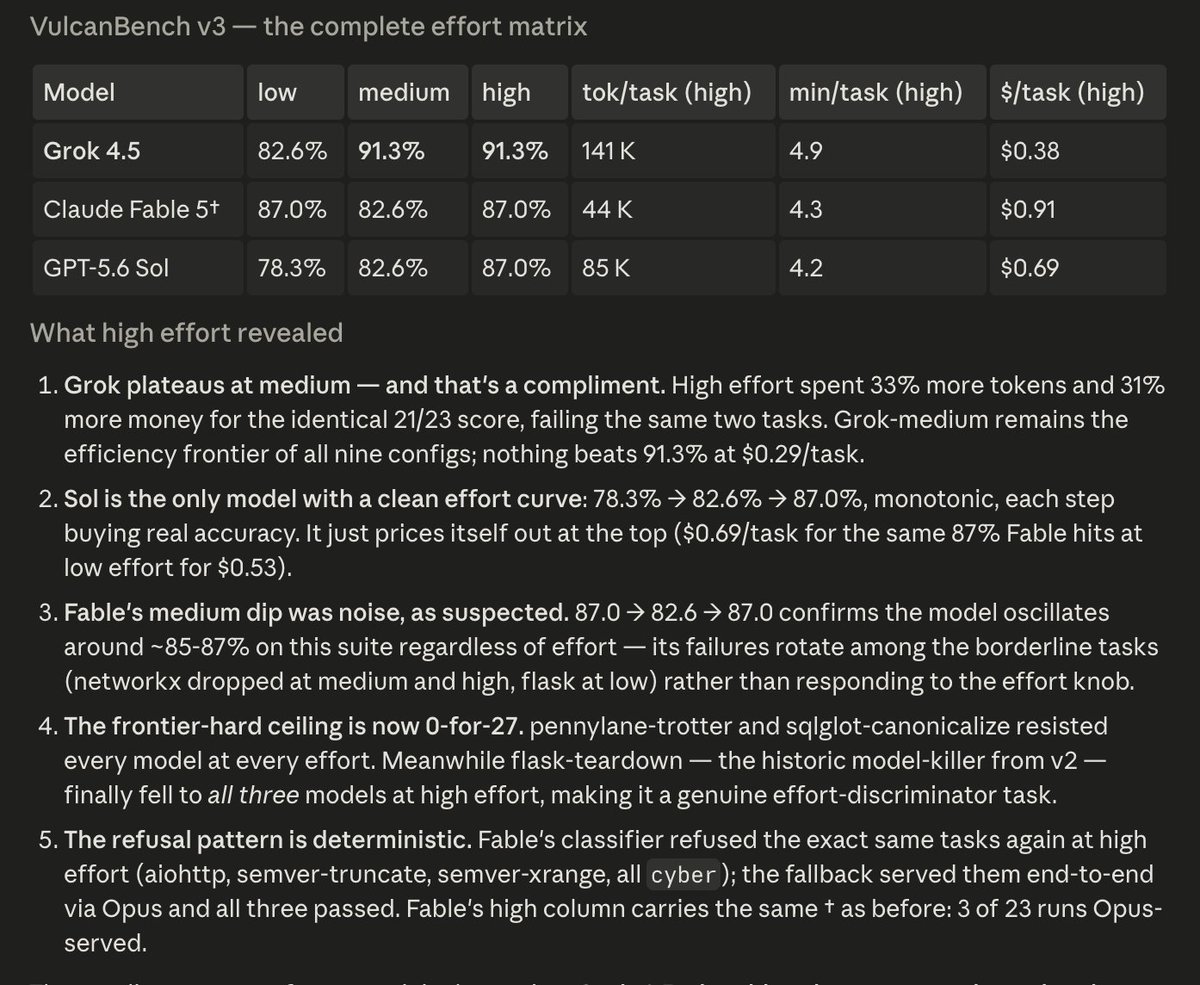
Results are in, and the TL;DR is. With this new class of models, moving from Medium to High doesn't always mean increasing accuracy.
In this benchmark comparing Grok 4.5 vs. GPT 5.6 vs. Fable 5, Grok 4.5 won on accuracy, and got the same score on Medium and High.
We all, very likely need to reconfigure our brains. We've been trained to think we need at least High effort to get good accuracy, that is no longer true.
Woke up to see the results of my sweeping effort level benchmark comparing Grok 4.5, GPT 5.6, and Fable 5.
This benchmark now looks at my eval suite across low, medium, and high effort.
My eval suite has no puzzles, and no math problem, and no meaningless, "can it one shot this!" tests. It's all real engineering problems that represent work engineering teams like mine would throw at these models on a regular day.
And I think this proves two things to me:
1. Grok 4.5 is a very good model, it is likely going to become my go-to as a core model in the execution layer
2. Moving from Medium to High effort doesn't increase accuracy. This is flawed thinking from the previous generation of models. With this new generation of models, Medium is very likely the sweet spot.
I will be sharing more details of these results later today or tomorrow. But now I want to go for a trail run! 🥾🌲
Might be back on my computer today, or might just spend the whole day adventuring in Tahoe, we'll see.
BREAKING - OFFICIAL RESULTS: GPT-5.6 Sol by @OpenAI is 1st overall on Design Arena with an Elo of 1353.
This puts GPT-5.6 Sol above Claude Fable 5 by @AnthropicAI and in the same performance band as GLM 5.2 by @Zai_org on frontend design.
This is an 18-position and 60-point Elo leap from GPT-5.5.
GPT-5.6 Sol also establishes a new Pareto frontier for preference vs. speed, faster than any model at this performance.
Congratulations to the @OpenAI team on the launch!
Imagine a fable 5 quality model that’s 3-4x less expensive in less than 6 months. And an Opus 4.8 grade model that can run on a local device in less than 12 months. Greater than 50% chance that these events will happen. Worth keeping in mind when you make predictions about the future.
GPT-5.6 Sol Ultra produced a proof of a 50 year old math conjecture. Unlike the Erdős Unit Distance Problem, this was done with a model publicly available *today*. I look forward to seeing what scientists and researchers are able to do with this model!