Consulting geologist, photography. Proud husband 47 yrs, father of two veterans and 2 grandsons. Friend of Bill. Oilfield trash & 10th Amendment fan #EFT#OOTT
Spent last last 40 years developing prospects and doing wellsite work. 20 years ago began doing nature/wildlife photography as a hobby while working. Will post every day or so just for fun.
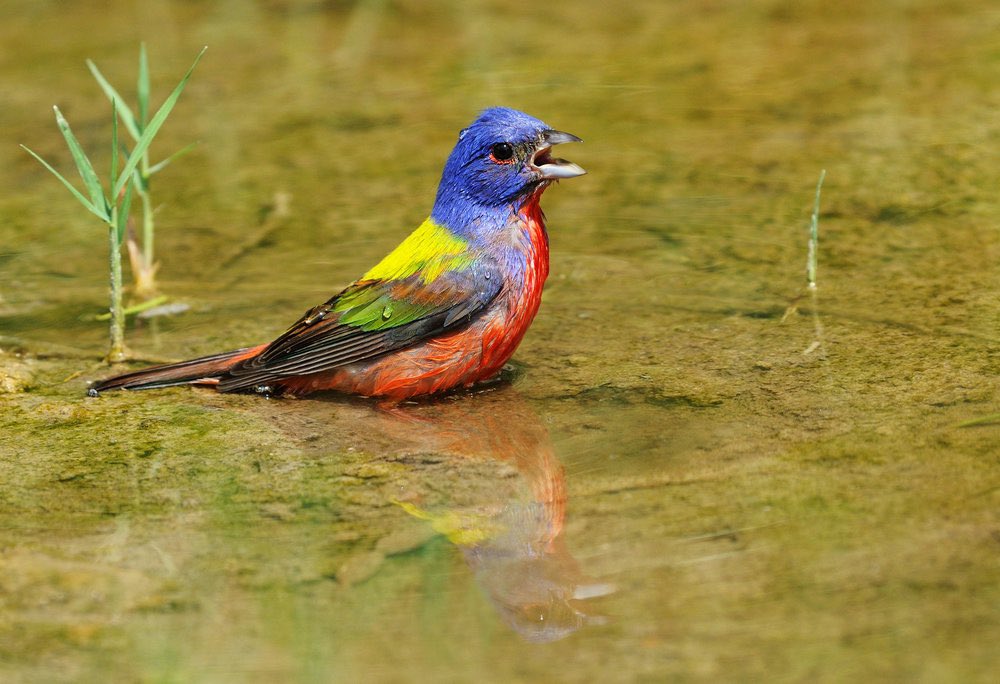
Painted Bunting NW of Aspermont TX
API Inventory Moves 6/9 (full version)
Crude -9.119 million (exp. -3.4 million)
Gasoline -1.191 million
Distillates +1.3 million
Cushing -1.125 million
SPR actual -7.9 million
#oott#crudeoil#API#gasoline
@willrayvalentin I hope so I just bought a slightly used jackup rig in Invergordon. Just need a few willing partners to help with shipping to Cook Inlet AK to drill for datacenter gas. Extremely light promote: DM for details
The US naval blockade is definitely biting, and Iranian crude exports are cratering, but the street is completely misreading the mechanics here.
Iran's oil export engine is nothing but a massive, structural money-and-logistics laundering matrix. On the physical side, the whole game is evading US eyes to scrub Iranian barrels and make them look completely kosher on paper.
The second these tankers clear the Strait of Hormuz or hit the Indian Ocean, they flip the switch and turn off their AIS. They’ll even manually paint over or mask the hull numbers to stay invisible to satellite tracking.
The real action happens via STS transfers in the EOPL or UAE, bleeding the cargo into un-sanctioned dark fleet.
While doing this, they doctor the Bill of Lading to wipe the origin clean, magically re-christening Iranian crude as Malaysian Blend or Omani barrels.
Those barrels eventually show up at the doorsteps of Shandong Teapots in China to discharge. That’s exactly why Beijing's official import prints show a massive spike in Malaysian volumes, while Iranian imports look like zero.
Obviously, standard trade finance rails like SWIFT and USD clearing are dead in the water. To bypass this, Tehran runs a bulletproof shadow banking network.
They’ve layered dozens of shell companies across Dubai, Hong Kong, and Turkey. Domestic Iranian networks, like the Amin Exchange, act as the central bank for these offshore front accounts.
The tape settles in RMB or AED, never greenbacks. Once a teapot wires cash to a shell account, the funds are instantly fractured and routed across multiple front profiles via Hawala style to completely blind any tracking.
When cash routing hits a brick wall, they just pivot to straight-up barter—clearing the oil bill in exchange for Chinese refined products, industrial machinery, consumer goods, or military hardware components.
This entire clunky setup creates a massive lag in the cash conversion cycle. Moving from Iranian loading docks, steaming dark at low speeds, floating in international waters waiting for an STS window, forging the papers, and finally getting the teapots to clear customs takes a solid 60 to 90 days.
Even when the teapots pay up, washing that money back through UAE and Hong Kong shells until it turns into spendable dry powder (or hard goods) for Tehran or the IRGC takes another 60 to 90 days.
Bottom line: Iran is running on a 3 to 6 month delay from the time the oil leaves the ground to when they can actually spend the cash.
This duration risk and the structural discount blow out even wider whenever the US drops a combined hammer—like the Economic Fury campaign—targeting not just the dark fleet, but the financial nodes and clearing desks in Hong Kong and the UAE at the same time.
Every sweep locks up accounts and forces them to rebuild their routing from scratch.
So the liquidity hitting Iran's balance sheet today is cash from oil traded months ago. Since they're still clearing out the oil on water floating outside the Strait, it’s going to take months before their actual financial runway gets cut off.
But the real macro question everyone is missing is this: these guys already proved they can survive on zero exports during the COVID pandemic. Why is everyone so sure this cycle plays out differently? Who breaks first under the weight of time—Tehran or Washington?
That’s the real chart worth watching.
#oott #iran
Chicago lost the Bears this week. A team that's been in the city since 1921.
They didn't lose them to a bigger market or a better deal. The Bears decided they'd rather be a tenant in Indiana than deal with Illinois for one more year.
Think about how badly you have to run a place for that to be the smart move.
They lost them for two reasons.
The people running Illinois would rather villainize a builder than keep one. And they're bad at their jobs.
In 2021 the Bears spent $197M on the old Arlington Park racetrack.
Before they could break ground, Cook County valued the empty lot at $192M (Bears said $60M). They were salivating at the chance to extort a building that didn't even exist yet.
That fight dragged on for years.
The Bears were ready to put $2B into the stadium. All they wanted was a promise the county wouldn't reassess them into oblivion, plus $855M for infrastructure everyone uses. Roads, transit, utilities. A $3B project, two thirds of it private money pouring into Illinois.
Springfield had since 2021 to get this done. They dragged it to the final night of session, passed it through the Senate at 3:39AM, and the House went home without voting.
So now it's all gone.
The funniest part? This started because Cook County tried to grab the tax early. They knew a built stadium would pay $53M a year. Now they get under $4M on a vacant lot. No jobs, no buildout, no new anything.
Congrats on fighting for scraps and losing the whole prize.
Pritzker: they're "an $8.5B valued business" that doesn't need propping up.
But be smart for a second. Almost every NFL city throws in public money for a stadium. Not charity. The return is real. Tourism, hotels, restaurants, jobs, game days, property tax on a huge development. The math works.
Indiana did the math. While Illinois sat on it for years, Indiana passed a bill in months, put up $1B, and took the team.
And the Bears took a worse deal to get there. In Illinois they were going to own their stadium. In Indiana they rent it from the state. A team that wanted to build its own home gave up ownership just to escape Chicago.
Nobody won but Indiana. The Bears lost their stadium. Illinois lost the team, the $2B, and $53M a year in taxes.
Pritzker after they left: "I wasn't willing to give up billions of dollars of taxpayer money to give it to a billionaire-owned family or team."
There it is. "Billionaire-owned."
That's how Democrats talk about any business right before they run it out of town. Call them a billionaire, act like you're saving working families, take a victory lap while the tax base drives across the state line.
Meanwhile they're running the whole state into the ground. And you already know how this ends. You're living in it.
Pensions are $143B in the hole, worst in the country and not close. You pay $6,285 a year in property taxes, double the $2,969 national average, for a city that's $1.15B in the red. The mayor called its finances "the point of no return."
When you run things this badly, you sell what's left.
They leased the parking meters for 75 years to Morgan Stanley and a sovereign wealth fund in Abu Dhabi. Took $1.15B and burned through it in two years. The investors already made it all back, with 58 years left to collect.
Sold the Skyway. Sold the downtown garages. Every asset that made money, gone for one check.
But a fixed property tax rate for a team that's been here 106 years? That's "propping up billionaires."
Companies are leaving. Boeing for Virginia. Caterpillar for Texas. Citadel for Miami. In 2023 alone Illinois lost 56,000 people and $6B in income to other states. The ones who left earned a third more than the ones who moved in.
Indiana didn't outbid anyone. AAA credit, 16 years straight. A $676M surplus. Fourth-lowest debt per person in the country. They just weren't a disaster.
Illinois could have collected $53M a year. It chose zero. Ignore all the bad management but make sure to stick it to those evil, pesky billionaires.
A 24-year-old Polish tennis player arrived in Paris last week ranked 114th in the world, with no sponsors, no guaranteed income, and no certainty she could even pay for her hotel room.
She had to win three qualifying matches just to enter the French Open main draw. Prize money is only paid at the end of the tournament, so a Polish sports drink brand quietly stepped in and covered her hotel bill.
Her name is Maja Chwalinska. And today, she plays in the French Open final.
Before this tournament, she had won exactly one Grand Slam main draw match in her entire career. She had battled depression so severe that in 2021 she couldn't get out of bed. She underwent knee surgery in 2022. She spent years grinding through small tournaments across Europe just to stay afloat.
Then she arrived in Paris, won three qualifiers, and kept winning. Zheng Qinwen. Elise Mertens. Maria Sakkari. Diana Shnaider. Nine straight matches. One set dropped.
She is now the first qualifier in French Open history to reach the final. The last time a qualifier reached a Grand Slam final, it was Emma Raducanu at the 2021 US Open. Raducanu won.
By simply making the final, Chwalinska has earned more prize money than her entire career combined. The runner-up cheque alone is $1.6 million. If she wins today, she takes home $3.25 million.
One week ago she couldn't pay for her hotel room.
@Amena__Bakr It’s like Hotel California once you check in you can never leave.
Insanity is doing the same thing over and over and expecting different results.