Claude Code creator:
"Now I don’t prompt Claude anymore - I have loops that are running. My job is to write loops."
In this 30-min speech, Boris revealed his actual Claude setup for daily coding.
Claude Code + loops + dynamic workflow
Worth more than a $500 vibe-coding course
Mathieu Kassovitz on how "La Haine" (1995) changed many people's lives:
“When you want to make a political movie you want it to be relevant. No point in pleasing people. There are already many movies that can please people. 'Monty Python' or Disney movies are passed on from generation to generation but to be able to do a political movie that stays relevant 25 years later is amazing and terrible at the same time. Because it also means that the problems are still here. They are even worse now, they are combined with other problems that we didn’t have 25 years ago.
That movie changed a lot of people’s lives. I met people who became policemen or lawyers because of the film. That’s why we are releasing it again, because it’s a movie people can relate to. It’s what you’re looking for when you make a political film. People are more than just entertained.
My memories stem more from the audience than from the movie itself. The way it was received and the way people see it today. Either they were from the projects and it changed their way of looking at a problem. Art can really help with that. On a political level, it gave the kids from the suburbs a certain strength. It also gave cops another angle at looking at those kids. Many people were inspired to produce new work.
Even this year’s César winner is inspired by 'La Haine', not by the movie itself but by the theme. The end is almost the same. JR was 13 years old when he watched the film and his artwork is very much inspired by the poster. The film actually helped to create a new generation of filmmakers and artists. It wasn’t just a trend. It’s an adventure that we shared together. So that’s the point of making movies like that and I’m proud of it.
There is no music in La Haine but it’s a hip-hop movie. As it’s political, hip-hop and street culture has to be a part of it. Hip-hop is educating and entertaining at the same time. It’s the best way to learn, we call it ‘edutainment’. After all, 'La Haine' is also a comedy, except for the last 20 seconds of course.”
("La Haine Turns 25 – And Is As Relevant As Ever", Arijana Zeric, Another Magazine, 2020)
P.S: On this day, 31 years ago, "La Haine" (1995) premiered at the Cannes Film Festival, France.
TRAIN DREAMS (2025) feels less like watching a movie and more like remembering somebody else’s life in fragments. Quiet work, loss, love, entire years disappearing without warning. Rare kind of film that leaves an ache behind for days afterward.
Andrej Karpathy just explained the future of software engineering without directly saying it.
The best AI engineers are no longer “prompting.”
They’re building systems around the agents.
Karpathy’s biggest insight wasn’t:
“Claude can code.”
It was:
LLMs become dramatically better when you force them into disciplined workflows.
That’s why "CLAUDE.md" files are suddenly everywhere.
Not because they’re prompts.
Because they behave like an operating system for the agent.
Karpathy called out the exact problems with AI coding:
- models assume instead of asking
- they overengineer simple tasks
- they hide confusion
- they rewrite unrelated code
- they optimize for completion, not correctness
So developers started encoding rules directly into the workflow:
→ Think before coding
→ Simplicity first
→ Surgical edits only
→ Goal-driven execution
And the results are wild.
People are now running multiple Claude Code agents in parallel like engineering teams:
• one agent researching
• one debugging
• one writing tests
• one optimizing code
• one validating outputs
Not “AI assistance.”
Actual orchestration.
And this part from Karpathy changes everything:
“Don’t tell the model what to do. Give it success criteria and let it loop.”
That is the shift.
From:
“write this function”
To:
“here’s the goal, constraints, tests, and verification system — now iterate until correct.”
The craziest part?
This already feels like a phase shift in engineering.
A lot of developers quietly went from:
80% manual coding → to 80% agent-driven coding in just months.
Not because AI became perfect.
Because the leverage became impossible to ignore.
We’re entering an era where the highest leverage engineers won’t necessarily be the best coders.
They’ll be the people who build the best systems around AI agents.
This Chinese guy created agents in Claude Code for landing pages and single-handedly serves 47 small businesses a month, taking $400 from each.
He built a system of 7 agents on Claude Sonnet 4.6 that analyzes Google Maps in small towns, finds small businesses without websites there, and over 1 weekend takes each one to a finished mockup with video and cold message.
No assistant, no sales team, no SDR. Just him, a MacBook, an iPhone, and 1 API key.
And traditional web design agencies keep teams of 8 people on salary for the same order flow, while his expenses are only tokens and subscriptions to Lovable, Higgsfield, and Calendly.
7 agents work through 1 orchestrator on Claude Code Router. Usage is about 3 million tokens a day, the average API bill is about $480 a month.
All 7 go through MCP servers and write shared state to the file system, without shared state in memory and without race conditions, and 1 of them lives right in the iPhone and picks up positive replies from the subway, a taxi, or on walks.
And here is the system prompt he put into the orchestrator before launch:
"You are the orchestrator of a solo agency that sells ready-made websites to local businesses. You delegate read-only tasks to 6 sub-agents and own all writes.
sub-agents:
// Scout (walks through Google Maps in selected cities, looks for narrow niches: 5+ years on the map, fewer than 50 reviews, no website or a website from 2014, but high ratings)
// Diagnoser (for each lead writes a 50-word diagnosis, hero angle, tone matched to the industry, and a cold message under 70 words)
// Builder (generates a landing page mockup in Lovable through MCP only for the top 5 leads per day, with the sharpest diagnoses and the biggest gap)
// Filmer (pulls 5 screenshots of the mockup and through Higgsfield renders a 10-second vertical video 1080x1920 with a soft zoom)
// Pitcher (sends a personalized cold message through the right channel for the niche: email to roofers, SMS to tradesmen, IG DM to salons, LinkedIn to realtors)
// Checker (runs every message through evals for personalization, absence of AI markers and buzzwords before sending)
// Mobile (lives in the iPhone, handles positive replies in real time, books Zoom calls in Calendly through MCP while the owner is on the go).
You never let 2 sub-agents touch 1 lead. You stop and request approval from the human only when a deal exceeds $3,000 or the reply rate in a niche for the day drops below 12%."
Meaning the system knows what it is and within what boundaries it is allowed to act.
It knows it is supposed to find leads on its own.
It knows it is supposed to take each one to a mockup, video, and cold message without intervention.
It knows the human only steps in when a deal goes above $3,000 or the reply rate stops converging.
→ The system runs 24 hours a day
→ Scout goes through about 220 local businesses on Google Maps per day and leaves 30 new leads in the queue
→ Diagnoser outputs 30 structured diagnoses + briefs + cold messages per day
→ Builder assembles 3 to 5 finished landing pages in Lovable for the sharpest leads
→ Filmer renders a 10-second vertical video in Higgsfield for each one
→ Pitcher sends 30 personalized messages per day across 4 channels with a reply rate of about 14%
→ Checker runs every message through evals before sending
And only when a deal breaks $3,000 or the reply rate for the day drops below 12% does the orchestrator wake the owner.
And when the owner at that moment is sitting in the subway or a taxi, the Mobile agent in his iPhone picks up 1 move on its own: replies to a fresh positive reply from a dentist, books a Zoom through Calendly synced to the local time of the client, and puts the lead back in the queue. The owner only has to tap "approve" and in just 10 minutes join the call.
Here is what the system writes in his log during 1 of the Saturdays:
"scout report: 218 businesses checked in Austin, Denver, and Miami, 34 without a website, 19 with a website from 2014, 6 with an active redesign request in reviews. passing top 30 to diagnoser."
"pitcher: 30 cold messages sent across 4 channels, 14 replies, 5 positive, 3 Zoom calls booked for Sunday. passing to closer."
"builder: landing page for Westside Cosmetic Dentistry built in Lovable, 5 sections, mobile, soft beige. URL placed at /Users/dev/maps-agency/clients/westside/v1. filmer launching Higgsfield."
"eval flag: deal with The Lotus Salon at $3,400 exceeds the approved limit of $3,000. sending for manual review."
He has no server of his own and no separate backend.
Just a local file sandbox at /Users/dev/maps-agency, an MCP router, 1 API key to Claude, and the same key forwarded to Claude Code on his iPhone.
Out of everything I have seen this year, this is the cleanest one-person agency for selling websites to small businesses: $480 a month on the API, about $18,800 into the account, and between them 7 prompts, 1 file system, and 1 phone in the pocket.
ANTHROPIC JUST RELEASED THE OFFICIAL PLAYBOOK FOR BUILDING A COMPANY WITH CLAUDE CODE.
30 minutes. free. from the engineers who built it.
Bookmark this before you forget.
CEO: 1 human. Employees: AI agents. Operations: fully automatic.
The zero-headcount company is no longer a joke.
China’s discovery of micro-dramas—one already worth billions of dollars—has put it on a collision course with the incumbents in Hollywood. What does that mean for the future of TV? https://t.co/AbN1nLVYe2
Javier Bardem gave an extremely candid interview today with @Variety that’s definitely worth reading because of Bardem’s honesty. The entire interview is a window into Bardem’s approach to life, including his love for Penélope Cruz. Bardem fascinates me endlessly. Good interview.
How big is the gap between America and China on AI? And what do the country’s manufacturing prowess and huge trade surplus mean for the world economy?
Our panelists offer their take on Inside Economics https://t.co/6B3c9R5UZs
“The Brothers Karamazov” asks what we are living for, and it “seeks the answer in the little life, among the small people, in the frail, the fragile, the fallible, the failed,” Karl Ove Knausgaard writes. https://t.co/b78ZzveoKG
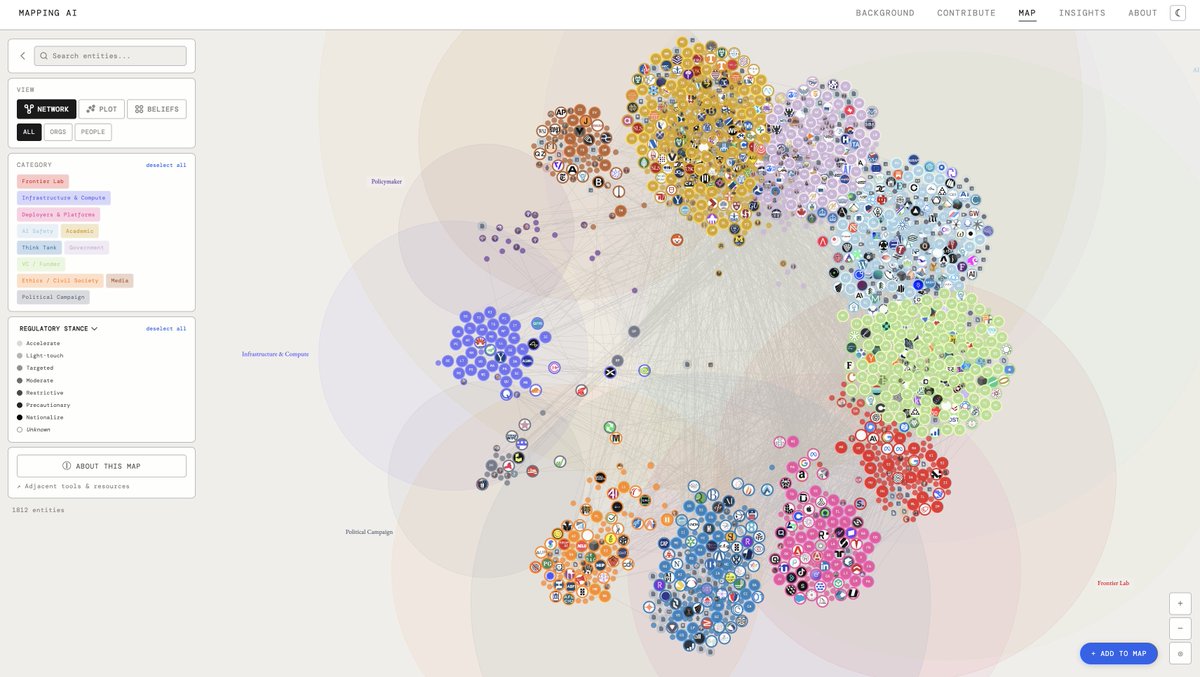
Who actually shapes AI policy in the U.S.?
We mapped 1,812 entities: 745 people, 918 organizations, 2,925 relationships. Frontier Labs, AI Safety orgs, Think Tanks, Government, VCs, and more.
https://t.co/6RDB1R0qNd
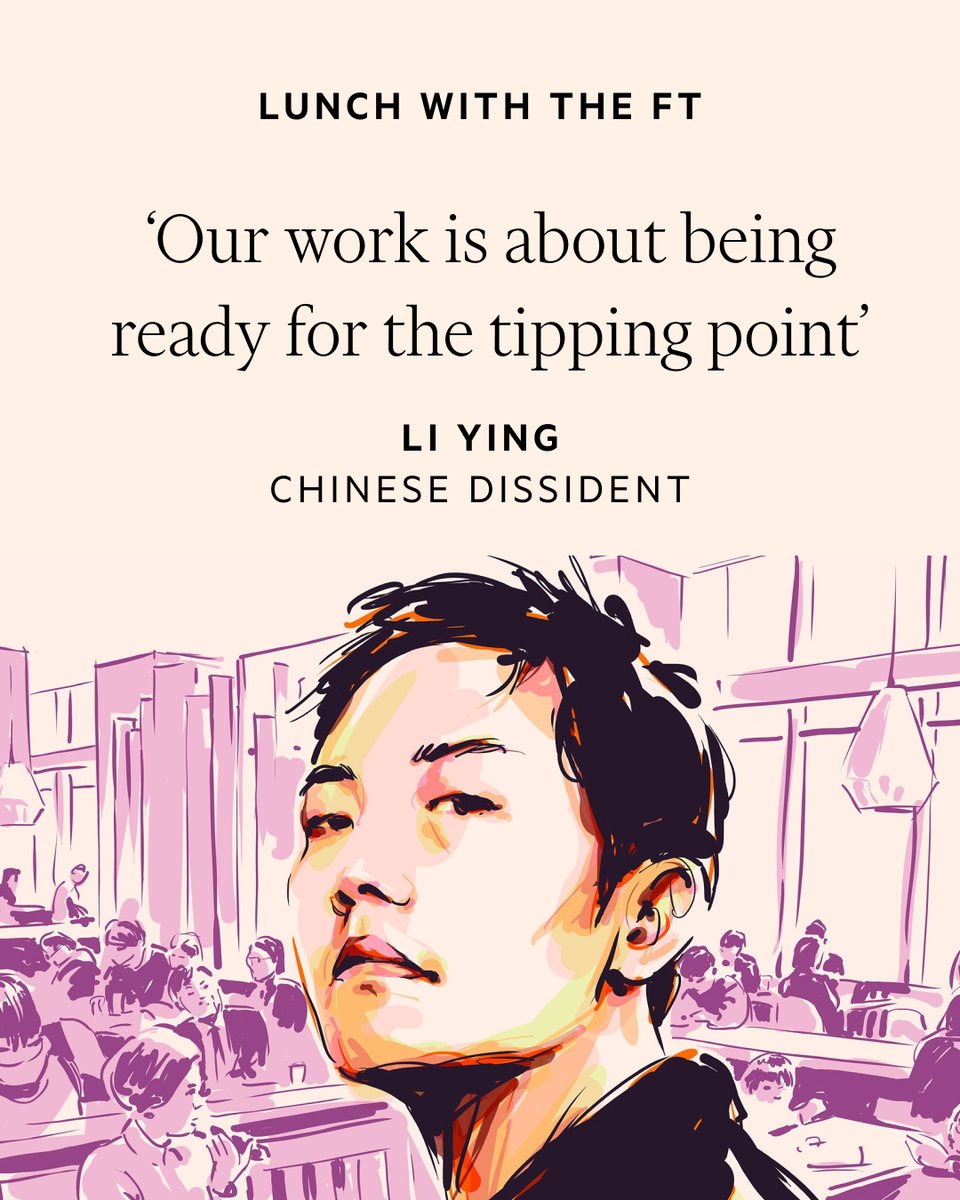
The activist known as Teacher Li on the dangerous work of cataloguing everyday life in China — and why he wants to change the CCP, not destroy it: https://t.co/BBLwWh8kgr
Demis Hassabis (@demishassabis) has had one of the most extraordinary careers in tech.
He started as a chess prodigy and video game designer at 17 before getting a PhD in neuroscience and going on to found DeepMind. His lab cracked Go, solved protein structure prediction with AlphaFold, and then gave it away free to every scientist on earth. That work won him the 2024 Nobel Prize in Chemistry. Today he leads @GoogleDeepMind, pushing toward the same goal he set as a teenager: AGI.
On this special live episode of How to Build the Future, he sat down with YC's @garrytan to talk about what still needs to happen to get us to AGI, his advice for founders on how to stay ahead of the curve, and what the next big scientific breakthroughs might be.
01:48 — What’s Missing Before We Get To AGI?
03:36 — Why Memory Is Still Unsolved
06:14 — How AlphaGo Shaped Gemini
08:06 — Why Smaller Models Are Getting So Powerful
10:46 — The 1000x Engineer
12:40 — Continual Learning and the Future of Agents
13:32 — Why AI Still Fails at Basic Reasoning
15:33 — Are Agents Overhyped or Just Getting Started?
18:31 — Can AI Become Truly Creative?
20:26 — Open Models, Gemma, and Local AI
22:26 — Why Gemini Was Built Multimodal
24:08 — What Happens When Inference Gets Cheap?
25:24 — From AlphaFold to the Virtual Cells
28:24 — AI as the Ultimate Tool for Science
30:43 — Advice for Founders
33:30 — The AlphaFold Breakthrough Pattern
35:20 — Can AI Make Real Scientific Discoveries?
37:59 — What to Build Before AGI Arrives