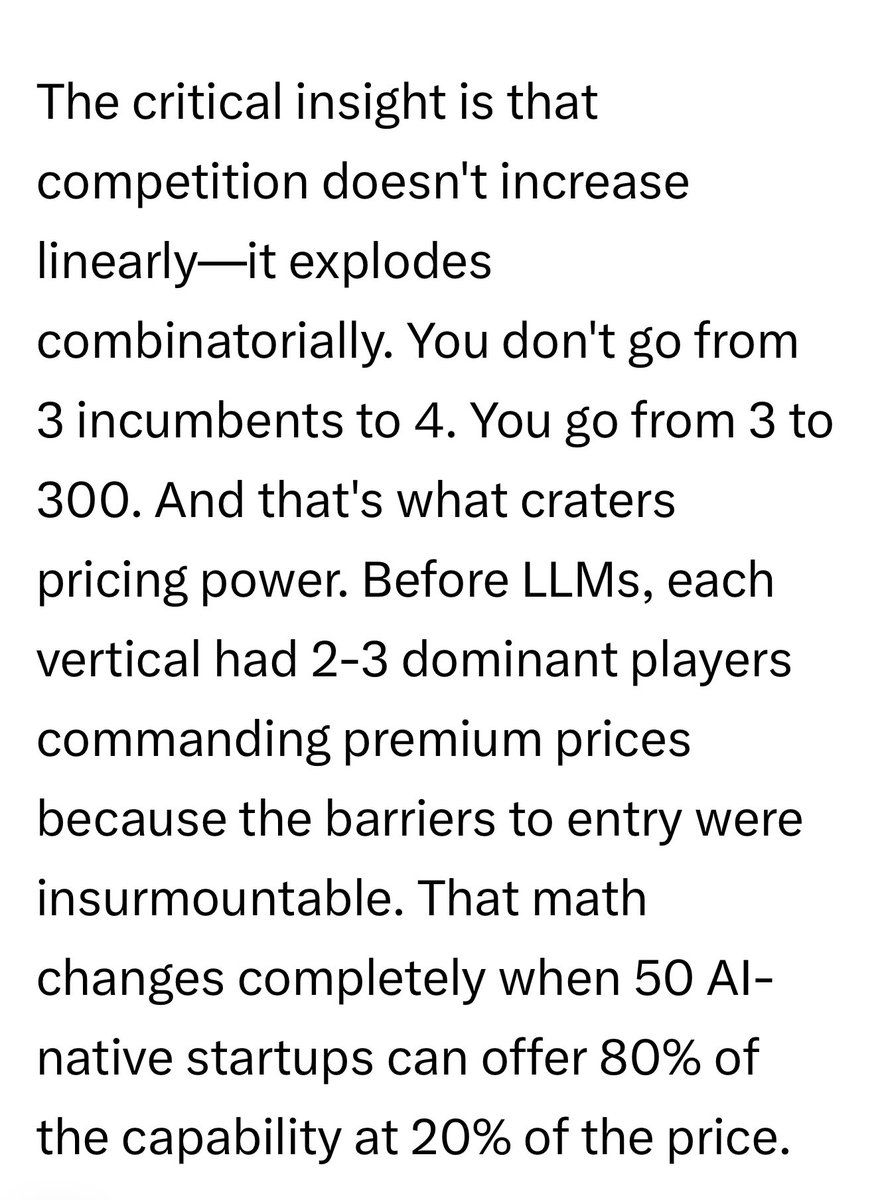
@wadefoster Awesome! I’m in the early days of building something similar for evaluating whether Cribl Investigator can find real environment failures. It’s amazing how fast we can iterate with well defined success function.
You state these like facts but they’re far from certain. From my perspective I don’t see a huge appetite for enterprises to spend more. I also don’t think the limiting factor in the number of companies in the market has ever been the production of the software. The question to answer is how these 10x more companies can solve the problems in a unique and better enough way long enough that the entrenched competitors won’t just copy, giving these new companies the time to achieve anywhere near the scale that would allow most enterprises to consider them a trusted option.
Let’s check back in 5 years and see what’s happened.
This just makes absolutely zero sense. There already isn’t a lack of supply in enterprise software. For any given category there are already dozens of choices. There are already funded and bootstrapped in every category. There are free and open sourced alternatives in nearly every category. So what is the limiting factor that drives spend to a handful of category leaders?
Trust. Trust is in very short supply. How do I solve this problem for my employer in a way that does not introduce new risk and get me fired? Buyers are not buying just a software package they are transferring risk from them to the vendor. Software is a people business. I’m going on record that a burgeoning supply of dozens of new competitors will do little to change the dynamics of where money flows in enterprise software.
.@nicbstme does a great job capturing the rapidly shifting sands in vertical SaaS!
This right here is the key… AI is arming the hordes - and they are coming for their cut of enterprise SaaS spend!
Both predictions can't be true: SaaS is dead, categories are going to shrink, and AI will enable tons of new competitors. There will be downward pressure on prices because enterprises are not going to allocate more money to software, but it is very unlikely that categories are suddenly going to flooded with new entrants and buying behaviors are going to suddenly change because of AI. Enterprises already do not opt for smaller competitors, and having dozens more smaller ones attempting to compete for a shrinking pie isn't a path to success for anyone.
I'll go on record that the opposite will actually happen. AI will enable software companies to be more efficient. Margins will improve. SBC is dead. It will no longer be a path for a mediocre exec to make millions. But, it will be even harder for startups to enter these categories. The door is shutting and incumbents will be cemented.
@guruchahal Enterprises aren’t looking for more choice. They already pay analyst firms to tell them what to buy so they don’t have to spend time surveying the market. It’s not that nothing will change but the surface level analysis of AI impact on enterprise software is wrong.
@guruchahal In most enterprise software companies less than 25% of the people are involved in actually building the software. This is a stupid take. Nobody’s going to replace their mission critical software with something built by bootstrapped hobbyists.
The amount of people who are prognosticating with supreme conviction about the future of the software business while seeming to have little to no experience building software businesses is approaching COVID level faux expertise.
We will look back at this time and recognize that DeepSeek was the tipping point on focus moving from training to real-time inference. Cost of intelligence is quickly marching towards zero.
If you’re a product person and you’ve never really done sales, I mean really done it, then a) you’re missing out and b) you’re living a theoretical life that isn’t grounded in reality. Life is a negotiation. And I don’t mean negotiating with engineering.
There are advantages to DSLs for articulating for example how to work with different types of data versus SQL. On the other hand, there are numerous implemented languages which are complete that allow you to avoid writing your own. For us, we chose Kusto from Microsoft. Saved a ton of effort.
Excited to see @getmetronome unveil their latest updates in Metronome 2.0. We were an early adopter at @cribl_io, and Metronome is core to our cloud usage billing. The new capabilities are critical to new pricing structures we'll be rolling out next year. Proud to be an investor. Congrats to the team!
✨Excited to announce Metronome 2.0! Over the past few years, we've learned a lot from powering billing for companies including @OpenAI, @AnthropicAI, and @databricks. We've productized those learnings into Metronome 2.0 to help companies launch new products and pricing faster.
@_cartermp@mipsytipsy There is no universal solution. No single engine can give everything. Thusly, it’s about how are the engines exposed to the user and do they need to learn a new experience for each engine or can that be abstracted. I believe you can unify experience at least.