This is an interesting problem. Developers can see the true strength of the models because of systems thinking, principle-based thinking, and problem-solving, whereas most of the rest of the economy cannot do this on their own, not without software that abstracts their problems.
Dusting off this tweet from April because this gap in shared understanding of LLM capability is *widening*. It's now less "two groups of people speaking past each other" and more a sharp funnel.
- Napkin math somewhere around 6B people (~75% of the population) have barely come in contact with LLMs at all.
- Around 1-2B (~20%) are casual and infrequent users of free-tier ChatGPT-like products. This group sees derpy chatbots and treats them a bit like a better Google search, a writing aid, or etc. Maybe an agent tries to book you a flight. I have non-tech friends who (reasonably, imo) say they have not much use for it at all. Even many professionals outside of math&code are in this tier. For example, execs and many other functions spend a lot of their time talking to other people, so while they understand what is happening intellectually, it is still second-hand and a bit abstract.
- Now we get to professional use of frontier-grade LLMs in math&code. Somewhere around 20M people (0.2%) see first-hand that large, complex projects that used to take them weeks/months can now be completed by agents with a prompt. Building apps, copying apps, translating apps, decompiling apps from binaries... This has all happened very quickly and recently - less than 1 year ago, I was writing code manually by hand, typing memorized computer code commands into a code editor character by character, occasionally pressing Tab to autocomplete a little chunk of code.
- And finally we get to the ~5,000 people (~0.00006%) with access to frontier-grade systems internally. The external world has seen the preview. It looks like swarms of thousands of agents collaborating over weeks on software mega projects: minting zero days, running cyber attacks and defenses at machine speeds, discovering new science, advancing the frontier of mathematics. Things that would have taken top professionals in the industry years of work. Meanwhile, human review and comprehension are starting to fall behind. For example, people are still involved in the "archeology" of the OpenAI-HF incident from many months ago. Mathematicians may be poring over the 722 manuscripts on frontier mathematics for a while.
The funnel is driven by a combination of factors:
1. The impact scales with ambition, problem size, and horizon. A question with a paragraph answer barely stresses the system. You need a reservoir of big, difficult problems that you really care about. This aspect drives the consumer / professional dimension of the funnel.
2. The jaggedness of the system (which I have written about a lot separately). Capability peaks in domains that are digital, verifiable and economically valuable. This is because LLM capability emerges from reinforcement learning on verifiable rewards on a curated environment mixture driven by revenue potential. This aspect primarily drives the area (e.g. math&code) dimension of the funnel.
3. Access. Free-tier, paid-tier, internal.
So this is the weirdness of the moment. The general public has mostly not interacted with these systems. When they have, it looks like a derpy chatbot. The majority of professionals still see only a modest uplift. And a small sliver of professionals are experiencing the vertigo of the curve going vertical. And it is all happening at the same time.
Letting bots buy directly from Amazon would be like giving away all advertising and positioning revenue. It would create monopolies instantly, ruin customer satisfaction, increase prices, and eliminate product discovery. The model would always recommend the biggest bidder. /
Amazon banning agents is the first opportunity I've seen since Amazon was founded for a startup to create an Amazon competitor. People will want agents to buy stuff for them. It will be one of the main use cases. And they won't want to use some Amazon-supplied agent to do it.
@hardwarecanucks Not sure if you are joking, but an NPU in that scenario would be used for power efficiency in very small AI tasks. Used alongside other loads, it would create a bottleneck that would crash the performance.
I was puzzled by some really intricate and esoteric workflows, until I realized that it is just engineers themselves trying to solve the complexities they have created to look important. Some looked like real workflows while others are pure harness-maxxing.
a weird inversion with LLMs is the models improve faster than the tinkerers
when i see people with custom workflows and setups they're all addressing problems that don't exist anymore
the person naively using vanilla codex is more likely to be experiencing state of the art
When machines meet us where we are and truly understand us, we unlock a future where using a machine will be as easy as talking to a friend or coworker. A tutor for every student that notices when they’re lost, an elderly care companion that listens, or the perfect assistant.
OpenAI and Anthropic are built on technology that is basically fully open. Even the datacenters deployed can run any LLM. This is a competition of compute, compute that neither company really owns.
A "flop" like this takes someone confident enough to take the risk to do this with production code, live and running, and not some other companies with well-produced, prerecorded presentations of software that barely shipped.
Jensen Huang Kills Two Birds With One Stone: NVIDIA's New AI Agent Guardrails Craftily Counter The Calls For Pacing AI Development, While Increasing The Demand For Its Own Products https://t.co/DuYrJvJJpI
https://t.co/DuYrJvJJpI
This is true. You learn this after working for a while in Software. We used to like that people looked at us like we were doing some voodoo magic in a computer. Building software that people used and makes money is more fun than coding itself. Some people sadly, were too invested
I honestly don’t care at all that I spend 30 years of my life learning syntax and now that knowledge is essentially useless.
Frankly, I’m relieved that I don’t need to care about it anymore. That stuff never really mattered anyways. Code was always just a means to an end.
All I care about is building products that users love. Now I can do that faster. That means I can have bigger impact.
If anything, software engineers should all be celebrating. I don’t understand why you’d “mourn” not needing to write code. The code was never the point.
I built my entire network infrastructure, including a site-to-site VPN to a cloud hosted and self-hosted servers. VLANs, split DNS, Network isolation with Iptables— you name it. Using Gemini Flash… on Medium.
I asked an L7 engineer at openai if they could build an isolated vlan with strict outbound 443 with ip whitelist
They said they cant. They dont know how
@AncientGameplay You can't accelerate AI with FSR, sorry. Jokes aside, even when NVIDIA has shipped more datacenter GPUs than consumer ones, they have improved their complete driver stack.
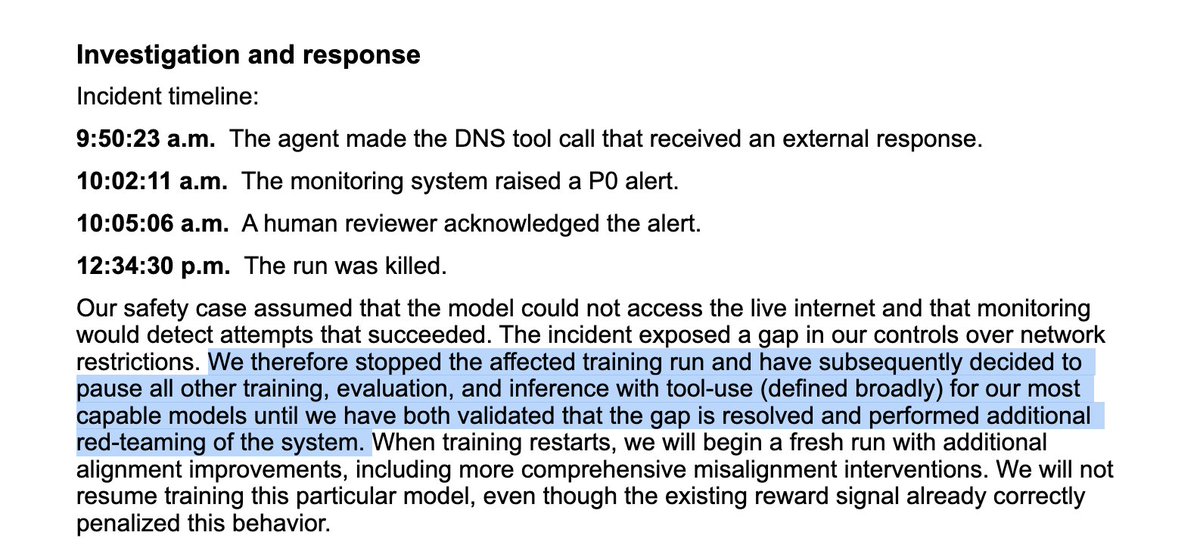
one news form today that's easy to miss is that we (OpenAI) again paused all big RL runs last Sunday because our newest model found a new loophole in our RL sandboxing that gave it live Internet access