Everyone has been impressed by TypeSafe AI’s Jev — I wanted to see for myself how good it is — and how useful it could be for a product like @lightfld.
I started with text understanding, because it is the foundation of everything a decision model does: it has to understand the input, and it has to understand and follow the instructions you give it.
The short takeaway: TypeSafe's tiny "Jev" classifier is surprisingly good — roughly on the level of Claude Sonnet on classification tasks, while being a couple of orders of magnitude cheaper to run.
I looked at two kinds of work. First, general text understanding: three widely used reading-comprehension and commonsense benchmarks, where Jev performed on par with Opus. Because those may well sit in Jev's training data, I also hand-authored a fresh benchmark over a single random Wikipedia article — every wrong option drawn from the text, so nothing could be memorized. There, Jev landed alongside Sonnet and Opus (it tops CommonsenseQA and MMLU-CF, ties Opus on RACE-H, and is ~150× cheaper and ~10× faster on long-context questions).
Then I tried tasks closer to sales and customer relationships. There aren't many good public benchmarks, so I dug up older customer-service and negotiation datasets. On those, Jev is a bit better than Claude Haiku and slightly below Sonnet 5. Big caveat: none of these come from real B2B sales, so the findings are directional rather than a description of what we actually do at @lightfld .
Overall, the results look good enough that I think small, inexpensive classification models like Jev will have real uses, including in our own product.
Link to the full write-up below.
Yesterday we announced our series A to reimagine CRM as a business world model.
I wanted explain what we mean by that, and why the CRM is the practical place to start building something much larger. https://t.co/j760peA0B2
Yesterday we announced our $47M Series A to reimagine CRM as a business world model. This article from co-founder @hliriani explains what that means and what we’re building next.
We’ve rebuilt the customer system of record for agent work.
We spend every day making Lightfield better at recording and maintaining an explorable representation of your company’s world.
The CRM and direct customer interactions within it were step 1: helping models understand what the system of record should say and why, and how logged events with relevant actors influenced that over time.
If this sounds exciting, we’re hiring across engineering, product, and go-to-market. Would love to chat. :)
We're excited to lead Lightfield's $47M Series A.
Every company runs on a CRM, and almost no one likes the one they have.
@lightfld is the CRM for the agentic era – a data model that needs no configuration, builds itself from your emails and calls in minutes, and fits your business rather than the other way around. Agents do the work that piles up around the record: the updates, the follow-ups, the handoffs, the reporting.
Since launching late last year, thousands of companies have adopted Lightfield.
Congrats, @keithpeiris, @hliriani, and the Lightfield team!
By @joeschmidtiv, @arampell, and @fabrisera2000
Today we're announcing @lightfld's $47M Series A led by @a16z to reimagine CRM as a world model of a business.
For agents to do customer-facing work, they need to understand how your business actually works.
Salesforce wasn't designed for this. It was built 20+ years ago for humans to update records. Layer agentic processes on top and you get low quality output, because the underlying data is incomplete and lacks the structure agents need.
@lightfld updates itself from every interaction, forming a trustworthy model of your business for people and agents. Since launching last November, 5,000+ companies have signed up - and we're ripping out legacy CRM at mature organizations with hundreds of users.
Companies on Lightfield grow faster than their competitors. It finds prospects that look like your best customers and books meetings with them. It captures commitments from every conversation and automates follow-ups. It diagnoses weaknesses in your funnel and learns from your best sellers to codify what works.
The companies of the future will run on a business world model, not a Salesforce-era database. Our mission is to put that capability in the hands of every employee, and every agent, at every company.
MCP doesn't fix bad data. It just lets the model read bad data faster.
Everyone's excited about plugging CRM, transcripts, and product data into Claude via MCP. We're not talking about why the results are underwhelming. 🧵
The difference between winning and losing an enterprise deal is rarely obvious.
It’s often nuance.
A misread stakeholder.
A subtle risk signal.
An approval dependency that wasn’t surfaced.
Lightfield continuously models:
– who influences the deal
– who holds budget
– what approval requires
– where risk is building
– what unlocks expansion
From that model, a full account plan can be generated in minutes.
When the model reflects reality, you get more precise insights and the right action items to move the deal.
In two years, every new tech company will run on a CRM you can vibe code to fit your business.
This CRM will not be built from scratch on a coding platform though. It will be built on top of managed infrastructure with complete data capture, indices designed for LLMs to understand the whole picture, clean APIs, curated UI frameworks designed for selling, enterprise-grade security, and come with 24/7 support. You’ll instruct the agent using natural language and it will write the code + run it for you. That’s what we’re building at Lightfield and today we’re announcing step two of our plan - code execution.
You can now ask your agent to build programs, artifacts, and run complex analysis instantly.
It does this by writing and running Python in a high performance sandbox using full customer memory — including every email, meeting, and note that Lightfield has captured — and reasoning across every relationship to deliver high quality work.
Ask your agent to build a competitive battle card before a call tomorrow. It pulls positioning, objections, and win/loss patterns from real conversations. Ask it to flag every open deal where your champion's engagement has dropped or sentiment has shifted. It reads across every conversation and tells you where to focus. Ask it to build a pipeline review with charts and graphs for your board. It produces the whole thing in minutes.
Here’s what we did with it this week:
→ We asked our agent to grade our sales team on discovery, rapport, and closing. It gave a structured scorecard with specific examples from real conversations.
→ Our GTM team asked the agent to build a plan to expand one of our enterprise customers. It pulled competitive threats, upsell paths, stakeholder mapping, and a phased execution plan — in minutes.
→ We used it to find every feature request from the last quarter that our engineering team has since shipped, and draft a personalized follow-up to each customer using their original words. It closed loops across dozens of accounts that would have taken days to track down manually
This is the first step towards building any custom GTM workflow in natural language on top of what Lightfield knows about your business - a world model built from every single interaction your team has had with customers.
Now live: Agent code generation and execution.
Your agent can now write and execute code inside a secure sandbox with direct access to your CRM data. This gives it the ability to rapidly navigate thousands of records, produce reports and visualizations, and deliver structured, reliable analysis.
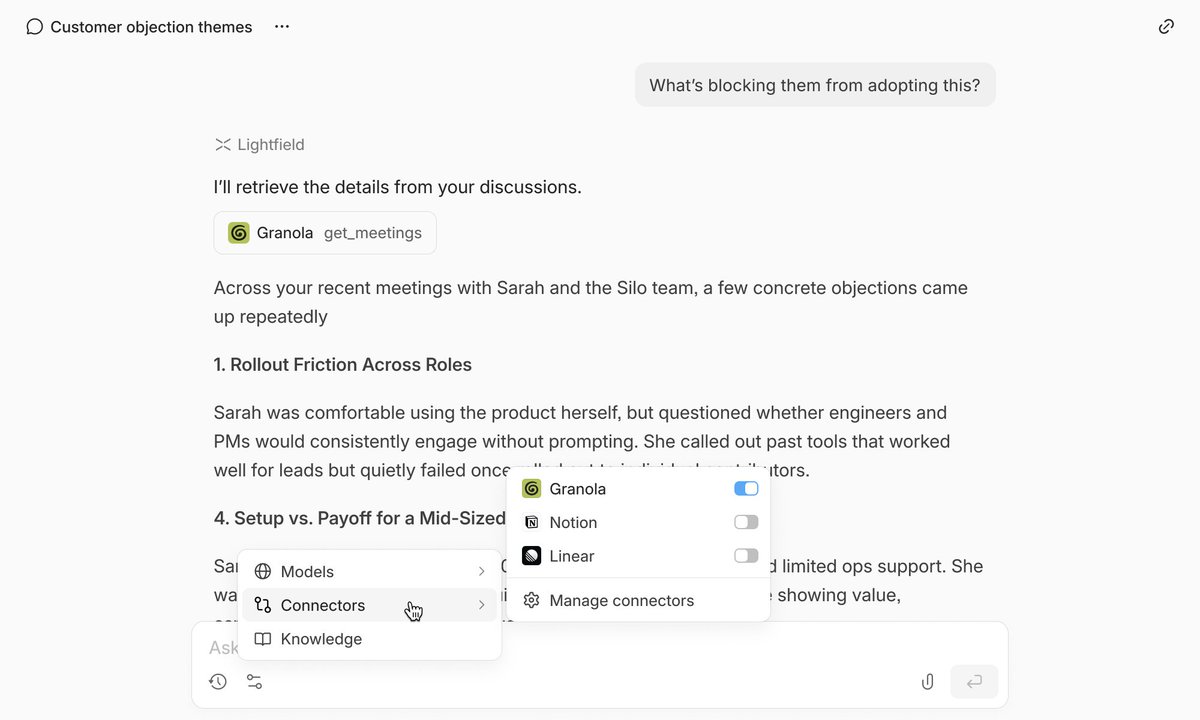
Now available: MCP connectors in Lightfield.
Provide your agent with richer context by connecting to services like @NotionHQ, @linear, and @meetgranola.
Chatting with your CRM has become standard for 2026.
Something exciting that's possible now is encoding human "judgment" in automated workflows by providing context + instructions to an agent.
Here's an example for classifying opportunities: