🚨 #BREAKING: Michael Dell said $DELL currently holds a 31.2% share of the enterprise storage market.
➜ According to the figures he shared, the closest competitor is $NTAP with a 9.9% market share.
➜ $P follows with an 8.9% share.
VoidZero, the team behind Vite, Vitest, Rolldown, Oxc, and Vite+, is joining Cloudflare. Vite stays open source, vendor-agnostic, and built for everyone. https://t.co/DJTpX4Q9Xt
Codex can now deploy and host websites for you using Sites! 🎉
This includes storage for data and files using D1 and R2 💥
We started rolling out to Business and Enterprise customers before rolling out more broadly.
More details 👇
PSA: @TencentGlobal is aggressively scraping the Internet to build yet another AI slop chatbot, DDoSing many websites in the process.
We've found that, as of last week, their scraping bots can now solve Cloudflare challenges and behave like real users while ignoring robots.txt. In the last 24 hours alone, our website received more than 3 million successful requests from Tencent bot IP addresses, plus another 1 million that were blocked by Cloudflare challenges.
These recurring DDoS attacks from Tencent have been going on for over a year, and we have been constantly adjusting our firewall rules to filter them while trying not to impact Tencent's real users. Because that is no longer possible, we're now fully blocking Tencent IP addresses, starting with ASN 132203. We recommend other sysadmins do the same.
Other ASNs displaying similar abusive behaviour will also be fully blocked from our services.
We'd also like to thank @Cloudflare for sponsoring us with Project Alexandria as of 2025, giving our sysadmin the tools to keep RPCS3's online services running without service disruptions.
Welp, that happened faster than I predicted. Thought it would be end of 2027, then early 2027, but agentic traffic growing so fast that bots have now passed human traffic online for the first time in the Internet's history. https://t.co/2zX5bHdhsa
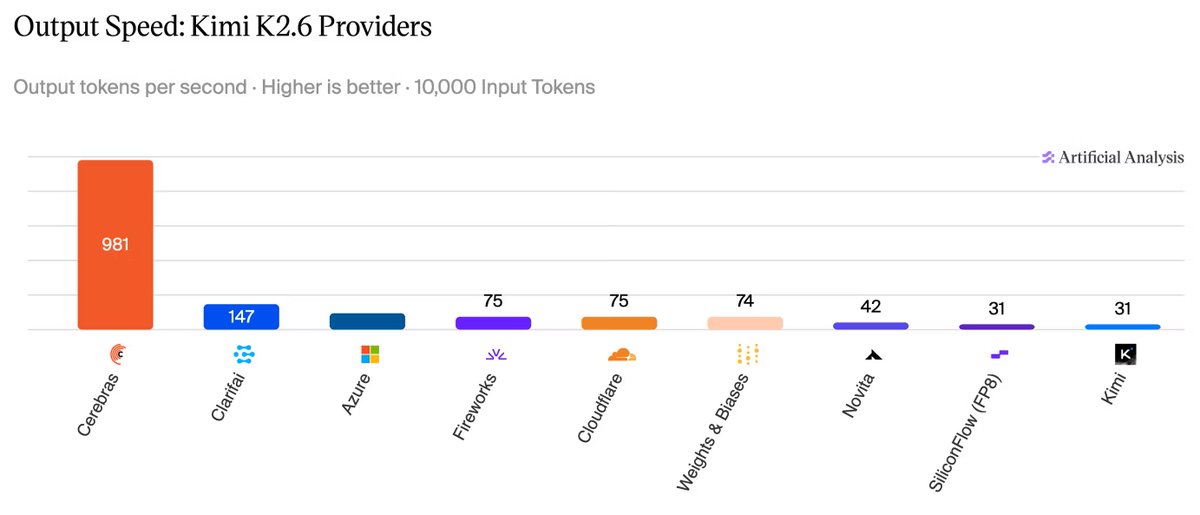
Cerebras is now running Kimi K2.6 – a trillion parameter model – in enterprise trials.
At ~1,000 tokens/s, this is the fastest frontier model performance ever measured by Artificial Analysis @ArtificialAnlys.
Every day for the next long while, I'm going to tear down a new public software company and highlight the AI risks/opportunities around it- products launched to date, top startups, key quotes from earnings calls, etc.
Day twenty-five: Cloudflare $NET
Peak share price: $253.3 (Oct 31, 2025)
Share price today: $200.99 (-21%)
EV today: $70.2bn
ARR today: $2.46bn (+34% Y/y
NRR: 120%
EV/ARR: 28.5x
GAAP Operating Margin: 6.2%
EV/Run-rate GAAP EBIT: 453x
Headcount: 5,200 (+21% Y/y)
What Cloudflare does:
Cloudflare operates an edge network that it uses to provide an array of value-added connectivity, CDN, and security services to customers worldwide.
Its core business, application services, is built on upsells on top of its free CDN offering, which undercut the low-end of the paid CDN market and became an onramp to cross-selling higher value security services( WAF, DDoS mitigation, bot management, etc.
It then built and executed on an impressive second act, moving into enterprise access with a SASE business model that replaces corporate VPNs and firewalls with cloud native security.
Finally, Cloudflare uses the same infrastructure to run a developer platform, offering serverless compute (Wokers), object storage (R2), and more at the edge as a sort of distributed, developer-native alternative to traditional hyperscalers.
The company hasn't disclosed much on the relative sizes of these businesses, but its strength in enterprise customers and expanding net retention rate suggest that it is seeing significant success in the latter two businesses.
AI bear case:
This is less of an AI-specific bear case (those are hard to build), but Cloudflare's second-act businesses both face heavy competition from existing cybersecurity (Zscaler/Palo Alto) and hyperscaler (AWS, GCP, Azure) incumbents with substantially larger capex and go-to-market budgets.
On the AI side, perhaps most worrisome is the idea that provisioning of AI infrastructure might become the purview of the model vendors (OpenAI/Anthropic) who leverage their capabilities and the ubiquity of their APIs to ensure that inference compute happens on their backends, not Cloudflare's edge servers.
AI bull case:
The AI bull case for Cloudflare is pretty crisp (and arguably reflected in the multiple and metrics). Cloudflare occupies an increasingly strategic position between users and web content, and as agents proliferate, the types of security that Cloudflare specializes in (especially advanced bot detection) become increasingly critical.
Beyond that, there ARE AI workloads that likely belong at the edge, and in general enterprise security challenges will compound as agents come to the fore.
Finally, Cloudflare has done a surprisingly good job of maintaining its developer-first ethos (I use R2 for some of my projects!), giving it valuable exposure to the broader vibe-coding trend.
In short, Cloudflare has a history of executing well and beachfront real-estate from which to add value in an AI native world.
AI traction:
Cloudflare has seen a material acceleration in growth of late, with revenue growth increasing from 27% in Q1 to 34% Y/y in Q4, driven by increased net expansion, particularly with large customers.
The company doesn't disclose any AI-specific revenue (and indeed, is stingy on revenue breakouts for any segments), but it seems safe to assume that AI is showing up as a tailwind in the business one way or another. One of the most plausible candidates is heavy use of Cloudflare's Workers product by vibecoding customers (both developers and applications).
Strikingly, the company called out that the number of weekly agent-made requests on its platform doubled in the month of January alone (!!), highlighting the intensity of the usage tailwind.
Adjacent AI-native startup summary:
Though not fully AI native, @vercel is the most relevant competitor to the core CDN business (912 employees, +28% Y/y), and clearly executing well.
On the enterprise security side- ZScaler, Netskope and Palo Alto are the companies to watch, although all relatively mature. @Tailscale (315 employees, +68% Y/y) competes with Cloudflare's WARP and Tunnel products at the low end.
On the dev-tooling side, the competition is fierce, with @vercel showing up again along with a host of other inference platforms running from the low end to enterprise. It's hard to specify competitors given the breadth of Cloudflare's offering and the particular wedge it brings (a massive, highly optimized edge network).
Management Quotes:
"We blew away our previous record for new ACV in the quarter, with strong year-over-year and quarter-over-quarter acceleration. In Q4, new ACV book grew nearly 50% year-over-year, making it not only a record quarter in absolute ACV dollars but also the fastest growth rate we've delivered since 2021."
"A leading AI company expanded their relationship with Cloudflare, signing a 2-year $85 million pool of funds contract for our full platform, selecting Cloudflare as their single long-term infrastructure provider with 100% traffic allocation."
"A U.S. media company signed a 3-year $3.1 million contract for AI Crawl Control, along with application services and Workers. This customer was facing a massive increase in AI scraping, which was crushing their network and driving up infrastructure costs. They chose Cloudflare to gain visibility into which AI models are consuming their data, allowing them to protect and eventually monetize their unique content."
"That means we win when AI applications are built on Cloudflare Workers, but we also win just from the increased usage of all of our products and agentic Internet drives."
"It's not a coincidence that most so-called vibe coding platforms are either built on Cloudflare Workers or have us as their preferred deployment target. We exited 2025 with more than 4.5 million human developers active on our platform. It's a lot more if we count their agents."
Commentary:
No comment on Cloudflare would be complete without reference to the company's sky-high valuation multiple. At 28.5x sales only Palantir is higher, and the next highest in SaaS in CrowdStrike at 19.7x with another cliff down to Palo Alto at 12.7x. This is a very, very expensive stock and while the metrics are truly impressive (and more importantly, trending the right direction) it's strike that they aren't yet standout on an absolute basis (other companies have similar/higher growth rates and similar net retention, yet trade at a massive discount). The market clearly believes that Cloudflare is a secular AI winner- and yes, it does have good reason to believe so.
The biggest challenge to writing about Cloudflare's AI tailwinds more specifically is the inscrutability of the business given the range of business lines and market segments served. The company's investor day on June 9th will hopefully provide some helpful context.
What seems true is that AI is a meaningful tailwind for Cloudflare's business, although there is no one hero SKU to point to and analyze. Still, taking the sky high, top-in-all-of-SaaS multiple aside, it is hard to argue against a well-oiled machine with a stellar management team that occupies beachfront AI real estate. It will be interesting to see if/how the story evolves into something more legible (and quantifiable) for investors over time.
The CPU is the bottleneck in agentic AI, not the GPU.
Up to 90.6% of an AI agent's runtime, the GPU is idle. Georgia Tech and $INTC hooked five production-style agents to real hardware and stopwatched every step. Where the latency actually goes.
> RAG retrieval. CPU document search consumes 83 to 89% of total latency.
> SWE-Agent coding. CPU bash and Python execution accounts for 38 to 65%.
> Web-augmented agents. CPU summarization runs 40 to 55% of total time.
> ChemCrow chemistry. CPU conformer generation hits 85 to 88% on heavy molecules.
Then they swapped in the H200, Nvidia's most expensive GPU. The CPU share got worse, not better. On SWE-Agent it climbed from 38% to 65%. Finishing the GPU part faster only makes the CPU wait look bigger.
Every Nvidia upgrade widens the gap.
This is why Intel's CFO told analysts unmet CPU demand "starts with a B." Billions of dollars in orders they cannot ship.
$AMD $INTC $ARM $QCOM $TSM
Microsoft sold every spare CPU it had to Anthropic and OpenAI. Amazon tripled its CPU buys year over year and still can't keep up. Two of AWS's biggest customers asked Andy Jassy if they could buy the entire 2026 production run of Graviton chips. He said no.
The ratio inside an AI datacenter used to be 100 megawatts of GPUs to 1 megawatt of CPUs. CPUs handled storage, checkpointing, pre-processing. Light work. GPUs did the actual training and inference.
Then OpenAI shipped o1-preview in September 2024. RL post-training went from "check the model output with a regex" to "run classifiers" to "compile the code and run the unit tests" to "spin up a sandbox, call three databases, run a physics simulation, verify the answer."
Every rollout now needs a CPU-backed environment to verify against.
Codex 5.4 runs agentically for 6-7 hours at a time. Each database call, each cron job, each scraped URL is CPU work. Coding agent revenue went from a couple billion to north of $10B in six months. That compute is sitting on CPUs.
The CPU to GPU ratio is now approaching 1:1. The entire global cloud was built for 1:8.
That's why GitHub has been unstable for weeks. Nvidia and Arm both announced they're entering the server CPU market in March. TSMC will only meet 80% of server CPU wafer demand this year. High-end server CPU prices are already up 50%.
When the GPU king and the IP licensor both pivot to CPUs in the same month, the boring chip isn't boring anymore.
Cloudflare dashboard can now complete tasks for you.
- "Create a Worker and bind a new R2 bucket to it"
- "Change my DNS records to 1.1.1.1"
- "How many errors have happened this week"
Not only do we tell you, but we show you with generative UI.
PROTIP: Use full-screen mode.