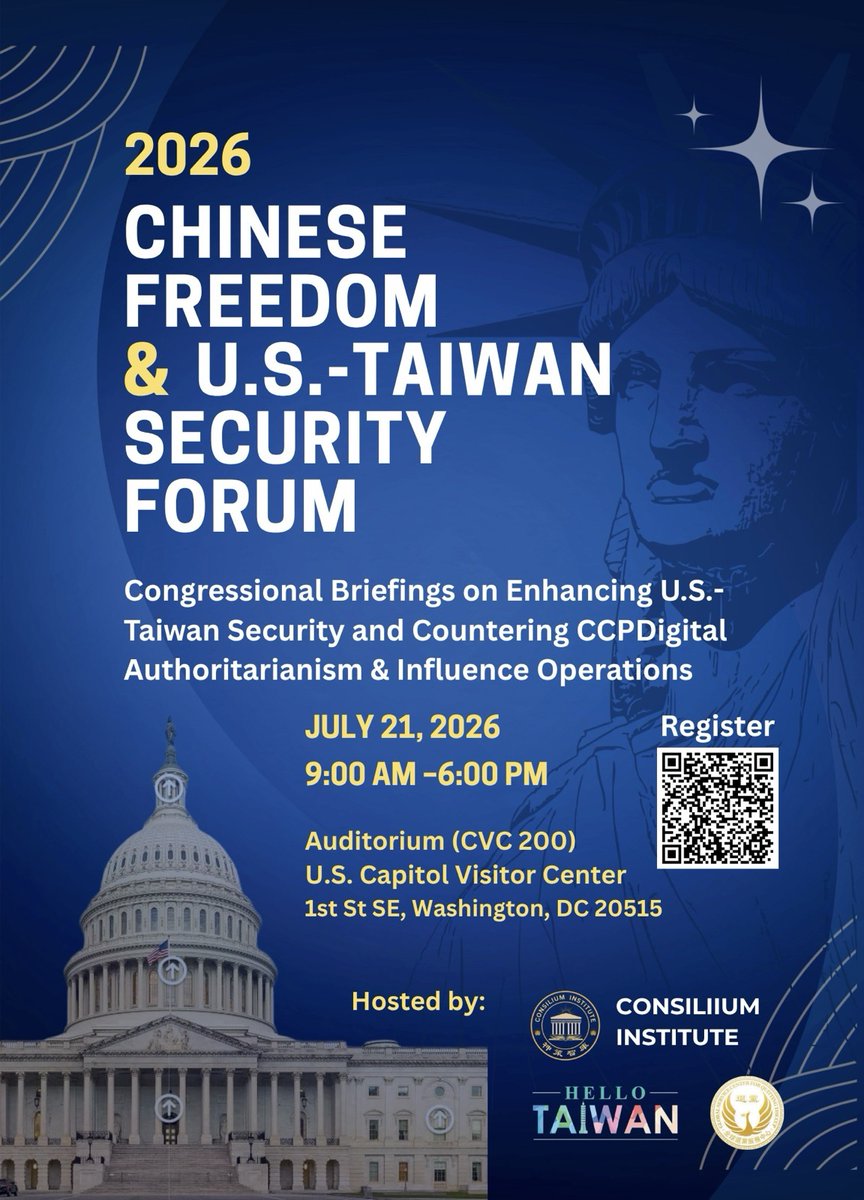
🇺🇸 Washington, D.C.
What can America learn from Taiwan's frontline experience?
Join leading experts from Taiwan and the U.S. to discuss cybersecurity, democratic resilience, and national security.
📍Scan the QR code to register.
July 21 | U.S. Capitol Visitor Center
Our final panel: winning the strategic competition in critical technology and energy. AFPI's Adam Savit, economist Wu Chia-Lung (吳嘉隆), Prof. Chin-Mo Cheng (鄭欽模)of Tamkang University, and Prof. Chu-Cheng Ming(明居正)return to the stage. Moderated by Consilium's Prof. Frank Xie(谢田).
Session V looks across the Strait: deterrence, CCP internal fragility, and the Indo-Pacific in 2026. NTU Professor Emeritus Chu-Cheng Ming, retired ROC Army Maj. Gen. Tsung-Chi Yu, author and political analyst @GordonGChang, and former Asst. Secretary of State David Stilwell (remote). Moderated by Hello Taiwan's Ming Chiang.
Session IV examined the CCP’s forced organ harvesting and transnational repression, with insights from human rights lawyer David Matas, @A1Policy Piero Tozzi, Dr. Alejandro Centurion (@MDsAgainstFOH ), and Erping Zhang of the Falun Dafa Information Center, moderated by @JanJekielek (@EpochTimes ).
The panel warned that forced organ harvesting is not only a human rights atrocity, but a profound medical ethics crisis requiring greater international accountability, transparency, and action.
“The Chinese Communist Party does not equal China, and it does not represent the Chinese people.” — Dr. Zhiyuan Wang, President of the Global Service Center for Quitting CCP.
A historic moment at the U.S. Capitol: more than a dozen Chinese immigrants publicly renounced their CCP membership and received Certificates of Quitting CCP alongside a Congressional proclamation.
A powerful expression of conscience, freedom, and the right to choose one’s own future.
#CCP #HumanRights #Freedom
Nicholas Eftimiades @neftimiades author of the 1994 book on Chinese intelligence and a Penn State professor with 34 years of experience at the CIA, State Department, and DIA — has documented 900+ Chinese espionage cases. His message: the CCP’s whole-of-society espionage model requires a new strategy. “Stop reinforcing failure.” The U.S. must impose costs that threaten what the CCP values most — its grip on power — through a durable, long-term approach.
“Taiwan shows what China should be.”
Dr. Bradley A. Thayer, founding member of the Committee on the Present Danger: China and co-author of Understanding the China Threat, argued that Taiwan’s transition from authoritarianism to a vibrant democracy proves that democracy is fully compatible with Chinese civilization. Taiwan’s success challenges the CCP’s narrative and underscores why democratic resilience against cognitive warfare is a first-order national security priority.
#Taiwan #IndoPacific #DemocraticResilience #CognitiveWarfare #NationalSecurity
Session II is underway. Taiwan is the CCP's testing ground for influence operations before they go global. Dr. Yu-Hsi Liu (Lucy 劉玉皙), Associate Professor at Shih-Hsin University, brings the Taiwanese research perspective on how those campaigns work — and what inoculates a society against them.
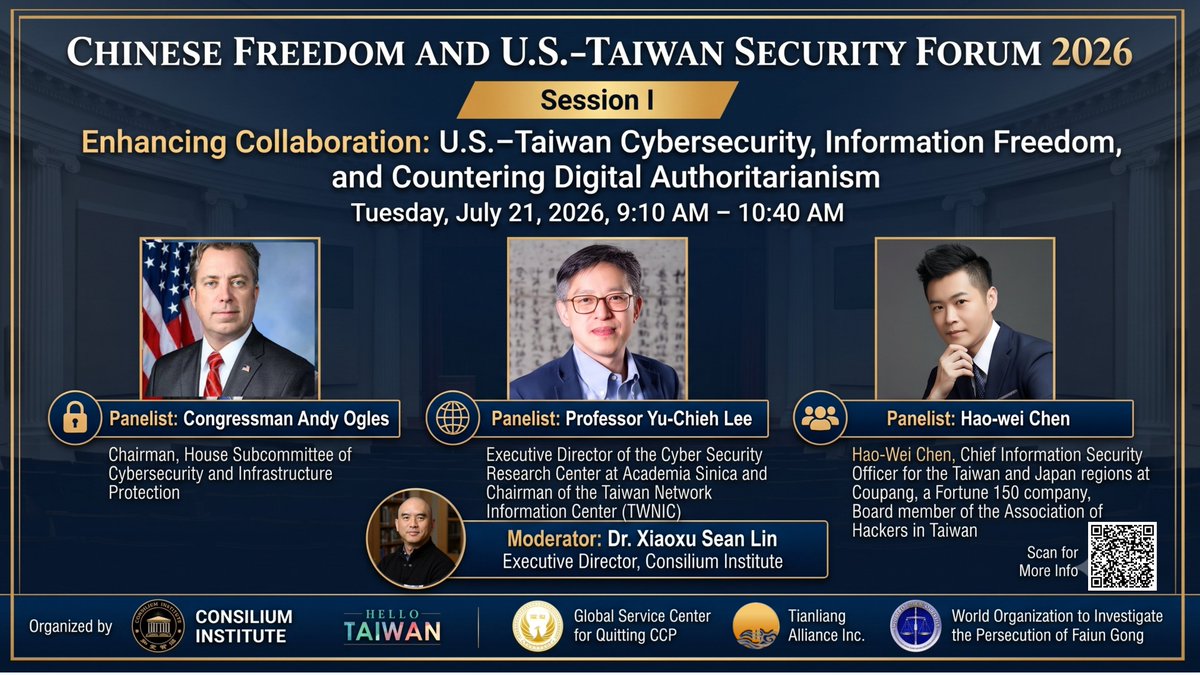
“In cyber, minutes matter.” Rep. Andy Ogles @OglesRep a parallel between pandemic response and cybersecurity: delayed communication can allow threats to spread, while rapid coordination is critical to containing attacks and strengthening resilience against state-sponsored adversaries. #CyberSecurity #CyberResilience
Taiwan absorbs a staggering volume of intrusion attempts daily — and has built one of the world's most battle-tested cyber defense communities as a result. Prof. Yu-Chieh Lee (李育杰), Executive Director of the Cyber Security Research Center at Academia Sinica and Chairman of TWNIC, on what the U.S. can learn from the front line.
#CyberSecurity #Taiwan #US #CriticalInfrastructure #AI #CyberResilience
Session I: building cyber resilience across the Pacific. Rep. Andy Ogles joins two of Taiwan's leading security practitioners — Prof. Yu-Chieh Lee of Academia Sinica and Coupang CISO Hao-Wei Chen — on critical infrastructure defense, AI-driven security, and a whole-of-society cyber model. Dr. Sean Lin moderates.
#CyberSecurity #Taiwan #US #CriticalInfrastructure #AI #CyberResilience
These issues will be discussed by Members of Congress, cybersecurity experts, Taiwan security specialists, human rights advocates, and policy leaders at the Chinese Freedom & U.S.–Taiwan Security Forum 2026 on July 21 at the U.S. Capitol Visitor Center. The event focuses on cybersecurity, digital authoritarianism, CCP influence operations, transnational repression, and democratic resilience.
Register here:
https://t.co/fMiFyHizcB
Chinese Freedom & U.S.–Taiwan Security Forum 2026
#CyberSecurity #Taiwan #NationalSecurity #ElectionIntegrity #Democracy #China #CapitolHill
@RepOgles@RepScottPerry@DHSgov@CISAgov@FBI@ODNIgov
These documents reinforce an important lesson:
Election security today is no longer just about voting machines.
It now includes:
✅ Cybersecurity
✅ Voter databases
✅ AI-generated content
✅ Social media platforms
✅ Foreign influence operations
✅ Critical infrastructure
✅ Information warfare
Democratic resilience requires defending the entire information ecosystem.
#ElectionIntegrity #CyberSecurity #AI
Perhaps the biggest revelation isn't any single operation.
It's the disagreement inside the Intelligence Community.
Some agencies concluded Beijing primarily sought to influence the policy environment rather than the election outcome.
Others argued the evidentiary bar had been set too high and that China's activities met the threshold for election interference.
That disagreement ultimately resulted in the publication of a rare alternative analysis memo.
#IntelligenceCommunity #NationalSecurity
🚨 NEWLY DECLASSIFIED by Trump Administration Last night: What did U.S. intelligence learn about Chinese election influence operations during the 2020 election?
Newly released intelligence documents reveal years of cyber operations, voter data collection, influence campaigns, and a remarkable internal debate inside the U.S. Intelligence Community over how to assess Beijing's activities.
A thread. 🧵👇
#ElectionSecurity #CyberSecurity #China #NationalSecurity #CCP
One of the most controversial documents alleged that Chinese authorities intended to use TikTok-derived data to facilitate counterfeit U.S. driver's licenses for election-related purposes.
Important context:
✔️ The report relied on a single, untested sub-source.
✔️ It was not corroborated.
✔️ The FBI later formally recalled the report.
✔️ CBP stated that most counterfeit licenses it seized were linked to underage alcohol purchases rather than election fraud.
Distinguishing raw intelligence from confirmed findings is essential.
#Intelligence #ElectionSecurity
Cybersecurity
@CISAgov@MITREcorp@SANSInstitute@CSIS@Mandiant@RecordedFuture
The documents also describe broader influence operations that extended far beyond hacking.
According to the intelligence assessments, Beijing sought to:
• Shape public opinion
• Amplify existing social divisions
• Influence online narratives
• Apply economic pressure
• Collect derogatory "black materials" on U.S. officials
Modern election interference isn't just cyber—it's an integrated influence campaign.
#InfluenceOperations #Democracy #NationalSecurity
@CSIS@HudsonInstitute@FDD@AtlanticCouncil
The reports identify APT31, a Chinese state-sponsored cyber group, as conducting reconnaissance against U.S. presidential campaign personnel.
One notable tactic:
📧 Hidden tracking links embedded inside emails could confirm that an account was active simply by opening the email, allowing attackers to gather system information before attempting additional compromise.
Google and the FBI reportedly detected these attempts before they succeeded.
#APT31 #CyberDefense #InfoSec
The documents describe how PRC cyber actors reportedly amassed enormous datasets on U.S. voters through multiple channels, including:
• Public voter registration databases
• Commercial data brokers
• Government election information
• Social media data collection
According to the documents, Chinese actors also possessed leaked databases containing more than 200 million U.S. voter records, along with numerous other compromised datasets.
#CyberThreat #ElectionIntegrity #DataSecurity
How should democratic societies respond when competition is no longer limited to military power or economics—but increasingly unfolds through information warfare, influence operations, political infiltration, cognitive warfare, and transnational repression?
These challenges are no longer theoretical. They affect democratic institutions, public trust, critical infrastructure, higher education, media, and policymaking across the Indo-Pacific and beyond.
Come enjoy the Session II of the Chinese Freedom & U.S.–Taiwan Security Forum 2026, bringing together distinguished experts with decades of experience in intelligence, national security, strategic studies, and China policy.
Session II:
Countering CCP Influence Operations: Strategic Competition and Cognitive Warfare
Featured Panelists
• Nicholas Eftimiades – Former U.S. intelligence officer (CIA, DIA, Department of State); Professor, Penn State Homeland Security Program
• Dr. Bradley A. Thayer – Founding Member, Committee on the Present Danger: China
• Dr. Yu-Hsi (Lucy) Liu – Associate Professor, Shih Hsin University, Taiwan
• Cheryl Yu – China Research Fellow, Jamestown Foundation
Moderator: David Zhang, Fellow, Consilium Institute
Discussion Highlights:
1. Understanding the Chinese Communist Party's influence operations and United Front strategies
Countering cognitive warfare, disinformation, and information manipulation
2. Protecting democratic institutions from foreign interference and transnational repression
3. Strengthening U.S.–Taiwan cooperation to build democratic resilience in an increasingly contested information environment
Rather than simply examining the challenges, the panel will focus on practical policy recommendations that governments, universities, civil society organizations, and democratic partners can pursue together.
As authoritarian influence campaigns become increasingly sophisticated, strengthening democratic resilience requires collaboration across intelligence, academia, media, technology, and civil society.
If you work in national security, foreign policy, cybersecurity, strategic communications, Indo-Pacific affairs, intelligence, public policy, or democratic governance, we welcome you to join this important conversation.
📅 July 21, 2026
📍 U.S. Capitol Visitor Center, Washington, D.C.
Register here:
https://t.co/D6grkKfHFW
#NationalSecurity #CyberSecurity #InformationWarfare #CognitiveWarfare #CounterInfluence #StrategicCompetition #IndoPacific #Taiwan #China #Democracy #ForeignPolicy #ThinkTank #Congress #CyberPolicy #DemocraticResilience #USChina #USTaiwan #WashingtonDC #ConsiliumInstitute
@MDsAgainstFOH@end_OH_@ETAC_Global@EndTransplant@FalunInfoCtr@hrw@freedomhouse@VoCommunism@BibleMuseum@amnestyusa@Rotary@JanJekielek@tozzi_piero@crossroads_josh@ChinaUncensored@ChinaInsider2@RepScottPerry@RepChrisSmith1@jenniferzeng97@LeisRealTalk@TuidangMovement@tuidang_CCP@tuidang@RESCUEorg@HRC@CPDChina@JamestownTweets@CherylYuuu@PLMattis@VoCommunism@FH_China@Insights_China @chinainsider
@RepStefanik
Taiwan is at the forefront of addressing CCP cyber attacks, facing millions of incidents daily. As we enter the AI age, innovations are crucial for strengthening cybersecurity. While attackers are also leveraging AI to enhance their offensive strategies, it raises questions about our current unprecedented vulnerabilities.
What can the U.S. learn from Taiwan in developing a whole-society approach to improve cybersecurity and infrastructure protection?
Join us for a strategic dialogue at the U.S. Capitol Visitor Center Auditorium at 9 AM on July 21, 2026.
This forum will feature Rep. Andy Ogles @RepOgles , Chairman of the House Subcommittee on Cybersecurity and Infrastructure Protection, alongside Prof. Yu-Chieh Lee, Senior Advisor for the National Security Council from Taiwan, and Hao-Wei Chen, CSIO from Coupang and board member of the Taiwan Hacker Association.
@RepGarbarino@RepCarlos @repmorganluttrell @RepNickLalota@RepVinceFong@repdeliaramirez @repsethmagaziner @RepLaMonica@Rep_Walkinshaw@BennieGThompson@RepBrianMast@SpeakerJohnson
This is an essential opportunity for anyone involved in cybersecurity.
If you work in national security, foreign policy, cybersecurity, strategic communications, Indo-Pacific affairs, intelligence, public policy, or democratic governance, we welcome you to join this important conversation.
📅 July 21, 2026
📍 U.S. Capitol Visitor Center, Washington, D.C.
Register here:
https://t.co/D6grkKf9Qo
#NationalSecurity #CyberSecurity #InformationWarfare #CognitiveWarfare #CounterInfluence #StrategicCompetition #IndoPacific #Taiwan #China #Democracy #ForeignPolicy #ThinkTank #Congress #CyberPolicy #DemocraticResilience #USChina #USTaiwan #WashingtonDC #ConsiliumInstitute