Five years ago, I hated writing.
But today I write every single day and run a 7-figure digital writing business.
Here are 7 simple frameworks I used to accelerate my progress as a beginner writer:
My words have generated over $10,000,000 in revenue.
The secret?
Copywriting.
This is one of the most valuable skills you can build as a writer.
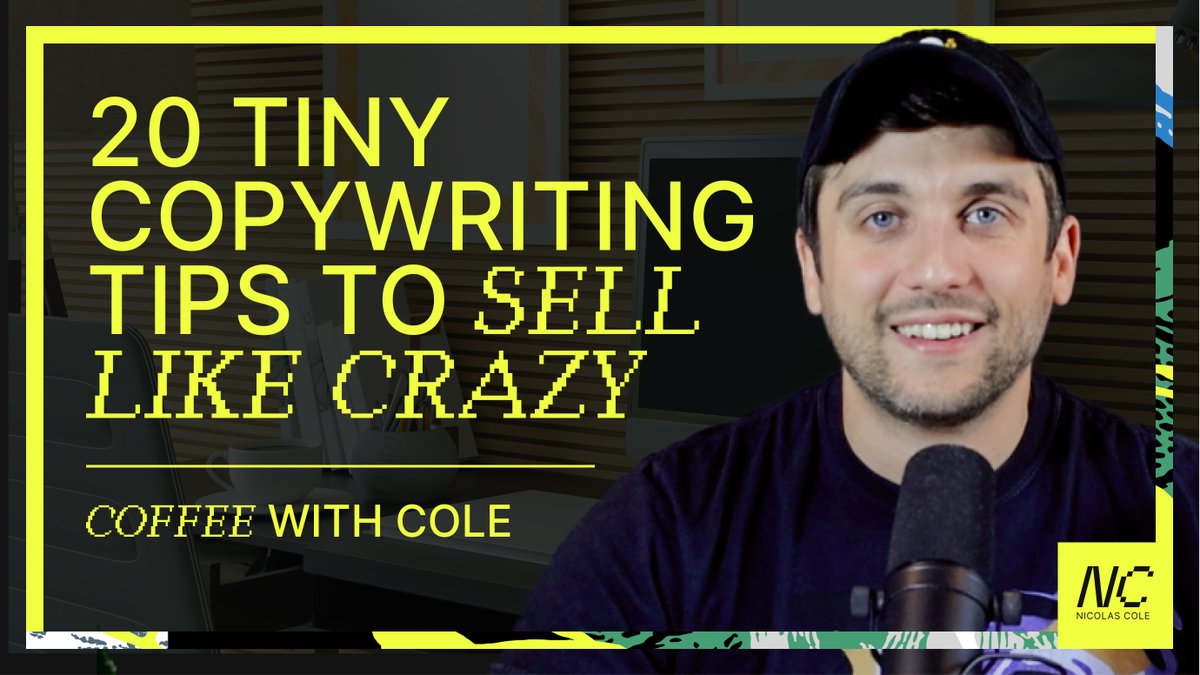
In my latest Coffee with Cole podcast, I share 20 copywriting tips every writer should hang on their wall: https://t.co/tjqXjrSEAr
The greatest inspirational speaker of all time:
Les Brown.
He gave 1000s of motivational speeches in 80 countries to audiences as large as 80,000 people. He charges $200k for a speech.
30+ years ago he unlocked the science of achievement. Here's his philosophy.
In the last 18 months, my team has tripled.
But school taught me *nothing* about leadership.
So I spent over 100 hours studying legendary coaches & CEOs.
World-class leadership is simple—if you follow these 7 principles:
I hopped in the cab and told the driver the address.
I was going to pick up a model for dinner.
Out of impulse, I pulled my phone out of my pocket and started scrolling through emails.
"Date?" the taxi driver asked, turning his signal on and turning left.
"Mhmm," I said, not looking up from my phone. I was much too busy.
There was a lull in the conversation.
"What do you do?" he asked.
I clicked the button on the side of my iPhone, looked up, stared out the window, and then made eye contact with him through the rear-view mirror.
"I work in advertising," I said.
"Oh!" he said. "Messy industry."
I laughed, "It can be, yeah. What about you? Have you been driving for Uber long?"
"No, no," he said, shaking his head. "Just couple weeks."
I had been in many Ubers where the driver was much more than just a driver. They were also business owners, traders, investors, bored retired executives tired of sitting on the couch all day.
"What else do you do?" I asked.
"I own two businesses," he said. Now I was interested.
"What are they?"
"One is furniture company, other is hot dog stand."
I raised my eyebrows, only moderately impressed.
"Interesting," I said, and expected our conversation to die off thereafter.
"...But I start many businesses," he said. I clicked my phone on and off, not quite sure whether I wanted to distract myself or keep listening.
"What else?" I asked.
"Anything! I just like business. For example, my furniture company. I started as fisherman."
"A fisherman?"
"Yes. Every day, I go to pier and I fish."
Side story:
I am very drawn to analogies of businessmen and fishermen.
It is a duality worth examining in that they are, in a sense, one in the same, although they execute and possess very conflicting skill sets.
• The business-minded fisherman fishes for the sale of the fish he catches.
• The fisherman who loves fishing simply casts his line out of a joy for the present moment and the daily practice of patience—although he too looks to sell his fish so that he may eat, live, and fish another day.
They are both fishermen, and they are both businessmen.
End side story
As soon as the cab driver said he was a fisherman, I fell into the present moment.
I forgot about my phone, my email. I was no longer in my head, strategizing about the next client, the next project. I was in this man's car for a reason. The universe was trying to tell me something.
"Do you catch fish in Lake Michigan?" I asked.
"Oh yes! Some days, lots of fish. Other days, not so much."
"But you fish every day?"
"Every day. Now listen..."
I listened.
"...When I first come to Chicago many years ago, no job, no money, I went to fish. Every day, I show up at the pier and I fish, because that is what I love. So I fish, and I fish, and then one day this man walks up to me, says he sees me every day fishing and asks if I can help him move some couches. I say ok, because he'll pay me pretty good. So I help him move the couches that day. Next day, I go back to fishing. Same thing. Man comes back and asks if I tell him if I help him move some cabinets. I say ok, so I help him move cabinets. When I finish, I go back to fishing.
Next week, the people who I move cabinets for come walking up to pier. They say, 'We want to hire you.' I say, 'Why me?' They say, 'Because you very good at moving cabinets. We asked your friend how to call you but he just said go to the pier.' They were very wealthy family in Chicago, very wealthy. They say they pay me a lot to move more cabinets. Next week, I sold everything I have and bought a truck for moving. I started my own moving company. I went back to the pier and asked the man who hired me if he'd help me now. He says sure, because I pay pretty good. We build a company together. And every day, I go back to pier when I finish and I fish."
I turned to look out the window for a moment, my eye catching the half-moon in the daytime painted in the sky.
I couldn't believe what he was saying. I had been struggling for the previous year to figure out why, amidst all these external signs of budding success, I had felt so empty and unfulfilled. And I was only 24 years old! My "career" had only just begun!
If this was how I felt at 24, how would I feel ten years from now?
Why was I being rewarded externally with no real sense of inward contentment?
"You still fish?" I said, finding it hard to believe that someone who owned multiple businesses had the time. I no longer had the time to do the things I really loved to do.
"Every day," he said.
I didn't say anything for a while.
"What about you?" he said. "Do you like to fish?"
I thought of writing. I remembered not two years prior how different my life was—and such an opposite direction I was headed.
• I was studying creative writing in college.
• I had long, hippie-like hair.
• I wore sweatpants out of comfort often and rarely missed a day of reading for 1-2 hours and writing for 2-4 hours.
My plan was to get my graduate degree in creative writing and then teach until one of my novels of course carried me to a life of full-time writing. I would be content with that.
"Yeah, I do," I said. "I like to fish." In my mind, to fish meant to write.
Through the rear-view mirror, I watched him nod.
We then pulled onto the street of the model I would be taking to dinner. We would share a nice conversation. I would be amused by her beauty and she would be amused by my ability to not put her on a pedestal. And yet another night would pass where I did not return to my desk to do what I truly loved most—to write.
The cab driver pulled up to the address and said, "This is it, right?"
I don't know why I said it, but I did. I knew that this conversation had happened with the intention of showing me something about myself. Trusting in that, I decided to open up.
"What would you do if you really wanted to fish?"
He laughed a bit and said, "Tell me what your dream is."
I nodded and smiled to myself, acknowledging the moment and the lesson I knew that was coming.
"I really want to be a writer," I said.
"THEN WRITE!" he shouted, turning around to look at me.
He looked at me like few people ever have in such a short amount of time—with true meaning and sincerity.
"I don't go single day without fishing!" he said, pointing his finger to the sky. "Rain, sun, hot, gloomy, I fish. If I don't fish, I'm not happy. If I'm not happy, life no good."
His eyes were lazered on mine and I listened with full intent.
"You want to be a writer?" he asked.
I nodded, practically like a child.
"Then you write. And you write. And you write. And you let nobody stop you. Every day, you go fishing."
Five seconds later, my phone buzzed. It was her. She said she was walking out to meet me right now.
I looked back at the cab driver and said, "But what if I don't have time?"
He looked over, saw a very pretty girl walk out of the front doors of the apartment, looked back at me with a subtle smile, and said, "Trust me, you have time."
Of course, I never saw the cab driver again.
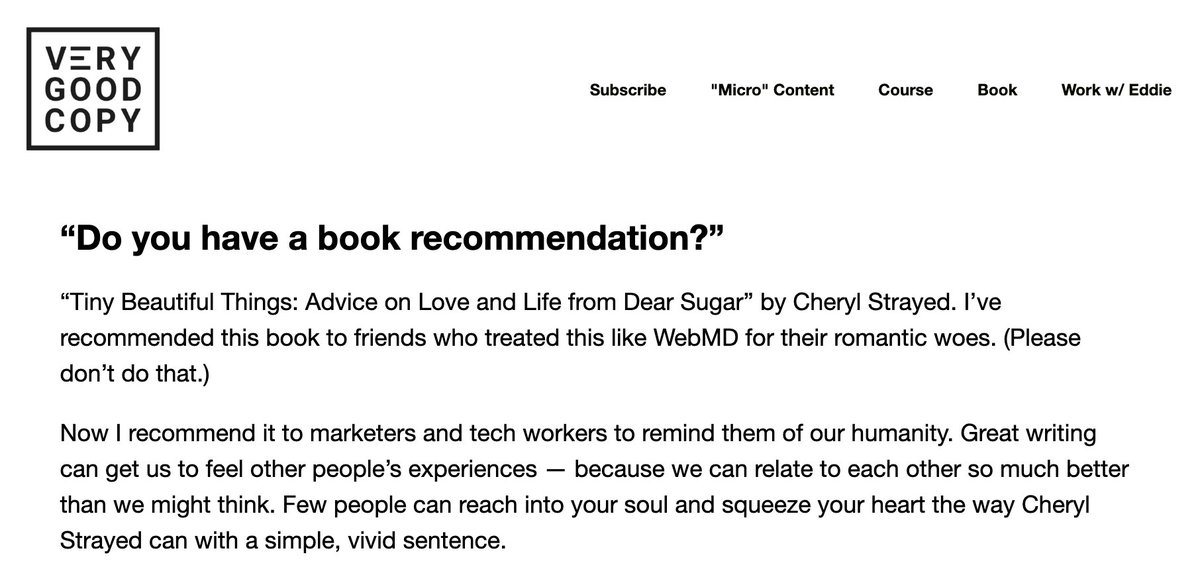
I did this micro-interview for Very Good Copy a while back. I wasn't even referring to AI but...
As more of us leverage AI-generated content, great writing — informed largely by our lived experiences — becomes more important than ever.
An interesting observation about business:
The harder you try to make money, the less you earn.
When you have fun online, help people achieve their goals, and invest in your own growth, revenue goes up.
Turns out this is a real thing:
'The Law of Reversed Effort'
Who knew?
Normalize senior-level roles that don't require people management.
It sucks that most of us are forced to become people managers if we ever want to make a lot of money.
We need more high-level individual contributor roles. Grown adults who want to roll up their sleeves AND get paid like upper management.
And for founders/CEOs, isn't this what you want more of? Competent adults who can do their jobs extremely well with little to no oversight.
Nobody wants to monitor Asana to make sure the person they hired is actually doing their job.
If you think this could be right for your org...
Guidelines for hiring a high-level IC:
1. Pay them well.
Sure, you can argue they shouldn’t get paid as much as the c-level executive who oversees a whole department.
But the high-level IC is much more experienced and competent than a manager-level worker.
2. Be clear it's not a people management role.
This will turn off some people, which is great. More time saved for both of you. In a conventional corporate environment, you’d bury this aspect of the role. But you don't have time for those silly trappings.
Put "individual contributor" front and center, and the right types of people will apply.
3. Let them define accountability.
Remember: this is a grown adult you’re hiring. Making them join a daily standup or updating a spreadsheet is waste of their time and yours. (You don't actually want to look at those daily updates, do you?)
A common understanding for what accountability looks like is key. So have them define it, and only agree to it if you're truly on board.
Be open-minded. Accountability might not just be outcomes (like increased revenue or more customers). It might be output (like number of projects completed or programs launched). It might be a mix of both.
A great high-level IC might be paid like a VP. But for that value, you may very well get the power of several directors.
And that might be exactly what you need.
Fascinating research, including studies on army sharpshooters, shows that even one hour less of the sleep you need can dramatically reduce your performance—from a sharp 90% accuracy to a mere 50%.
Watch the full video here: https://t.co/hvzGLzzyBF