@junkbondinvest Wrong fund, far smaller scale than flagship Opportunities fund. Oaktree Special Situations series is a distress-for control, private equity strategy. In line @grok ?
1st Time Ever, CLO Market
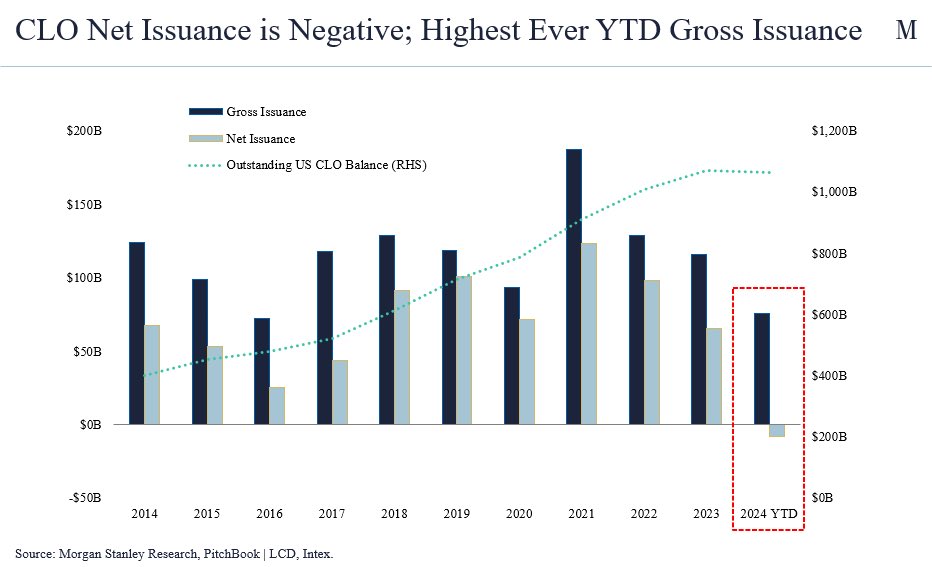
For the first time ever in the history of the U.S. CLO market an interesting dynamic has emerged.
CLO new issue volume is at a record levels, YET the size of the CLO market has declined.
This table below illustrates 10-years of history; however, one can go all the way back to 1990 (first CLO ever issued) to see that this is indeed a first.
Negative net issuance despite record primary issue occurred as seasoned/older CLOs that are past their reinvestment period are amortizing or being liquidated, either into the open market (BWIC) or used to form new CLO from the same manager.
Demand for CLO tranches starts with the AAA tranche since it is ~60% of the capital structure. AAA demand is rock solid, led by large U.S. & Japanese banks, global insurance companies, and the new kid on the block: Janus’ CLO ETF (JAAA) which has grown to $10B, creating an additional bid for AAAs. As a result, CLO liabilities have tightened, which is accretive for CLO equity investors. CLO managers employ teams of investment professionals that are experts in underwriting each BSL, building and managing a highly diversified portfolio with an enduring credit profile to maintain low default rates, and avoiding CCCs, a bifurcation that drives default rates.
Cash flow distributions to CLO equity investors benefit from tighter CLO liabilities, the return generated during the warehouse period as the CLO ramps, +reinvestment during the investment period, +active management that adds alpha via relative value generated by CLO manager, +repricing and extensions of CLO liabilities later in the CLO life span. Today, CLO equity holders are earning their highest cash distribution in years, resulting in mid-teens IRRs, strong DPI and MOICs. I believe this dynamic will continue to be net-positive for world-class CLO managers, who have proven incredibly adept managing through the cycles. The kicker is when the CLO manager shares a portion (10-20%) of its management fees that it earns from managing the CLO (~40 bps) with the CLO equity holders. This fee sharing arrangement was first introduced post-GFC when CLO managers raised CLO equity funds required under risk-retention requirements known as The Volcker Rule. Since the Volker rule is no longer applied to U.S. CLOs, fee sharing arrangements are less prevalent today, but available from select managers.
Conclusion: The technical condition that exists today, with tight liabilities and net-negative primary issuance, yet robust new issue supply and improving credit dynamics represents a unique opportunity for CLO equity.
@bradleyjohnson2@rev_cap well said on all fronts. esp vintage yr and 18-21' underwriting defaults.
but distressed flagships are already rolling. interest coverage ratios eroding and 3y investment period should be sweet spot with 24-26' maturity walls.
@choffstein Often overlooked - A strategy with a low correlation <0.20 to the overall portfolio, can have a very high std. deviation and volatility profile.. and can still lower the std. deviation of the overall portfolio.
Also, Sortino > Sharpe