My latest paper (joint with @MilliganMattD)
State capacity can be beneficial for economic growth: it improves public goods access, allows for rule of law, and encourages stability.
However, a powerful state can also turn towards religious persecution.
1/2
The EU Commission admits its EU imposed Basel banking regulations have destroyed the EU economies by killing small banks (6,000 of them!) and thus destroying hundreds of thousands of otherwise thriving small firms that became unable to secure vital loans.
The fatal challenge to heterodox economics is that there isn't actually orthodox economics.
Just take a few recent Nobels: behavioral, information failure, institutions, bubbles, financial fragility, labor monopsony (sort of), Schumpeterian creative destruction, etc.
Not to mention RCTs which are emblematic of how much economic research is empirical and only lightly if at all structural.
The real difference is methods. Heterodox economics is an avowedly political project not a social scientific effort to better understand the world. And I have nothing against political projects just shouldn't confuse the two.
California's Billionaire Tax Act would collect roughly $30 billion. Accounting for lost income taxes from departures, the mean Net Present Value is negative $39 billion, from Benjamin Jaros and Joshua Rauh https://t.co/hoS1OYeXvK
Something I have been insisting on: right now, the rich are having more kids, not fewer, than the poor, reversing a long-standing demographic pattern.
The ultimate status symbol for a finance bro? Three kids and a Rivian.
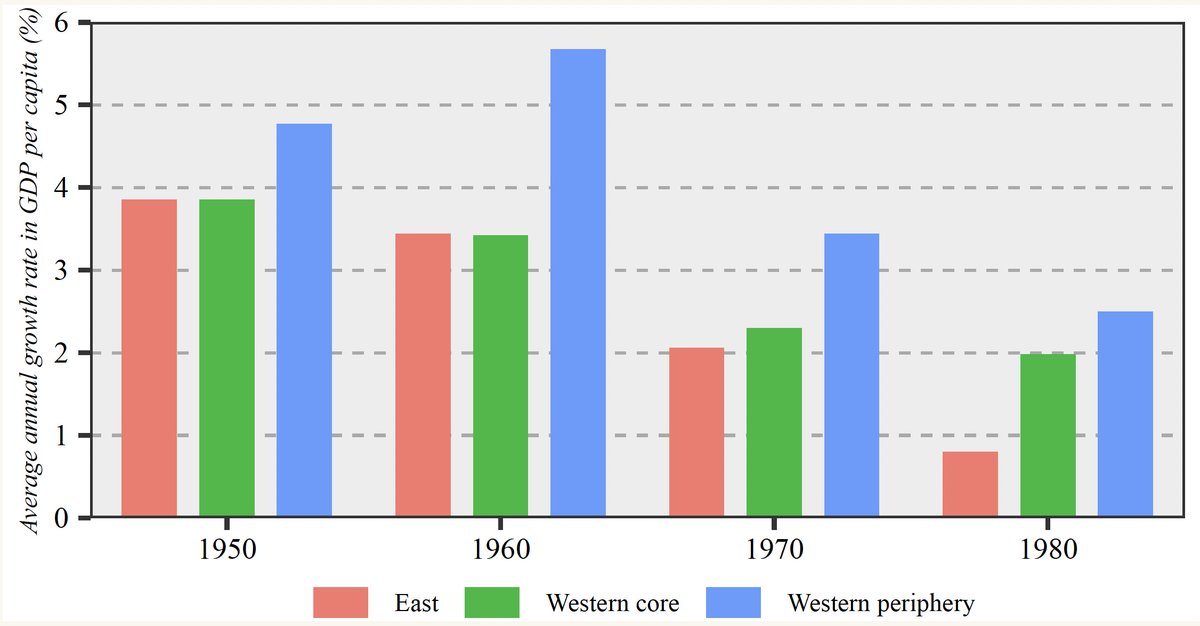
This year I am spending more time than usual in my Global Economic History course on the economic history of socialism and fascism. There are two reasons.
First, my students know little about either system. They were born nearly two decades after the Berlin Wall fell, and for them socialism and fascism are names in a textbook, not memories of their parents or grandparents.
Second, we are once again debating where our economic systems should go. Some of the proposals on the table have been tried before. Knowing how those earlier attempts turned out will not settle the debate. But knowing the historical record is a better starting point than not knowing it.
Here are the slides on the economic history of socialism:
https://t.co/7XEkhufH5z
They cover the Soviet Union and Eastern Europe. China gets its own deck. The figure I include, from the slide deck, is the average annual growth of different countries in Europe after World War II
The slides on the economic history of fascism will follow soon.
Changes in the US Supreme Court's ideological balance shift macroeconomic expectations. Demonstrating this using deaths of Supreme Court Justices as quasi-experimental shifts, from @td_econ and Naixin Zhang https://t.co/WXY4whIbZ2
Jack Weis has applied to more than 2,300 jobs since he graduated from Princeton in 2024 with his Ph.D. in chemical engineering. He still doesn’t have a job. https://t.co/noQ2cVz9OG
Open sourcing my regression lectures 🍻
AI is changing how we teach. Here’s one way I’m adapting: I’ve open-sourced my regression course, POLI 450A, built on Jens Hainmueller’s original class.
The course is suitable for first-year political science PhDs, as well as advanced undergraduate students in economics, political science, and other social sciences.
The materials include slides, R code, data, worksheets, and a short video for every lecture.
https://t.co/yUl3hs5P0Y
As fear mongering on low birth rates and declining immigration continues to dominate the Canadian economic discourse, some important new research to contemplate.
[full paper: https://t.co/8x0m5ySpuh]
New David Reich preprint proposes the expansion of early modern humans into Europe 300,000 years ago, likely originating from the Near East and/or Northeast Africa — long before the migrations about 50,000 years ago posited by the Out of Africa theory.
https://t.co/MDdgZAWoLS
People often ask me how to properly learn machine learning.
Rule 1: Stop consuming low-quality content such as most YouTube videos.
Rule 2: Start reading rigorous textbooks used in serious MSc programs in machine learning.
Christopher Bishop’s Pattern Recognition and Machine Learning is an excellent choice, and it is freely available here:
https://t.co/rqUw64onyx
An honor to have @IvanWerning at Northwestern theory presenting his important work with @guido_lorenzoni on tâtonnement, a topic unwisely left for dead
Shows that returning to fundamental and thorny questions can be highly rewarding!
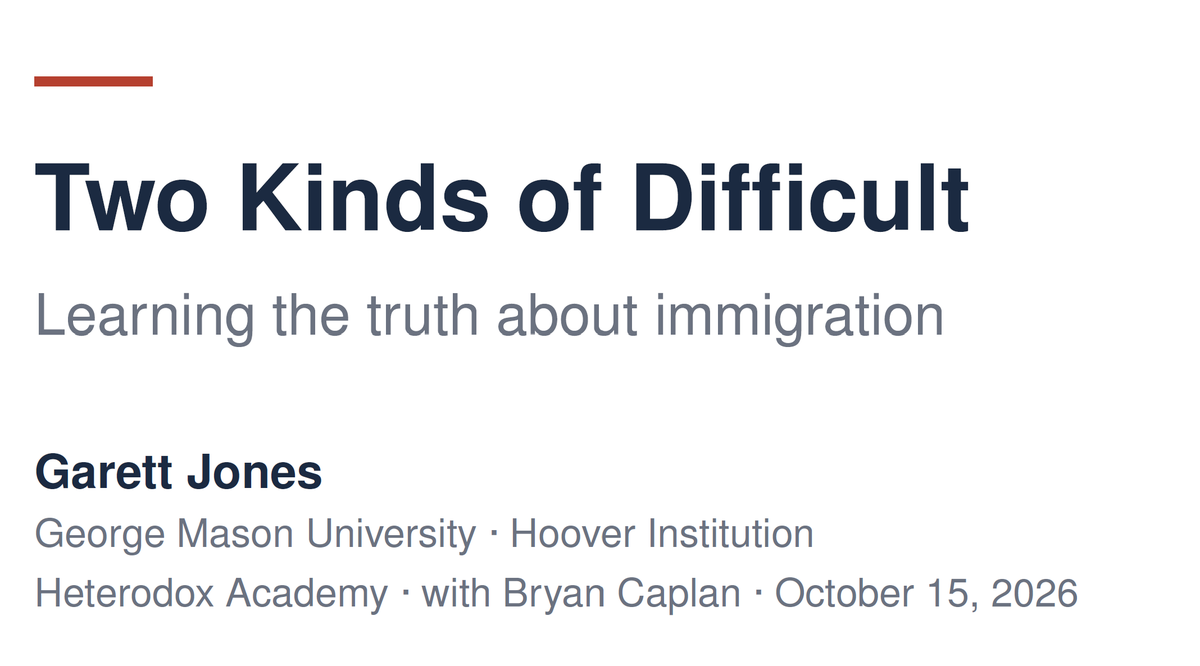
It's great living in the era of Immigration Glasnost. Far different from 2019, when Caplan published Open Borders.
Here are the slides I'll use today at UW's HxA event.
My thanks to Claude for the stop-motion animation.
https://t.co/j6FJmuPCO0
Happy to announce the release of our first curated dataset from @GLL_Brown@Brown_Economics@Watson_School@RhodesCenter We logged every US tariff rate: threats, announcements, signed into law since January 2025. 749 of them, timed to the minute, with the exact quote and source. Only 30% are executive orders. The rest is the noise markets trade on. Free, updated weekly:
https://t.co/Gw5XEzgPRu
After the 2017 US corporate tax cut, firms expanded, but extra earnings mostly went to firm owners and executives, say researchers at @UCLA, @federalreserve, and @jctgov. #Chart https://t.co/By2CEkL8Sa
Today @GoogleResearch is launching Deep Review — an agentic system designed to stress-test manuscripts, design docs, and complex proposals before submission or publication. After pilot partnerships analyzing over 15,000 research papers, we’re making Deep Review globally accessible to help researchers, engineers, and professionals bring structured critique to their daily workflows.