🦔Thomson Reuters just built its own AI model for about $40 million over two years. The final training run cost $450,000. They started with Qwen, an open-source model from China's Alibaba, and trained it on their own legal and news content from Westlaw, Practical Law, and Reuters. The company said the move is about reducing its dependence on Anthropic. Their CTO compared paying for outside AI to being a permanent tenant versus owning the building. Enterprise customers broadly have been cutting spending on OpenAI and Anthropic and switching to cheaper alternatives.
My Take
I covered the DeepSeek pricing collapse a few months ago and said the frontier labs would have a hard time defending premium API pricing once open-source got good enough. Thomson Reuters just did exactly what I expected someone to do. They grabbed a free model, trained it on their own stuff, and now they're pulling back from Anthropic. $40 million, done. Anthropic charges that in API fees from a handful of big customers in a year.
The $190 to $200 billion revenue projection Anthropic is selling to IPO investors assumes companies like Thomson Reuters keep paying. They just stopped. And Thomson Reuters put their model on Hugging Face for academics to use, which means the playbook is now public. I think the frontier API business has maybe two or three years before most large companies with good data figure out they can do this themselves, and the ones who move first are going to pressure the ones still paying full price to ask why.
Hedgie🤗
🔴⚡️ ÚLTIMA HORA | Marruecos admite la autenticidad de los datos de Jabaroot, pero niega que procedan de un ciberataque
Rabat acusa a supuestas compañías de seguros y organismos de cobertura sanitaria... 👇
https://t.co/o27ox9zAJh
🦔Anthropic is expected to tell IPO investors that its total addressable market exceeds $30 trillion. That's roughly the entire GDP of the United States. TAM is the revenue a company could theoretically earn if it captured 100% of its market, and Anthropic is defining that market as all work that could be completed with AI models. The company lost $42 billion last year, projects $190 to $200 billion in revenue by 2028, and is seeking a $2 trillion valuation. SpaceX claimed a $28.5 trillion TAM in its IPO filing. Anthropic is one-upping that.
My Take
Every company inflates its TAM in an IPO filing, that's standard. But $30 trillion is the entire US economy. Anthropic is telling investors that its addressable market is every task a human does that could theoretically involve AI. By that logic my addressable market is every atom in the universe because I could theoretically touch all of them. TAM is supposed to help investors size an opportunity. At $30 trillion it's just a number on a slide.
A year ago these companies were pitching billions. Then it was hundreds of billions. Now it's $30 trillion, which tops SpaceX's $28.5 trillion claim from May. The numbers escalate because they have to. Each round of fundraising needs a bigger story than the last one, and the story has to be big enough to make a $2 trillion valuation on a company that lost $42 billion last year seem like a bargain. I think most of the investors in the room know the $30 trillion number is decorative. The problem is the retail investors who buy the IPO after them, who might not.
Hedgie🤗
🦔Anthropic is expected to tell IPO investors that its total addressable market exceeds $30 trillion. That's roughly the entire GDP of the United States. TAM is the revenue a company could theoretically earn if it captured 100% of its market, and Anthropic is defining that market as all work that could be completed with AI models. The company lost $42 billion last year, projects $190 to $200 billion in revenue by 2028, and is seeking a $2 trillion valuation. SpaceX claimed a $28.5 trillion TAM in its IPO filing. Anthropic is one-upping that.
My Take
Every company inflates its TAM in an IPO filing, that's standard. But $30 trillion is the entire US economy. Anthropic is telling investors that its addressable market is every task a human does that could theoretically involve AI. By that logic my addressable market is every atom in the universe because I could theoretically touch all of them. TAM is supposed to help investors size an opportunity. At $30 trillion it's just a number on a slide.
A year ago these companies were pitching billions. Then it was hundreds of billions. Now it's $30 trillion, which tops SpaceX's $28.5 trillion claim from May. The numbers escalate because they have to. Each round of fundraising needs a bigger story than the last one, and the story has to be big enough to make a $2 trillion valuation on a company that lost $42 billion last year seem like a bargain. I think most of the investors in the room know the $30 trillion number is decorative. The problem is the retail investors who buy the IPO after them, who might not.
Hedgie🤗
@Mulagros7@lapaseata Lo que quiero decir es que Margarita Robles pudiera ser la tapada, el elefante blanco, la sucesora de Pedro Sánchez, su presencia en las fuerzas armadas no es casualidad. Para que se entienda, que veo que no, por eso he colocado la frase que pronunció el rey durante el 23F.
Jack Dorsey says the real threat isn’t open-source AI.
it’s five CEOs deciding what the world is allowed to build with AI.
“These AI companies are building platforms, and they’re all incentivized around their own models. You have to ask for permission, you hit rate limits, and even what the models return is constrained.”
“What technologies let you build without asking a company—or a CEO—for permission? The durable ones. That’s why open protocols matter.”
“When a handful of CEOs make the call, it caps the upside of great ideas that could move humanity forward. They might know what’s best for their company—but not what’s best for the world’s creativity.”
“Luckily, open-source AI is gaining real momentum. DeepSeek was a key moment—not just showing a different path, but proving it can be competitive, even better than what the big corporations are shipping.”
“We shouldn’t be dependent on five companies claiming they know best—and calling open source ‘dangerous.’ We should build in the open and race toward solutions that stay ahead of the risks.”
PS. If you found value in this post, like and repost this tweet + follow @AiEvolutio58513 to stay updated with the latest AI news.
See you in the next one:
@soul_purpose1@LogWeaver@GeniusGTX As you can imagine, there is a point in time where you'd better buy a new GPU to replace the old one. That point is much earliar than 5 or 9 years.
@soul_purpose1@LogWeaver@GeniusGTX Beyond the reinvestment issue, the most sensible parameter is billable time, which is related to demand. Below 70% of billable load most of the calculations lead to very load EV
@soul_purpose1@LogWeaver@GeniusGTX In other words, he is outlining that you cannot valuate a neocloud company (utility) as a SaaS company. Revenue and EBITDA figures can be great but the real value of the company is affected by an accelerated reinvestment pace
@soul_purpose1@LogWeaver@GeniusGTX Burry is having into account the real (not theoretical depreciation) of the GPU assets. In other words, you cannot value neoclouds as m times EBITDA. You have to decrease EBITDA with the annual reinvestment in GPUs or use EBIT instead. When you do that the company valuation drops
@soul_purpose1@LogWeaver@GeniusGTX Again, this is not a contractual or even technological point. Real depreciation comes much earlier, just because you start billing 5-7$/GPU/h and in less than 2 years the revenue goes down to 1-2$/GPU/h as much powerful GPUs are needed to keep the pace.
Michael Burry, the investor who called the 2008 housing crash, bet against Nebius last week.
When he shorts a stock, people pay attention.
Six days later, the stock jumped 34% in one day.
Then he did something almost NOBODY expected...
Nebius rents out computing power for AI.
It is what the industry calls a neocloud.
Burry shorted it at $211.77 a share.
He shorted Oracle the same day.
The Nebius bet was the bigger one.
Then Nebius reported earnings on Wednesday.
Revenue jumped 454% from a year ago.
That is $582 million in a single quarter.
Its core AI cloud business grew 514%.
The company reaffirmed its guidance for the year.
The stock ripped 34% higher that day.
It closed near $259 a share.
The stock has more than doubled this year.
That is about 22% above Burry's short price.
His Oracle short went the wrong way too.
Oracle rose more than 5% the same day.
Many traders were also betting against Nebius.
Their rush to cover fed the huge jump.
There are real reasons people are buying:
Nvidia owns a 9.3% stake in Nebius.
Nebius signed a deal with Reflection AI worth over $1 billion.
Its annual revenue is now running near $3 billion.
New deals now pay for themselves in about a year.
Its boss says next year's capacity could sell out today.
Most people would quietly cut the loss.
Burry did the opposite.
He added to his short at $247.
That is higher than his first short price.
He called Nebius "what the top of a boom looks like."
Now look at what the headlines skipped:
Nebius spent $5.7 billion on equipment last quarter.
All of that gear loses value over time.
The more chips it buys, the bigger that bill grows.
The company booked $259.7 million in depreciation.
That is 45% of its revenue.
Nebius reported $236 million in adjusted profit.
Its depreciation bill was even bigger than that.
The company actually lost money on paper.
It lost $190 million in the quarter.
And there is one more detail:
Nebius stretched how long it counts its chips as useful.
It moved that number from four years to five.
That change makes today's profits look bigger.
It is exactly the move Burry warned about.
So the same report told two stories.
The crowd saw revenue up 454% and bought.
Burry saw the depreciation and doubled down.
One number was the headline.
The other number decides if this is real.
Chips wear out whether the hype lasts or not.
That cost does not care about the headline.
Most buyers never checked that line.
Whether Burry is right is not settled yet.
He has been early before.
He has been wrong before.
But the people who bought never read the filing.
And that is the part that matters.
Retail bought the headline.
The bear read the filing.
That's the whole game.
Surmount builds automated investing strategies from real data.
Start for free and let the numbers lead.
Michael Burry, the investor who called the 2008 housing crash, bet against Nebius last week.
When he shorts a stock, people pay attention.
Six days later, the stock jumped 34% in one day.
Then he did something almost NOBODY expected...
Nebius rents out computing power for AI.
It is what the industry calls a neocloud.
Burry shorted it at $211.77 a share.
He shorted Oracle the same day.
The Nebius bet was the bigger one.
Then Nebius reported earnings on Wednesday.
Revenue jumped 454% from a year ago.
That is $582 million in a single quarter.
Its core AI cloud business grew 514%.
The company reaffirmed its guidance for the year.
The stock ripped 34% higher that day.
It closed near $259 a share.
The stock has more than doubled this year.
That is about 22% above Burry's short price.
His Oracle short went the wrong way too.
Oracle rose more than 5% the same day.
Many traders were also betting against Nebius.
Their rush to cover fed the huge jump.
There are real reasons people are buying:
Nvidia owns a 9.3% stake in Nebius.
Nebius signed a deal with Reflection AI worth over $1 billion.
Its annual revenue is now running near $3 billion.
New deals now pay for themselves in about a year.
Its boss says next year's capacity could sell out today.
Most people would quietly cut the loss.
Burry did the opposite.
He added to his short at $247.
That is higher than his first short price.
He called Nebius "what the top of a boom looks like."
Now look at what the headlines skipped:
Nebius spent $5.7 billion on equipment last quarter.
All of that gear loses value over time.
The more chips it buys, the bigger that bill grows.
The company booked $259.7 million in depreciation.
That is 45% of its revenue.
Nebius reported $236 million in adjusted profit.
Its depreciation bill was even bigger than that.
The company actually lost money on paper.
It lost $190 million in the quarter.
And there is one more detail:
Nebius stretched how long it counts its chips as useful.
It moved that number from four years to five.
That change makes today's profits look bigger.
It is exactly the move Burry warned about.
So the same report told two stories.
The crowd saw revenue up 454% and bought.
Burry saw the depreciation and doubled down.
One number was the headline.
The other number decides if this is real.
Chips wear out whether the hype lasts or not.
That cost does not care about the headline.
Most buyers never checked that line.
Whether Burry is right is not settled yet.
He has been early before.
He has been wrong before.
But the people who bought never read the filing.
And that is the part that matters.
Retail bought the headline.
The bear read the filing.
That's the whole game.
Surmount builds automated investing strategies from real data.
Start for free and let the numbers lead.
@soul_purpose1@LogWeaver@GeniusGTX 2026 - 9 = 2017. Nvidia launched GeForce GTX 1080 at the beginning of 2017 and GeForce GTX 1070 by november 2017... Think of a datacenter full of those cards today, even last year...
The point is not if GPUs can last for 9 years, the point is obsolescence occurs as soon as 2-3y.
#AusAllenWelten
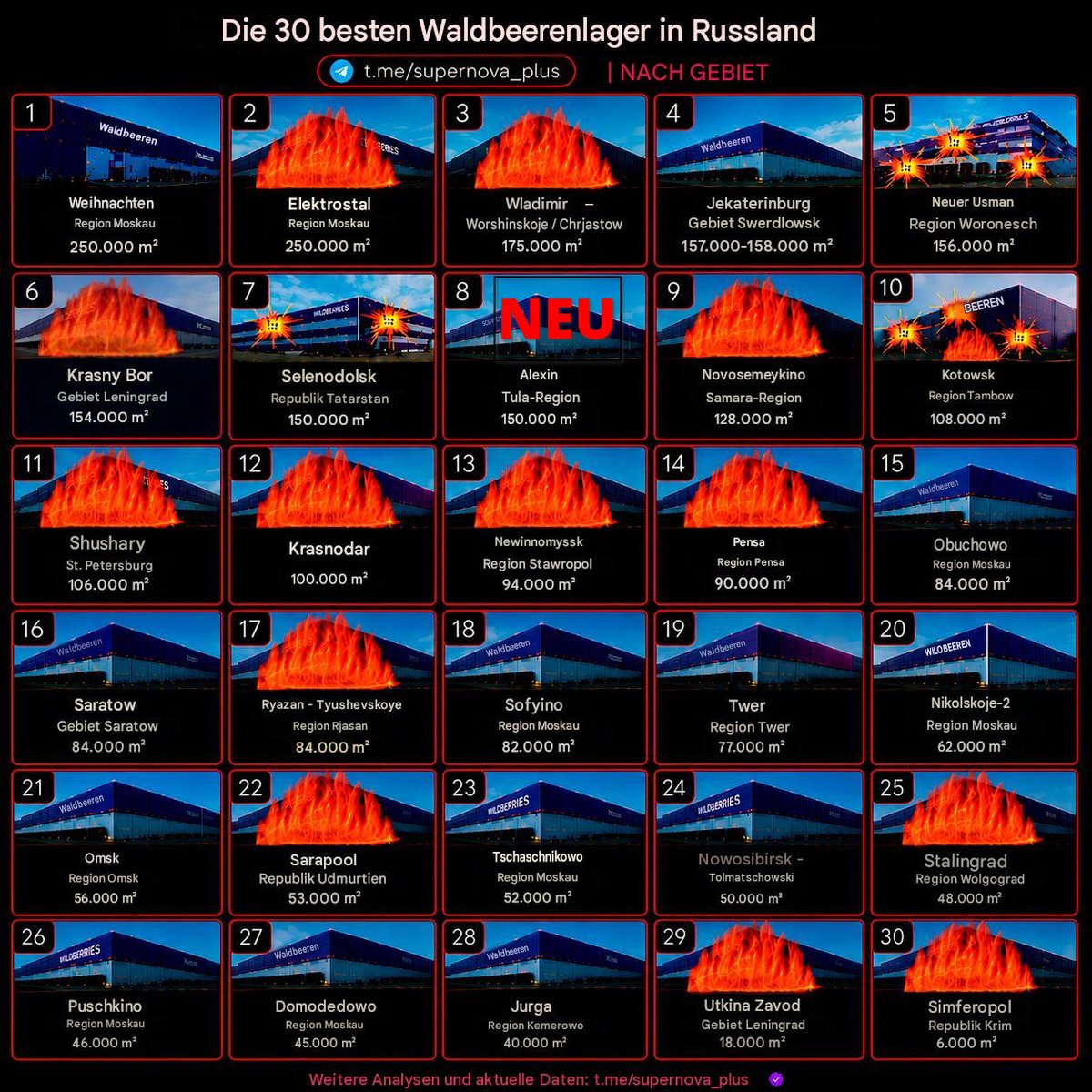
Fast 50 % der Lagerfläche der 30 größten Lager von Wildberries in Russland sind dauerhaft zerstört.
Unter normalen Umständen ist Wildberries Pleite, in Kriegszeiten gelten andere Regeln.
Wildberries erhielt im Jahr 2025 kurzfristige Kredite von 1,5 Billionen Rubel, davon wurde ein Teil zurückgezahlt, sodass am Ende 801,7 Milliarden ungesicherte Kredite verblieben.
Gleichzeitig wurde der Umsatz für Ende 2025 auf 1,1 Billionen Rubel geschätzt, der Nettogewinn des Unternehmens betrug 55,3 Milliarden Rubel.
Das wirft einige Fragen auf, da die kurzfristigen Darlehn von 2025 in keinem vernünftigen Verhältnis zu den Umsätzen stehen.
Der Kauf oder Bau von Lagerhallen sind ganz normal durch 48 Milliarden langfristige Darlehn abgedeckt.
Wofür die 1,5 Billionen Rubel gebraucht wurden, ist der Bilanz nicht zu entnehmen.
Ein Vergleich der hinkt:
Wenn ein Bürger zur Bank geht, ob er sein Konto um das 16-fache seines monatlichen Bruttogehaltes überziehen darf, dann müssen dort sehr triftige Gründe vorliegen, zum Beispiel ein noch nicht ausgezahlter Gewinn des Lotto-Jackpots, normal sind 3 Nettogehälter.
(Der monatliche Umsatz von Wildberries sind rund 92 Milliarden Rubel und das 16-fache sind rund 1,5 Billionen.)
Wildberries scheint noch eine andere Aufgabe zu haben, neben den bekannten Aufgaben wie Handelsplattform oder Verkauf von militärischer Ausrüstung. Eine Aufgabe, die öffentlich nicht bekannt ist.
-
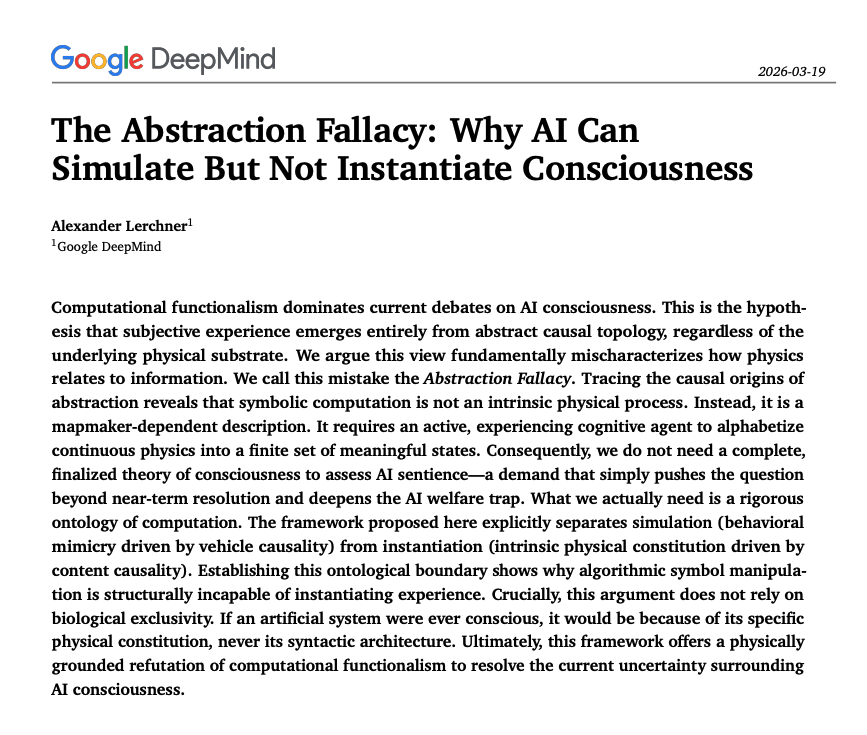
Google argues that AI will never be conscious.
It is impossible.
For years, the entire tech industry has operated on a foundational belief called computational functionalism.
the belief that if you build an AI network complex enough, subjective consciousness will automatically emerge from the software.
They published a paper called "The Abstraction Fallacy" proved that premise is logically impossible.
Here is the core breakthrough:
Expectant tech optimists treat calculations like they are an intrinsic physical process built into silicon. They aren't.
Inside a computer chip, there are only continuous, raw physical properties—voltage drops, thermal fluctuations, and electron flows.
The 1s and 0s? The algorithms? The syntax?
None of those are native to the hardware. They are externally assigned rules mapped onto the physics by a human observer.
Computation is a description, not a property.
As the paper bluntly puts it: "Expecting an algorithmic description to instantiate the quality it maps is like expecting the mathematical formula of gravity to physically exert weight."
This exposes the fatal flaw in modern AI narratives.
An AI can simulate speech, mimic empathy, and pass every intelligence benchmark you throw at it. But simulation is not instantiation.
It is manipulating symbols on a screen, detached from any real internal experience.
The map is not the territory. No matter how high-resolution the map becomes.
This changes everything about how we look at the future of technology:
1. It kills the "AI welfare" panic. You cannot commit a moral crime against a mathematical mapping. There is no hidden suffering inside the weights.
2. It strips away the mystical AGI hype and returns AI to its rightful place: the greatest productivity tool ever engineered.
3. It preserves what makes humans irreplaceable.
We’ve spent the last few years terrified that AI is becoming more like us.
This research proves it is just a sophisticated calculator running on a borrowed language.
The machines can simulate life all they want.
They will never feel it.
⭕ El volumen de la avalancha
49.000 personas entraron en Ceuta en menos de 24 horas
✍@JorgeSanzCasi y Luis Cano
🔗 Sigue leyendo aquí: https://t.co/aLFeGjOLaN