RPI-Zero: Zero-shot RNA-Protein Interaction Prediction
1. RPI-Zero targets a practical gap in RBP biology: predicting RNA–protein binding for proteins/RNAs with no interaction data (zero-shot), using sequence only, and evaluating explicitly on unseen RNAs, unseen proteins, and unseen pairs via strict similarity-based splits.
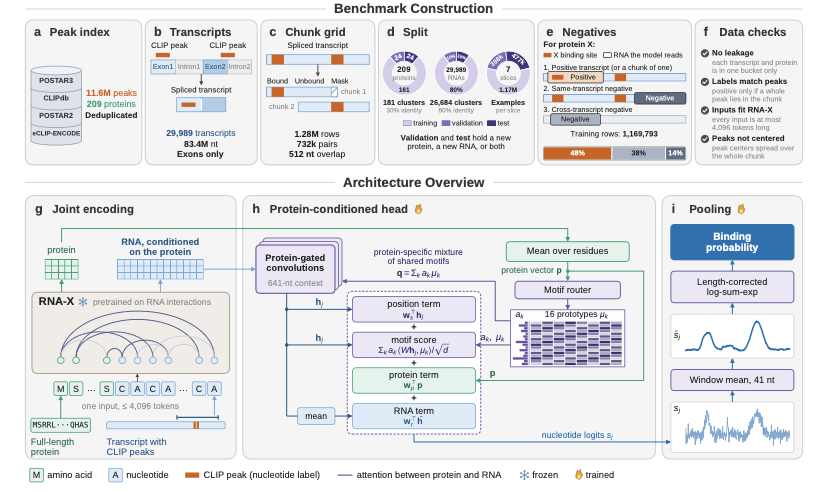
2. The paper’s benchmark is a major contribution: 2.1M labeled examples derived from 11.6M CLIP peaks across 209 proteins (from ENCODE eCLIP, POSTAR2/3, CLIPdb), where each RNA input is a full spliced canonical transcript (not just peak windows) with nucleotide-level labels.
3. To prevent over-optimistic evaluation, transcripts (80% identity) and proteins (30% identity) are clustered and entire clusters are assigned to train/val/test, yielding dedicated test slices for unseen RNA, unseen protein, and unseen pair generalization (rather than random splits that leak near-duplicates).
4. Negative construction is designed to remove common shortcuts: negatives are matched to positives by transcript length and by “transcript popularity” (number of other proteins binding the transcript), reducing the chance that models predict binding from global transcript bias rather than protein-conditioned recognition.
5. Model design: RPI-Zero uses a frozen RNA-interaction foundation model (RNA-X) to jointly encode the full protein and RNA in a single ≤4,096-token input, so nucleotide embeddings are already conditioned on the partner protein; long transcripts are handled via fixed-grid overlapping chunks (512-nt overlap) to avoid centering peaks and leaking labels.
6. The trainable head introduces a protein-as-mixture-of-motifs mechanism: each protein is represented by weights over 16 shared motif prototypes, allowing unseen proteins to be expressed in the same motif basis as seen proteins; protein-gated convolutions over RNA provide wide context (641 nt receptive field) and produce per-nucleotide binding logits.
7. Training uses both dense nucleotide supervision (peak labels) and pair-level supervision (bind vs not), with a schedule that first learns to localize peaks and then increases the weight of pair classification; batches are balanced to avoid domination by proteins with abundant CLIP data.
8. On the strict benchmark, RPI-Zero ranks best across 8 metrics on all three test slices. Reported AUPRC: 0.753 (unseen RNA), 0.637 (unseen protein), 0.589 (unseen pair), outperforming five retrained baselines spanning k-mer, graph-based, language-model, cross-attention, and topological-feature approaches.
9. Beyond ranking metrics, the model’s probabilities separate positives/negatives more clearly in zero-shot settings (especially for unseen proteins), and it performs well when binding signal is sparse (single-peak positives), consistent with its design to detect short sites within long transcript context.
10. Interpretability/usefulness: RPI-Zero outputs nucleotide-level binding profiles and shows enrichment of high logits within CLIP peaks even for unseen proteins/RNAs; an example highlights recognition of the known hnRNP L CA-repeat preference, with protein-specific elevation over CA runs compared to other proteins scored on the same RNA chunk.
💻Code: https://t.co/ZQQE6dFTbx
📜Paper: https://t.co/DE923eNTLj
#computationalbiology #bioinformatics #RNA #RBP #CLIPseq #deeplearning #foundationmodels #benchmarking #zeroshot #sequencemodeling
If every problem in your lab needs you, how will your team grow?
In my book draft, I wrote: “One of my most important jobs is to train people to solve problems.”
This is a difficult transition for a new PI. You know how to do the experiment, fix the analysis, or rewrite the paragraph. Doing it yourself feels faster. But if that becomes the routine, people keep waiting for your answer.
Give someone ownership of a problem. Ask what they have tried, what they think is happening, and what they would do next. Discuss their reasoning. Agree on when to check back and when they should ask for help.
Then give them room to try. Including room to choose a good approach that is different from yours.
For PhD students and postdocs, these are opportunities to practice leading a project. For PIs, this is how we develop the next generation of leaders.
It takes patience now. It gives the whole team more capacity later.
What has helped you give your team more independence?
#Academic #Leadership #Mentorship #PhDLife #Postdoc
Tomorrow at RECOMB-RSG 2026 in Thessaloniki, Greece, @sobhanshukueian will be presenting our latest work from CICEKLAB: "RNA-X: Modeling RNA interactions to design binder RNA and simultaneously target multiple molecules of different types."
Designing custom RNA molecules to selectively and strongly bind specific targets has always been a major hurdle in therapeutic design due to the vast sequence space. RNA-X completely changes the game.
What makes RNA-X unique?
1. It's the first RNA interaction foundation model. Trained end-to-end on over 100 million RNA-target interactions using masked language modeling.
2. Multi-modality targeting: Unlike existing models restricted to protein targets, RNA-X designs RNA sequences to target proteins, RNA, and DNA molecules.
3. Simultaneous multi-targeting: It can design a single RNA molecule to simultaneously bind to multiple distinct targets (proven by designing a guide RNA from scratch that binds both Cas9 protein and bacterial DNA!).
4. Despite having orders of magnitude fewer parameters than traditional RNA foundation models, it outperforms state-of-the-art methods in protein targeting and diverse downstream tasks.
Thanks to Duygu Kuzuoglu Ozturk and her group, Sobhan will mention preliminary experimental data to show that RNA-X designs are effective in binding and lower Androgen Receptor transcript and protein levels.
If you are attending the Regulatory Genomics Satellite meeting in Thessaloniki, don't miss Sobhan's talk tomorrow during the afternoon session (15:50 - 16:00 at the Nikolaos Germanos Congress Center)! We wish @HelyaHashemi could be there too but due to visa issues she will not be able to attend.
Check out the preprint here: https://t.co/5dngRPTXvX
and
Check out our code here: https://t.co/DeWAb8PtfG
Last weekend, we hosted our second annual ASAPLAB and CICEKLAB ethnic garden party! Carrying on the tradition established by @JPHubaux, @muhayyileli and I loved seeing everyone share and introduce dishes from their unique cultural backgrounds.
🚀 34 innovative projects, demos, awards, food, and fun! #CSFair2026
Held on May 8 at the Bilkent Hotel, CS Fair of the Computer Engineering Department brought together students, faculty, industry leaders, and proud families for a day full of innovation and fun🎉
📢 CS Fair 2026 is coming!
Join us on May 8, 2026 (Friday) at Bilkent Hotel, Sakarya Hall for an exciting showcase of innovation 🎓Our senior students will present 34 graduation projects from Senior Design Projects, featuring live demos, project & personal awards 🚀
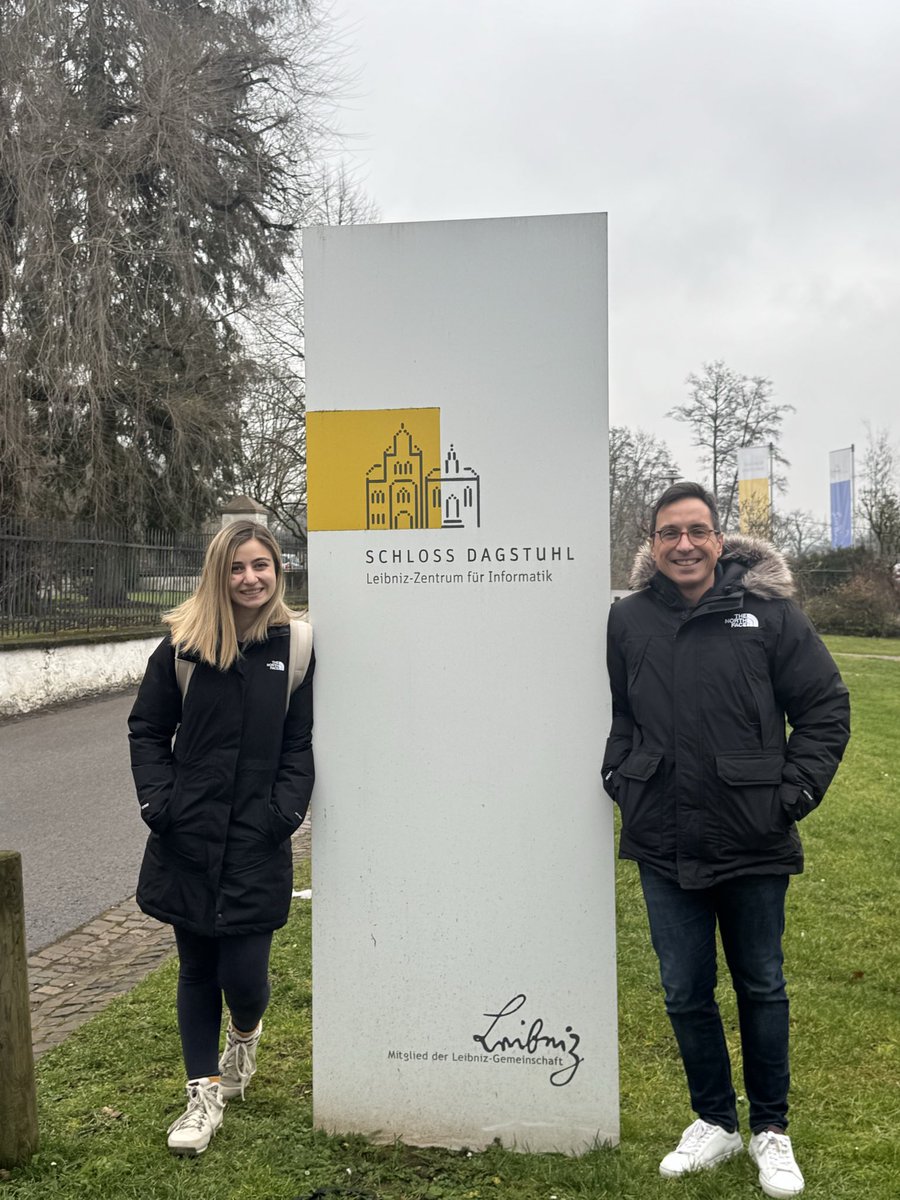
It was great to meet with old and new friends at @dagstuhl where we discussed the future of privacy-preserving solutions for biomedical data sharing. Big shout out to all organizers: @bradmalin, @kantarcioglu, Fruzsina Molnar-Gabor, Fabian Prasser and Daniel Ruckert.
Another exhilarating Dagstuhl Seminar (https://t.co/lJIBkZK8N4) in the books. It was a long week, but very inspiring to see what the future of privacy-aware health data sharing will look like!
I've never felt this much behind as a programmer. The profession is being dramatically refactored as the bits contributed by the programmer are increasingly sparse and between. I have a sense that I could be 10X more powerful if I just properly string together what has become available over the last ~year and a failure to claim the boost feels decidedly like skill issue. There's a new programmable layer of abstraction to master (in addition to the usual layers below) involving agents, subagents, their prompts, contexts, memory, modes, permissions, tools, plugins, skills, hooks, MCP, LSP, slash commands, workflows, IDE integrations, and a need to build an all-encompassing mental model for strengths and pitfalls of fundamentally stochastic, fallible, unintelligible and changing entities suddenly intermingled with what used to be good old fashioned engineering. Clearly some powerful alien tool was handed around except it comes with no manual and everyone has to figure out how to hold it and operate it, while the resulting magnitude 9 earthquake is rocking the profession. Roll up your sleeves to not fall behind.
Very happy to announce that our study on designing RNA to bind and target proteins is now published @PLOSCompBiol.
RNAtranslator is a generative language model that formulates protein-conditional RNA design as a sequence-to-sequence natural language translation problem for the first time.
Aside from enabling the design of RNAs with natural-like properties and high binding affinity, this approach also allows us to target proteins for which no RNA interaction data are available—something that was not previously possible. As an example, we designed an RNA (red) that binds with PRP4K (blue) with high affinity, and the resulting complex is shown below.
This is the result of the hard work of our grad students at CICEKLAB: Sobhan Shukueian Tabrizi @sobhanshukueian, Sina Barazandeh @sinabr01 & Helyasadat Hashemi Aghdam @HelyaHashemi.
Paper is available here - open access: https://t.co/ALLn6IkQZd
The code is available at GitHub: https://t.co/A4YS06ceSd
#RECOMB2026 will be in Thessaloniki, Greece on May 26-29, 2026. Satellites on May 24-25. Save the date!
Το συνέδριο #RECOMB2026 θα πραγματοποιηθεί στη Θεσσαλονίκη, στις 26-29 Μαΐου 2026. Οι δορυφορικές εκδηλώσεις θα διεξαχθούν στις 24-25 Μαΐου 2026. Σημειώστε την ημερομηνία!
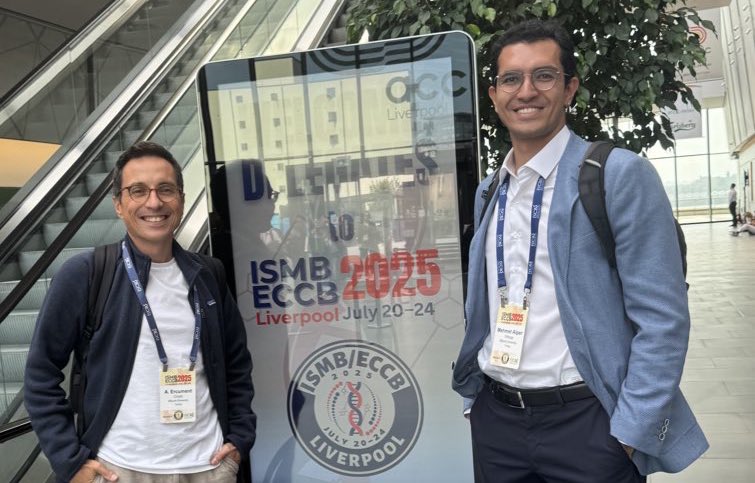
It is a wrap. #ISMBECCB2025 was a nice mix of jetlag, catching up with friends, observing the state-of-the-art and presenting. It is time to go back home after a loong journey (Izmir - Ayvalık - Los Angeles - London - Liverpool). See ya, mate!
Finally, we have a poster presentation (C-335) on DeepSynba; our deep learning model to predict dose-response profiles in synergistic drug combination detection led by our recent PhD graduate @hllibrhmkuru and @HaotingZhang1. It will be in Session C: July 23, 2025 at 10:00-11:20 and 16:00-16:40. Lovely collaboration with @HaotingZhang1, Magnus Rattray, @TastanOznur and @marta_milo.
https://t.co/x3GF23Aeok
We are headed to #ISMBECCB2025 Conference organized in Liverpool, UK! We have two oral and one poster presentation this year.
@m_alperyilmaz from our group will present our proceedings paper on detecting copy number variations on ancient DNA 🗿🧬samples in the HitSeq session on July 24 at 14:40 in room 01A. Great job by my current/former students Ahmet Arda Ceylan and @gun_kaynar.
https://t.co/64SFgDsmfu
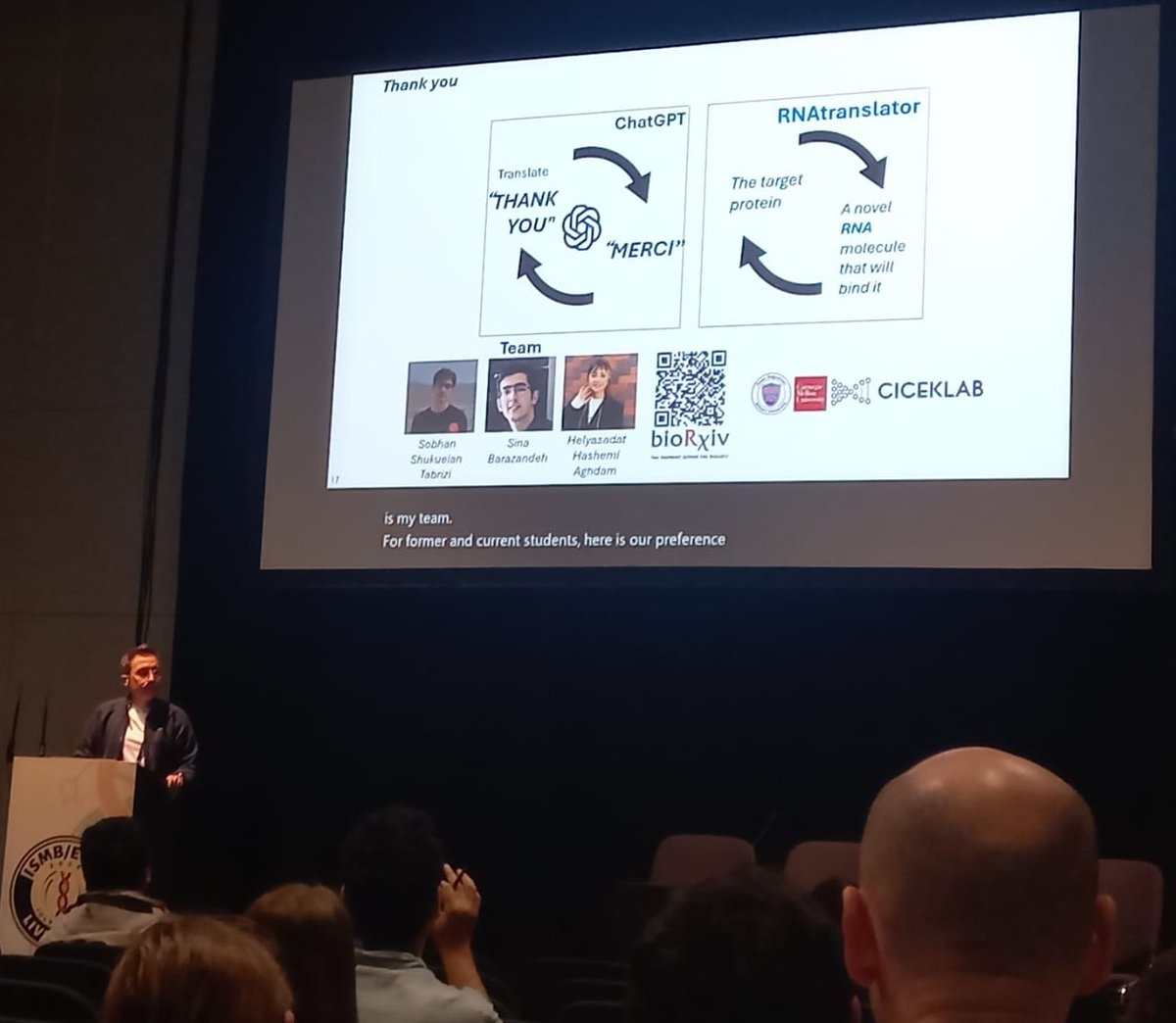
I will give a talk on RNAtranslator; our recent language model to design protein-binding RNA for virtually any protein. The talk will take place in the iRNA session on July 24 at 12:00 in room 02N. This is the result of a great effort of my current/former students @sobhanshukueian , @sinabr01 and @HelyaHashemi.
https://t.co/ijt6Q3En8H