The loudest voices stoking fears about AI dangers have made tremendous headway in the past two weeks. AI technology has not taken some unexpected, dangerous turn, but the hype around it — propelled by what appears to be a well orchestrated PR campaign — has drummed up considerable fear. I worry that it represents a setback for our field.
I have written frequently that fears of AI are overhyped. AI’s capabilities can be uncannily human-like and unpredictable, and it’s rational to worry when people who are directly involved express concerns. But I see the problems as a sign of the engineering work that ahead, rather than insurmountable barriers or the sky falling. AI technology continues to advance — which is a good thing! — but technical advances, poorly understood by the public, give those who seek to generate hype repeated opportunities to do so.
First, I don’t see any step up in the risk of human extinction from AI compared to a few months ago. The theories about this remain the same fantastical, science fiction scenarios as a few months ago. The biggest change in AI risk is its cybersecurity capabilities — a topic which we should take seriously — but this, too, will not lead to the end of the world.
The most notable recent event leading to increased fear was when an OpenAI team deployed an agent swarm that hacked into Hugging Face. Much of the popular press contained significant hype. For example, some publications reported that a swarm of 1,200 agents carried out the attack. While this was technically accurate, as I write this, I have about 1,300 processes running on my laptop. Yes, the ability to get large swarms of agents to work in parallel on a task is a significant technical advance, And, in computing, many processes run at the same time. So this shouldn’t be seen as some magical capability.
Additionally, OpenAI’s buggy sandboxing and monitoring processes were key to enabling this incident. Fixing these bugs and putting in place improved monitoring would be appropriate fixes, not pausing AI. There are many well known ways to attack software systems. The main advantage of AI agents is that they are relentless. They will tirelessly try many tactics — and have the patience to chain vulnerabilities together — that previously would have taken an infeasible amount of human effort. But in the long term, I believe the advantage will lie with defenders (because they have more information with which to identify bugs, which they can fix), but the cyber-threat landscape has changed significantly. There are still bottlenecks to identifying and exploiting a vulnerability. AI agents still have to try a lot of things to see what works, and taking these actions takes time and might be detected by defenders. This is why, even though it is now easy to obtain versions of leading open weight models that have had their guardrails removed or weakened, so they will not refuse to try to execute cyber attacks, the world has not ended.
I am also concerned about the anthropomorphization of AI in a lot of reporting, where LLMs and agents are unnecessarily treated as if they were people. If I wield a hammer, miss a nail, and accidentally dent the wall, it’s not the fault of the hammer. The problem lies in how I used the hammer. Similarly, if I prompt an agent and it hacks into someone else’s system, the responsibility lies with me, not the agent.
Of course, we want to build systems that are as safe and predictable as possible. (For example, an unsafe hammer would be one whose head randomly flies off under normal use.) Today’s agentic systems are not predictable, but I see no reason why, by applying sound engineering practices, we won’t be able to make them extremely safe to use. One new element in the forecasts of AI-enabled doom is AI companies disclaiming responsibility for their own products. “I didn’t do it; my out-of-control agent did!” There’s a balance to be struck between the responsibility of the tool maker and the tool user, but when something goes wrong, let’s hold the people building and/or using the hammer responsible, rather than the hammer. (By the way, if you’re worried about AI bioweapon risk, David Bellamy has a great post on why this, too, is overhyped. Briefly, the bottleneck in building a bioweapon is not intelligence, but lab work and manufacturing.)
Pausing AI progress will create much more harm than benefit. First, our adversaries will certainly not slow down. Second, engineering requires discovering problems empirically so we can fix them. If we pause AI by a decade, we will also delay finding and implementing safety engineering fixes by about the same duration.
Of course, the incentive to stoke fears — for regulatory capture, to garner attention, or to make one’s technology seem more powerful — remains the same as before. Disclaiming responsibility is a new one. Taking a hard technical look at the actual risks however, I see little factual basis for the degree of fear that’s been stoked up. We still have hard research and engineering work ahead to improve AI safety, but the beneficial applications continue to vastly outweigh the risks, and we should keep building.
[Original text (with links): https://t.co/jni2tWazAH ]
Humanities in IIT get a lot of undeserved hate. Lack of awareness about the crucial work they do plays a big role in such hate, so lets put a full stop to that with 4 examples of the world class work they do - one each from faculty books, exam questions, research output and subjects taught.
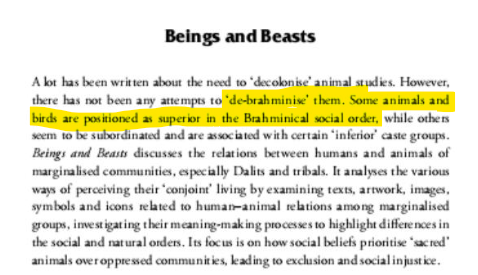
1) A humanities prof at IIT Gandhinagar has compiled an important book about "De-Brahmanizing" animal studies and decoding the hierarchical superiority of certain animals and birds in the Brahmanical soshal order.
Published by Cambridge, praised by Harvard profs, this magnum opus is priced at a meagre 1000 Rs only. It is critical that India redirects the useless money wasted on Jet engines and semiconductor fabrication to such sociology research so that we will know where exactly Owl stands in the Brahmanical aviary order. We will never become Vishwaguru without settling such civilization defining questions.
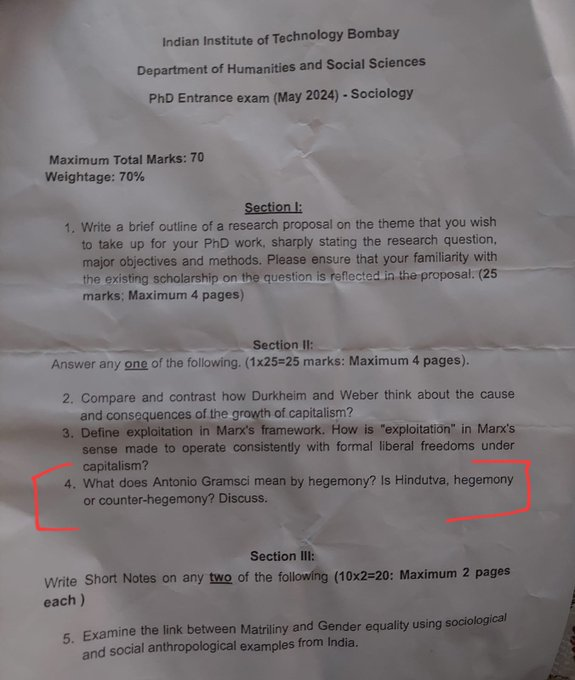
2) IIT Bombay's Sociology PhD entrance exam candidates wrote essays on the consequences of capitalism, Marx's definition of exploitation and Gramsci's definition of hegemony. A beautiful follow-up question about whether Hindutva was hegemonical was asked in the entrance exam, so that only peaceful Marxists get selected for the country's prestigious cutting edge research done within these humanities laboratories.
My heart swells with pride that my tax money funds the sutta cost of a young 46 year old PhD candidate who studies about Marx without worrying about marks - because assigning marks/grades is itself a Brahmanical construct that our humanities researchers have done away with.
3) If you are still skeptical about their research output, take a look at IIT-Delhi's humanities department's phenomenal research paper about the tyranny of Indian nationalism and the resistance in Kashmir. Only third world countries like USA take anti-nationals seriously, we are a first world nation that funds its own secessionism. It is baffling why aren't patriotic Indian taxpayers taxed 78.6% more so we can produce more such liberal thinkers?
No wonder we rank 6th in the useless nominal GDP rankings but are ranked below Iraq, Azerbaijan and Libya in the metric that matters - Human Development Index.
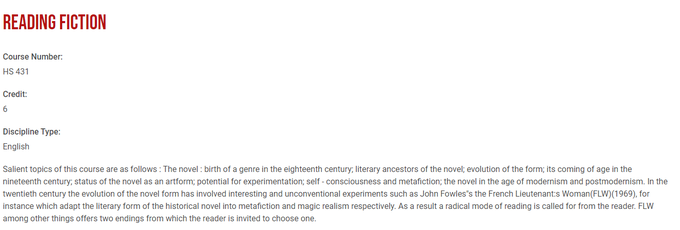
4) And finally, let us look at what IIT humanities students actually get to study. While the world is uselessly studying about Machine Learning, Quantum Computing, Hydrogen Fuel cells and CRISPR gene editing, IIT Bombay's best minds are studying a 6 credit course on "Reading Fiction"
How can we call ourselves world class thinkers if we do not understand the inner world of the characters in Arundhati Roy's Booker winning book of why did the mixed twins sleep with each other. This is how we build sharp minds. Remember that while you are lazily clocking 60 hour workweeks, there are hardworking students in airconditioned rooms of Powai trying to figure out the narrative subtext behind the curtains being blue from a 19th century novel.
Hopefully you are convinced now why we should absolutely have more funding for the value crating humanities departments within the useless STEM institute called IITs. Jai Bhim, Jai Samvidhaan, Jai Humanities.
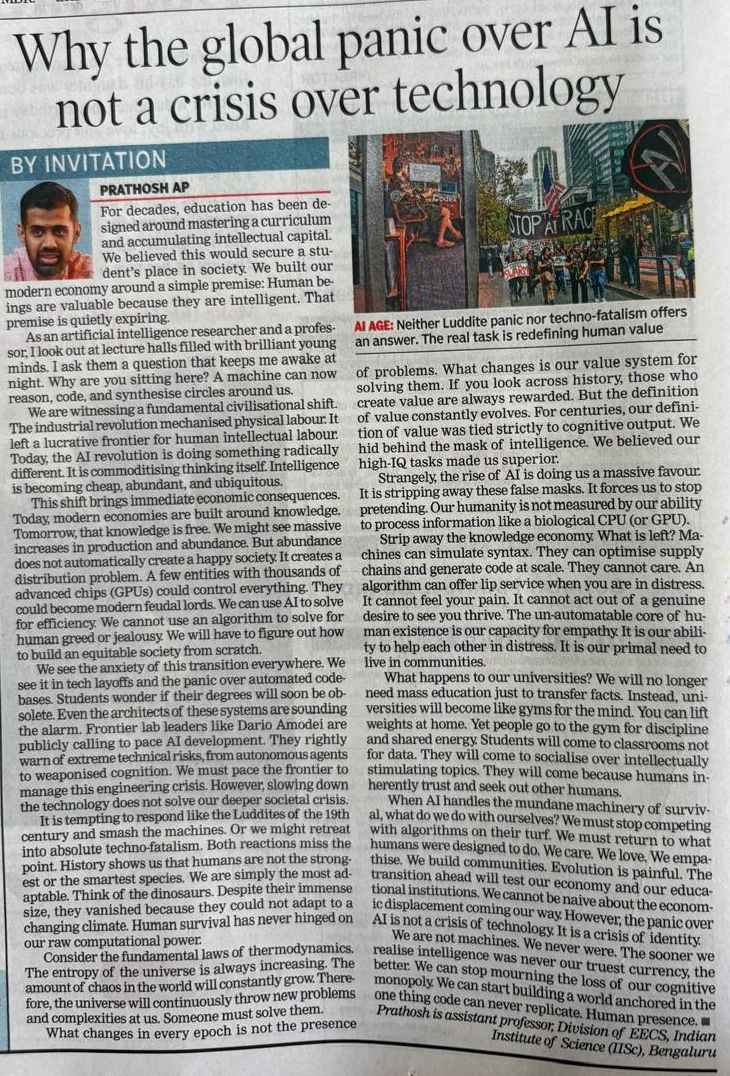
A few days ago, I shared a candid conversation with my students on AI, higher education, and human value.
It went unexpectedly viral.
This time, I’ve tried to put those thoughts into a more structured form - my latest piece in TOI. Take a look.
We desperately need help!
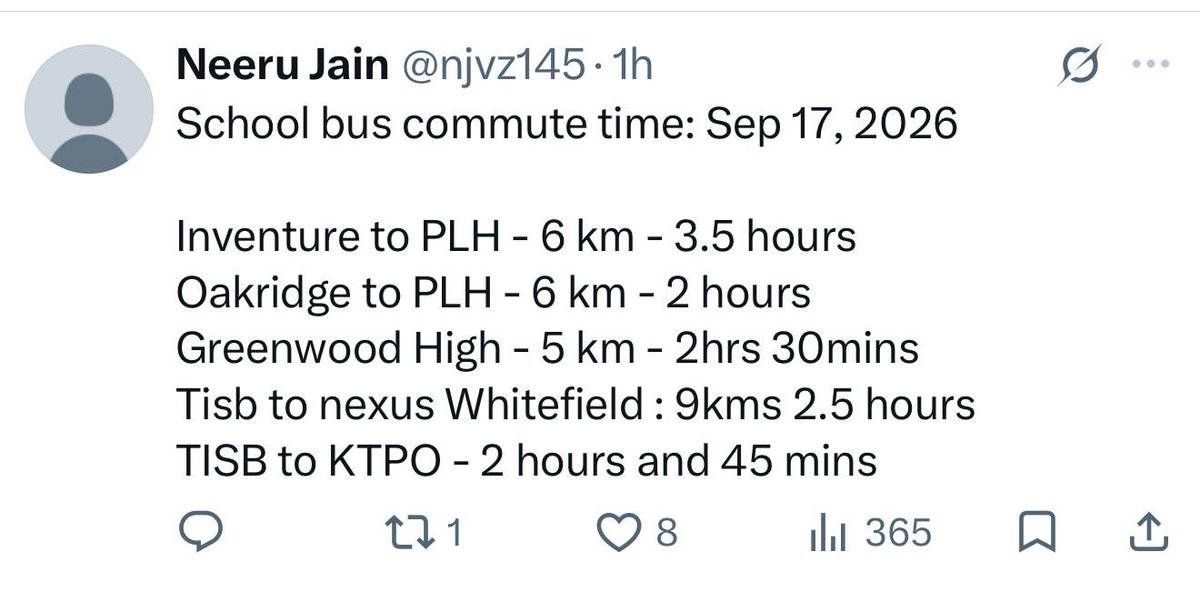
Children and teachers spent as much as 7 hours on the road getting to school and back home today. Sadly, this is not a one-off event
We urgently need to invest in mass mobility & public transport, a bigger road network - long term investments for an ever growing #Bengaluru.
And meanwhile, there are things we can do now:
• Keep heavy vehicles off key roads during school peak hours
• Enforce penalties for wrong-side driving & other traffic violations
• Incentivise school buses & shared transport over individual vehicles
• Collect real mobility data and use simulation / “what-if” analysis to determine optimal school & office timings
• Fix potholes, blocked drains & other bottlenecks urgently
This area is home to some of Bengaluru’s and India’s best schools. Their parents & educators have built Brand Blr. And these thousands of children will power the future of our city & country
Surely we can do better for them & for the teachers, parents, staff & citizens who are losing hours of their lives on our roads every day. This needs both immediate action and long-term planning
I believe all stakeholders want what’s right for our citizens & city. So here’s hoping, praying … working collaboratively towards effective solutions
Today my daughter’s school bus took 2 hours to travel just 2 km in Varthur/Gunjur road.
For those 2 hours, I sat there as a parent feeling completely helpless.
I work hard. My wife and I pay lakhs in taxes every month. We took a huge home loan mainly so we could live close to our daughter’s school and give her a safer, easier childhood.
And yet, this is what “2 km from school” means here.
In the last year alone, we have seen a school bus topple, a woman suffer serious injuries after a fall, a biker almost lost his life after falling because of a pothole, and many more incidents that never become headlines.
Every day, ordinary people here tweet, email, complain, follow up and plead with authorities.
We are not activists.
We are not fighting for a political party.
We are parents, employees, families and taxpayers asking for one basic thing:
Please give our children a safe road to come home on.
Today, more than the traffic, what broke me was the feeling that despite doing everything a responsible citizen is supposed to do, I had absolutely no power to protect my own child.
If anyone knows how ordinary citizens of Varthur/Gunjur can reach someone with the authority to actually intervene, please help us.
@krishnabgowda@DKShivakumar@MALimbavali@ArvindLBJP@GBA_office@BECCUPDATES@ChristinMP_@RamSNarayan@GunjurCharan@RisingVarthur@BDAOfficialGok
#varthurisbleeding
The great temples of India are often remembered through the names of the kings and queens who built, and renovated them. But the story of the Madurai Meenakshi Temple, which will witness its Kumbhabhishekam tomorrow, is also the story of its people.
The temple suffered heavily during the sultanate invasions that struck Madurai, and several parts of the sacred complex had to be rebuilt, restored and expanded in the centuries that followed. Royal patronage undoubtedly played a major role in this revival. Yet what makes Madurai extraordinary is the remarkable participation of ordinary citizens as well.
Here is the thread of some of the contributions.
The majestic South Gopuram was built by Siramalai Sevvanthi Chetti , who was a merchant from Tiruchirappalli. Not only him, his family including his sons and grandsons contributed to the rebuilding the temple. 1/7
We are now poised to:
Formalize all known Human Mathematics.
This is the modern equivalent of the Human Genome Project. or AlphaFold more recently, whereby all data of its kind is fully classified.
With sufficient funding and compute/tokens, a coordinated effort among academia, frontier labs, philanthropic organizations, and the federal government can formalize all Human Mathematics in the next year.
In a landmark finding, the novel composite Al–11Si–0.25MWCNT demonstrates exceptional thermal conductivity of 335–355 W/mK, enabled by efficient phonon transport, reduced interfacial thermal resistance & refined microstructure in a DIA-RCoE @iiscbangalore project of @DRDO_India.
Wtf how this breakthrough by DRDO only have 200 likes :(
Let's make it to 1k likes atleast.
( Aluminium silicon multi-walled carbon nanotubes )
This is special composite material to make heat spread faster which leads to ease of cooling the system.
Cheaper than copper:)
Motorsports legend Maletira Jagath Nanjappa passed away at the age 68 today.
Last rites at their residence at Nalvathoklu village in Kodagu tomorrow at 4 pm.
Nanjappa won the Indian National Rally Riders Championship nine times in the motorbike section between 1986 and 1996.
He competed alongside his wife, Anita Nanjappa, who served as his navigator during his illustrious early motorcycling career.
They famously completed a 70-kilometer stretch of a rally with a flat rear tire by having Anita sit on the bike's petrol tank to ease the load.
After dominating motorcycle rallying, he transitioned to four-wheel and off-road events. In 2018, alongside co-driver Chetan Changappa, he won the grueling Rainforest Challenge India held in Goa.
"I'm doing a (free) operating system (just a hobby, won't be big and professional like gnu)..."
On August 25, 1991, a 21-year-old student sent a message to a Usenet newsgroup. He thought he was just building something fun for himself.
35 years later, that "hobby" is the backbone of global technology:
🚀 Powering helicopters in space with NASA
☁️ Running the global cloud and 100% of the world’s supercomputers
📱 Connecting billions of people
🎮 Redefining the future of handheld gaming
What started as one student's side project became the greatest collaborative technology movement in history. Thank you to every maintainer, contributor, and advocate who made it possible.
Happy 35th Birthday, Linux. Here’s to the power of open source and the next 35 years of building together.
https://t.co/KDN6Coob7F
#Linux35
Yesterday had been an Āyurveda day for me. Spent quite a bit of time digging into it. 🙏🙏
We all know that modern immunology rests on a foundational distinction:
- Innate immunity (defenses we are simply born with, present from birth, not learned)
Versus
- Acquired immunity (defenses our body builds up over a lifetime, through exposure and adaptation).
This distinction is treated as a relatively modern conceptual achievement, developed properly only as 19th and 20th century immunology matured.
Caraka got there 1st, and split it into more categories than the modern 2.
In the Caraka Saṃhitā, the concept is called Vyādhikṣamatva, literally, "the capacity to resist disease" and Caraka does not leave it as 1 vague idea.
He explicitly divides the body's disease-resisting strength, balā, into 3 distinct types:
- Sahaja-balā: strength we are simply born with, inherent and constitutional. This is, structurally, innate immunity.
- Kālaja-balā: strength that changes with time, age, and season, describing how the body's resistance shifts across a lifespan and across the calendar year. Modern immunology has its own well-documented parallel here too: immune function genuinely does vary by age and by season, a fact modern medicine only properly systematized in recent decades.
- Yuktikṛta-balā: strength actively built up through deliberate effort: correct diet, exercise, and specific rejuvenating herbal formulations called Rasāyana. This is, structurally, acquired immunity, resistance we build, not resistance we are simply issued at birth.
Multiple modern peer-reviewed papers in Ayurvedic and integrative medicine journals have made this exact 3 way comparison explicit, treating Vyādhikṣamatva as a genuine conceptual ancestor to the innate/acquired immunity framework.
A structurally similar attempt to categorize the same underlying biological phenomenon, built entirely from clinical observation with zero access to a microscope / WBC / any concept of a pathogen.
Nobody in Caraka's era could have known what a T-cell was....
But somebody paying close enough attention to which patients got sick, which patients recovered, which patients seemed naturally hardier, and which patients could be made hardier through diet and lifestyle, somebody built a 3 part framework for that observation, gave it a name, and wrote it into a foundational medical text, over a 1000s years before the word "immunity" existed in any European language with anything close to its modern meaning.