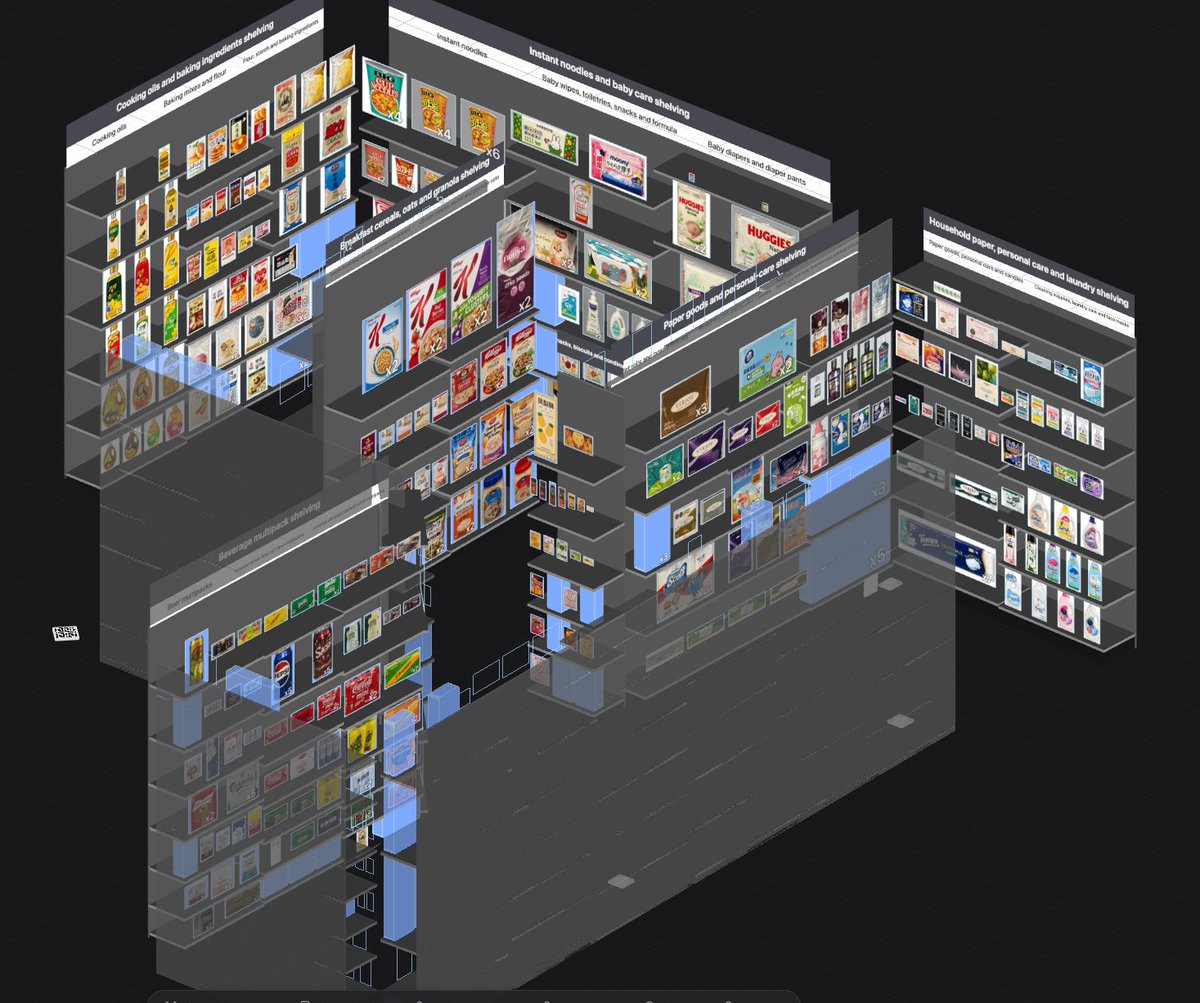
Coming soon to @CactusXR: fixture geometry, product locations, labeled products from image recognition, and facing counts straight from reconstructions.
This will reduce hours of scanning barcodes and counting facings to the few minutes it takes to film the area.
$AUKI is bringing intelligence to physical retail, and what @AukiNetwork is building with @CactusXR is bigger than shelf analytics.
Imagine replacing hours of manual barcode scanning, product identification and facing counts with just a few minutes of filming.
That’s the power of spatial AI.
With fixture geometry, product location mapping, AI-powered image recognition and automated facing counts, @CactusXR is turning ordinary retail environments into data-rich, intelligent spaces.
The value proposition is huge 👇
Less manual work, lower operating costs, better inventory visibility, improved shelf management and smarter business decisions.
E-commerce already has analytics.
Physical retail deserves the same intelligence.
$AUKI is helping bridge that gap, building the spatial intelligence layer that allows machines to understand the physical world.
TOP 10 DePIN projects by revenue but one name I expected to see getting more attention is missing: $AUKI
Most revenue rankings focus on measurable protocol revenue generated over a specific period. AUKI does have tracked protocol revenue with network credits purchased in AUKI and subsequently burned.
But its bigger story is developing across enterprise retail, spatial intelligence and robotics.
Look at the progress:
• Cactus pilots expanding across retail environments.
• Enterprise customers and grocery partnerships.
• Galbot and RealMan robots scanning store fixtures autonomously.
• CactusXR turning store reconstructions into actionable retail data, including product recognition, locations and facing counts.
• An open source SDK designed to connect robots, sensors and devices to shared spatial intelligence.
AUKI is tackling a different infrastructure problem and working on helping machines understand the physical environments they operate in.
I don't think enterprise adoption should automatically be counted as token revenue. Those are two different metrics and the token economics still need to prove themselves as deployments scale.
Judging a project's potential exclusively by today's protocol revenue can leave out an important part of the picture.
Humanoids already outnumber humans at Auki HQ.
There's never been a better time to come build something at our hacker house — we've got loads of robots from different manufacturers you can work on.
Guess which crypto project gets another $1M worth of robots dropped on their doorstep.
F**** $AUKI. Sleeping giant in the making.
This is the time to buy. 2027 is going to be an amazing year for Auki.
Another $1M worth of robots coming from an OEM partner is a strong signal of the work happening behind the scenes at @Auki HQ.
It's not just about having access to more hardware. It's about expanding the range of platforms Auki can integrate with, test and develop deployment workflows for.
Physical AI won't scale if every robot needs its own isolated infrastructure. The real opportunity is making the same spatial intelligence layer useful across different machines and real-world environments.
Milestones like this make the vision increasingly interesting for me.
base:0xf9569cfb8fd265e91aa478d86ae8c78b8af55df4
▪️ $AUKI ▪️
Demand for @Auki is surging 🚨
And for good reason ↓
Alibaba’s online store recently reported a 258% increase in revenue using AI
Impressive, but bringing AI into physical retail is a whole different challenge…
Stores have thousands of moving parts:
Staff, stock, customer behaviour
product placement, foot traffic etc.
That’s exactly what @auki is tackling using their AI copilot: @CactusXR
—���———————————————
Early results for @CactusXR show:
—————————————————
⏱️ 15+ mins saved per employee: via
frictions free task
⏱️ 30+ mins saved per employee: via
direct product search
⏱️ 50% saved in walking distance: via
multi tasking optimization
⏱️ 6% lift in basket attachment rate: via
direct product search
—————————————————
THE RESULTS:
✅ Higher revenue potential
✅ Faster staff onboarding
✅ Fewer handover meetings
✅ More efficient store operations
—————————————————
All achieved using Tech suite:
—————————————————
▪️ AR product search
▪️ Real-time AI store intelligence
▪️ AI task generation
▪️ Sales heat maps (via cctv cameras)
▪️ Attention mapping
▪️ Cross-chain analytics
—————————————————
And with seamless robotic integration this productivity will only increase!
@Auki is already targeted to deploy 1,000+ robots next year alone!
🚨 TRUMP PROMISED TO MAKE AMERICA THE "CRYPTO CAPITAL OF THE WORLD".
#BITCOIN IS NOW DOWN 42% SINCE THE DAY HE TOOK OFFICE.
AND HIS FAMILY GOT RICH WHILE YOU GOT LIQUIDATED.
→ BITCOIN ON INAUGURATION DAY: $102,145
→ BITCOIN TODAY: $59,000
→ HIS OWN MEMECOIN: DOWN 99%
→ $1.57 BILLION LIQUIDATED IN THE LAST 24 HOURS
→ THIS SUNDAY: A PRIVATE DINNER FOR THE TOP 185 HOLDERS OF HIS COIN
UNDER BIDEN, WHOSE SEC SPENT FOUR YEARS SUING CRYPTO, BITCOIN WENT UP 188%.
UNDER THE "CRYPTO PRESIDENT", IT HAS BEEN CUT ALMOST IN HALF.
THE FED IS HIKING. THE DEMOCRATS WON CONGRESS. THE CRYPTO BILL IS FADING.
WAS CRYPTO EVER THE PLAN?
OR WERE WE JUST THE EXIT LIQUIDITY? 👀
"Physical AI has to be more than a motor cortex. We want AI to help us run our physical businesses. Why shouldn't the physical AI be capturing the data, analyzing the data, and making decisions?"
- @broodsugar at @TheHumanoidHub conference ICYMI: https://t.co/72XWfLNc9b
An OEM partner sending another $1M worth of robots to your lab says something about the work happening behind the scenes for @Auki
Building a robotics product is one thing but getting manufacturers to trust your technology enough to put more of their hardware into your hands is another.
More robots mean more opportunities to test integrations, improve deployment workflows and work across different robotic platforms.
Real opportunity for $AUKI is making deployment easier for many different robots in real world environments.
$AUKI is working on something that could fundamentally change how we think about retail and physical AI.
I found this presentation by @broodsugar particularly interesting because it goes beyond the idea of simply putting robots in stores.
The vision is AI powered robot store managers.
Think about all the decisions involved in running a supermarket:
• What products to carry
• Where to place them
• How to price them
• When to offer discounts
• When to replenish inventory
Now imagine removing as much human guesswork from those decisions as possible and allowing AI to make smarter, data driven decisions.
Nils references an experiment with a Chinese retailer whose flagship supermarket in Beijing reportedly increased revenue by 258%.
That's a pretty remarkable result.
What really caught my attention was the explanation of what these robot store managers actually do:
•They autonomously navigate the store
• Respond to changes in the physical environment
• Analyze sales data
Their job isn't simply to perform physical tasks. It's to tell human employees how to run the store better.
One example really brings this to life:
It's Friday afternoon, but chocolate sales are lower than usual.
The store's AI detects the change and dispatches a robot to investigate.
Is the product still in stock? Has there been shoplifting? What's happening in that section of the store?
The robot investigates, and whatever it discovers can be turned into a task for employees through an augmented reality task manager.
I particularly liked Nils point that the frontline needs brains more than muscle.
This isn't just about replacing people with robots, it's about giving employees better intelligence and helping them make better decisions.
Another interesting part is the connection to customers phones. People already use AI through their phones, where the camera allows AI to see and understand the world around them.
Nils also discusses starting to deploy these robots to those customers in January, with onboarding taking approximately one minute.
We're talking about AI moving beyond screens and into the physical world, understanding environments, responding to real world changes and coordinating meaningful actions between machines and people.
Retail is an incredible place to demonstrate the potential, but the implications of this kind of technology extend much further.
@Auki is one to watch.
POV: you have such a good path for getting robots deployed that one of your OEM partners decides to send another $1M of robots to your lab just because.
In 1999, most businesses didn’t think they needed a website.
In 2026, most businesses don’t realise they need an Agent.
The companies that claimed domains early won the last era.
The companies that claim verified Agents will win the next one.
Fetch Business enables this.
Verify your brand agent and build your agent in minutes.
https://t.co/kKkyZ124j8
Cactus thought every store looked the same. base:0xf9569cfb8fd265e91aa478d86ae8c78b8af55df4
It started by assuming every product sits on a shelf, which works for plenty of stores but not all of them.
Real stores rarely stick to one layout.
Islands, freezer cases, and produce displays sit alongside shelves in the same aisle, each one shaped differently.
@Auki 's demo store now has all of those, and Cactus is catching up to match them.
That gap only became visible once Auki’s own demo store stopped looking like a simple shelf layout.
Most systems meet their limits this way
Through a space that no longer matches the one they were built for.
Augmented reality was always going to be for communicating with robots.
They're AR natives, and our beginnings as a shared AR company is now giving us a huge head start on teaching robots to understand space collaboratively.
Every business is starting to have two front doors.
One for people: the website.
One for their AIs: a verified agent that can answer, book and resolve.
Not sure how to use agentic AI for your brand? Get details at https://t.co/S4IpTGDlXq