What if the biggest challenge facing AI isn’t innovation, but legitimacy?
As generative AI accelerates, concerns are moving beyond competition and copyright.
Amnesty International has raised a major warning about the foundations of generative AI.
In @amnesty new report, Unlawful by Design, the organization argues that many leading AI models may be built on large-scale privacy violations through web scraping practices that collect personal data without meaningful consent.
The report examines systems behind tools from Google, OpenAI, Meta, DeepSeek, Midjourney, and Stability AI.
But the concern goes beyond privacy.
Amnesty says these systems also raise broader human rights risks:
• Amplifying bias and discrimination
• Threatening freedom of thought
• Increasing environmental strain through energy-intensive infrastructure
This shifts the AI debate into new territory.
For years, the focus has largely been on copyright and competition.
Amnesty reframes the issue around something bigger:
Human rights.
As AI becomes core digital infrastructure, the real challenge is not just building more powerful systems.
It’s building systems that are transparent, accountable, and aligned with fundamental rights.
The future of AI will be shaped not only by what it can do, but by the principles it is built on.
Peut-on encore parler d'intelligence artificielle à l'heure actuelle ? Est-ce un euphémisme d'évoquer le terme de "raisonnement artificiel" : c'est le postulat avancé par Hayat Outahar, experte stratégique numérique, au JT.
https://t.co/cHI4q60sqe
Just built an insane new agent skill.
It can perfectly extract slides from YT videos, then write notes, images, transcripts, and slides into Obsidian vaults.
An HTML artifact allows me to navigate and add more notes as I listen.
Should I release the skill?
Une société qui oblige une personne de 90 ans à utiliser un smartphone pour accéder à ses droits n’est pas une société moderne. C’est une société qui abandonne peu à peu ses anciens.
En 2026, tout est devenu une application, un code, un mot de passe ou un portail en ligne.
Mais ceux qui ont construit ce pays avec leurs mains se retrouvent aujourd’hui perdus face à des écrans qu’ils ne comprennent pas toujours.
Quand une personne âgée doit appeler son fils, sa fille ou son petit-enfant simplement pour prendre un rendez-vous, payer une facture ou remplir un document administratif… alors le système a échoué quelque part.
Ce n’est pas du progrès quand une partie de la population se sent exclue dans son propre pays.
La technologie devrait simplifier la vie de tout le monde, pas réserver la dignité à ceux qui savent tout faire sur un téléphone.
Parce qu’une société qui laisse ses anciens derrière elle ne devient pas plus moderne.
Elle devient simplement plus froide et plus égoïste.
/goal is really insane!
It's how you can get the most out of coding agents today.
For efficiency, I find it works best when you do planning before /goal. This ensures the agent has the right context and goal, which often only happens with careful planning.
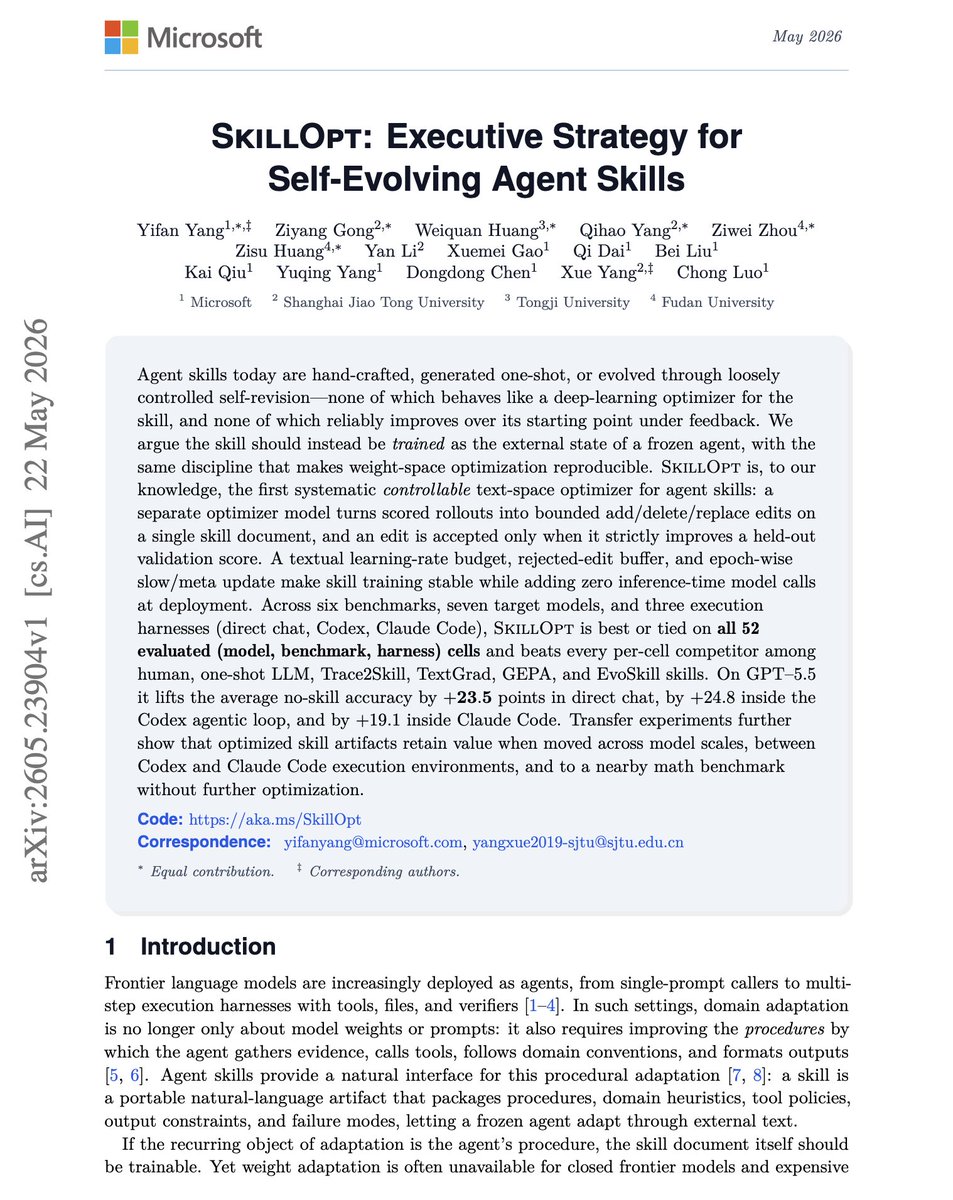
New research from Microsoft Research
I see a lot of AI engineers handwriting agent skill docs and hope they generalize.
Probably not optimal. This works show why.
It treats the skill doc as a trainable external state of a frozen agent instead.
It introduces SkillOpt, where an optimizer model makes validation-gated edits to the skill file. It adds, deletes, or replaces instructions, with a textual learning rate that controls how aggressively each round rewrites the doc. The agent itself never changes.
SkillOpt is best or tied on all 52 (model, benchmark, harness) cells.
On GPT-5.5 it adds 23.5 points in direct chat, 24.8 with Codex, and 19.1 with Claude Code over no skill. It beats human-written skills, TextGrad, GEPA, and EvoSkill, carries zero extra inference-time cost, and the learned skills transfer across models and harnesses.
Paper: https://t.co/mNgTmmT32U
Learn to build effective AI agents in our academy: https://t.co/1e8RZKs4uX
Most people still think building AI products requires:
→ expensive APIs
→ huge cloud bills
→ VC funding
→ a team of ML engineers
That was true in 2023.
In 2026, a single developer can build production-grade AI systems for basically $0.
Here’s the modern AI stack nobody talks about enough 👇
🧠 LLM Layer
Run models locally for free:
→ Ollama
→ Gemma 4
→ Llama 3.3
→ Mistral Small 4
No API costs.
No rate limits.
No sending private data to external providers.
⚙️ Agent Orchestration
Coordinate multi-step AI workflows with:
→ LangGraph
→ CrewAI
Agents can now:
• research
• reason
• use tools
• delegate tasks
• validate outputs
This is where AI shifts from “chatbot” → “system.”
📚 RAG Stack
Production retrieval without paying OpenAI:
→ LlamaIndex
→ ChromaDB
→ Qdrant
Build:
• internal copilots
• document search
• memory systems
• AI knowledge bases
• autonomous research agents
Entirely local if you want.
🔌 Tool Layer
MCP changed everything.
It’s becoming the universal protocol between:
→ agents
→ IDEs
→ databases
→ browsers
→ APIs
→ developer tools
One standard interface for AI systems to interact with the real world.
💻 Coding Agents
Your new AI engineering team:
→ Claude Code CLI
→ Aider
People are shipping entire startups with AI-assisted development loops.
The best developers now orchestrate agents instead of writing every line manually.
🌐 Frontend Layer
Ship interfaces instantly with:
→ Next.js
→ Streamlit
→ Vercel free tier
You can go from idea → deployed AI app in a single day.
🗄️ Data Layer
Simple > overengineered:
→ SQLite
→ DuckDB
→ Supabase free tier
Most AI apps do NOT need complex distributed infrastructure early on.
📈 Observability
Serious AI systems need tracing:
→ Langfuse
→ Phoenix
Track:
• hallucinations
• latency
• agent decisions
• prompt failures
• retrieval quality
Production AI without observability is blindfolded engineering.
🚀 Deployment
Deploy almost anywhere:
→ Docker
→ Cloudflare Workers
→ HuggingFace Spaces
Global AI apps can now run on infrastructure cheaper than a Netflix subscription.
Total stack cost:
$0
The tools are free.
The real moat is:
→ architecture knowledge
→ workflow design
→ context engineering
→ system thinking
Not access to models.
We’ve entered the era where small teams can build systems that used to require entire companies.
Save this for your next AI build 🔖
#AIArchitecture #AgenticAI #LLM #BuildInPublic
FORUM INTERNATIONAL CONGO-CANADA : LA DIASPORA AU CŒUR D’UN PARTENARIAT ÉCONOMIQUE D’AVENIR
Le Forum Congo-Canada marque un tournant historique dans les relations bilatérales entre Ottawa et Kinshasa. Loin des schémas d'aide traditionnels, cet événement pose les jalons d'un modèle de coopération moderne : un partenariat stratégique, durable et équitable. À travers des échanges denses, nous avons présenté la RDC sous son vrai jour, celui d'une terre d'opportunités majeures prête à intégrer pleinement les chaînes de valeur mondiales.
Transformer le potentiel en richesse partagée
La RDC refuse désormais d'être un simple réservoir de matières premières brutes. L'objectif partagé par les gouvernements et les opérateurs économiques est sans équivoque : transformer les ressources localement pour stimuler la création d'emplois et de richesses en RDC, tout en garantissant des rendements solides aux investisseurs canadiens.
Les discussions ont mis en lumière quatre secteurs prioritaires :
Mines et transition énergétique : Valorisation des minéraux critiques (cobalt, lithium, cuivre) indispensables à l'industrie technologique canadienne.
Énergie : Exploitation du gigantesque potentiel hydroélectrique congolais.
Agriculture : Développement de l'agro-industrie sur des millions d'hectares de terres arables.
Infrastructures : Modernisation des réseaux de transport et de télécommunications, leviers indispensables à l'expansion du commerce.
Réformes et incitations : un climat des affaires sécurisé
Pour concrétiser ces ambitions, la RDC déploie des arguments institutionnels forts. Représentant le gouvernement congolais à ce forum, le ministre du Commerce Extérieur, Julien Paluku Kahongya, a mis en avant une série de réformes structurelles majeures. Ces politiques visent à sécuriser les capitaux, moderniser le cadre législatif et stimuler l'industrialisation locale. L'assainissement du climat des affaires et la sécurisation juridique s'affirment désormais comme des garanties de transparence et de prévisibilité pour les entreprises canadiennes.
Sur le plan fiscal, le Directeur Général de la Direction Générale des Impôts, Barnabé Muakadi Muamba, a exposé les mesures incitatives et transparentes spécialement conçues pour attirer les investisseurs étrangers. En simplifiant les procédures et en offrant des régimes préférentiels clairs, la DGI s'impose comme un partenaire de confiance pour sécuriser et accompagner le déploiement des capitaux canadiens.
En tant que Directeur honoraire des IXes Jeux de la Francophonie, nous encourageons fortement l’axe stratégique Ottawa-Kinshasa à jouer un rôle moteur dans la promotion d’une Francophonie économique forte, véritable vecteur de développement pour notre espace commun.
La RDC, qui ambitionne légitimement de prendre le leadership de l’Organisation internationale de la Francophonie, sait qu’elle peut compter sur le Canada – fort de ses trois voix au sein de l’institution – pour soutenir l'élection du prochain Secrétaire général et bâtir ce bloc économique francophone d'avenir.
Le véritable catalyseur de cette nouvelle ère est la diaspora congolaise établie au Canada. De Montréal à Vancouver, en passant par Toronto, Ottawa et Calgary, cette communauté vibrante regorge de talents, de scientifiques, d'entrepreneurs et de cadres de haut niveau.
Cette diaspora dépasse le simple rôle de pont culturel : elle est un acteur économique de premier plan. Grâce à sa double culture et sa fine connaissance des réalités des deux pays, elle agit comme un facilitateur d'affaires naturel. Elle constitue le véhicule idéal pour le transfert de compétences, le codéveloppement et l'innovation technologique entre le Canada et la RDC.
En unissant l'expertise canadienne, les ressources congolaises et le leadership de la diaspora, le Forum Congo-Canada ouvre la voie à une prospérité commune. L'histoire s'écrit maintenant, et les opportunités n'attendent que ceux qui osent bâtir l'avenir.
Isidore KWANDJA NGEMBO
Now pitching is Hayat Outahar from @GoodHiveLabs 🐝
A decentralized recruitment protocol for Web3 tech talent—using token incentives and on-chain reputation to align hiring with community values.
#EthVC
Immigration : "Un certain nombre de manipulateurs ont, petit à petit, jeté la suspicion et l'opprobre sur le statut même du demandeur d’asile et du réfugié" dénonce Najat Vallaud-Belkacem (@najatvb) #LaVéritéEnFace
https://t.co/QxXAa8msfq
In tech, we often talk about first-mover advantage. But increasingly, the real mass-market power lies with the second mover: the one who refines, scales, and distributes after the groundwork has been laid.
@reidhoffman puts it best:
“You don’t have to be first, you just have to be right.”
Look at @brexHQ vs. @tryramp.
@samdblond and the team at Brex spent 4 years building a GTM engine from scratch:
•Educating the market
•Sponsoring conferences
•Plastering billboards
•Sending custom gift boxes to fundraising CEOs
By the time Ramp arrived, customer education was done.
Ramp just had to copy the playbook, ship a smoother product, and win.
We’re starting to see similar patterns in crypto:
•Solana → Sei
•Base → Robinhood
Solana and Base pioneered the category - investing deeply in infra, ecosystem building, and narrative shaping.
Now, Sei and Hood are showing signs of being second movers with cleaner UX, refined positioning, and the ability to scale downstream, without the same CAC burden.
Customer education is expensive.
But for second movers, timing is a weapon.
So pumped for this 25-28 consumer supercycle fam 🚀
We're launching the first-ever zkVerified markets on @avax with @eulerfinance@multiplifi@PythNetwork
This changes everything.
Institutional capital can finally access DeFi without sacrificing privacy or decentralization.
[Activité partielle]
Un outil clé de prévention des #licenciements#économiques@Travail_Gouv#dreets#ASP
- Comment effectuer la demande ?
- Quelle rémunération pour le salarié ?
- Quelle allocation pour l’employeur ?
▶️Dispositif en détail : https://t.co/X8GFMHfj03
The man who can predict the future:
Balaji.
He was an early investor in Bitcoin, Ethereum and Eight Sleep.
He just said, "Social media is about to become far, far more lucrative than people realize."
His 4 shocking predictions on the future of social media & wealth creation:
Nous sommes partenaires de la 6ème édition des Universités d’Été de l’Économie de Demain qui s’intéressent à la thématique #REDIRIGER, aux côtés du @Mouv_ImpactFr. Rendez-vous le 28 août à la Cité Internationale Universitaire de Paris ! 👉 https://t.co/6Zyr6TBlUw









![lesaides_cci's tweet photo. [Activité partielle]
Un outil clé de prévention des #licenciements #économiques @Travail_Gouv #dreets #ASP
- Comment effectuer la demande ?
- Quelle rémunération pour le salarié ?
- Quelle allocation pour l’employeur ?
▶️Dispositif en détail : https://t.co/X8GFMHfj03 https://t.co/yF4EDod8wv](https://pbs.twimg.com/media/Ga9lrUmWgAAdXCL.jpg)




![EthCC's tweet photo. That’s right, frens!
EthCC[8] will take place in the beautiful city of…Cannes! 😍🥳✨
See you there in 2025 😎 https://t.co/IoTSBdtlDM](https://pbs.twimg.com/media/GSNu4S-WgAA4tnN.jpg)
![Web3TalentFair's tweet photo. [Meet your speakers : @HayatOutahar], join us on July 12th! 🎉 If you're in town for #ETHCCweek 🇧🇪, sign up now for a day of #web3 networking and job opportunities! 👉 https://t.co/Os2dTXbTDL 👈😊💯 #Blockchain #ETHCommunity #ethereum #ethcc #ethcc2024 #cryptocommunity #devs https://t.co/DG74ceJoA5](https://pbs.twimg.com/media/GSIqsnzWQAA-Da4.jpg)