🚀Excited to share how @CollateData 's $10M Series A accelerates @open_metadata open source mission
→ Faster release velocity
→ More Product Development and community support
→ Renewed investment in open core
Read more in the OpenMetadata blog: https://t.co/5FyEr1C7hM
ChatGPT on database schemas: 10% accuracy.
Same model + Collate semantic context: 77%.
Context tells AI where data lives. Semantics tells AI what data means. Both layers matter.
Collate named to the DBTA 100 — Companies That Matter Most in Data, 2026.
https://t.co/yrs3m3jgot
#SemanticContext #ContextLayer #AIforData #DBTA100
Your AI is missing context that lives in Confluence pages, shared drives, documents, and the institutional knowledge your teammates carry but never wrote down.
Live demo June 18, 9 am PDT: Collate Context Center. 30 minutes.
Register Now: https://t.co/K8dxOhJAQn
#Collate #OpenContextLayer #DataGovernance #OpenMetadata #DataEngineering
Check out the latest episode of the Collate Product Demo Series. This shows many of the powerful data quality capabilities in Collate that eliminate the errors that cost your business money. Also see how to get an analytics head start with Collate AI Analytics.
🎥👉Watch here: https://t.co/Ttqhsrw8fg
#DataQuality #OpenMetadata #DataEngineering #Collate #AiAnalytics
🆕 A while back, @open_metadata added the StarRocks connector.
This makes it easier to bring metadata into OpenMetadata, including schemas, tables, column types, and view definitions via StarRocks’ MySQL-compatible interface.
Setup guide: https://t.co/OIhAFgdfso
I audited unofficial Openmetadata CLI from romamo/openmetadata-cli against 22 Critical CLI Agent Spec failure modes.
Even though it was built during a hackathon, it has the best score among all the other tested tools.
Result: 1.5/3 average. Readiness: 12/15 [B].
This CLI already has a serious agent-first foundation: JSON envelopes on normal commands, schema introspection, dry-run mutation previews, MCP mode, bundled agent skills, non-TTY SSO protection, and prompt-injection tagging for external data.
The remaining gaps are mostly contract gaps, not conceptual gaps.
The two failing Critical checks were:
§43 output size: no max-output flag, truncation metadata, or schema-declared output cap.
§74 credential scopes: schema does not declare required_scopes and there is no check-permissions preflight.
The partial failures matter too: timeout maps to GENERAL_ERROR, credential expiry maps to AUTH_REQUIRED, invocation errors can bypass JSON, and dry-run output lacks affected scope/effect fields.
Bottom line: omd is close to being highly agent-ready. The next step is making every failure and credential boundary machine-readable.
Full report: https://t.co/6al9QXPe4y
@open_metadata
Regulated banks don't get to choose whether they govern data. They govern or they fail audits.
@unionbankph: 12.5M customers, 38K+ assets, lineage across @Snowflake + SageMaker + QuickSight.
Started with Excel. Moved to @CollateData.
Cirene Simbahan at #CollateSummit. June 10. Free.
https://t.co/6usRIsUZR2
#DataGovernance #DataLineage
Supply chain attacks and OSS sustainability go hand in hand. I've semi-seriously joked for years that OSS upstreams should periodically purposely inject full vulns into their code and let downstreams fuck around and find out. Downstreams can pay to get the non-FAFO version.
The not joke part is simply that OSS maintainers aren't a supply chain. OSS maintainers are not responsible for monitoring CVEs (because, they are not a supply chain). OSS maintainers are not at fault when bad shit happens to downstreams, because basically every OSS license (MIT, Apache, GPL, etc.) literally says: the software is provided "as-is, without warranty." You get what you pay for (that is to say: absolutely nothing!)
Now, the joke part is that I do believe there is an ethical obligation to try to prevent harm downstream. But "try" is the key word. So, this isn't a serious proposal.
But, if you're using OSS code and you're not paying for a license with a contract that promises some kind of warranty, you have no supply chain. You (the downstream user of an OSS lib) ARE the supply chain.
To use a metaphor: physical goods have a real supply chain. Car manufacturers, chips, clothes, toys, etc. You have a signed commercial agreement with all your suppliers that promises quantity AND quality and blowback if either are missed. Thats a supply chain.
If someone puts some chips on the side of the road with a "FREE" sign, then you integrate those into a product, then find out those chips are hacking customers, its your fault, not the person who dropped them on the side of the road.
@Scout24 runs @Collatedata, built on @open_metadata, in production and calls it a "context catalog."
AWS, Starburst, Collate. MCPs for GitHub + Confluence. AI-generated docs, human-certified. PII tags propagate from Collate to the query engine for agent-level governance.
Angelita Frozza Sanches presents the full build at Collate Summit, June 10.
Free: https://t.co/tjDOwqkspP
#OpenMetadata #DataEngineering #AIAgents #ContextLayer
"Data catalog" became a bad word at @Scout24 after their legacy catalog failed.
After modernizing with @CollateData, Head of Data Infrastructure and Governance, Angelita Frozza Sanches implemented their "context catalog"
The goal: give AI agents and people shared meaning, ownership, and trust signals for every data interaction.
She presents the full build at Collate Summit, June 10.
Free: https://t.co/rrP7aQaVDb
#DataGovernance #ContextLayer #AIAgents
Lukas Patzke, Analytics Architect @Airbus is sharing his knowledge on an expert panel at Collate Summit on June 10.
"Governance in an AI-First World"
Experts will discuss trends in data and AI governance as self-service analytics and self-service AI scales at organizations.
June 10. Free.
🔗 https://t.co/wKFETzHpfc
#DataEngineering #DataGovernance #AIGovernance #AIAnalytics #CollateSummit
Lukas Patzke, Analytics Architect @Airbus is sharing his knowledge on an expert panel at Collate Summit on June 10.
"Governance in an AI-First World"
Experts will discuss trends in data and AI governance as self-service analytics and self-service AI scales at organizations.
June 10. Free.
🔗 https://t.co/tjDOwqkspP
#DataEngineering #DataGovernance #AIGovernance #AIAnalytics
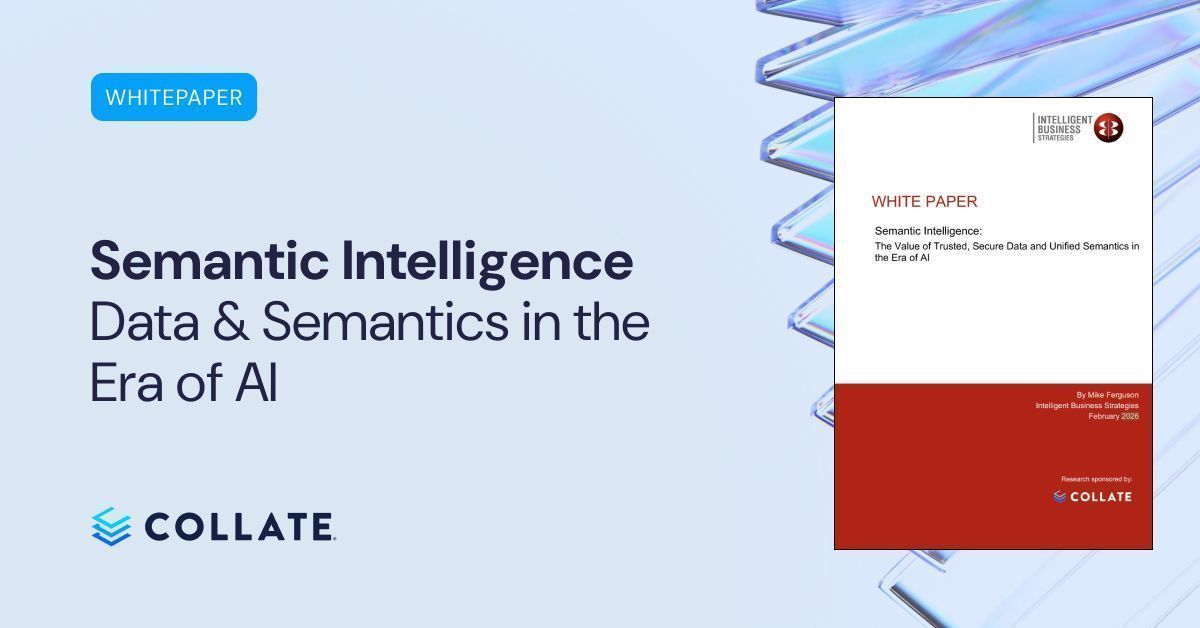
Context isn’t optional for enterprise AI. It’s the difference between answers and accurate, trustworthy decisions.
This new white paper from industry expert, @mikeferguson1, explores how leading organizations are building AI-ready data foundations with unified semantics and governance 👇
What you’ll learn:
→ How a unified knowledge graph eliminates semantic chaos and gives AI consistent context
→ Why AI-powered governance is key to enforcing quality, security, and policies at scale
→ How to build reusable, AI-ready data products faster with metadata-driven workflows
→ What a semantic system of record looks like - and why it acts as persistent memory for AI
If you’re serious about reducing hallucinations and scaling AI responsibly, this is a must-read.
Download here👇
🔗https://t.co/ZYoYurCGMK
#DataGovernance #AI #Metadata #KnowledgeGraph #AIAgents #DataEngineering #SemanticLayer
Most governance failures mean audit findings.
In clinical genetics, the stakes are higher.
Dan Kostecki from @AmbryGenetics at Collate Summit '26: governed data product lifecycle, PHI-free production environment, CAP/CLIA + HIPAA + FDA Part 11 compliant.
June 10 | Virtual | Free
https://t.co/ZjguEWTQRE
#CollateSummit #DataGovernance #DataQuality #DataEngineering #AIinProduction
Before you deploy an AI agent, ask yourself one question:
Does your data have an agreed-upon meaning that a machine can actually read?
If the answer is no, the agent will guess. Every time.
Semantic intelligence is the trust layer that fixes this. It turns metadata into machine-readable context that both humans and AI can rely on.
At @CollateData Summit, we're going deep on how to build it.
June 10. Free.
🔗 https://t.co/tjDOwqkspP
#SemanticIntelligence #AI #DataGovernance
This Wednesday at 11 AM PDT, our CEO & Co-Founder @suresh_m_s is on stage with @DataSciConnect.
The question on the table: as enterprises push AI into production, how do you ensure outputs reflect the right data, tone, and constraints, every time?
It's a context architecture question. And the answer is becoming foundational to trustworthy AI.
Free. One hour. Worth it.
Register here 👉️ https://t.co/Jcekxsh7yV
#ContextLayerAI #DataScienceConnect #SemanticIntelligence #RAG #GenerativeAI #AIAgents #DataGovernance #OpenMetadata
In this month's Product Demo, Dale Kim and James Nguyen showed how Collate, the enterprise platform built on OpenMetadata, takes you from "I need data" to "here's the data I need, who owns it, and why I can trust it."
Your data teams can spend hours hunting for the right datasets, and even longer figuring out if they can trust what they find. You can't succeed with your data initiatives if you're constantly afraid of garbage-in-garbage-out.
They covered:
* A brief demo of data discovery and trust signals in Collate
* Why discovery is only the start, and what else you need to make data usable
* A quick walkthrough and discussion of Data Contracts in Collate
👉🎥Watch here: https://t.co/9IivJZlfPw
#AI #datadiscovery #dataquality #datalineage #datagovernance #dataengineering #datastewards #dateacontracts
AI amplifies ambiguity 100x. "Revenue" means three things across your org. Your agent picks one and returns a confident wrong answer.
@suresh_m_s explains why this is an architecture problem, not a model problem: https://t.co/QAJJ8greDJ
#DataGovernance#SemanticLayer#AIAgents #Ontology #ContextLayer