Can you donate blood if you have tattoos? Watch this video to find out.
Today is World Blood Donor Day, a reminder to donate blood. Your blood can save lives!
Sustained wealth happens when you have a community thinking together. The key person who is visibly wealthy only achieves that wealth because others also have skin in the game and propel them for their benefit.
I am not engaging in "trillionaire worship" like others, but what was instructive about the SpaceX IPO was that the cafeteria workers and janitors at the same company also became wealthy. That is a bigger deal than anything else.
I hear so much talk about founders and investors in African entrepreneurship, but what nobody tells you is that the people who also became wealthy are the people who supported the entrepreneur and the enterprise with work.
Decades ago, I discovered that Dangote's depot operators, when he was selling commodities, were also Naira billionaires in their own right. They didn't need to cheat him to get wealthy, as most misguided people believe employees should do; they had an arrangement that made all of them wealthy.
Dangote took the financial risk while the depot chiefs took the operational risks. I see this same dynamic in many supply chains in Africa. My wife's aunt's 70th birthday in Accra last year was attended by all the key FMCG players and traders who worked together in an ecosystem that they all profited from.
Aliko became rich because his family learned about this model long before anyone else did. He benefited immensely from it, and he is passing this same ecosystem-building approach on to the next generation of his family.
This aspect of African entrepreneurship is rarely discussed. People want to hear grass-to-grace stories or miracles. True wealth in reality is built by communities and ecosystems that work in sync. I will be talking about it a lot more.
I survived surgery yesterday, and I am grateful for another chance to keep doing this.
🧵Nairobi has a comprehensive roadmap for its future: the NIUPLAN from 2014,prepared by JICA & officially approved by the Nairobi City County. Containing some of the most rigorous transport data analysis in the country. Let’s break it down (Transport Infrastructure).
I am greatly honored to take over the mantle as the next President of Rotary Club of Kitengela for 2026/2027.
I will serve with dedication and passion.
Let's endeavour to make a lasting impact together
Congratulations to my entire board of director. A big thank you to Caroline Njiru and your outgoing board for a job well done.
This paragraph by Haruki Murakami hits very hard:
“Once the storm is over, you won’t remember how you made it through, how you managed to survive. You won’t even be sure, whether the storm is really over. But one thing is certain. When you come out of the storm, you won’t be the same person who walked in. That’s what this storm’s all about.”
In an Ebola outbreak, the virus itself isn’t the only killer. When communities fear that health facilities or services are disrupted, deeper challenges arise. In the 2014–2016 Ebola outbreak, more people died from malaria because the health system shut down than from Ebola itself. That's what's at stake. The goal isn't just stopping Ebola—it’s also keeping health systems from collapsing around it.
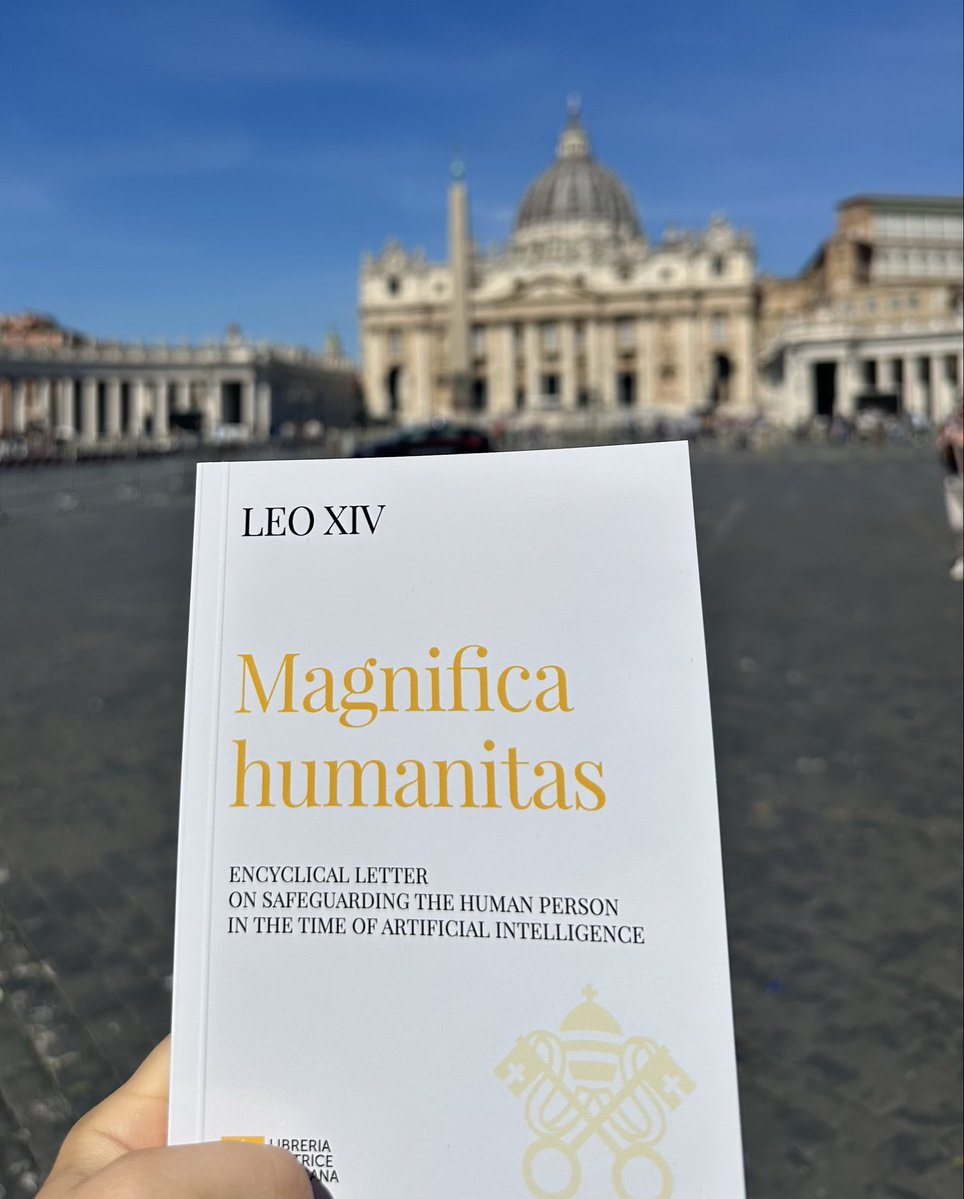
A note before I start. I am Catholic, and the Papal encyclical I reference shapes how I read this moment. I am not asking anyone to share my opinions or my beliefs. I am explaining how I see things.
The Pope just preserved many jobs and created many new job openings through the conversation around the encyclical - Magnifica Humanitas, his first encyclical. It is long, and I am still reading it.
The line that stays with me is his predecessor Leo XIII's response to objections that the Church should focus on eternal life rather than worldly matters. He said the proclamation of the Gospel cannot overlook the concrete lives of people. Leo XIV is making the same argument now, about AI.
I once had to give a presentation on behalf of the Nigerian Society for Corporate Governance to an audience of Nigerian directors and senior management in 2024. They were not fully sold on the impact of AI. A lot has changed in two years.
The transformative effect of AI will be felt not just in this era but for generations. The Church is worried for good reason. AI could alter the nature of society itself.
AI Ethics and Governance have moved from "nice to have" afterthoughts to imperatives if societies and organizations are going to survive and thrive. AI is shifting from a productivity tool to an adversarial and manipulative product.
Someone wrote this on Twitter: "Gunpowder used to be for entertainment, then it was used to kill. Drones used to be for entertainment, then they were used to kill. AI is used for entertainment."
Even in corporations, when AI is positioned as an augmentation tool rather than a means of labor replacement, organizations fail when they measure adoption rather than outcomes. Several large enterprise coding tool rollouts this year have shown exactly this pattern.
As the encyclical insists, the priority is to build a more human society rather than allow a few powerful people to use AI to destroy the social fabric we once knew.
The global policy contrast is now sharp. Chinese courts have begun ruling that companies cannot terminate employees solely to replace them with AI, though the mechanism is driven more by state direction than by worker dignity. The United States has no coherent worker doctrine, and its major AI labs are priced as if labor displacement is the business model. Europe has a doctrine but no platforms at scale. Africa has neither.
Africa has the largest number of young people entering the job market globally. Yet conversations and policies on the impact of AI on Africa and African jobs are still not taken seriously at the highest levels.
The African Union's continental AI strategy has existed on paper since 2024, but most member states have not operationalized it. Meanwhile, the slavery already inside the AI supply chain is African. Kenyan data workers sued OpenAI in 2023 over content moderation conditions that left some with diagnosed PTSD. Documented data labeling rates across the continent have been reported well below local minimum wages. The harms are not theoretical or future; they are here.
The goal should be to improve our societies by creating greater abundance for everyone. That means both increased capacity and full employment. They are not mutually exclusive. Africa needs both.
Three things make the math in Africa different from that in the West. Demand is not saturated; it is suppressed. The continent has doctor-to-patient ratios at fractions of WHO minimums, class sizes that swallow up learning, agricultural extension reach in single digits, and legal services most adults will never access. We have major problems with scale and access.
Many of the processes and workstreams needed in Africa to create more employment have yet to be developed. There is no scaled health insurance infrastructure to disrupt in most countries, no mass legal services market to compress, no formalized tutoring industry to replace.
The demographic math runs the opposite way from the West. Africa is adding roughly fifteen to twenty million people to the workforce every year through 2050. Aging Europe needs AI to cover work that fewer workers can do. Young Africa needs AI to create the work that more workers want to do. This will also help rebalance the migration equation.
The thesis, however, holds only if the value capture is local. If foreign AI platforms serve African demand without local workforce participation, capacity expands, but employment does not. You get extraction, not absorption.
Closing that gap requires policy. Local data sovereignty. Local language coverage as a structural moat. Regulatory requirements that AI deployment include local workforce participation. This is why the doctrine gap matters more than the platform gap, and why the policy work has to start now rather than later.
The narrow goal of profitability, which treats humans as expendable tools, is not the model we should import. This should be our priority in Africa, and we should be actively working towards how these new technologies can help us achieve it. The encyclical gives that work cover. The Catholic church is a major global institution lending its voice to this debate. The question is whether the continent's boardrooms, capitals, and policy desks will pick it up.
If you are an observant person,
A man who is keen, and concerned about his consciousness,
You will realise something unusual is happening,
There is a silent shift going on,
We are moving from an OWNERSHIP ECONOMY to a SUBSCRIPTION ECONOMY.
In a subscription economy, you own nothing, but you pay for goods and services which you consume,
For example,
Back in the 90s,
We bought and owned music hardware like cassettes and discs,
This ensured that the music hardware was yours and nobody would charge you a recurring monthly fee to play music,
We owned newspapers and kept them,
We bought and owned books,
We owned letters written to us,
We bought, and claimed ownership,
But this is changing, and it is concerning,
In a subscription economy, you own nothing, but you pay for it.
MKOPA phones and Electric bikes are examples of how we have lost ownership of what we have bought.
It will reach a time where,
• You won't make a call, unless you subscribe to a calling service, on top of buying airtime,
• You won't send an email unless you subscribe, or you will lose all your emails,
• You won't listen to music unless you pay a monthly subscription fee for streaming,
• You won't send a text or a WhatsApp message unless you subscribe to a monthly plan, or get used to annoying advertisements,
• You won't cook food unless you pay for a monthly gas subscription plan or pay double for electricity,
• You won't drink clean water unless you subscribe to a monthly water delivery plan.
Ultimately, you won't own land or a house or a cow,
You will own nothing, and you will never be happy.
You will become a slave of the subscription economy.
That day is coming.
If you are wise,
• Go to a rural area,
• Own land,
• Get solar,
• Sink a borehole,
• Keep poultry, cows, goats and sheep,
• Grow your food.
Don't sit in the city like sheep.
Freedom will be given to those who will defeat the subscription economy.
WAKE UP!
#ManDay
The top 5 wealthiest people in the world are:
1. Elon Musk: Tesla, SpaceX
2. Larry Page: Google
3. Sergey Brin: Google
4. Jeff Bezos: Amazon
5. Mark Zuckerberg: META
What is the most interesting thing you can see about these billionaires?
These are not politicians.
They are not doctors or lawyers.
These are founders.
They founded, own, and invest heavily in technology innovation companies.
Now, if you want to be relevant in the next 10 years, invest your resources in these 5 companies.
This doesn't mean buying shares in them.
It means aligning your skills around these companies.
For example, if you are a carpenter, identify a product or service in these companies, then build an idea around it, and then develop a product or service based on those products or services.
Or, if you are an interior designer, find out how you can borrow an idea from these companies or how you can leverage your skill using the products and services built by these companies.
The era of saying,
"I am going to school because I want to be a lawyer," — is gone.
These traditional careers began losing their grandeur two decades ago.
I am not saying being a lawyer is bad.
What I am saying is that even if you are a lawyer, align your skills and leverage your work with the products and services of companies owned by the top 5 wealthiest individuals.
Why is this so?
Because where the wealthiest people are, that is where the value sits. That is what people want.
These billionaires are not there by accident.
They are there because the world wants what they are selling.
Kenda Mutongi’s work on the Matatu industry (2017) is such a fascinating study on this exact moment rn. I tweeted about it last week but I’m combing through my notes on it rn na she’s analysed so much of the political potential of the sector already.
A psychiatrist named Jan Fawcett tracked 954 depressed patients. He found that one symptom predicted who would die by suicide within a year, no matter how bad their depression was otherwise: losing interest in everything. Doctors call it anhedonia.
It shows up on brain scans. A small region deep in the brain called the reward center quietly stops working, and the brain releases less dopamine, the chemical that makes things feel good. Around 70 percent of people diagnosed with major depression report this loss of interest. A 2024 review in the International Journal of Neuropsychopharmacology found that patients with anhedonia are much more likely to end up with depression that doesn't respond to medication.
The most prescribed antidepressants often fall short on anhedonia. SSRIs like Prozac, Zoloft, and Lexapro mainly raise serotonin, but anhedonia is mostly a dopamine problem, so the standard prescription is aimed at the wrong chemical.
Four treatments have actual evidence. Ketamine, and a nasal spray version called esketamine approved for stubborn depression, can lift anhedonia in hours. Standard antidepressants take weeks. A 2025 paper in the journal Neuron traced this to specific changes inside the brain's reward center. Behavioral activation therapy, where patients schedule small pleasurable activities and force themselves to do them even when they don't feel like it, slowly teaches the reward center to fire again. Exercise releases a brain-repair protein called BDNF that helps rebuild dopamine pathways over weeks. And a treatment called TMS, which uses magnetic pulses on the front of the brain, has shown strong results in recent trials for anhedonia specifically.
There is also a newer research area called digital anhedonia. Brain scans of heavy social media users show the reward center lights up strongly for notifications and feeds but stays quiet for ordinary pleasures like food, conversations, and walks. The reward bar gets reset so high that normal life cannot reach it.
The brain heals. With proper treatment, many people improve within weeks, and the reward system can rebuild over months. So losing interest in everything is treatable. And the first medication doctors usually prescribe is rarely the one that fixes it.
I am an Engineer by profession, the business bit and startups are a consequence of what I build needing to be sold. I learnt something very interesting when we started selling the pool table devices from QuePay. It is the one vertical where we had real competition, a lot of the others were cheaper but we still get sales and this is from people who are familiar with the others who are cheaper.
So sometimes, especially with the pool automation devices we have to tell people that the devices we have have all been pre-ordered and they will have to wait for like a week before we restock (we have fixed this now btw haha), to which they pay and wait.
Initially we were pulling our hair trying to figure out how to price around what everyone else was so that we don’t lose clientelle. But eventually we just decided to price it right, factor in the inputs, since it is a premium product so it will obviously be a tad more expensive, then sell it at the right price.
My point: more than cost, people(customers) value the brand and reliability( translated: peace of mind). The client believes in your service delivery then unless you are astronomically priced, then they will pay.
Anyway we have built a payment solution for automated systems like vending machines, laundry machines, milk/water and cooking oil ATMs, gaming systems and arcades foosball, PS/FIFA places and most recently pool tables.
Reach us on Call/Text/WhatsApp: +254705876339
Africa is full of surpsises
Ugandan police arrested a man for witchcraft, took him to court, and he responded by inviting bees to the court.
Everyone was attacked by the bees. He didn’t get a single sting.
Interesting to see a man running around with a fire 🔥 extinguisher.
Earth is hard , best such guys are left in peace.
When @SafaricomPLC launched MyOneApp in early April, I found myself locked out of my own M-Pesa for days. I run two lines; M-Pesa on one, data and calls on the other and the new app required active Safaricom data just to log in. Saved paybills were gone. Diaspora users were locked out entirely. Safaricom apologised two weeks later, patched it, and the app works now.
But the technical failure was never the interesting part. The interesting part is how M-Pesa; 18 years old, 35 million users, 800 developers ships a broken product to a press audience and calls it a super app.
My instinct, from the outside, is that once Decode 4.0 was announced and the FinTech 2.0 narrative was in investor communications, the internal cost of delay had already exceeded the user cost of a broken launch. Nobody owned the question of whether the product was ready. Everyone owned whether the launch was on schedule.
To understand how that happens, I went back to Ford's Edsel; one of the most expensive product failures in American industrial history. The people who built the Edsel weren't incompetent. The failure was structural: an incentive system that rewarded the schedule over the product, and an information architecture that filtered bad news before it reached the people who could act on it.
M-Pesa is not the Edsel. The structural conditions protecting it are real and durable. But the launch revealed an organisation still deciding whose question it is actually trying to answer.
Full piece on Frontier Fintech — link in comments.