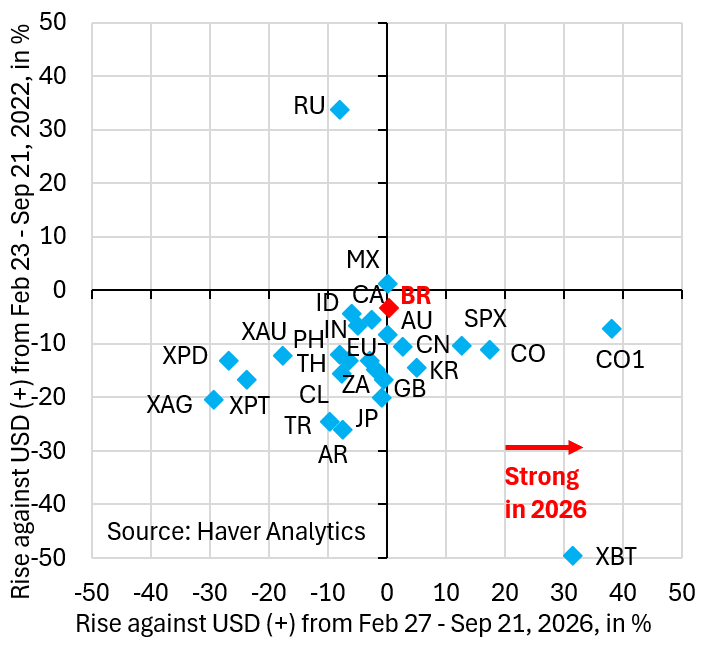
Brazil's Real has been stuck above $/BRL 5.00 for much of 2026, which makes it seem like it's weak. But it's outperformed almost everyone else in EM, so markets are rewarding its status as pre-eminent commodity exporter in EM. More strength is coming...
https://t.co/YYWMT2iWG2
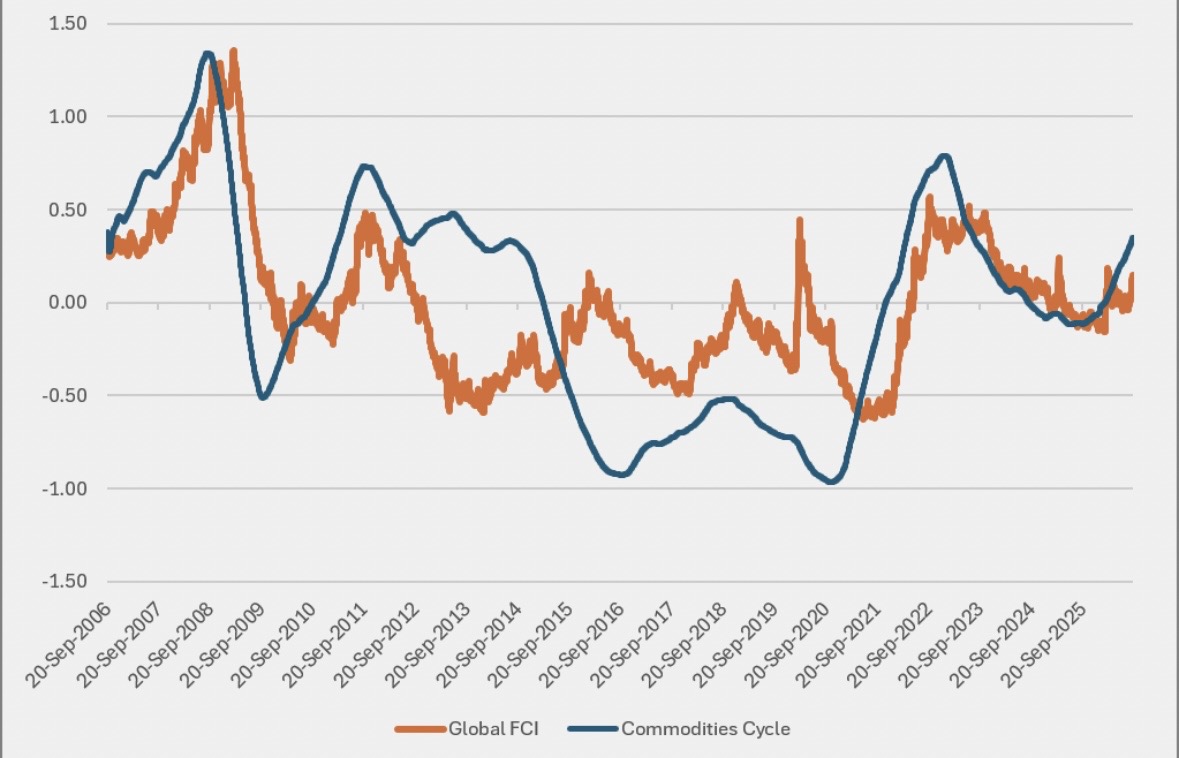
The chart is showing link between financial conditions and commodity cycle. While the last decade was driven by liquidity impulse / low inflation, this one is likely to be driven again by commodities, which would mechanically tightening financial conditions.
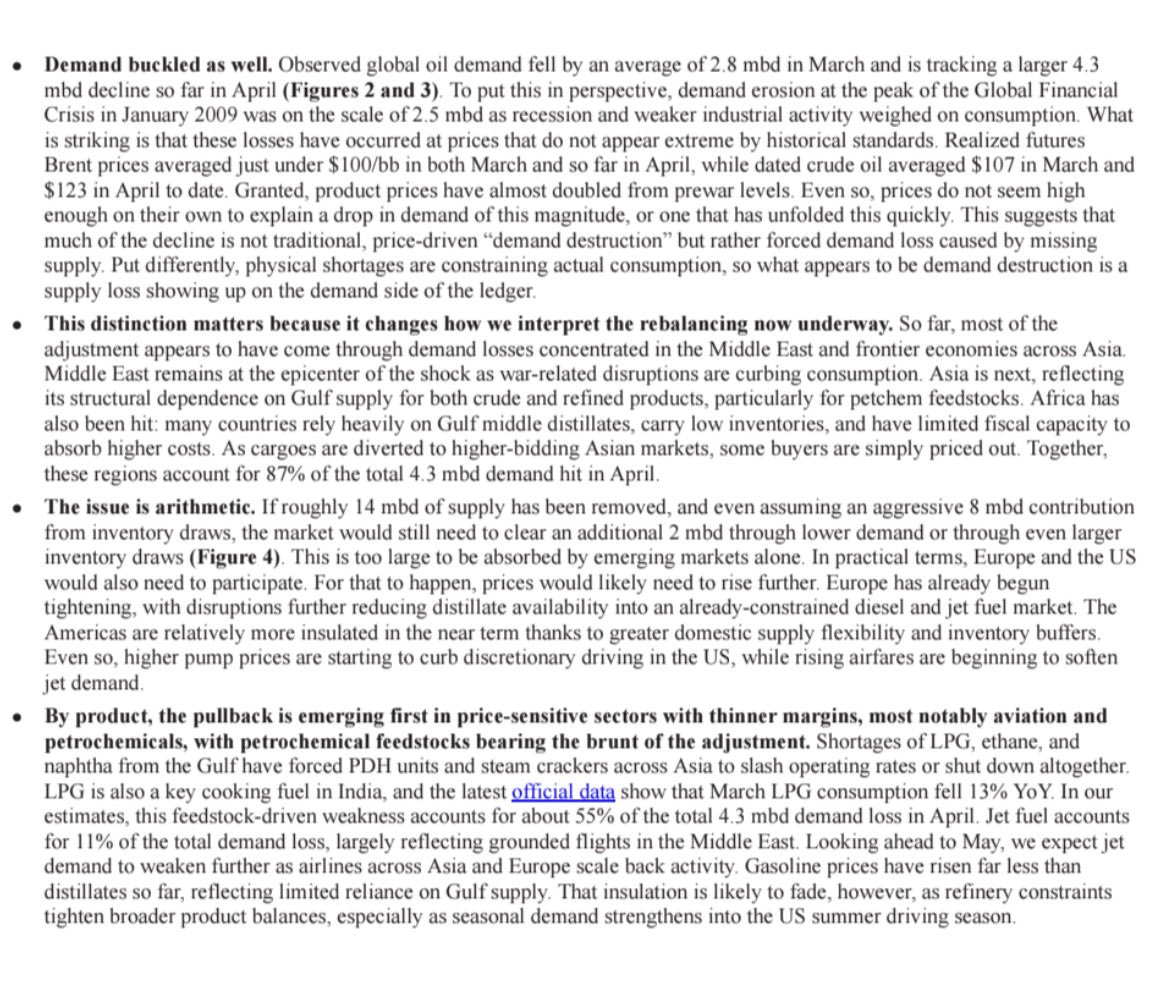
🛢️🛢️🤯 Esse é o relatório que todo mundo está comentando sobre o petróleo.
@grok resuma em português e em bullet point os principais pontos de forma completa.
Tomorrow, one possible outcome after the Fed hiked, is that we may discover that tightening doesn’t lower long-term yields. If that happens, it would confirm that fiscal is the culprit in the whodunnit saga.
By raising the government’s marginal funding cost, a rate hike enlarges future interest deficits and increases the amount of debt Treasury must place with private investors. If investors doubt that fiscal policy will offset those costs, the term premium could rise, pushing long yields higher and reinforcing the deterioration in debt service.
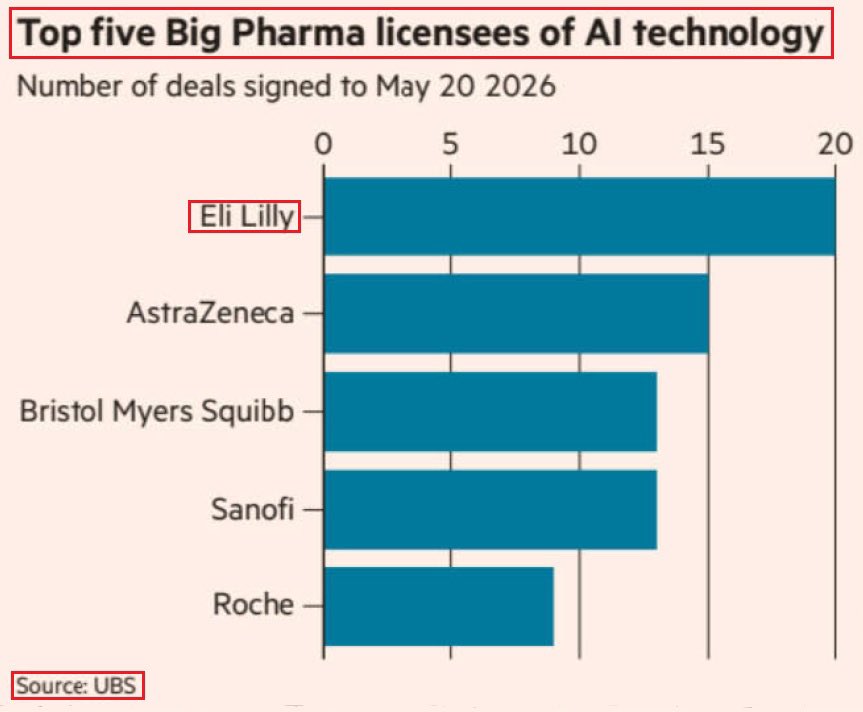
Another testimony of Eli Lilly’s increasing dominance in the BioTech and Pharma ecosystem - compared to other Big Pharma companies - $PFE $JNJ $NVS $NVO $BMY $ABBV $MRK $SNY and others, can be seen in this excellent FT chart 👇. According to UBS $LLY has rapidly ascended to the top of the list of the big Pharma company which signed the most AI deals after it had signed 20 deals to license AI technology from third parties. As of May of this year that is more than any other big Pharma company - with $AZN as a far second with 15 AI deals. The most notable AI deal which $LLY made was in March of 2026 when it announced a $2.75B R&D collaboration deal with an AI drug discovery company - Insilico Medicine, in which Eli Lilly was granted exclusive global rights to a portfolio of preclinical therapies and to use Insilico’s AI engine to discover new treatments across multiple diseases areas. Eli Lilly is a true powerhouse of research and innovation.
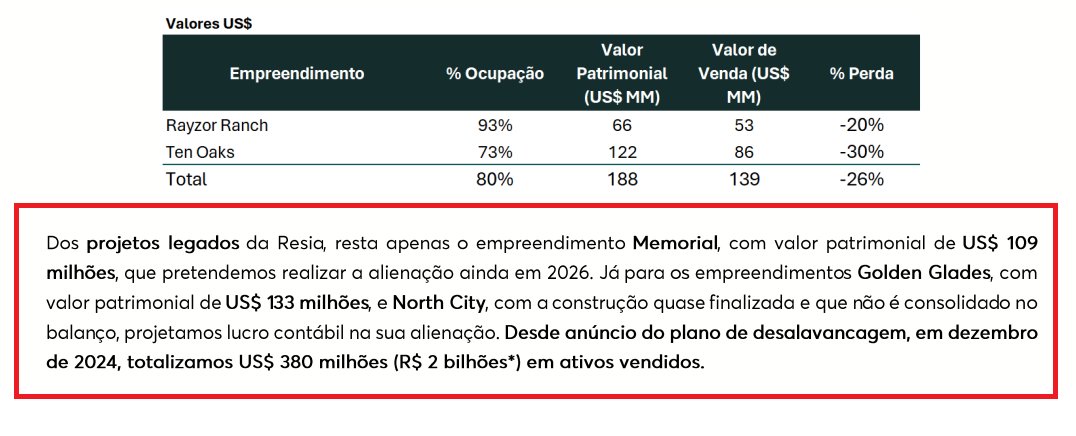
MRV #MRVE3 reduz endividamento líquido e segue com seu plano de vender ativos Resia.
Companhia anuncia venda do Ten Oaks e Rayzor Ranch por um total de US$ 139 milhões (R$ 716 milhões).
A MRV também cita os próximos passos e vendas que devem ocorrer ainda em 2026.
Drugs are an annoying market.
Competition between two branded drugs does basically nothing to prices. But if a generic enters the market, prices plummet.
If you're expecting drug prices to fall as a result of competition, think again!
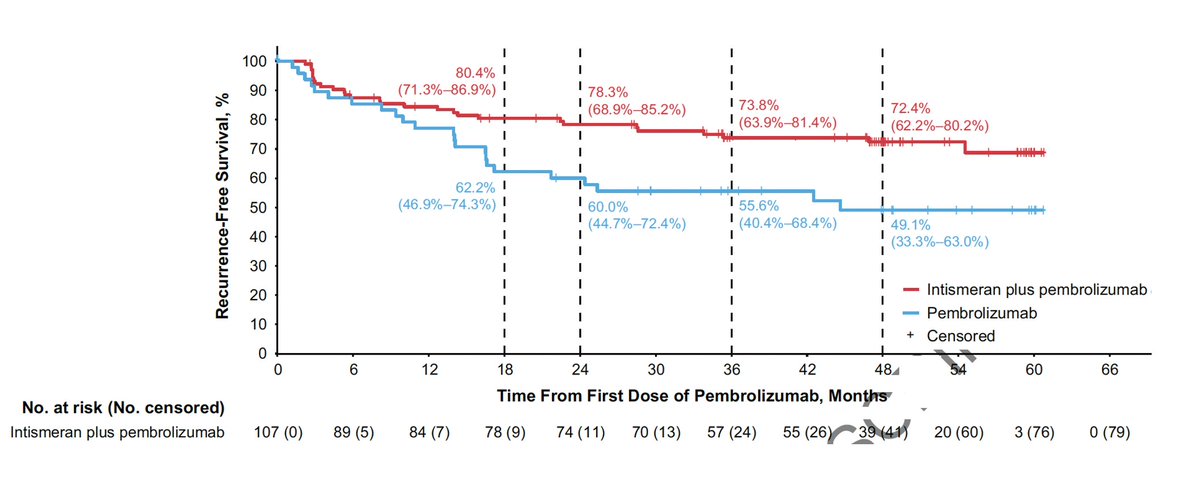
Another major advance vs cancer! @ASCO#ASCO26
Personalized neoantigen mRNA vaccine 5 year follow-up vs metastatic melanoma reduced recurrence and death by 49% (on top of Keytruda)
https://t.co/NadITTYIT2
Cheers, chills, and a standing ovation when RASolute 302 showed unprecedented survival on daraxonrasib for patients with progressive pancreatic cancer
Seldom do you sense you’re witnessing a historic moment in cancer care but this feels like ras targeting has arrived
#ASCO26
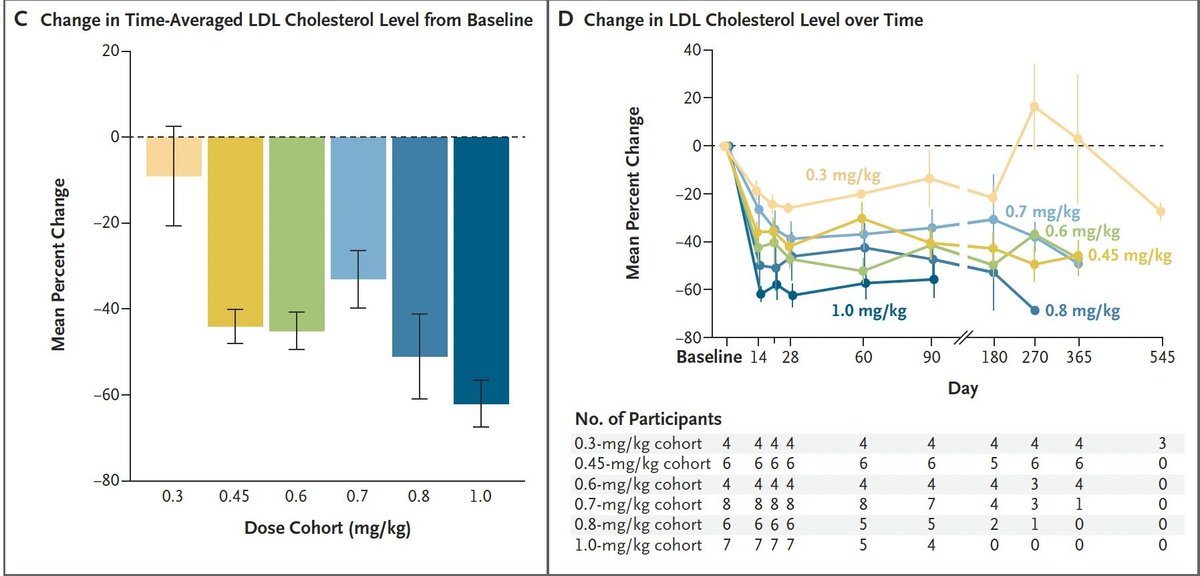
It feels very futuristic to imagine a world with one-and-done therapies that lower LDL cholesterol for life, but... it might not be far off!
These are new phase 1 data for Verve/Lilly's PCSK9 base editor: one single intravenous infusion reduces LDL cholesterol by as much as 60%
Eli Lilly has done it.
They've gone and made what seems to be a powerful, permanent gene therapy for LDL cholesterol.
That means they'll be able to effectively prevent most heart disease with a single infusion!
For decades, biology textbooks have enshrined a simple rule: DNA is made by copying a template. After one enzyme unzips a DNA double helix into separate strands, another called a polymerase builds a complementary sequence, base by base, for each strand. Presto: two copies of the original DNA.
But new research into how bacteria defend themselves from viruses now shows this synthesis rule isn’t absolute.
Now, a team describes a bacterial enzyme that synthesizes DNA without a nucleic acid template, using its own structure as a guide.
Learn more: https://t.co/TeUWvyO0OD @NewsfromScience
1) Large-Cap Private Equity Recent Defaults
“Private-equity owned companies drove corporate defaults higher – hitting some 6% at the end of Q1 2024, the highest since the pandemic.
In fact, around two-thirds of defaults since the 2020 default cycle stemmed from PE-owned LBOs. However, there were some differences in default performance among firms owned PE sponsors.
Overall, between 2022 and August 2024, companies owned by the top 12 private equity firms defaulted at a somewhat slower pace than their counterparts owned by the rest of the PE firms in our rated universe, with default rates of 14.3% versus 16.7%, respectively.
However, both PE cohorts defaulted at a much higher rate than the group without any private equity presence (at 7.1%). [Key Stat #1]
Distressed exchanges (DEs) were the most common default type between January 2022 and August 2024 across all PE-owned debt issuers. This data reinforces an ongoing trend of private equity sponsors heavily favoring DEs as a debt restructuring tool, which helps them sidestep a costly bankruptcy process and preserves their equity.”
The math on Fannie and Freddie is so dislocated it looks like a pricing error.
Fannie printed $14.4 billion in net income last year. Freddie printed $10.7 billion. Combined market cap on the pink sheets right now: ~$12 billion. The market is pricing $25 billion in annual earnings at a 0.48x multiple. Find me another 0.48x earnings multiple anywhere in American finance. It doesn't exist.
The dilution fear is the reason the stock is cheap and the reason the stock is wrong. Treasury put in $187 billion. The GSEs have swept back over $300 billion since 2012. That's an 11.6% IRR. If Treasury exercises its 79.9% warrants at today's price, the government's stake is worth ~$9.6 billion. If it exercises post-relist at 10x earnings, that stake is worth $200 billion. The difference is $190 billion. Washington doesn't leave $190 billion on the table to spite penny stock holders.
Capital requirements look scary until you do the arithmetic. The ERCF says $334 billion. They have $179 billion. The FHFA can lower Tier 1 to 2.5% without Congress. New target: ~$190 billion. Gap: $11 billion. One IPO closes it. One year of retained earnings closes it twice.
G-fees are already at 65 bps. Pre-crisis they were 20. The GSEs have been charging privatized pricing inside a conservatorship for 14 years. Credit losses outside of 2008 average under 5 bps. The margin is so fat that mortgage rates don't move at all on release.
So what are you actually buying at $5? A royalty on the American mortgage system. 65 bps on $7.5 trillion in outstanding MBS. $48 billion in gross annual revenue. Under 5 bps in historical losses. The most predictable spread in finance, backstopped by a guarantee both parties have publicly committed to preserving.
JPMorgan trades at 13x and takes real credit risk. Utilities trade at 15x with half the visibility. These two trade at 0.48x collecting tolls on other people's risk.
The second those warrants convert and the NYSE listing goes live, every index fund and pension fund with a financial sector mandate has to buy. Two of the ten most profitable companies in America, sitting on the pink sheets, waiting for one signature.











![Restructuring__'s tweet photo. 1) Large-Cap Private Equity Recent Defaults
“Private-equity owned companies drove corporate defaults higher – hitting some 6% at the end of Q1 2024, the highest since the pandemic.
In fact, around two-thirds of defaults since the 2020 default cycle stemmed from PE-owned LBOs. However, there were some differences in default performance among firms owned PE sponsors.
Overall, between 2022 and August 2024, companies owned by the top 12 private equity firms defaulted at a somewhat slower pace than their counterparts owned by the rest of the PE firms in our rated universe, with default rates of 14.3% versus 16.7%, respectively.
However, both PE cohorts defaulted at a much higher rate than the group without any private equity presence (at 7.1%). [Key Stat #1]
Distressed exchanges (DEs) were the most common default type between January 2022 and August 2024 across all PE-owned debt issuers. This data reinforces an ongoing trend of private equity sponsors heavily favoring DEs as a debt restructuring tool, which helps them sidestep a costly bankruptcy process and preserves their equity.”](https://pbs.twimg.com/media/HFQQODXWEAEq9Pq.png)


