Aave's annualized fees have now almost surpassed $AAVE market cap.
Aave annualized fees: $945 million
AAVE market cap: $980 million
Insane to see this.
If you weren't around 5 years ago, it's difficult to describe how Bankless felt back then. They were *The* ETH media. And amazing at it. It was glorious.
Nobody on TV is telling Eth's story deeply and consistently at a professional level.
I was an early fan of BTC. Later, I loved ETH much more due to the benefits of onchain and PoS. Then for years I talked endless trash about BTC. Recently, I expressed gratitude to BTC for holding up the market.
That all being said, the downside risk of BTC we've warned about for many years is looking increasingly realistic.
What is this downside exactly? Well, it starts from the observation that BTC is just a religion with significant structural sell pressure from the physical cost of mining. There is no spoon, it's a fugazi. OK but a huge chunk of the gold valuation, and USD global demand, and many other confidence-based assets are mostly just confidence, so why does it matter that BTC is just a religion?
It matters because of- in no particular order- Saylor, macro, structure of the 2025 bull chart, quantum, security budget, and the current price of BTC.
And all this matters for ETH because of the current delusionally low ETHBTC ratio, which will take time and further realized growth (it's coming) to correct itself. Ethereum is winning and it's not even close. We're in a transitory period where most investors don't yet understand how big onchain is going to be and how (ironically) central that the Eth L1 will be to this global growth story. But this post isn't about ETH, it's about BTC and current market conditions.
Saylor is a real problem because homie told ppl to mortgage their houses, and his generational success story is at risk of cratering because he bought his own top so hard that he pulled his cost basis up to $75,700. His credibility is shot. Do you know how many BTC he has to sell by Q3 2028 if BTCUSD stays *flat* and he doesn't successfully refinance/do some financial wizardry? About ~130k BTC worth $9.1 billion.
Macro is a real problem because *gestures wildly*. Gas prices exert real pressure on the economy. OpenAI, Anthropic, and SpaceX IPOs are gearing up to look more like meme stock cash grabs than measured capital formation. Stock market internals are divergent. Valuations are extremely high.
In 2025, BTC's price chart caused a lot of investors to buy into BTC near highs, as it sustained 100k for 6+ months on the hopes that 150k, 200k were around the corner. Heavyweights like Armstrong called for 1M per coin. Ultimately BTC returned less than 2x vs 2021 pico top, disappointing true believers while long term whales cashed out generational (centuries not decades) wealth at the ~$2.5T valuation. This has left new buyers and the public disaffected, rightly so. It will take a lot of renewed confidence, religious groundwork, and siphoning growth vibes from Ethereum (major historical success factor for BTC) for BTC to regain its September footing, nevermind significant new heights. Crypto cycle and all that. This puts an effective multi-year price cap on BTC that insiders know is real and will cause ppl who buy local highs to continue to get rinsed- you're trading against pros who know this is a wavy bear, you're not frontrunning the public... unless you intend to frontrun them by years which most don't.
Quantum is a major problem for BTC because it's a stake into the heart of the religion. In practical terms, it reinforces that BTC is years away from regaining highs because serious buyers know that BTC isn't as immaculate as it seemed last year. They know that quantum meaningfully increases the odds that BTC never recovers to highs.
BTC's security budget is like a baby quantum: severe problem on the horizon, easy to discount, barely affects. But some people know its real and that adds up. Smallest factor but yet another card stacked against BTC this season/year.
The current price of BTC is that people are still paying $71,500 real American Dollars for 1 magic internet money coin. The valuation is still $1.432 trillion. 45% off ATH is still 55% on. If BTC wants to tumble, it has far to fall.
Nobody knows if BTC will see much lower lows. But the deck is currently stacked against BTC in a way that hasn't been the case at any other time in its history. Who cares if BTC falls 5%, that's noise. The real question is will we see a rout to 50k's or 30k's.
The challenge here is we're in a bear-a-thon, a bear marathon. If BTC avoids a crash this month or this summer, that's nice. The above factors are measured in quarters and years, not weeks and months.
Such a crash- this season, later this year, early next year- would clearly and unfortunately bring ETH down with it. The ETHBTC ratio isn't going to magically shoot up during the moment of the crisis.
Should a very serious BTC crash occur, after the crash, investors will be left asking themselves- is an ETH valuation this low justified? The efficient market hypothesis is more dead than alive in tradfi. In crypto it's science fiction. Markets don't know. The market price is just today's news. People who buy ETH this year will end up doing extremely well as Ethereum grows to global ubiquity and BTC's structurally bearish factors cause investors to re-rate the value of the onchain story overall vs BTC.
In short, we are again strapped onto this rollercoaster. Much is outside ETH's and our control. The community has been focused on stuff we can control: CROPS and growth. LFG. We'll be above $20k and multi trillion in due course. Ethereum
If you're wondering why crypto is being left behind while the stock market takes off, look no further than the "everything is a meme" crowd.
That type of thinking, which birthed ideas like ultra sound money, memecoins, DATs, etc... is why we're lagging.
It's not because the regulators are out to get us, or because crypto has an access problem, it's because the value prop of most crypto assets is not as good as other sectors.
We must, we MUST accept that crypto assets are subject to the same rules of gravity as every other asset on earth.
They will have to compete in the same arena as other industries like robotics, AI, etc... for capital.
We should accept that 99% of crypto assets will be valued on cash flows and dedicate all of our efforts to making those cash flows as high as possible.
Just look at which coins are outperforming today, tells you everything you need to know.
Proposal to deploy Aave V4 on Arc with a minimum revenue commitment of $2 million per year to the Aave DAO over a five-year period, totaling $10 million in revenue.
Aave V4 is modular lending infrastructure, powering various use-cases on Arc.
It's been almost 4 years since the collapse of FTX
I'd like to re-establish the context of this photo, as I've let other people rewrite it's history.
FTX took over 5 days to implode. The @Bankless podcast with @ErikVoorhees and @SBF_FTX happened on a Friday.
The bank run accelerated over the weekend, and by the following Tuesday, FTX stopped processing withdrawals.
By Thursday, it was clear it was all over, and the sharp decline from crypto's 2021 highs suddenly became an obvious and prolonged bear market.
All the momentum crypto had acquired from 2020-2021 was obviously gone. Burned. Wasted. Squandered.
The Warren/Gensler era hadn't arrived yet, but you could feel the foreboding threat of the regulators descending, while crypto still was relatively young.
During the slow-motion fall of FTX, we streamed every day. We covered the fall of FTX better than anyone.
That whole week my life was:
- Wake up, open Twitter
- Piece together the pieces of the last 24 hours (it wasn't clear what was actually happening at the time)
- Put it into a podcast episode agenda
- Go live and stream, doing our best to answer questions and get clarity
I was stressed out and sleep deprived. I remember the night before this, I had gotten about 3-4 hours of sleep.
On Thursday, the emotions I had been suppressing finally all caught up to me while recording.
People got hurt.
The curses of centralization, once again, lost people their life savings. It felt like 2008, but our own smaller version of it.
The crypto industry, which supporting felt like my lifes work, was in the biggest hole I had ever experienced.
It felt like we had lost YEARS of progress, which ended up being mostly true! - the Gensler era came and fucked us all.
And so I was sad about all of that, so I let out some tears on the podcast.
I worked harder in 2020-2022 than I ever have in my life, and to have that era conclude with some amphetamined autistic gnome fuck it up for me, my friends, and my industry felt like shit.
So I cried about it.
People use this photo all the time for memes. It's funny - I enjoy it.
But I just wanted to make a statement about the context around this photo, because I never did in the first place.
Some things are worth crying over, and that's okay 👍
Babylon Labs submitted a Temp Check to Aave DAO to integrate Trustless Bitcoin Vaults with Aave V4.
This would allow native BTC as collateral and introduce two new V4 Spokes, one for borrowing against BTC and one for post-liquidation settlement.
$ETH went from a consensus hold to a contrarian bet in 2-3 years.
Some of this was market driven, some was self-inflicted:
1) The EF pushed the L2 scaling roadmap after failing to scale the L1.
It doesn't matter whether that came from lack of motivation, skills, or available tech and research at the time.
Now the EF is scaling the L1, but even with gas limit increases, Ethereum will never be faster or cheaper than most competitors.
And that's okay, because maximizing decentralization and censorship resistance requires tradeoffs.
The problem is that market participants are giving it lower valuation multiple than in the past.
And it's dead annoying though that full ERC-20 deposits to CEXs still take ~13 minutes (no 1-slot confirmation) and that approve + action still requires two txs across DeFi, despite years of 'account abstraction' upgrades.
Watching EF members leave one by one isn't helping the sentiment either.
2) Ethereum can be slower and pricier than other chains, but the market now wants revenue to back valuations.
$HYPE is generating 2x-3x the fees of Ethereum despite trading at ~5% of its market cap.
Even more humiliating is $TRX, up 5x while ETH is down 40% over 5 years.
Ethereans mocked TRX as a copy/paste vaporware scam, but Tron dominates retail stablecoin payments... The sector EF pushed for years and failed to capture, because Ethereum was simply too expensive and slow for adoption.
Ouch.
I believe Ethereum had it good with the ultrasound money narrative.
Quickly deflating supply is the sexiest narrative that even BTC bulls would love.
But it needs a massive pick up in txs numbers to generate the fees that burn ETH.
And Glamsterdam just cut fees by ~78% (gas limit will go from 60M to 200M per block), which means transactions need to pump by 4.6x just to keep the burn flat.
If onchain activity doesn't pick up to compensate, Ethereum's revenue drops further.
Sure, Ethereum still dominates TVL but the ratio dropped from 96% in Jan 2021 to 52% today.
And even with that, TVL monetization mostly flows to protocols and stablecoin issuers, not the L1.
L2s aren't taxes either.
----
So what's the bullish case for Ethereum here?
EF has partly got the message.
The cypherpunk manifesto is personally very appealing to me, with its mission to promote privacy, self-sovereignty, and independence in an increasingly unstable world.
I hope that recent departures from the EF is simply a realignment period.
Pivoting to L1 scaling is the also right move, but UX needs to drastically improve, especially as more corpo-slop chains and institutions enter the market.
EF is taking the quantum threat seriously, unlike the mixed reaction from Bitcoin core devs.
But that all takes time, and if the market's demand for revenue doesn't subside, Ethereum simply needs to bring more users and transactions to the chain.
The real ultrasound money narrative, while being the most decentralized chain, would do the trick.
But we're far from ETH being deflationary again.
The way to save Ethereum: The community needs to create an organization that's economically aligned with Ethereum and accountable to it.
The EF now holds less than 0.1% of all ETH. There is no flow of Ethereum staking or fee revenues to it.
If we want to get Ethereum back to winning:
- create an organisation with credible funding, minimum $1b as a start. That's very reasonable for an ecosystem with $250b market cap
- find a leader who is competent and wants to fight
- make it accountable: a board of people who want ETH to go up, and a charter that holds the org accountable to it
- fund it permanently: A significant amount of staking revenue needs to go to it. A governance mechanism that can adjust it (also part of accountability).
Very hard to imagine now, but I think this is the only way (and it will probably happen, but it might take a long time before it is consensus).
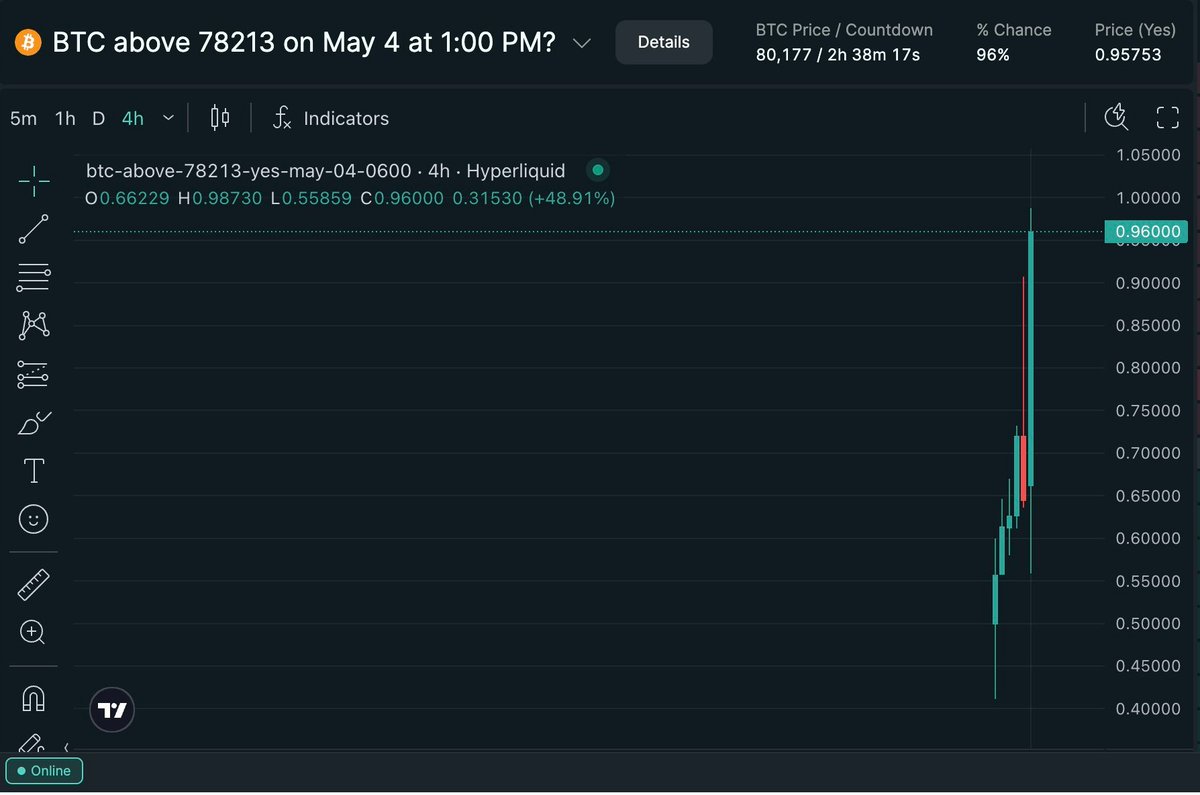
Hyperliquid just dropped HIP-4 — and it’s quietly making Polymarket look like yesterday’s news.
Here’s the straight-up comparison:
1. Permissionless vs Permissioned
Polymarket: Only approved creators can launch markets. You wait for the team to say yes.
HIP-4: Anyone can deploy a new outcome market instantly by staking 1M $HYPE. No approval, no gatekeepers. True permissionless.
2. On-chain & Composable
Polymarket: Standalone app on Polygon. Your prediction bets live in their own silo.
HIP-4: Everything runs natively on Hyperliquid L1. Trade BTC outcomes, ETH perps, and spot — all in the same wallet, same margin, same liquidity pool. Hedge a prediction against your perp position in one click. No bridging, no extra gas, no separate accounts.
3. Speed & Fees
Polymarket: Polygon fees and slower block times.
HIP-4: Hyperliquid’s ultra-fast CLOB engine. Sub-second fills, maker rebates, and taker fees that actually get cheaper the more you trade. Plus every PnL settles in native $USDH stablecoin.
Polymarket nailed the early hype and proved prediction markets can do billions in volume. Respect.
But HIP-4 takes the same idea, puts it on a real high-performance chain, removes the middleman, and stitches it directly into the deepest on-chain liquidity in crypto.
Never become a coin maxi.
Regardless of how much you love a certain project, being a maxi will make you miss so many opportunities.
Remember you're here to make money, not to become a community member.
Thanks to @LayerZero_Core, who has been actively engaging with Aave and the broader DeFi United movement since the moment the rsETH incident occurred.
Their contribution advances our plan to restore rsETH's backing and normalize market conditions.
Compound will join DeFi United’s coordinated recovery effort to restore rsETH backing, improve positioning across affected protocols (including Compound), and help restore stability to the DeFi ecosystem.
Leading Ethereum stewards @Consensys and @ethereumJoseph have joined DeFi United with up to 30,000 ETH in financial support for the rsETH recovery effort, with ongoing strategic advisory from @Sharplink.
Their contributions are a substantial component of the broader DeFi United effort to restore rsETH's backing and normalize market conditions, and the recovery would not be progressing as it is without them.
DeFi United.
1/ $AAVE buybacks have been paused since April 19, 2026.
Rather than deploying capital into buybacks, the DAO is putting its strong balance sheet to work for what matters most: supporting DeFi United and making affected users whole.
TokenLogic has submitted an ARFC to formally ratify the pause 👇
Circle Ventures is purchasing $AAVE tokens because strong DeFi infrastructure does not build itself. Aave is helping to shape the future of onchain finance, and we’re backing that ecosystem and the entire community built around it.
DeFi United
This is another great example of leaders in the space coming together to support DeFi United. Thank you @Consensys and @ethereumJoseph
This 30,000 ETH contribution, the 30,000 ETH from @Mantle_Official, 25,000 ETH from @aave DAO and the 5,000 ETH from @StaniKulechov means we have a clear path towards making rsETH whole.