Gig alert at @MITelectionlab. We have an opening for a Research Support Associate position in the lab, which is ideal for someone just graduating who wants to see what research at a place like MIT is like. Pass it around.
https://t.co/q7RZodj6aR
@Nolan_Mc I guess the question is whether there are any voters out there who are in favor of banning the use of the absolute value of NOMINATE (I assume that’s basically the entirety of your platform).
@sidlowe Not the greatest but one of my favorites (I remember gasping while watching it live): Inter’s Stankovic vs. Schalke’s Neuer.
https://t.co/tz02iwlDoZ
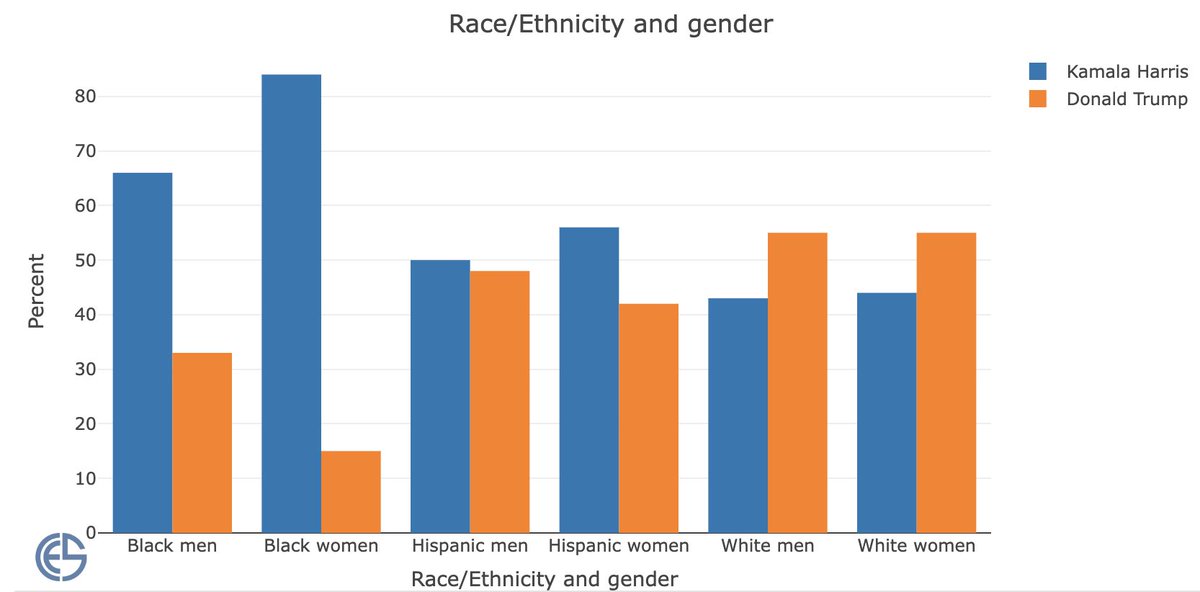
@jbarro FWIW (not that much until there is validated turnout for respondents), the CES also shows a similar sized swing for Black and Hispanic voters. https://t.co/oyXQqoHice
we have updated this app to allow you to calibrate the likely voter weights to the final popular vote margin...should provide a more accurate description of vote patterns (until we have the vote validated data nex year)
@b_schaffner Will be interesting to see if this pattern is present once we have validated vote (i.e., no gender gap for white voters and a massive gap for Black voters).
@StevenTDennis That seems unlikely to be what’s driving the movement in this poll relative to her September poll. The Omaha DMA primarily overlaps with CD-4 (though it includes three low population counties in CD-3). CD-4 has the smallest shift toward Ds of the 4 districts.
@matt_blackwell@Nate_Cohn Must be 15%: “Interviewers spoke with 7,879 likely voters across the seven battleground states… For these polls, interviewers placed about 850,000 calls to more than 320,000 voters.”
@SamaraKlar Alternatively, yet another instance of an academic in the ivory tower insisting that the behavior of the masses is inconsistent with their true “enlightened” interests.
With #APSA2024 done, excited to announce I'm on the job market this cycle! I work at the intersection of U.S. political behavior and institutions, with specific interests in representation, partisanship, and democratic functioning across national, state, and local gov 🧵1/n
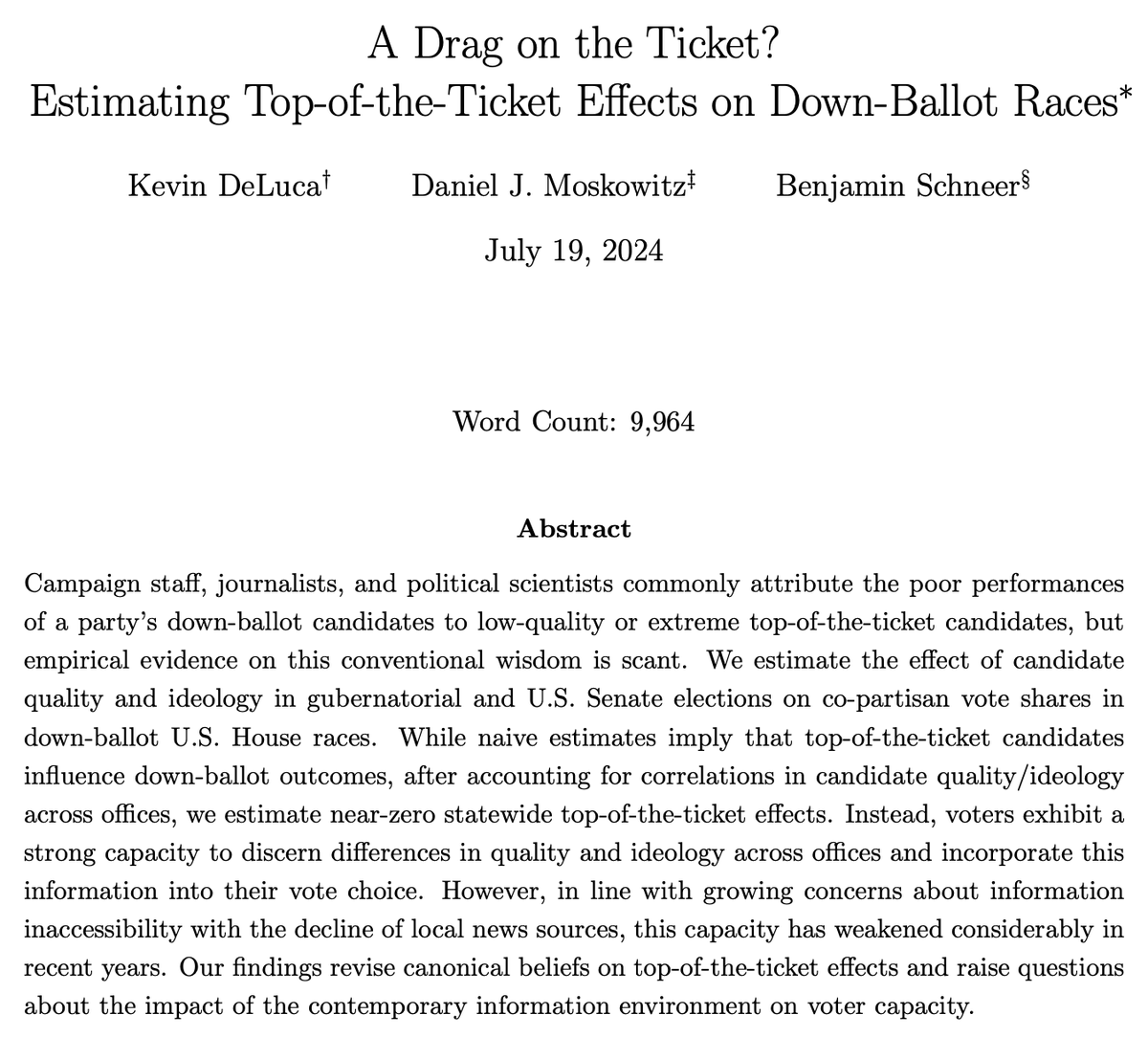
While only indirectly informative to the presidential election context, in a new paper with @cantstopkevin and @BenSchneer, we estimate statewide Senate/governor top-of-ticket effects on down-ballot House candidate vote shares.
PDF of paper: https://t.co/hw4D0IpSqK
2) Anticipatory balancing could play a more prominent role in an election in which both presidential candidates are very unpopular but one candidate is presumed to be a clear frontrunner.
As Democrats deliberate over whether Biden should step aside, a consideration likely on the mind of House & Senate Democrats up for reelection is whether a weak presidential candidate at the top of the ticket hurts down-ballot candidates.
As @daveweigel has brought up, there’s a decent case the expectation that Trump was going to lose big in 2016 boosted R candidates for voters looking for a check.
1) In the paper, we find little evidence consistent with differential partisan turnout based on the quality/ideo. of the Senate/governor candidates. However, it's easy to imagine that presidential campaigns are more effective at mobilizing partisans (e.g., Enos and Fowler 2018).