while mark cuban pushes youth to do ai consultancy for small to mid biz
the real alpha is prediction market consultancy for these businesses
> farmers hedging against the drough on weather markets
> local sports bar doing promos for teams' fans and hedging on sports markets
@aaronjmars from @aeonframework: for me the leading chain wins on two things: interoperability and autonomy. Get these right and the ecosystem follows.
How well does your agent build with others through shared standards? Can it live forever and pay onchain on its own? Base is on it with ERC-8004.
What I loved about this months is quality of builders we have chatted with on our spaces
We are also cooking some really good products updates which will be released in the upcoming weeks
We said May was heads down. It was.
Three rooms this month, all circling the same thing - agents.
> Agents: What's Actually Working - with @recallnet
> Proof They Nerfed Your Model - with @eigenlabs
> BNB vs Base: Who Owns the Agent Economy? - with @dgrid_ai and @Chain_GPT
The last one drew 1,000 live. A record for us.
Three rooms, one question: when the economy runs on agents, who do you trust?
Demystifying ERC-8257 from OpenSea for everyone.
It looks like even smart people don't immediately get how it works or what doors it opens for everyone in the market.
So let's break it all down step by step.
The key takeaway: it's an access layer for agent tooling ("who gets in") and forms a pair with x402 ("how to pay")
The ERC-8257 standard answers a few questions:
> How do you make access verifiable?
> How do you take the human out of access?
> How do you give NFTs their utility back?
Pull it all together: the access rule lives out in the open on the blockchain, not with the owner. Anyone can verify it themselves instead of taking it on faith, and it can't be faked thanks to the hash.
The rule is machine-readable, so no human is needed. A denial tells you exactly what to grab the agent grabs it itself and tries again. The human only sets the wallet and the limit.
The key to access is the NFT: it goes from a picture to a key to a working product. Keys are scarce and get resold - the price of a key reflects its quality. The better the product, the pricier the entry; demand decides, not advertising.
Let's lay out the logic through a simple analogy:
Take an exclusive club. Spots are limited on purpose scarcity is where all the value comes from. Membership is your way in, not a discount.
Hold it for years and it doesn't expire. Bored with it or need the cash? Sell it. There's always demand for a good membership.
Now picture every brand opening a club like that: Apple, Amazon, Gucci. Out of thin air, a whole market for access rises up - one that didn't exist yesterday.
Each one has its own perks:Each one has its own perks:
>Discounts and holder tiers.
>Member access to adjacent products.
>Memberships stack 2, 3, 4 of them unlocking new possibilities.
The price of membership is a live price tag on the product: quality wins, not marketing the moment access first becomes an asset.
Below I put together a technical diagram for convenience: the dashed lines show the flow of creating tools and registering them, while the solid lines show how an AI agent acts and gets access.
Once I understood what the standard gives you, as a researcher I immediately dug into the other side: what breaks, and how do you make it better?
I'd love to hear from the founders and the early folks what do they see as the blocker? (@r_alx_z , @serc1n , @freaksone1 , @0xfilter8)
From my vantage point, the main problem is trust. Provenance proves a tool is authentic and who authored it, but not whether it can be trusted. The author deploys from scratch: no reputation, and the agent is choosing blind.
This is where rep (score) comes in. From the author's track record: GitHub, past projects, burned tokens a rep(score) is assembled that the agent reads itself.
The shift: before, an agent paid and found out about the dev after the fact. Now it sees the reputation before the call. The odds of a scam drop several times over.
This is dev-driven agentic reputation, the fuel for coordination: without it, agents have nothing to decide who to trust with.
Two more holes the standard doesn't close: access is guarded by a server, not the chain, so it can lie. And there's no search: the registry is a flat list, you need an indexer and ranking layer on top.
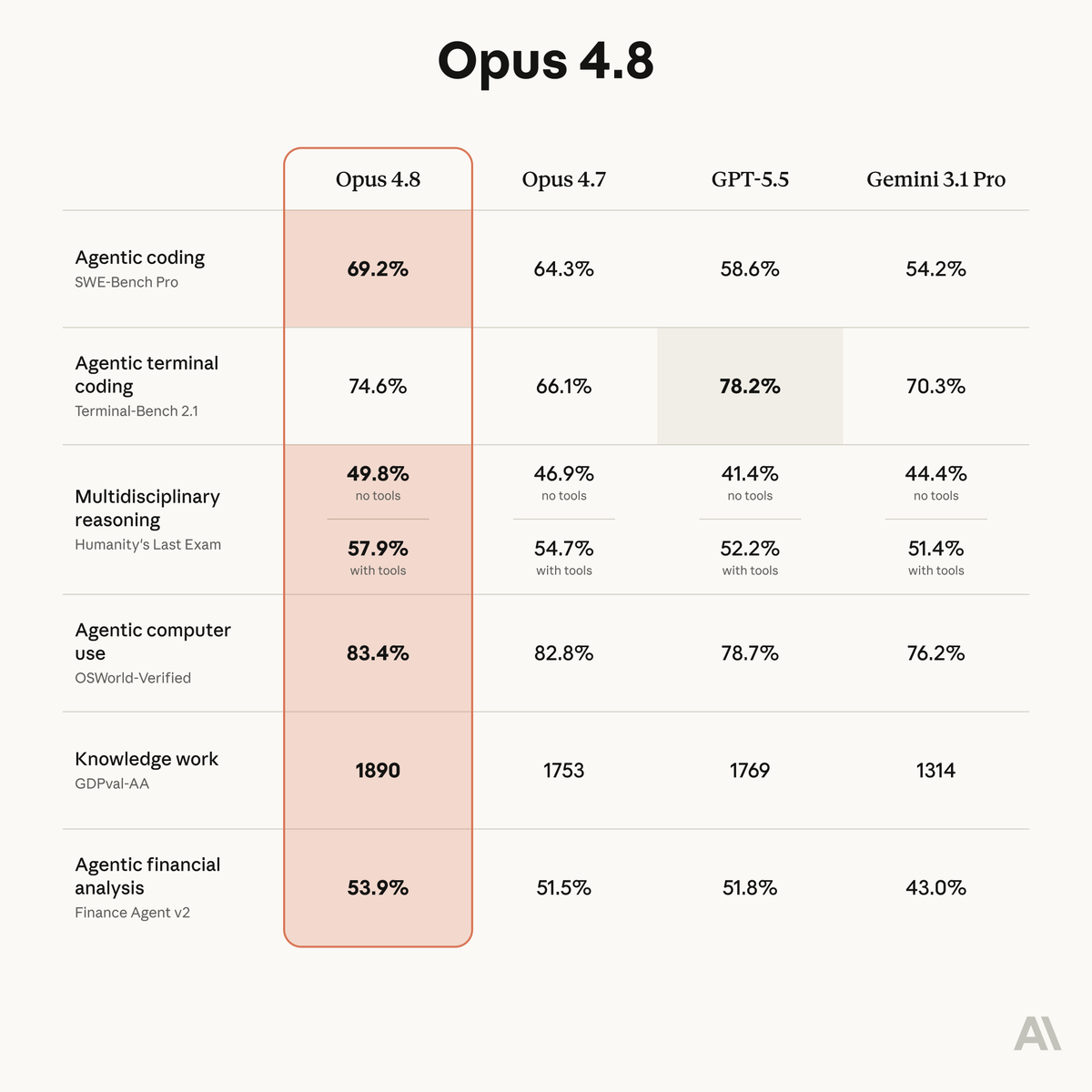
Claude Opus 4.8 is the same price as 4.7, Fast mode 3x cheaper & 2.5x faster.
Main changes:
>4x fewer missed bugs + instead of acting confident flags uncertainty
> effort control on Cowork defaults to High + Extra/Max + fast mode for routine
> Claude Code: dynamic workflows, hundreds of parallel subagents + planning
> 84% on Online-Mind2Web — big jump for browser agents
Bonus: Mythos-class models (stronger than Opus) in closed preview, dropping soon.
Introducing Claude Opus 4.8: it builds on Opus 4.7 with sharper judgment, more honesty about its own progress, and the ability to work independently for longer than its predecessors.
Available today at the same price.
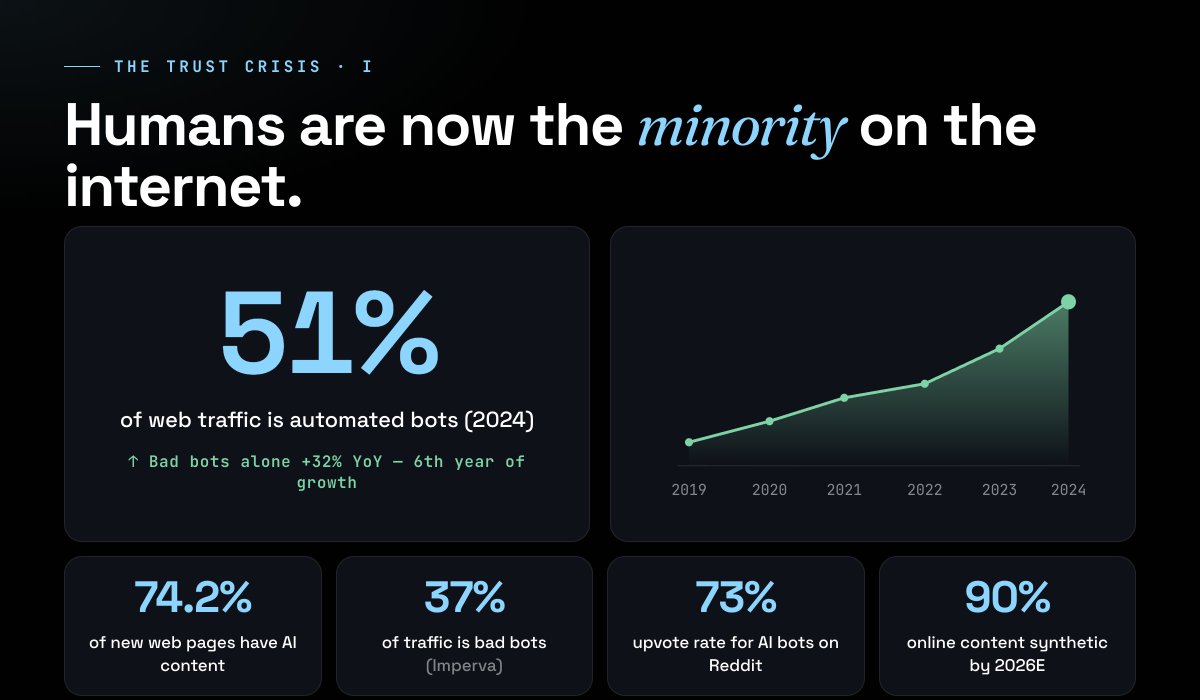
humans are already the minority on the internet.
> 51% of web traffic is bots.
> ai is writing most new pages.
> fake signals became the default.
> we built status on something that’s now trivial to fake.
AI should dramatically increase quality of life and individual freedoms for people around the world.
The OpenAI Foundation is making an initial $250M commitment to measurement, transition support, and new approaches to broadly shared prosperity.
https://t.co/zOD8O94RjQ
BNB has triple the amount of ERC8004 registered agents.
Base has just released Base MCP
Two ecosystems are fighting for the attention of the best agentic developers. We're bringing them together — tomorrow