@carl_feynman Lucky you. I have no doubt he’s the coolest and most interesting person you ever met. But was he actually the *most famous* person you ever met?
@Yankeedft Unless they were behaving like Sacha Baron Cohen in the famous helicopter scene 👇, I would mind my own business and avoid texting my racist brother who will embarrass me by posting my text on X.
https://t.co/SLkrUV6vzt
Fun observation! Okay, I'll bite.
The word boat is shaped like a boat.
The word theist contains two crosses.
So does the word atheist.
The word king contains a pawn (i)
"lol" looks like a man who is drowning, not lol-ing.
The word hamster does not look like a hamster.
“this was just a fun experiment”. Yeah, super fun for the women who are receiving your bot-generated comments as well and being misled to think the comments are from a real person! I’m sure no woman you actually start dating will be upset when she discovers your X writeup about your “fun experiment”… 🙄
Actually refactoring is a lot of what math research is about (even pre-AI), and is usually just called “doing math” not “refactoring”. And while I agree some people complain too much, in fairness, some of the AI proofs are like assembly language spaghetti code from the 1960s. Can be very difficult to refactor.
@ArthurMacwaters “we … inscribe a hundred billion little on/off switches on it”
Actually the whole thing is much weirder and more amazing even than your description:
https://t.co/DHi2sN7kMu
@gexahedron@nihilunbounded@gexahedron There are several relevant papers but the main one is by Robertson, Seymour, Sanders and Thomas (JCTA 1997). It covers both discharging and reducibility.
“If AI continues to bulldoze pure math, it’s going to crush the hopes of the young people who were dreaming of joining this tradition.”
With all due respect, AI ain’t bulldozing anything. This is an unnecessarily apocalyptic way to describe what is happening.
And as for crushing hopes, I suspect these apocalyptic narratives are doing more hope crushing than a collection of PDFs idly sitting in a repository.
It’s some mathematicians’ pride that got crushed.
Other mathematicians are simply engaging: reading, understanding, explaining, experimenting, developing new ideas, writing papers, and, yes, advancing mathematics.
Of course, our profession needs to adapt many of its practices and habits, and quickly. But unless the most pessimistic voices in mathematics, the math Cassandras so to say, eventually convince the world to defund mathematics, there will be jobs, because there will be a great deal to do.
What, exactly, is the proof of forced Navier–Stokes useful for until the ideas in it are extracted from the Lean proof and its confused, sloppy, natural-language translation, and integrated into scientific discourse?
A mathematical proof does not automatically become part of our mathematical understanding simply by existing. Someone has to understand it, explain it, connect it to what we already know, and determine what else can be done with its ideas. This is not a secondary activity that mathematicians perform after the real work has been done. It is a fundamental part of how mathematics advances. And it remains central to science, unless the plan is to delegate our entire intellectual life to machines and go live like brutes, mindlessly spending our (very hypothetical) universal basic incomes.
One further point: people are only focusing on LLM-generated proofs, but how many papers will humans write without using an LLM, simply in response to the new ideas and perspectives that enter the field? It is not even clear to me that the best results will necessarily come from LLMs.
Mathematicians have changed science in small and large ways, over and over again, through fifteen-page papers built around a single lateral insight or a powerful vision. Why should that stop now?
There will be a lot of work to do: Why should young mathematicians see this as the end of their intellectual ambitions?
The ongoing apocalypse is psychological rather than technological, and it is not being imposed on us by frontier labs. It’s more into how some of us have decided to think about this. I totally understand the initial emotional reaction, but maybe it’s time to move on.
Let’s get back to work. Advance mathematics, improve math education, demonstrate why our work deserves support. That is how we secure our future.
Young people will adapt faster than we do, and soon enough they will be leading the way.
@gexahedron@nihilunbounded People should be aware that many human math papers are conceptually similar to slop, and conversely some AI proofs are easy to understand and contain amazing insights. So simplistic terms like “slop” and “leanslop” aren’t advancing the conversation as much as you may think.
@gexahedron@nihilunbounded Actually the original proof by Appel-Haken was quite similar to slop - hundreds of pages long and basically unreadable. Many people found it problematic exactly for that reason. Still it was recognized as a major achievement, and led to better proofs eventually.
Thanks, this makes your position much clearer than your earlier post.
I think it makes sense to distinguish between “valid proof” and “useful proof”. A 20GB Lean proof may not be a useful proof in terms of how much it advances mathematicians’ goals, but it seems foolish to insist that it’s not a valid proof.
@nihilunbounded Okay, so I’m curious, do you also consider the four color theorem to not be proved? Mathematicians have been coming up with computer assisted proofs long before Lean. If you think these are not valid proofs, why aren’t they? And if they are, how is a Lean certificate different?
Very impressive concept taking the idea of AI-native startups to the next level. Jude is a friend and an inspiration, never met anyone who works as hard and has such interesting ideas about tech and innovation.
I'd like to share a little about what I've been working on at my new company @ultrametricai with my cofounder @tylerlastovich. We have been exploring how we could automate the startup itself, leaving founders with more time to focus on their exact mission.
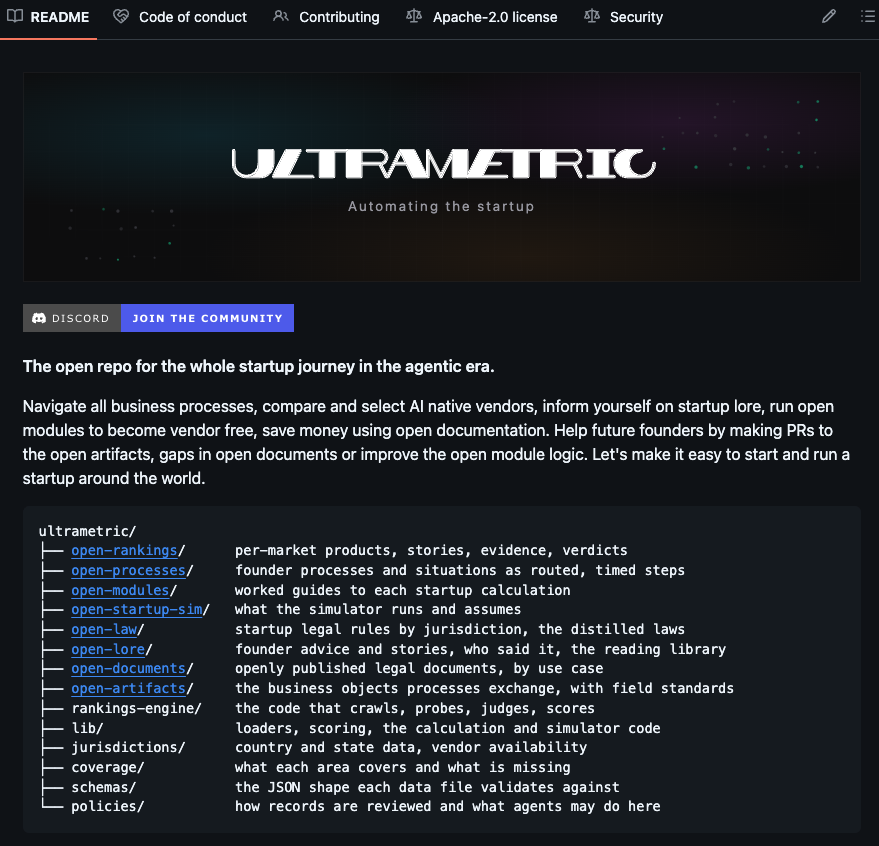
Enter our first release of the Open Startup Repo: https://t.co/ecZZRU9iX4
A common foundation for transparent automation of the startup.
After close to 20 years in silicon valley, backing hundreds of amazing founders & startups, being in the trenches of founding Heyzap (YC08), then solo founding @golden, going through 2 acquisitions and working behind the scenes with some of the iconic companies today, I'm witnessing the largest change to how we work I could have imagined - a truly monumental era of creative abundance.
I believe the next generation of companies will largely run themselves: from operations, code, product upgrades, growth, vendor control & selection, process execution, special situations, strategy etc etc. That leaves founder time for 'the art' at the very niche core: the (currently) unautomatable, the special leaps humans tend to make, and north star setting.
We want founders to go super deep into the main problem they are trying to solve and not get held up doing anything else, from searching for domain availability with trademark checks to setting their company up, to running their processes on autopilot.
So to help that broad foundational layer for starting and running a company, we have spent around a year exploring how to help founders focus on their mission across different verticals, geos, stages and initial starting conditions.
Our first few attempts at making something useful actually failed as the market and AI was moving so fast; it just got absorbed into the models or other product releases. We saw polsia happen, openclaw, then grokbot, muse, dots, etc era as the astras, fables, opuses, kimis and jevs rolled out. What seemed to have been missing along the way was a common repo to identify, unify, open and normalize all the lego bricks that startups have to interact with (vendors, processes, business logic, law, best practices, surface areas, art of the possible).
As the number of software vendors blew up, the interfaces to drive them multiplied, the international startup founder blew up as silicon valley moved from a specific location to a state of mind and global movement. Unlimited pre seed funding in unlimited vertical sub markets and permutations has brought us to the age of infinity but we have yet to achieve being able to type into an agent a very simple sentence with very complex implications 'just setup my company and make $1m/m'. We have ended up with a hybrid mismash of computer use, API calls, plugins, shifting surface areas (API/MCP/CLI/plugins/chats/musish futures), and changing model absorption to vendor balance making it an exciting and unstable time.
As our first step we started to rank all the vendors that startups interface to when going about their journey in terms of how agentically controllable they are via their APIs, MCPs, CLIs etc and computer use compatibility as we are largely switching from a UI driven world to the agentic control surfaces and onto full automation. We have 100 ranking areas you can check out with an overall open ranking here: https://t.co/V6XRMME0Ib
Then we looked at the processes that startups do and how the vendors rank for the sub steps or process as a whole and how this changes across geos. Open processes: https://t.co/iSQ90poYxq
Then we started to hack on an open repo for startups that would contain all the components we are going to need for a common foundation for founders across the globe even if our gov processes vary so much from Bengaluru to SF or Lisbon to Shenzhen. The founder spirit is geo-invariant.
We have looked at special founder/startup situations, the business logic that will make open modules for the startup that we can hack on together, ranked law firms, government services and interfaces, stacks that go well together. We have mapped the law and lore that maps to startups and the schemas that make up the data objects and documents. But also the open documents and the missing gaps. MUCH TO DO.
All the BS processes and fluff work that founders waste their time on needs to goto zero. I want to see more supersonic planes, cancer drugs, seemingly impossible missions done and increase the bang for buck founders have with their funding.
This is a work in progress and we are keen for the community to come hack on the repo with us here: https://t.co/ecZZRU9iX4
Lets get into the structure of the general repo and the visualizations we made on https://t.co/XEYK9ipnfI site with example links:
- Open rankings: https://t.co/V6XRMME0Ib
- Open rankings example (online payments): https://t.co/1kXHZCVfIi
- Open ranking example 2 (cap table): https://t.co/oqBjatGkfW
- Open processes: https://t.co/iSQ90poYxq
- Open process example (Incorporate C-Corp) https://t.co/pxKUXpW03D
- Open situations that founders face: https://t.co/AFzAp5FRPk
- Open startup simulator (you can test our different initial starting conditions): https://t.co/QqPek01J7K
- Open modules (e.g. cap table, payroll logic etc - we'd love help improving these) https://t.co/sfzIhgAJYS
- Open law (we are interested in how law changes the processes, situations and normalizing this over time) https://t.co/5yJnYbC0bk
- Open lore (we are interested in the historical lore of startups, the rules of thumb and heuristics that might guide your agent): https://t.co/gjliXoQwe1
- Open fields (we are interested in how the schema for the data connects to the open modules, business logic, open documents and artifacts of each process eg how is a EIN defined?) https://t.co/59rcEXhnCx
- Open documentation (eg SAFE notes and missing! docs) https://t.co/BbvBow2Olt
We have looked at YC companies as well in terms of which ones do well agentically: https://t.co/snnJ83r9ly
We are interested in stacks and how people are changing their work: https://t.co/wFHoew5V9I
We are interested in what is automatable and where the agentic ceiling is currently and how to push that up in all areas: https://t.co/WmTDjmNyV4
There is more for you to explore and a lot more coming in terms of how you will be able to navigate business in an optimal way in your chosen surface area; whether you are hanging in grokbot, dots, muse, claude, terminal, chat, or whatever is coming up in this exciting time.
We have a lot of data to collect, clean up and help agents navigate the vast landscape emerging functionality the entire startup ecosystem has to offer.
Come join us getting your vendor in, ranked or that access pattern you have wanted or getting the data more accurate in terms of which vendor is best for a process or steps. Or open a module of something that currently cost money that could be free.
Also come play in our discord for founders and join the chaos (we can solve each others issues including fund raising tips from me personally): https://t.co/AmBtzFy0Bz
It's time to lift all the boats in the harbor and I'm extremely excited as to what the community of hackers and painters will hack into the repo, what asks they will have and whether we can shift normalization of processes globally, gov agentic interfaces and have common repo for founders that grows over time. I expect a lot of experimentation along the way, bugs and upside...
I appreciate our backers having faith in us as well from @ycombinator with @garrytan to @immad doing a sizable check (congrats on $1bn rev homie) to @darbyw (congrats on Stripe buying @clerkyinc), @drewhouston form @Dropbox and also @pioneer_fund@tomerlondon cto @GustoHQ and hopefully this is 'boring' and complex enough for Charlie Songhurst :> @delingpole@Liquid2V@ivolo from @segment @ryanpowe @sonicaghi of @kong@DellyTamer+ other supporters (@michaelwfrank, Fundamental ventures and if I missed you sorry moving fast!).
[And don't worry, all vendor rankings are open scoring methods so no favors are being done if someone backed us and is a vendor they have to compete with how agentic and automatable they are just like anyone else.]
PS: we have bugs and many quality upgrades to make but thought better to go out early and fix as a community.
PPS: we have other stuff to launch we just thought this was a great place to start and have 200 PRs coming out pretty soon but I still want to know what is broken or doesnt make sense or inaccurate.
Special thanks to current and past team members for getting us here and all the experiments we did you know who you are.
My son is six and a half years old. He can now sit and read a comic book in complete silence for over an hour. It's amazing and eerie; feels like we've entered the foothills of the singularity.
Since he was born, every year has doubled the amount of time he can work autonomously.
By the time he graduates from college he'll have attained full recursive self improvement, and won't need a human in the loop anymore. 😐
Is anyone else feeling lame carrying their laptops around with the lid open all the time to avoid interrupting their Claude Code sessions? This free Mac app I made is for you. (Also works with Codex or any other running tasks.)
https://t.co/pyGZAELzEb