We've been building something. Here's what the platform does for you:
- Host and share structured datasets
- Collaborate with other creators to build datasets together
- Build and publish dashboards
- Download datasets
Check it out 👇
https://t.co/DczeARGPnT
#data#Africa#AI
What does it really mean to belong to a community?
At the close of Deep Learning Indaba (@DeepIndaba) 2026, our Founder, Dr. Olubayo Adekanmbi (@bayoadekanmbi), left Africa's AI community with a challenge that extends far beyond one conference:
Do not measure your place in an ecosystem only by what you receive from it. Measure it also by what becomes possible for others because you were part of it.
For a thriving African AI ecosystem, participation must ultimately translate into contribution: sharing knowledge, opening doors, mentoring emerging talent, creating opportunities and strengthening the communities that helped us grow.
Because the strength of an ecosystem is not simply the number of people within it. It is the value they continually create for one another.
As #DLI2026 ends, this is one reflection worth carrying forward.
Watch the full closing remarks on the DSN YouTube channel:
https://t.co/pPmcBZygjk
Do not simply belong to the community. Help build a community where others can thrive.
#DLI2026 #DeepLearningIndaba #AfricanAI #AIForAfrica #DataScienceNigeria #AICommunity
@pau_nigeria@naishofficial@FMCIDENigeria@NITDANigeria@Microsoft@GoogleDeepMind@datawise_AFR@curnance@AminiTech@ZindiAfrica@equalyz_ai@AISCAfrica@MasakhaneNLP
Behind every great gathering are people who choose to serve. Today, we celebrate the people behind #DLI2026.
For six remarkable days in Lagos, Nigeria became a meeting point for Africa's AI community as the 8th annual Deep Learning Indaba (@DeepIndaba) convened 1,000+ engineers, researchers, practitioners and policymakers from 45 countries at Pan-Atlantic University (@pau_nigeria).
Behind that scale, energy and experience was something even more important: people.
People who gave their time.
People who carried responsibility.
People who worked through countless details behind the scenes.
People who believed deeply enough in the vision of African AI to make it happen.
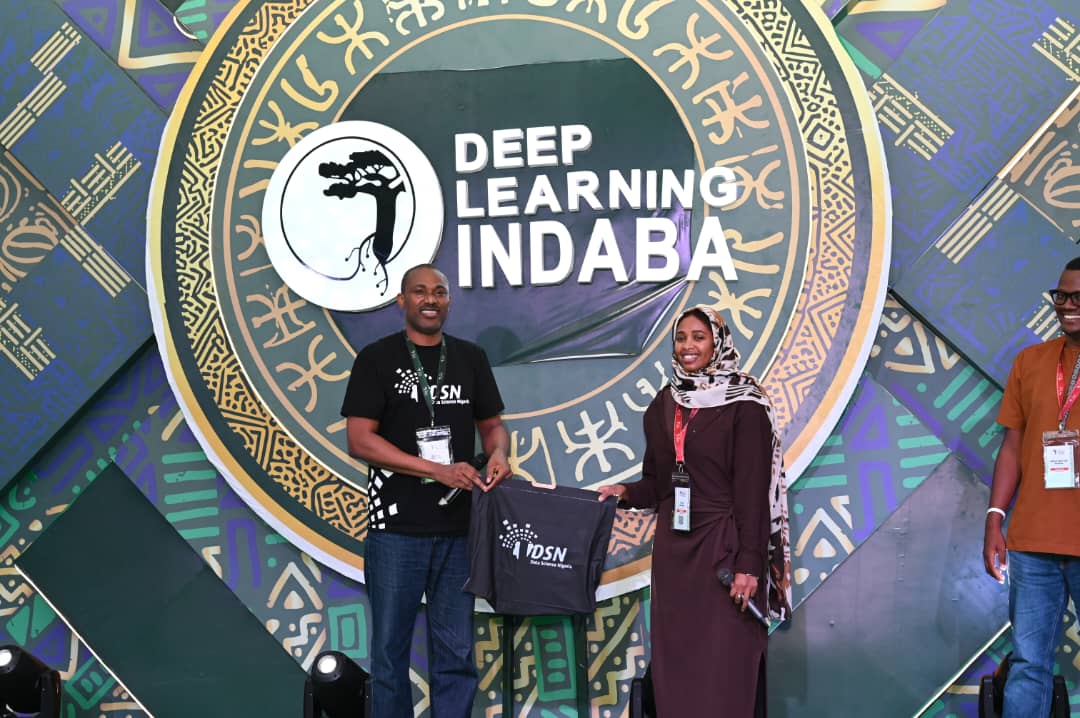
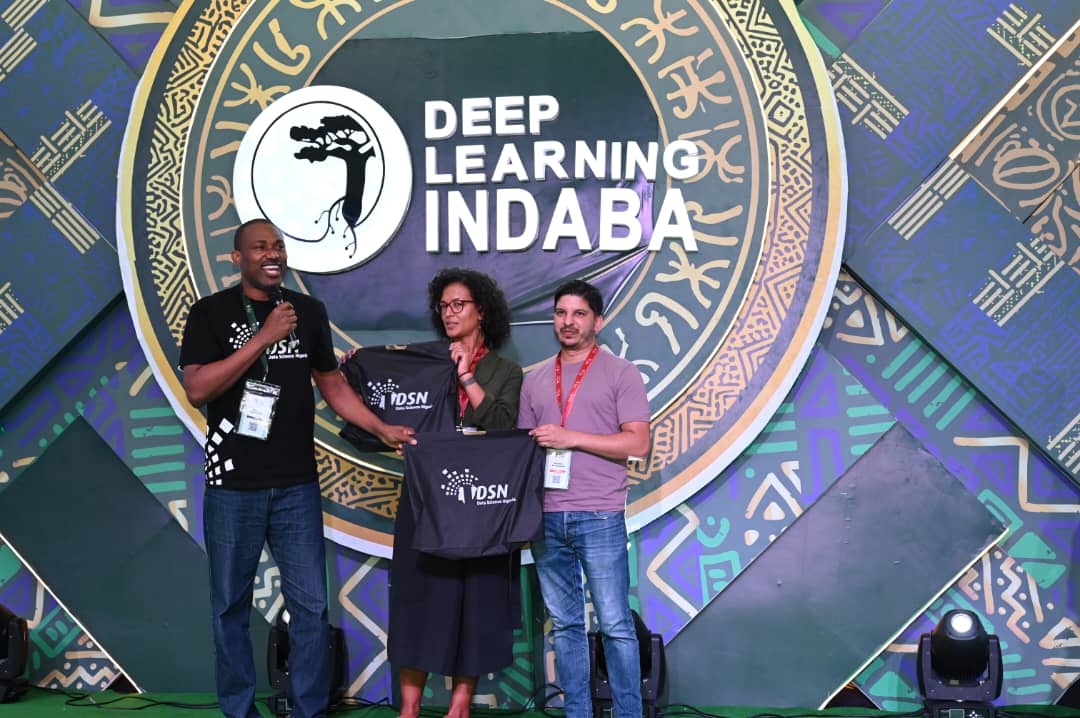
At the closing of Deep Learning Indaba (@DeepIndaba) 2026, our Founder, Dr. Olubayo Adekanmbi (@bayoadekanmbi), took a special moment to recognise some of those remarkable individuals.
We celebrated the Indaba Operations Committee, including Emily Muller and Avishkar Bhoopchand, for the dedication, selflessness and enormous work required to turn the vision for this year's Indaba into six days of learning, research, collaboration and community.
We also celebrated the three General Chairs of #DLI2026 — Aisha Alaagib (@AishaAlaagib), Albert Njoroge Kahira and DSN's own Director, AI Solutions Delivery, Chinazo Anebelundu (@rKyrian) — whose leadership helped steer the Indaba's journey to Nigeria and bring together a truly pan-African gathering.
Hosting more than 1,000 members of the AI community from 45 countries is no small undertaking. Beyond the numbers were hundreds of conversations, research exchanges, workshops, tutorials, community sessions and new relationships — all contributing to a much bigger ambition: ensuring that Africa is not simply participating in the future of AI, but actively shaping it.
As a small expression of our appreciation, DSN (@dsn_ai_network) presented special gifts to the Indaba leadership.
The gifts themselves were symbolic. The real message was much simpler: We see the work. We recognise the sacrifice. And we are grateful.
At DSN (@dsn_ai_network), we have learnt over almost a decade of community building that institutions may provide platforms, but people build movements. Deep Learning Indaba (@DeepIndaba) continues to demonstrate what becomes possible when talented people from across the continent choose to give back, collaborate and build something larger than themselves.
To the General Chairs, the Operations Committee, the wider organising team, volunteers, speakers, partners and everyone who worked behind the scenes to deliver #DLI2026:
Thank you for showing up.
Thank you for giving your time.
Thank you for serving Africa's AI community.
And thank you for making Nigeria 2026 a moment to remember.
The gathering may have ended, but the relationships, ideas and collaborations it created are only beginning.
Onward, together, as we continue building Africa's AI future.
#DLI2026 #DeepLearningIndaba #Indaba2026 #AfricanAI #DataScienceNigeria #AIinAfrica #Community #Nigeria
Lessons from @DeepIndaba:
As AI systems become increasingly integrated into decisions that affect people's lives, fairness cannot remain an abstract concept. It needs to be evaluated with the same rigour we apply to model performance.
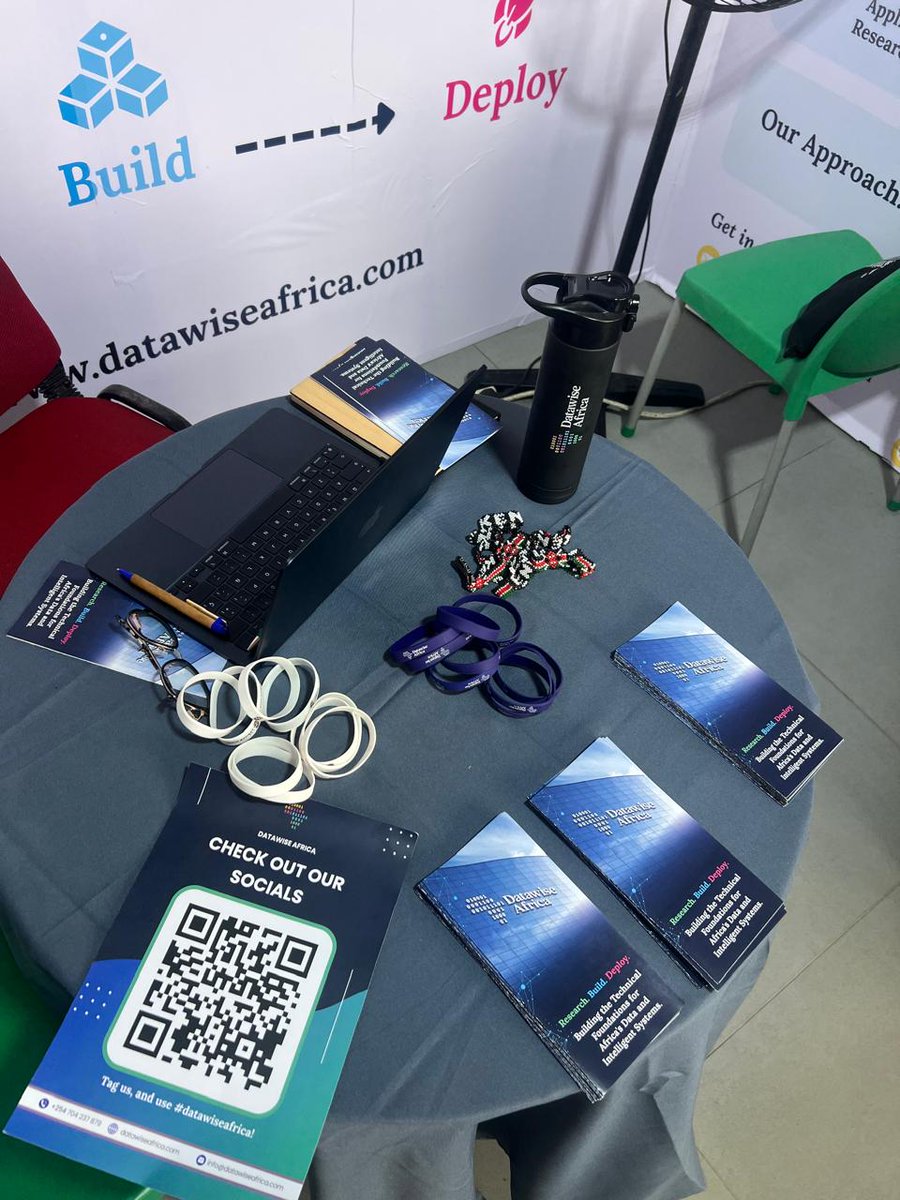
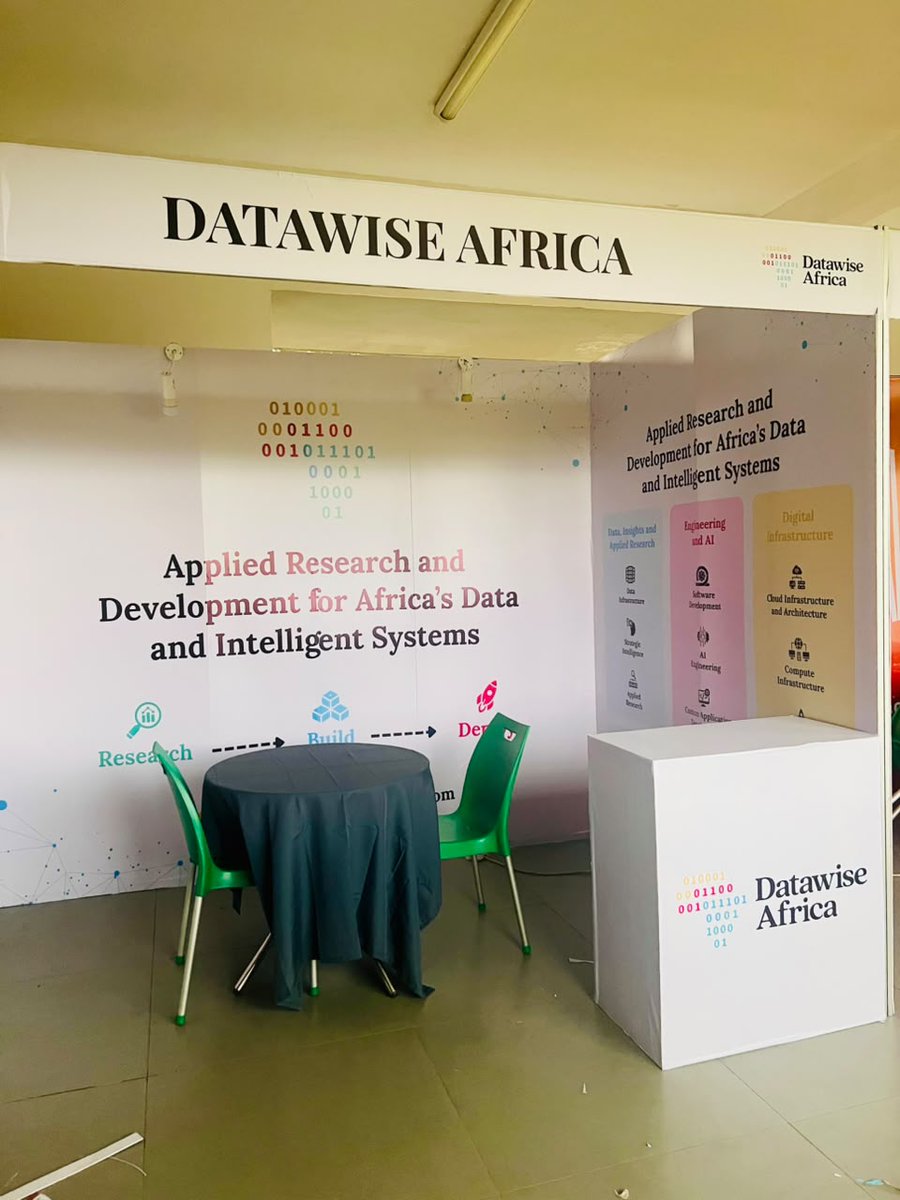
📍 If you’re at @DeepIndaba , find us at our booth!
👋 Come say hello, scan our QR code, pick up some Datawise Africa goodies, and let’s start a conversation!
@DeepIndaba is right around the corner, and we’re preparing to interact with you on a deeper level.
We're excited about the opportunity to connect and build partnerships!
See you there!
Worth a read <> Analysis: Navigating the Constitutional Anatomy of Copyright in the Age of AI
A Technical Breakdown by AfriDSAI Senior Fellow Prof. Chijioke Okorie on South Africa's Copyright Amendment Bill
https://t.co/jeRCHWTF9f
🔥 Workshop Spotlight Series | #DLI2026 🔥
Next up in our workshop spotlight series for the Deep Learning Indaba 2026 in Lagos, Nigeria!
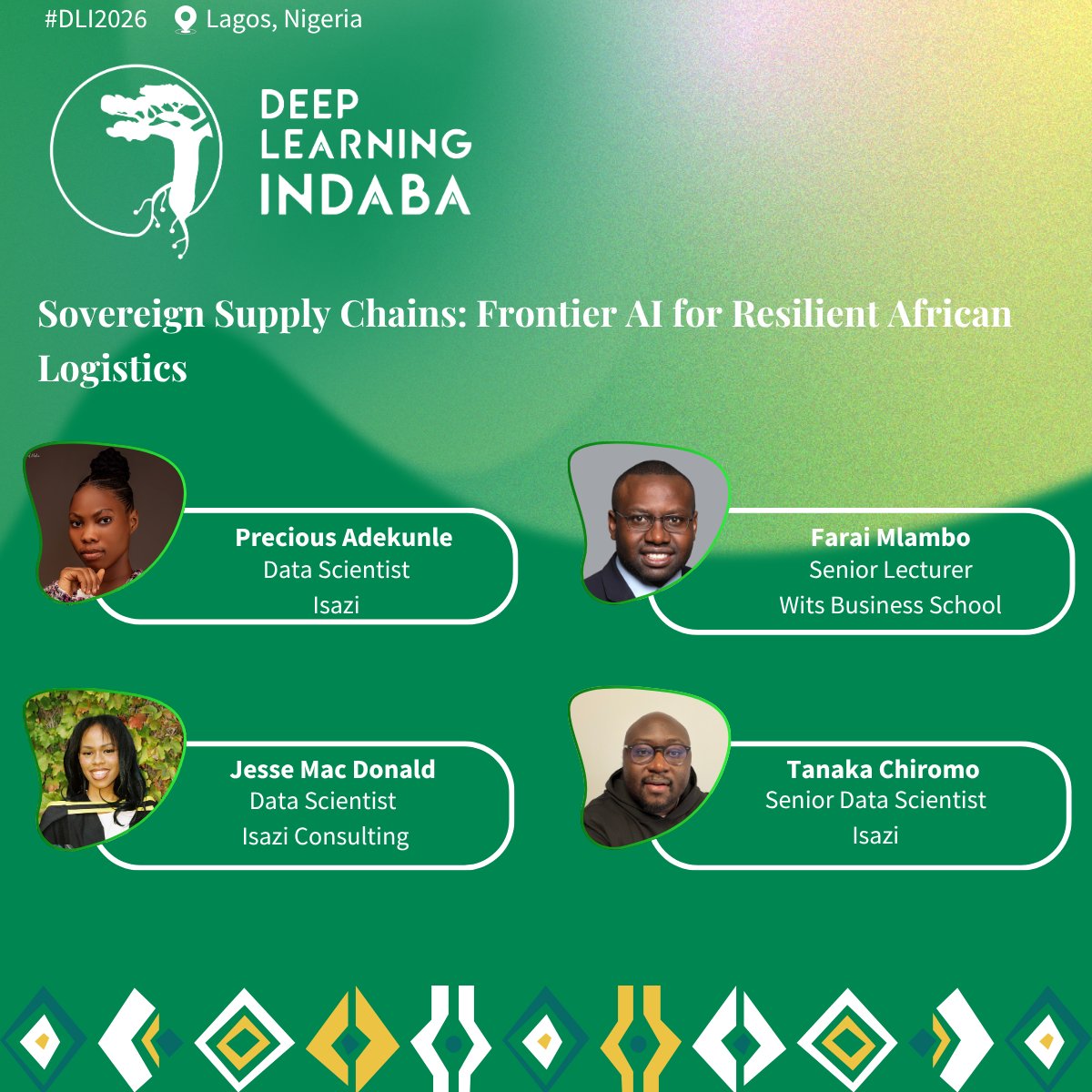
This one brings AI down to the ground, literally: Sovereign Supply Chains: Frontier AI for Resilient African Logistics.
Supply chains are the backbone of every economy, and they are often where disruption hits hardest. This workshop looks at how frontier AI can make African logistics more resilient, efficient and self-reliant, from ports to last-mile delivery.
The session brings together an applied team:
Precious Adekunle, Data Scientist, https://t.co/6y5wnc43v0
Dr Farai Mlambo (PhD, Mathematical Statistics), Senior Lecturer, Wits Business School
Jessé Mac Donald, Data Scientist, Isazi Consulting
Tanaka Chiromo, Senior Data Scientist, Isazi
From ports to pipelines, Lagos is where it comes together.
#DLI2026 #indaba2026 #ÌmọWa
Who defines AI, and whose interests does it serve?
That is the question Dr Margaret Mitchell @mmitchell_ai will bring to the Deep Learning Indaba 2026 keynote stage in Lagos this August.
Dr Mitchell is a Researcher and Chief Ethics Scientist at @huggingface Face, where she leads work on ML data processing, responsible AI development and AI ethics. She was previously at Google where she founded and co-led Google's Ethical AI group to advance foundational AI ethics research and operationalise AI ethics Google-internally. She holds a PhD in Computer Science from the University of Aberdeen and a Master's in Computational Linguistics from the University of Washington.
She has published over 100 papers on natural language generation, assistive technology, computer vision, and AI ethics, and holds multiple patents in the areas of AI conversation generation and sentiment classification. She has been recognised for her leadership and ingenuity in public fora such as TIME's Most Influential People in the world, Fortune's Top Innovators, and Lighthouse3's 100 Brilliant Women in AI Ethics. Her work has received awards from Secretary of Defence Ash Carter and the American Foundation for the Blind, and has been implemented by multiple technology companies. She is most known for her work pioneering "Model Cards" for ML model reporting; developing "Seeing AI" to assist blind and low-vision individuals; and developing methods to mitigate unwanted AI biases.
In her keynote, she will examine the promise and the reality of the pursuit of AI, interrogating the assumptions and fact-checking common narratives. Her case is that the way we advance AI today is largely controlled by a small set of actors with concentrated interests, and that this risks prioritising power, influence and market position over measurable human benefit.
It is a session for anyone who wants AI that answers to communities rather than to incumbents.
#DLI2026 #Indaba2026
A dashboard transforms your data from rows and columns into something people can see, interact with, and understand without needing to be a data analyst themselves.
On Datalab, creators can now publish their dashboards directly on the platform.
https://t.co/Onwpaoa7qu
Virtual Indaba 2026: Accessible Learning
A reminder that registrations for the Virtual Indaba 2026 are open, and we welcome your participation.
The Virtual Indaba ensures that anyone across the continent and beyond can join the conversation. Whether you are unable to travel to Lagos, prefer to participate remotely, or are interested in exploring what the Indaba offers, this format provides full access. It remains a vital part of our gathering, turning the annual event into a truly continental conversation.
Register for the Virtual Indaba: https://t.co/d74RjD6wC6
#DLI2026 #Indaba2026
Next in our keynote announcements for #DLI2026, we're excited to welcome Prof. Vukosi Marivate @vukosi to the stage in Lagos, Nigeria! Prof. Marivate is Director of the African Institute of Data Science and Artificial Intelligence (AfriDSAI), the ABSA UP Chair of Data Science and Professor of Computer Science at @UPTuks, where he leads the @DSFSI_Research group. His research sits at the intersection of machine learning, artificial intelligence and natural language processing, with a particular focus on African and other low-resource languages. He co-founded @LelapaAI, the @MasakhaneNLP and the @DeepIndaba.
His keynote is titled "What Do Our Benchmarks Actually Measure? Evaluation Challenges for African Language AI"
Over the past decade, research on African languages in natural language processing and speech technologies has accelerated. New datasets, multilingual models and collaborative research initiatives have delivered measurable gains across machine translation, automatic speech recognition and language modelling, showing that progress for historically under-resourced languages is both possible and increasingly visible. Yet as the field begins to envision supporting thousands of the world's languages, a critical question emerges. How should progress actually be measured? Many current benchmarks were designed for well-resourced languages and assume standardised text, stable orthographies and abundant labelled data. Applied to African and other Indigenous languages, they often capture only a narrow slice of linguistic reality while privileging what is easiest to measure. This keynote explores the growing gap between advances in language modelling and the methods used to evaluate them, and argues that rethinking evaluation is essential for truly multilingual AI. Moving forward, evaluation frameworks must better reflect linguistic diversity, community priorities and the complex sociotechnical contexts in which these languages are used.
Prof. Marivate holds a PhD in Computer Science from Rutgers University, and an MSc and BSc in Electrical Engineering from the University of the Witwatersrand. He was recently honoured with the Order of Mapungubwe (Silver), one of South Africa's highest national awards, for his contributions to artificial intelligence and computer science. He also serves on the @UN Independent Scientific Panel on AI and the African AI Council at Smart Africa.
Welcome on board, Prof. Marivate!
Virtual Indaba: Registrations still open: https://t.co/d74RjD6wC6
#DLI2026 #Indaba2026
At the Global Data Festival, Dr. Melissa Omino contributed to a plenary discussion that assessed the progress made, the barriers that remain, and what it will take to ensure that inclusion shapes the future of AI, technology, and development.
@SpaceAgencyKE
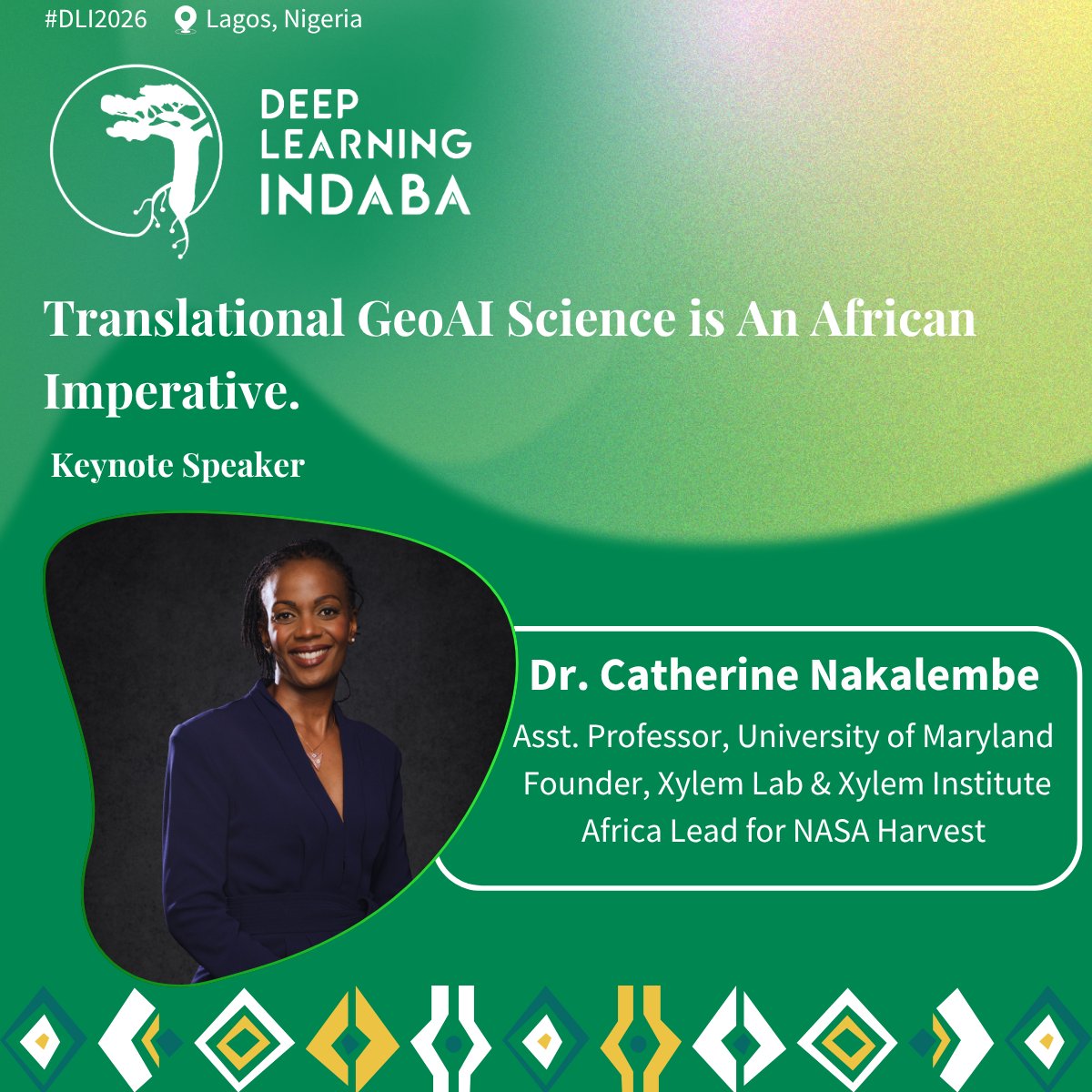
We're delighted to welcome Dr. Catherine Nakalembe @CLNakalembe as a keynote speaker at this year's Deep Learning Indaba in Lagos, Nigeria! Dr Nakalembe is an Assistant Professor of Geospatial AI at the University of Maryland @UofMaryland, founder of The Xylem Lab and The Xylem Institute, and Africa Lead for NASA Harvest.
Her keynote is titled "Translational GeoAI Science is An African Imperative."
Africa stands at a unique inflection point, home to the world's fastest-growing population, its youngest workforce, and some of its most acute development challenges, yet increasingly rich in satellite imagery, mobile data, and earth observation infrastructure. Artificial Intelligence applied to geospatial data (GeoAI) holds transformative potential for the African continent. From mapping informal settlements and monitoring crop failure to tracking deforestation and issuing early warnings of extreme events, including cyclones and landslides. Yet a persistent and costly gap persists between cutting-edge GeoAI models, largely developed in the Global North, and their deployment in Africa.
This presentation introduces Translational GeoAI Science as a systematic discipline designed to bridge this gap on African terms.
Dr Nakalembe holds a PhD in Geographical Science from the University of Maryland, an MS in Geography and Environmental Engineering from Johns Hopkins University, and a BSc in Environmental Science from Makerere University, Uganda. Her honours include the Al Sumait Prize, Uganda's Golden Jubilee Medal, the Africa Food Prize, and a GEO Individual Excellence Award. She is a TED Fellow, a National Geographic Explorer, and a MacArthur Foundation/Op-Ed Public Voices Fellow.
Welcome on board, Dr Nakalembe!
Virtual Indaba: Registrations still open 👉https://t.co/d74RjD6wC6
#DLI2026 #Indaba2026
“It is not enough to simply collect data. We must also govern how it is used, how it is shared, and how communities are compensated for their contributions. ”
~Isaac Manzi
AI Technical Advisor
@DigiCenterRW