I think loops were a short-lived patch for models that couldn't reliably keep working on long problems until they hit a defined goal
Fable and GPT-5.6 (and probably Kimi K3 as well) can just do that out of the box, unassisted
Most teams skip the part that makes AI engineering actually work.
They write vague tickets.
"Improve dashboard performance."
"Fix the login flow."
"Refactor the user module."
Then they hand these to an AI agent and wonder why it produces garbage.
An agent-ready ticket has a clear scope and an explicit acceptance bar. It's safe to hand to a headless agent because the spec already defines what "done" looks like before any code is generated.
On our logistics firm engagement, every ticket went through Spec-Driven Development before an agent touched it. Define and clarify the requirement. Write a technical spec. Generate a plan. Only then does the agent implement.
This is the boring part nobody posts about. Six steps, every ticket, no exceptions.
1. Define and clarify the requirement before anyone touches code
2. Write a technical spec with inputs, outputs, edge cases, and acceptance criteria
3. Generate a plan the agent follows, not a vague story it interprets
4. Implement and review against the spec, not against vibes
5. Test and iterate until automated validation passes
6. Finalize and document so the next person, human or agent, has context
At a US healthcare enterprise running multi-team development on Azure DevOps, we taught their entire organization to write agent-ready tickets through SDD and TDD workshops. Their teams went from individual AI experiments producing inconsistent results to a shared practice that shipped measurable output within weeks. The practice transfers to people, not slides.
The difference between "AI can write code" and "AI writes code we actually ship" is ticket quality. And ticket quality is a discipline, not a tool feature.
If you're evaluating AI coding tools and your tickets still say "fix the thing," the tool isn't your bottleneck. The spec is.
São boas recomendações. Sim as empresas deveriam se atentar para não vazarem toda sua inteligência pros provedores de LLM.
Mas ao mesmo tempo, isso não vai acontecer na maioria dos lugares. Dois motivos:
1. A TI é desorganizada, incompetente e está sempre atrasada. Não há tempo para prever, preparar, planejar e pensar no futuro, só há tempo para o agora, para o trimestre, nunca para 2 ou 3 anos para frente. O CEO e o CIO tem que garantir seu bônus, e cuidar da sua inteligência corporativa para daqui dez anos só ajuda o próximo CEO, não o atual, então não vai rolar. Foco em resultado de curto prazo, como sempre.
2. Há pouquíssimos players nesse mercado, eles e os amigos deles são gigantes, e eles acham que você precisa mais deles do que eles de você. Se a sua empresa não for de tamanho semelhante você não terá poder político ou capital para discutir essas questões. Você já sofre em mercados pouco competitivos em que poucas empresas gigantes ficam com a maior fatia e você fica com quase nada, e isso vai continuar sendo assim. Isso vale até para empresas média grandes e boa parte das grandes.
E tem mais um ponto para se observar aqui no post do principal executivo da Microsoft: não conseguindo pagar os investimentos de capital nababescos com receita de IA, Microsoft volta às suas bases de 10 anos atrás e fala de nuvem.
Notem que todo o argumento é sobre você cuidar da sua infraestrutura, e para isso você precisa de serviços. Não serviços de LLM, mas de nuvem, tradicionais, boring, aqueles que usamos há décadas. É uma industria sem graça e sem lucro e crescimento exponenciais - mas é a que dá dinheiro pra eles - mais que o Windows e o Office, inclusive.
Quando o barco está fazendo água, você precisa de baldes. O problema é o tamanho do buraco no casco...
This is either brilliant or scary:
Anthropic accidentally leaked the TS source code of Claude Code (which is closed source). Repos sharing the source are taken down with DMCA.
BUT this repo rewrote the code using Python, and so it violates no copyright & cannot be taken down!
Expectation: the age of the IDE is over
Reality: we’re going to need a bigger IDE
(imo).
It just looks very different because humans now move upwards and program at a higher level - the basic unit of interest is not one file but one agent. It’s still programming.
I noticed a sentiment change towards AI.
Before, engineers used to marvel in awe at this technology.
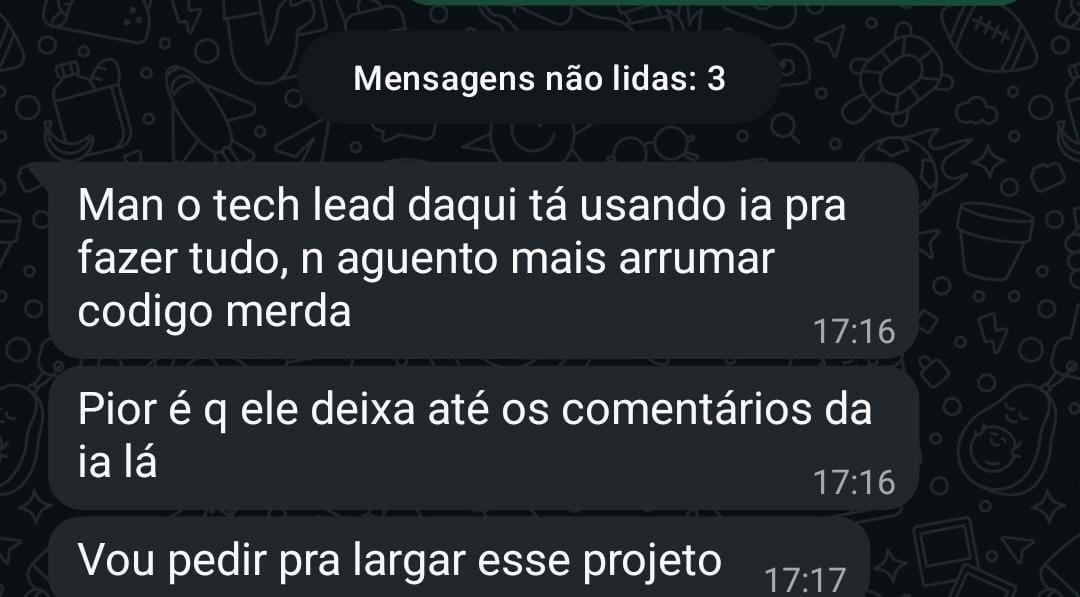
Nowadays, almost everyone acknowledges the speed, but utterly frustrated by the quality.
Fellas, I think humans evolved faster in the last 3 years than AGI.
é curioso como que em TI sua promoção vem da sua relevância para o negócio e não para o código - e isso foi desde sempre. mesmo quando código artesanal era mais relevante, o que te promovia era o resultado disso no negócio e no time - hoje isso é realidade mais do que nunca.
For millennia, jocks ran everything.
The nerds finally take over.
And what do they do?
Develop AI that wipes out their own coding/math/analysis moats.
Creating a social premium on interpersonal skills.
The irony.
everyone's talking about their teams like they were at the peak of efficiency and bottlenecked by ability to produce code
here's what things actually look like
- your org rarely has good ideas. ideas being expensive to implement was actually helping
- majority of workers have no reason to be super motivated, they want to do their 9-5 and get back to their life
- they're not using AI to be 10x more effective they're using it to churn out their tasks with less energy spend
- the 2 people on your team that actually tried are now flattened by the slop code everyone is producing, they will quit soon
- even when you produce work faster you're still bottlenecked by bureaucracy and the dozen other realities of shipping something real
- your CFO is like what do you mean each engineer now costs $2000 extra per month in LLM bills
The real story here is worse than a fumble. It’s a three-step own goal.
January 9: Anthropic locks Claude Code OAuth tokens, killing every third-party tool that built on Claude subscriptions. OpenClaw, which recommended Claude Opus 4.5 as its default model, wakes up to a broken integration. No warning. No partner outreach.
January 27: Anthropic’s legal team sends the cease-and-desist over “Clawdbot” sounding too similar to “Claude.” Steinberger complies at 5 AM on a Discord call. During the 10-second window where he releases the old GitHub and X handles, crypto scammers hijack both accounts and run a $16M pump-and-dump scheme. The chaos reflects on the entire Claude ecosystem.
February 15: Steinberger announces he’s joining OpenAI.
So Anthropic had the fastest-growing open source project in AI history (145K+ GitHub stars, 2 million visitors in a single week), built by a guy who sold his last company for ~€100M, whose tool literally recommended Claude as the default model to millions of new users.
Their response was to cut off his API access and send lawyers.
Steinberger spent last week in San Francisco meeting with every major lab. He explicitly said he could have built OpenClaw into a massive company but chose OpenAI because he wanted “the fastest way to bring this to everyone.” Meanwhile OpenClaw has already spread to China, with Baidu planning direct integration into its main app.
This is a project that was essentially a free distribution channel for Claude. Millions of developers installing a tool that defaults to your model. The growth marketing team at Anthropic should have been sending gift baskets, not legal notices.
Sam Altman just got handed an open-source agent framework with global distribution and a brilliant founder, because Anthropic’s legal department moved faster than their partnerships team.
THANKS, been trying to say it for a long time. Business matter, be a Product Engineer is maybe the future, but that importance does not exclude the technical importance (including code). The right technical decision is tied to right coding structure, AI is just “the printer”.
Prediction: In the AI age, taste will become even more important. When anyone can make anything, the big differentiator is what you choose to make.
https://t.co/3GQUlfH58t
Leetcode is dead.
Nobody writes code line by line anymore. Developers are orchestrating AI, debugging its output, catching when it goes wrong.
We're building assessments that test fundamentals and AI fluency together. Not just memorized algorithms.
Because that's the actual job now.
Anthropic:
- Blocks OpenAI from using Claude
- Blocks xAI from using Claude
- Blocks OpenCode from working with Claude subscriptions
- Forced Clawdbot to change its name
These little things are what make people dislike a company over time
There’s bad software.
There’s bad user experiences.
Then there’s the CEO and founder publicly blaming you for not knowing how to use their product.
This is the biggest sign to stay away, even if they have a better product today.
I just want to say I love Rust, I code in Rust.
At the same time, I have the highest respect for great C developers.
Big thanks to the devs behind SQLite, Postgres, FFmpeg, tmux, and so many others.
It's not about the language, it's about passion for the craft.
#2025
The RAM shortage might be a good thing actually. Maybe developers will stop using inefficient techs and start to code properly since their garbo webapp won't run on consumer hardware.