Omalauncher: agent friendly and fast omarchy arch Linux launcher for your stock android phone. Native Claude Code and Grok Build integration lets you build your own phone apps right from your phone, while keeping all your existing apps, such as banking apps @dhh
https://t.co/oh4RRjKJu3
@sole24ore vorrei segnalare come l'immagine usata sia generata con l'intelligenza artificiale.
Oltre che triplicare il numero di pensionati che emigrano, abbiamo anche duplicato il naso della signora nel mezzo, e la mano destra del signore.
The question of whether LLMs can reason is, in many ways, the wrong question. The more interesting question is whether they are limited to memorization / interpolative retrieval, or whether they can adapt to novelty beyond what they know. (They can't, at least until you start doing active inference, or using them in a search loop, etc.)
There are two distinct things you can call "reasoning", and no benchmark aside from ARC-AGI makes any attempt to distinguish between the two.
First, there is memorizing & retrieving program templates to tackle known tasks, such as "solve ax+b=c" -- you probably memorized the "algorithm" for finding x when you were in school. LLMs *can* do this! In fact, this is *most* of what they do. However, they are notoriously bad at it, because their memorized programs are vector functions fitted to training data, that generalize via interpolation. This is a very suboptimal approach for representing any kind of discrete symbolic program. This is why LLMs on their own still struggle with digit addition, for instance -- they need to be trained on millions of examples of digit addition, but they only achieve ~70% accuracy on new numbers.
This way of doing "reasoning" is not fundamentally different from purely memorizing the answers to a set of questions (e.g. 3x+5=2, 2x+3=6, etc.) -- it's just a higher order version of the same. It's still memorization and retrieval -- applied to templates rather than pointwise answers.
The other way you can define reasoning is as the ability to *synthesize* new programs (from existing parts) in order to solve tasks you've never seen before. Like, solving ax+b=c without having ever learned to do it, while only knowing about addition, subtraction, multiplication and division. That's how you can adapt to novelty. LLMs *cannot* do this, at least not on their own. They can however be incorporated into a program search process capable of this kind of reasoning.
This second definition is by far the more valuable form of reasoning. This is the difference between the smart kids in the back of the class that aren't paying attention but ace tests by improvisation, and the studious kids that spend their time doing homework and get medium-good grades, but are actually complete idiots that can't deviate one bit from what they've memorized. Which one would you hire?
LLMs cannot do this because they are very much limited to retrieval of memorized programs. They're static program stores. However, can display some amount of adaptability, because not only are the stored programs capable of generalization via interpolation, the *program store itself* is interpolative: you can interpolate between programs, or otherwise "move around" in continuous program space. But this only yields local generalization, not any real ability to make sense of new situations.
This is why LLMs need to be trained on enormous amounts of data: the only way to make them somewhat useful is to expose them to a *dense sampling* of absolutely everything there is to know and everything there is to do. Humans don't work like this -- even the really dumb ones are still vastly more intelligent than LLMs, despite having far less knowledge.
Your email system is not able to send me the documents (in 2024...) after many tries. Even when I asked them to be sent by letter, they never arrived. This is becoming ridiculous.
I am considering contacting the @TheFCA to defend my rights at this point.
@ScottishWidows could you please provide my annual pension statements I never received for the years 2022 and 2023.
I called your contact center more that 5 times (spending more that 30 pounds, as I am currently abroad) and the issue is not solved after more that 2 months!
Gli emendamenti presentati da @daniela_torto e @toniricciardi al Milleproroghe sui lavoratori impatriati correggono il testo del Governo che non ha nemmeno recepito le raccomandazioni delle Commissioni - reintrodurre la logica del radicamento per non tornare indietro di 10 anni
Unfortunately , too few people understand the distinction between memorization and understanding. It's not some lofty question like "does the system have an internal world model?", it's a very pragmatic behavior distinction: "is the system capable of broad generalization, or is it limited to local generalization?"
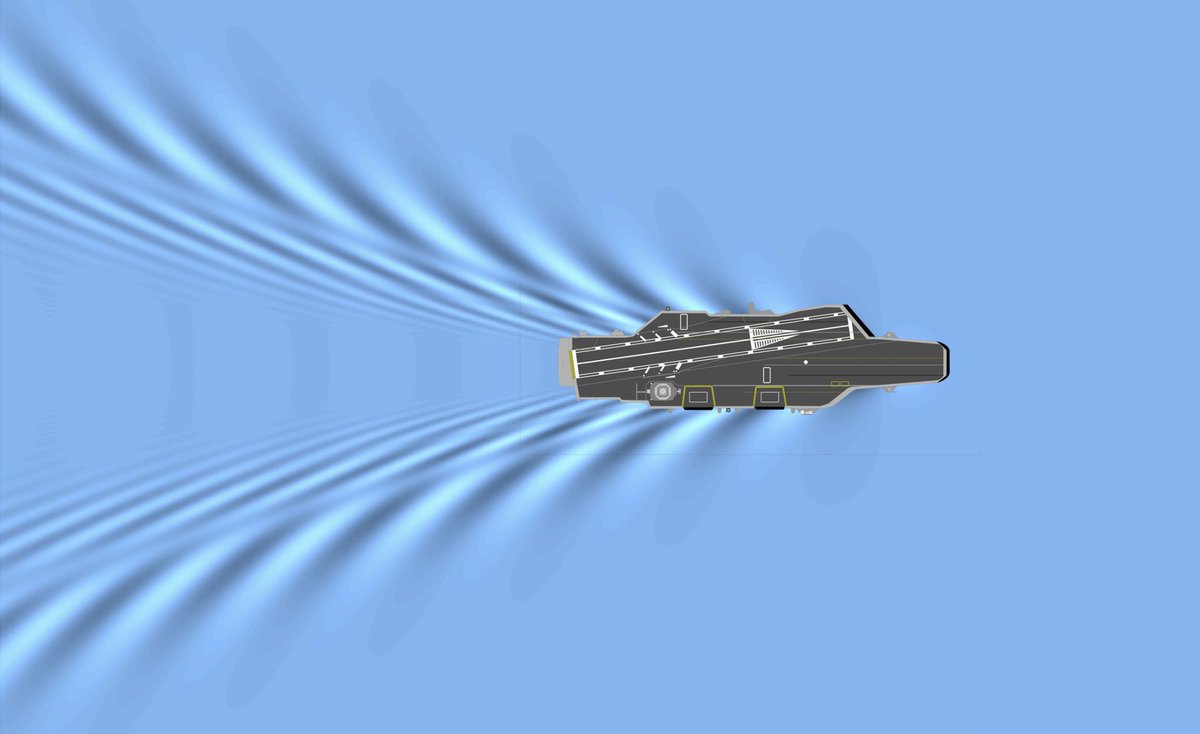
If you're programming a game where a boat moves through water, you might be tempted (as I would) to change the V-shape angle of the waves behind the boat based on how fast the boat was moving!
What if I told you that that V-shaped angle is always 19.47°, regardless of how fast the boat is travelling? 😱
This pattern even holds true for a duck traversing a pond. 🦆
The envelope of these waves stands at a fixed angle, and the wake has a characteristic feathered pattern.
This wake pattern was first explained mathematically by Lord Kelvin (William Thompson) and are known today as the Kelvin wake pattern.
After nearly 70 years, researchers have discovered a fast algorithm for finding shortest paths on negative-weight graphs — those in which traveling along one segment can offset the cost of traversing another. My latest for @QuantaMagazine:
1/3
https://t.co/q2TpOBfbr9
Blocking an ISP will *increase* spam, because you still deal with the same amount of spammers, but your ability to detect them is decreased. It's a rookie move.
This is a kind of situation you see a lot in real-world ML, not just with spam and fraud detection...
If the far-right weren't attacking trans people like they are today, they'd find another target. The entire schtick is to find an outgroup to label as degenerate, subhuman, and dangerous to society (e.g. "groomer" panic), and harass the outgroup as a public display of cruelty.
Looking at the output of a deep learning model trained on human-generated data and believing the model is "intelligent" in the human sense is exactly like looking at motion-captured CG and believing the characters on the screen are "alive".
I know it's hard to grok... but don't judge the performance of an AI system based on *specific* examples. *100%* of the value of an AI system comes from its ability to generalize broadly, which you *cannot see* through a few specific examples.
With AI systems, it's a bad idea to use a product demo (= absolute best case scenario) to extrapolate about the median case. The value of AI lies in its ability to generalize, which is entirely impossible to evaluate from a cherrypicked sample.
🚨 CRITICAL ALERT
A severe 0-day vulnerability called #Follina has been exposed (since May 27th) in MS Word Documents.
It could allow hackers to take full control of your computer, in some cases WITHOUT even opening the file. 🧵