Now out in @NatureBiotech ! Do lncRNAs commonly bind 1000s of genomic sites? Maybe they do, but the dozens of studies that report genomic binding maps of lncRNAs are deeply flawed, with probes binding suprious DNA sites rather than RNA-bound ones. https://t.co/01NroM67dK
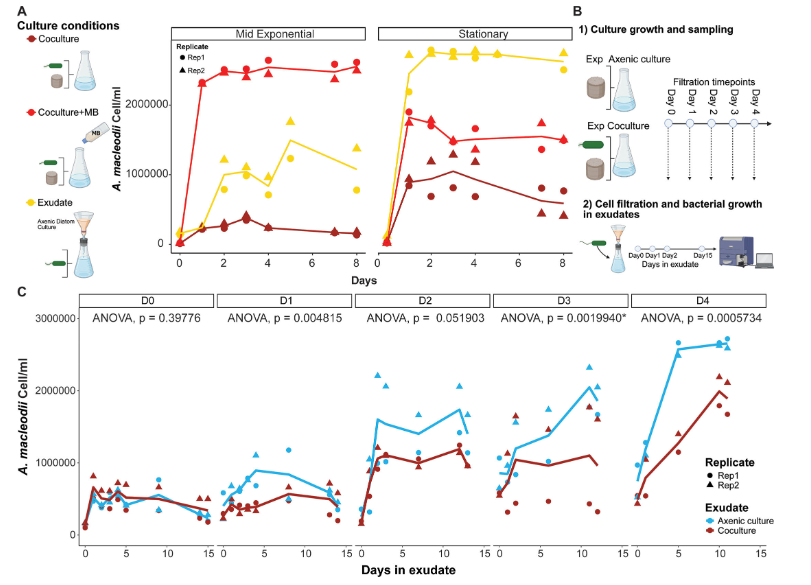
Diatoms are responsible for almost a quarter of global primary production. How do they interact with bacteria? First, bacteria swim and secrete exudates that induce diatom death. They then aggregate around diatom debris. Learn more in #mBio: https://t.co/3XsfvosvYI
A preprint‼️that's bound to ruffle some 🪶 "Widespread DNA off-targeting confounds studies of RNA chromatin occupancy" led by our @MicahGoldrich and Louis Delhaye from @pieter_mestdagh. TL;DR we show that many of lncRNA chromatin occupancy maps are flawed🧵https://t.co/eCq6nORxQm
Very happy to share our latest article at the @SchragaSchwartz Lab on RNA modifications, specifically on 16 rRNA modifications, their dynamics, across the tree of life. #Epitranscriptomics#RNAmods
You can check it out using the following link
https://t.co/iawoM5bU4I
(1/5) 🧵
Excited to share txtools with the RNA and genomics community. It's been a work-horse for many of our projects in the @SchragaSchwartz lab. https://t.co/XCpGvLfZbT
What are the forces shaping m6A evolution? Using interspecies hybrids in yeast and mammalian systems, we find that changes in m6A levels are nearly exclusively driven in cis. https://t.co/cajn570Ukh
Our @SGinossarLab virus encoded CRISPR screen is online on bioRxiv https://t.co/0ggmebD3n4 We established a new platform (VECOS) for screening infection factors, where an sgRNA library is encoded in the viral genome, uncovering hundreds of host factors, and more.
>>>
🔥Hot from the oven🔥! Our new paper led by @OffirLupo on the role of TF cooperativity in binding specificity is now out in @CellSystemsCP
see🧵below for highlights (1/10)
@WeizmannScience
https://t.co/qRY5xdQi4c
📣 Our Fellows Program has launched its #CallforApplications for the 2024-25 Azrieli International #Postdoctoral#Fellowship! Candidates worldwide are eligible to apply beginning Sept 1, 2023.
Learn more: https://t.co/SWKmAsV8Rb
Pastel de choclo
📍 Chile 🇨🇱
⭐ 4.7
💯 #1 best-rated casserole in the world
Discover the best rated casseroles in the world: https://t.co/gJ7HtbcByP
Chile leads the list of the world's best casseroles with pastel de choclo! Chile's favorite home-cooked meal, the soft and creamy pastel de choclo is a casserole-like pie that is also popular in Peru, Argentina and Bolivia. It consists of ground beef, chicken, black olives, onions, hard-boiled eggs, and corn flour dough called choclo.
Corn plays a key role in the dish, and unsurprisingly so – it was worshipped by the ancient Incas whose most important god was the Corn God. Corn was so important to Incas that their chief, believed to be a descendant of the gods, planted the first corn seeds every year.
Nowadays, large raisins are sometimes incorporated into the pie, while the pie itself gets sprinkled with sugar before baking, ensuring that a caramelized crust develops on top. All that's left is to enjoy it while it's hot and consume a delicious slice of culinary history.
Photo: IG inti.momiami
Attention scientists from all over the world🙃The final deadline to submit a Letter of Intent for a #HFSPFellowship is coming close. Hurry up! We can't wait to read your bold research ideas! + info: https://t.co/fLL0t9znhH #basiclifesciences
🥳🎉We are delighted to share our new paper that deciphers the complementary strategies by DNA binding domains (DBDs) and IDRs in directing transcription factor (TF) target specificity. 🎉🥳
https://t.co/SBuCQuV7rM
@Divya_KKumar@FJonas15@BarkaiNaama
I feel blessed to be working in something that has kept me interested after 6 years. RNA modifications are really wondrous and the people working on them are full of curiosity. I've been working in an R package that helps me analyze sequencing data https://t.co/0FhEroyuJ1 (1/2)..
It's official! The 2023 #HFSP New Awardees are here! Congratulations to the 34 winning teams of #HFSPResearchGrants and the 52 researchers awarded #HFSPFellowships! 🥳Are you a #2023HFSPAwardee? 🏆Tell us! +info: https://t.co/WVoXji1AHB
Proud to present our 🎉new paper🎉deciphering the IIDR grammar of transcription factor target specificity: https://t.co/Gij3ZAG7a2. Special shout out to my fellow code breakers 🕵️ @BennyKrupkin and MiriCarmi and the rest of the @BarkaiLab - follow 🧵 for highlights
1/8 Today we highlight awesome work from @SchragaSchwartz lab at @WeizmannScience exploring how and why m6A is deposited on mRNA. They reveal that m6A is not selectively installed but is instead inhibited by splicing. https://t.co/eGhVJ6s5Z3
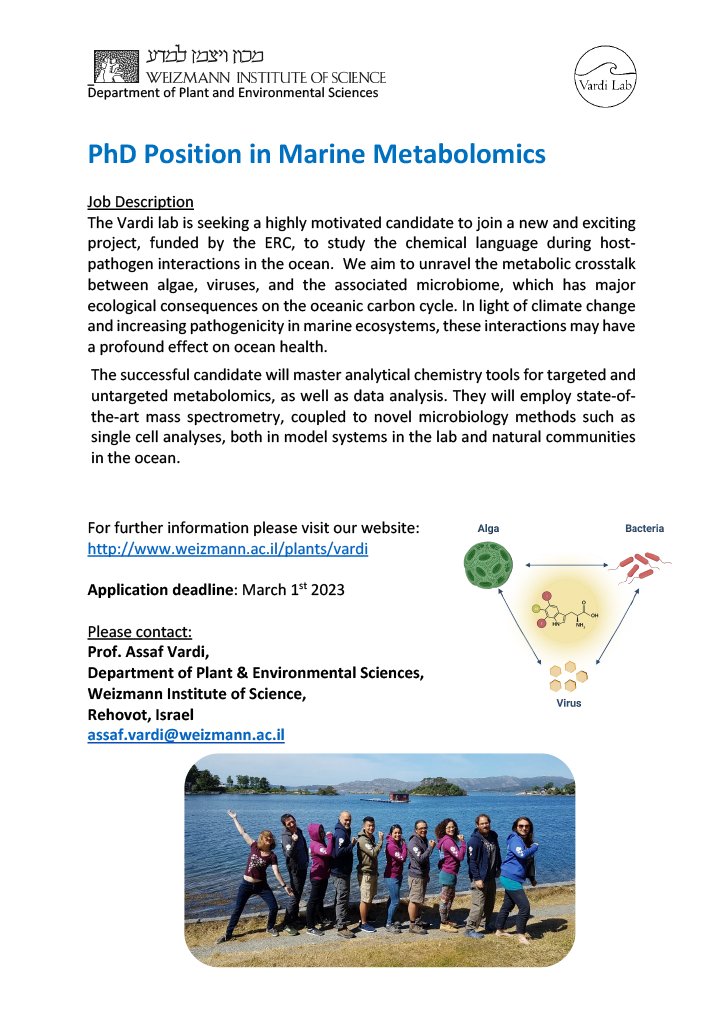
🚨JOB ALERT! 🚨 Do you want to join our lab for an exciting new project on marine chemical ecology, funded by @ERC_Research? 🌊🌊 We are looking for you!🧑🔬
🚨 PhD position is open! 🚨 Do you want to be part of an exciting new marine metabolomics project funded by @ERC_Research? 🌊⚗️ The Vardi lab is looking for you! 👩🏾🔬🧑🏻🔬👨🏿🔬 Details attached ⏬
Our work, demystifying m6A deposition, is out! m6A is not selectively installed. It is installed by default, at all eligible consensus motifs, except in the vicinity of splice junctions, where it is excluded by the exon junction complex https://t.co/D5m1AsDAYF
Thanks to the @RNASociety for this endorsement. And thank you Paula Petronela Groza - was a pleasure interacting with you regarding this piece.
https://t.co/M6j5l5ohdp