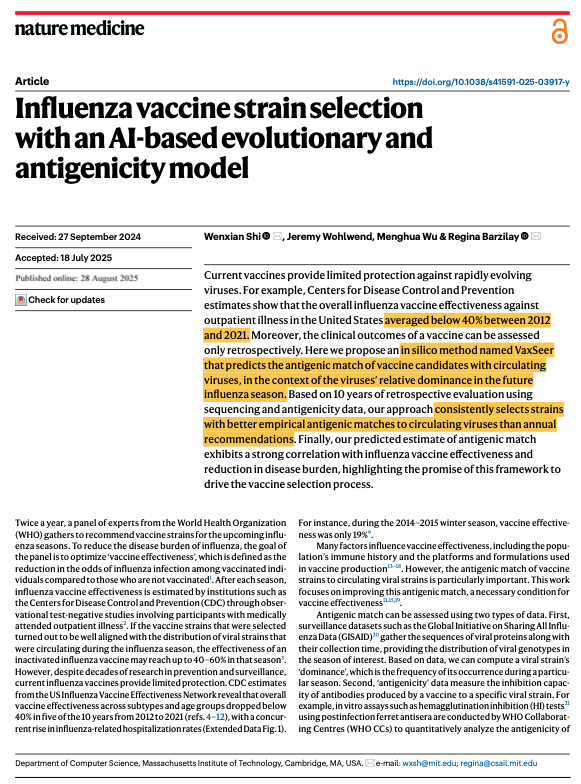
Seasonal flu vaccines have an average efficacy of ~40%, and they must be revamped each year.
A new computational model, called VaxSeer, could improve how we design annual flu vaccines.
But first: When I say vaccines have an “efficacy” of 40%, that doesn't mean 40% of people who get the vaccine are protected. Efficacy is a measure of relative risk reduction. If 10 out of 100 unvaccinated people catch the flu in a given season, and only 6 out of 100 vaccinated people do, the relative risk reduction is (10 – 6) / 10 = 0.40.
Flu vaccines work by training the immune system to make antibodies against hemagglutinin, a viral surface protein. When antibodies bind to hemagglutinin, they block viruses from entering human cells. The antibodies also flag white blood cells to engulf and destroy those viruses.
The challenge, though, is that twice per year, a WHO panel sits down to recommend vaccine strains for the upcoming flu season. This panel needs to figure out which viral strains will dominate and spread *months* in advance (to give vaccine manufacturers time to ramp up production.) The 2024-2025 seasonal vaccines included three viruses; two influenza A strains (H1N1 and H3N2) and an influenza B virus.
Even if the WHO gets these selections mostly correct, flu vaccines often only have modest efficacy for a few reasons:
1. Strain mismatch. If circulating viruses mutate or differ from the selected strains, protection drops.
2. Egg adaptations. Vaccines are made using fertilized chicken eggs injected with viruses. The viruses can pick up “egg-adaptation” mutations that change their surface proteins, weakening immune recognition.
3. Virus mutations. Flu viruses carry RNA genomes, which mutate super fast. These mutations can make it harder for antibodies to latch onto the virus.
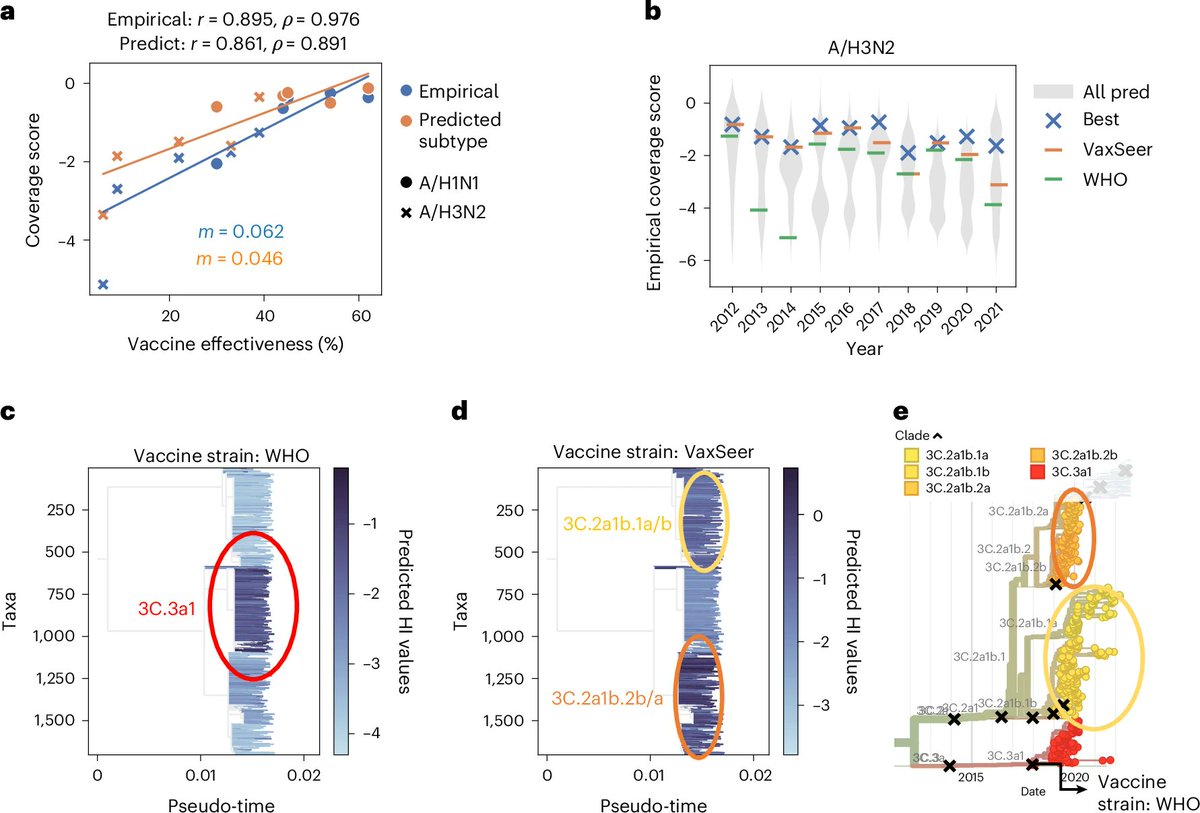
Fortunately, it seems like AI models could help with *some* of these problems. VaxSeer, for example, is a collection of two models that could consistently make better selections than the WHO panel. VaxSeer has:
1. A dominance predictor, trained on 394,000 rows of surveillance data (2003–2023), which learns which variants are most likely to spread.
2. An antigenicity predictor, trained on ~134,000 lab assays, which estimates how well vaccine-induced antibodies neutralize circulating viruses.
When these two models were combined and then "benchmarked" on data from the last 10 flu seasons, they consistently outperformed WHO recommendations. For H1N1, the models picked the best strain in 7 of 10 years (vs. 3/10 for WHO); for H3N2, 5/10 (vs. 0/10 for WHO).
The next step is to start using VaxSeer to design vaccines in FUTURE years, in parallel with the human panel. These models need to be validated in the real world; not only on historical data.
Thanks for reading.
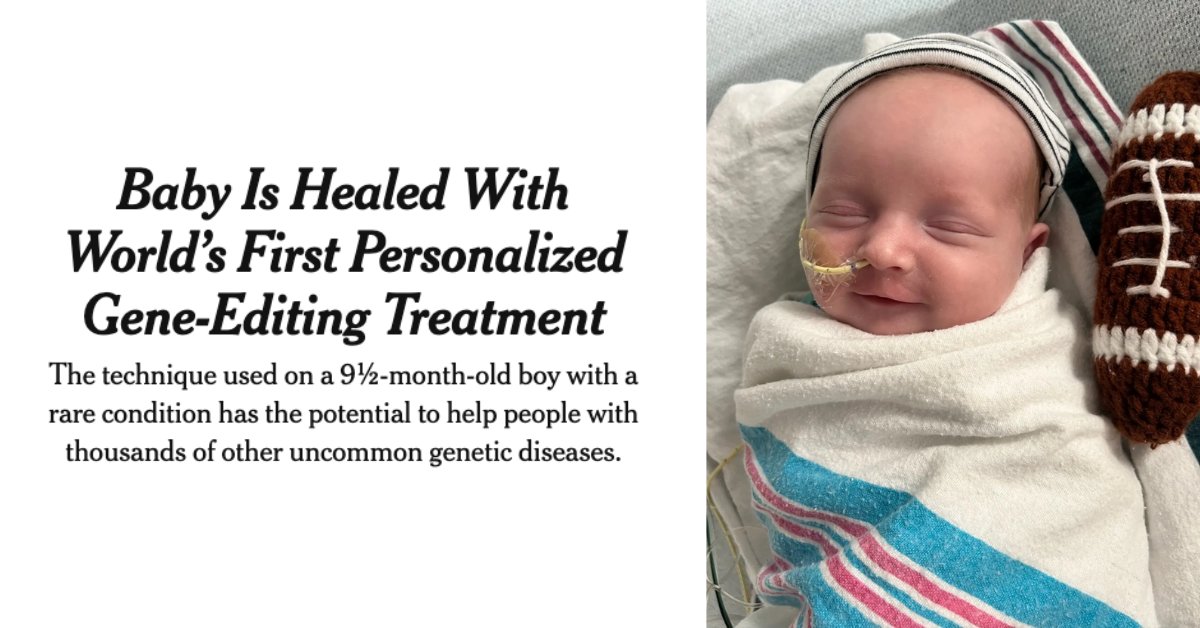
A baby named KJ, who was born with a rare genetic disorder – CPS1 deficiency – is healed thanks to doctors at the @ChildrensPhila who administered the world’s first personalized gene-editing treatment. The research team used base editing, a gene-editing method invented by HHMI Investigator @davidrliu and his lab at @Harvard University in 2016.
Earlier this year, Liu received the @brkthroughprize for developing both base editing and prime editing. These gene-editing technologies enable the correction or replacement of virtually any genetic mutation, including those that cause countless human genetic diseases.
Read more about Liu's work here: https://t.co/NlE25O7wJR
So excited to share my PhD work! A huge thanks to my mentor @diegodidibi and the amazing @Vi_Fusco. Together, we've developed the CASwitch: a zero-leakiness inducible gene expression system with great performances in mammalian cells. Explore its applications in the preprint!🧬💡
@diegodidibi @Tigem_Telethon Past 3 years seem to have flown by, but they've been intense and enriching for me, both scientifically and personally. It's been a pleasure to share them with current and past db lab members, and I feel fortunate to have had the opportunity to learn from you. Thank you, Diego! ;)
Giving my first oral presentation at #msbw2022 was a great experience! I was very excited and actually, I had a lot of fun presenting. Thanks to my boss @diegodidibi for giving me this opportunity.
Finished the "Insulin Release" painting this morning. I'll be showing it at the @ACAxtal meeting in Portland, and I'll put a full-size file at PDB-101 @buildmodels when I get a few free moments. Insulin crystal in yellow, fused vesicle and cell membranes in green, ECM in purples.
We're attending #SEED2022 Conference in Washington D.C., ready and excited to present our posters on the implementation of new genetic circuits in mammalian cells!