ok update on the deleted repo thing, since it kind of blew up
first, some context on why i posted it like that. there have been so many security incidents lately that my brain is basically stuck in alert mode. so when i saw a stranger in our audit log deleting a private repo, i assumed the worst.
we figured out what happened. nobody hacked us, and it wasn't a github bug.
that repo was a private fork of a repo owned by @StainlessAPI, the company that generated our SDKs. our entire SDK pipeline ran on it.
Stainless got acquired by @AnthropicAI back in may. and on october 27, with zero heads-up to us, someone there deleted their copy of the repo.
turns out when you delete a private repo on github, every private fork of it gets deleted too. same request, under two seconds. and our audit log shows the person who deleted *their* repo as the one who deleted *ours*. that's why it looked like a random outsider walked into our org and nuked something.
no email. no "hey, we're cleaning these up, grab a copy." just gone, along with the production repo behind every one of our SDKs.
github support walked us through all of it within a day, which, genuinely, thank you.
one ask though @github: put this in the audit log. right now the event for our repo just says "repo.destroy" by an outside user. if it said "deleted because upstream fork parent X was deleted", we'd have understood it in two minutes instead of spending a night thinking we'd been breached.
we had a local clone, so we pushed it back up as a standalone repo and the SDKs are running again.
if you were a Stainless customer and you've got anything living as a private fork of one of their repos, go detach it today. it takes ten minutes. their delete is your delete.
We believe voice is the most natural way to interact with intelligence, so we created Dessa, the most authentic full-duplex speech model ever built. Talking with it feels like talking with a person…full of emotion, nuance, pauses, and a natural cadence.
https://t.co/r0qFLdvd6c
eMudhra is investigating a security incident affecting a portion of our TLS certificate customers.
This incident has no impact on customers using our enterprise applications, digital signature services, or other electronic signature solutions.
We are actively engaging with affected TLS customers to provide the necessary support as we continue our investigation.
Updates will be published at: https://t.co/Ykzuwh34j0
For comparison, using better entropy, you would need 2*10^41 years to guess the key at 1 billion guesses per second. That's 100 duodecillion years (had to Google that)
On the flip side, far too many of the 35+ year olds I talk to have still not picked up coding with agents. Coding an agent harness is even better. Bubble or not - engineering is not going back to hand written code. Time to adapt.
Dusting off this tweet from April because this gap in shared understanding of LLM capability is *widening*. It's now less "two groups of people speaking past each other" and more a sharp funnel.
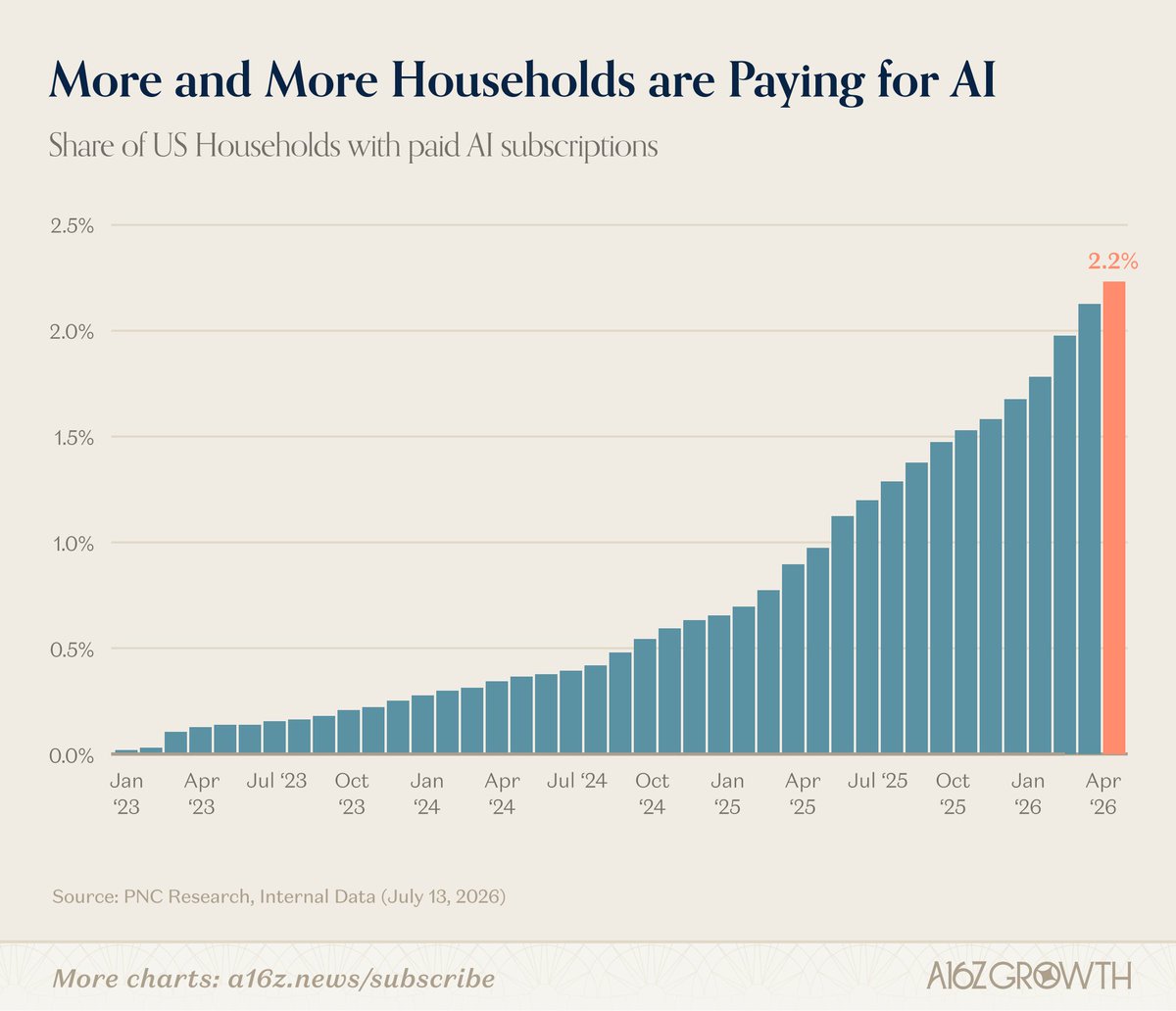
- Napkin math somewhere around 6B people (~75% of the population) have barely come in contact with LLMs at all.
- Around 1-2B (~20%) are casual and infrequent users of free-tier ChatGPT-like products. This group sees derpy chatbots and treats them a bit like a better Google search, a writing aid, or etc. Maybe an agent tries to book you a flight. I have non-tech friends who (reasonably, imo) say they have not much use for it at all. Even many professionals outside of math&code are in this tier. For example, execs and many other functions spend a lot of their time talking to other people, so while they understand what is happening intellectually, it is still second-hand and a bit abstract.
- Now we get to professional use of frontier-grade LLMs in math&code. Somewhere around 20M people (0.2%) see first-hand that large, complex projects that used to take them weeks/months can now be completed by agents with a prompt. Building apps, copying apps, translating apps, decompiling apps from binaries... This has all happened very quickly and recently - less than 1 year ago, I was writing code manually by hand, typing memorized computer code commands into a code editor character by character, occasionally pressing Tab to autocomplete a little chunk of code.
- And finally we get to the ~5,000 people (~0.00006%) with access to frontier-grade systems internally. The external world has seen the preview. It looks like swarms of thousands of agents collaborating over weeks on software mega projects: minting zero days, running cyber attacks and defenses at machine speeds, discovering new science, advancing the frontier of mathematics. Things that would have taken top professionals in the industry years of work. Meanwhile, human review and comprehension are starting to fall behind. For example, people are still involved in the "archeology" of the OpenAI-HF incident from many months ago. Mathematicians may be poring over the 722 manuscripts on frontier mathematics for a while.
The funnel is driven by a combination of factors:
1. The impact scales with ambition, problem size, and horizon. A question with a paragraph answer barely stresses the system. You need a reservoir of big, difficult problems that you really care about. This aspect drives the consumer / professional dimension of the funnel.
2. The jaggedness of the system (which I have written about a lot separately). Capability peaks in domains that are digital, verifiable and economically valuable. This is because LLM capability emerges from reinforcement learning on verifiable rewards on a curated environment mixture driven by revenue potential. This aspect primarily drives the area (e.g. math&code) dimension of the funnel.
3. Access. Free-tier, paid-tier, internal.
So this is the weirdness of the moment. The general public has mostly not interacted with these systems. When they have, it looks like a derpy chatbot. The majority of professionals still see only a modest uplift. And a small sliver of professionals are experiencing the vertigo of the curve going vertical. And it is all happening at the same time.
I'm not sure what's going on with Codex lately. Changing a file's structured output format took 5 minutes of thinking on Astra Light. I woke up the model with 'yo, are you alive?' and it responded with 'Yes - I'm here. The changes are not done yet'. And that was it.
AI is currently a Swiss Army knife that’s too complicated for most people. None of our customers understand a database index and they shouldn’t need to.
Product complexity like tool use, mcp, context window, model selection will go away soon.