Warren Buffett's wife left him after more than 20 years of marriage.
He was already one of the greatest investors in America, but without her, his own daughter wasn't sure he could take care of himself.
Susan Buffett moved from Omaha to San Francisco in 1977. In the video, Warren and several members of the Buffett family all talk about what her leaving did to him. Their daughter described the separation as devastating and said she couldn't understand how her mother could leave because, in her words, “he can't function by himself.”
Susan knew it too. Even after leaving, she still loved Warren and worried about what would happen to him. Eventually, their daughter called a woman named Astrid Menks and asked her to go to Warren's house, make him some soup and look after him because she genuinely feared “he's not gonna make it.”
Astrid went over. Eventually, she moved in.
But Susan never divorced Warren. She remained his wife and stayed emotionally close to him while Astrid became the woman living with him in Omaha. Stranger still, Susan and Astrid became close themselves. Buffett's children later explained that their mother was happy Astrid was there because she wanted someone to take care of Warren.
Susan remained married to Warren until her death in 2004. Two years later, Warren married Astrid.
What makes the story hit harder is hearing the family describe it themselves. This wasn't just a strange arrangement people later wrote about. The people closest to Buffett watched him go through it and remembered how badly the separation affected him.
Buffett spent his life proving that he understood businesses better than almost anyone alive. By the time Susan left, he already had more money than most people could ever imagine.
But none of it could replace the person who had held his life together outside of business.
Maybe that's the strangest part of Buffett's story. He could buy almost anything he wanted, but when his wife left, all the money in the world couldn't stop him from falling apart.
So can money actually buy happiness, or does it only make life easier until the things that really matter disappear?
Asset owners are the only winners in this economy.
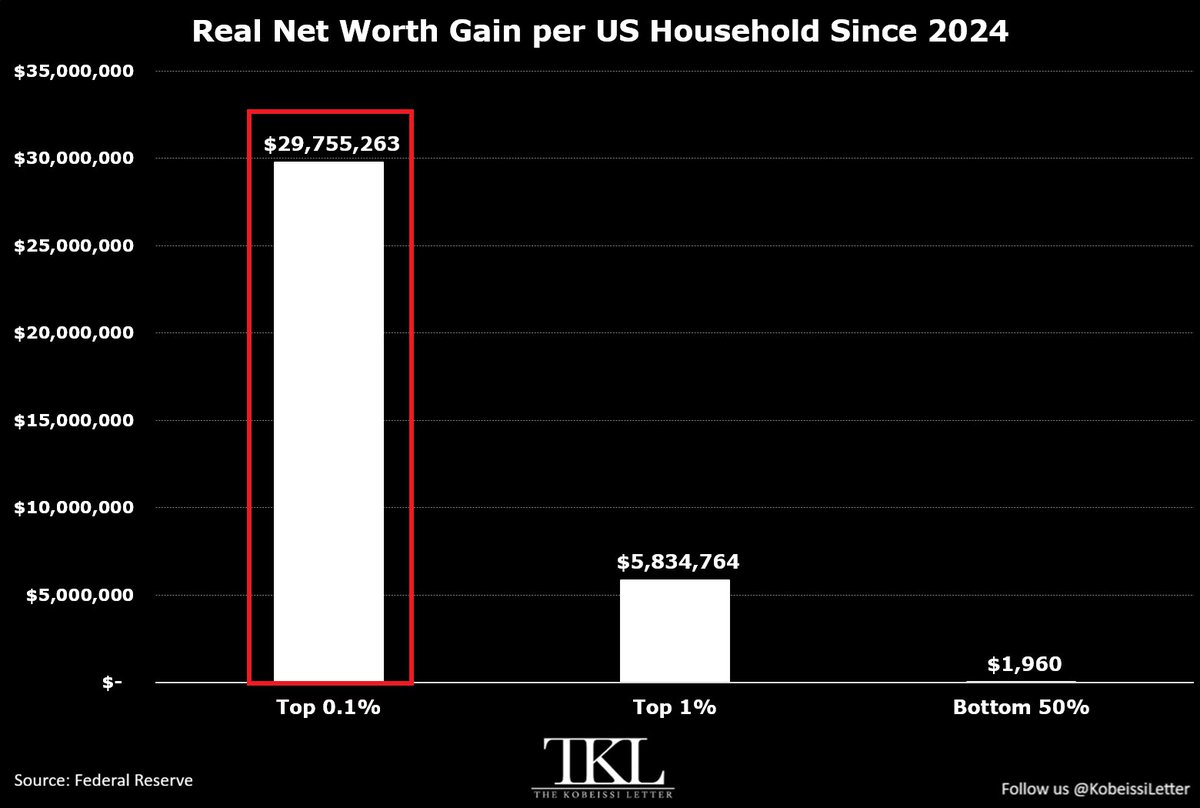
The top 0.1% saw a +$29.76 million increase in real net worth per household from Q4 2024 to Q2 2026.
Over the same period, the top 1% experienced a +$5.83 million surge in inflation-adjusted net worth per household.
By comparison, the bottom 50% saw an increase of just +$1,960 per household.
In other words, the top 0.1% has gained +15,183 times more wealth per household than the bottom 50% since 2024.
The top 0.1% has seen their real wealth rise +$4.44 trillion over this period, while the bottom 50% added just +$198 billion.
Own assets or be left behind.
Introducing Claude Sonnet 5.5, the second model in the Claude 5.5 family.
It’s a clear upgrade over Sonnet 5, runs more than 30% faster, and costs up to 30% less for most work.
Bill Ackman said something about Warren Buffett that sounds almost like an insult to human nature itself. Investing requires a kind of emotional discipline that has nothing to do with intelligence and everything to do with going directly against every instinct a person is born with. If a lion shows up in the jungle and everyone starts running, you run with them. That instinct kept your ancestors alive for a very long time. In markets it does the exact opposite. When the lemmings are running over the cliff, you are supposed to turn around and run the other way, straight into the thing everyone else is fleeing.
I did not have this in me at twenty five. Nobody does. I watched a mentor of mine sit completely still during a session where three of the loudest men on the floor were screaming that the world was ending, and he bought the entire time, quietly, without raising his voice once. I asked him afterward how he did it and he said something that stuck with me for forty years. He said panic is just information wearing a very convincing disguise, and your job is to take off the costume before you decide what to do with it.
Most people think temperament is something you either have or you don't, a trait handed to you at birth like eye color. It isn't. It is closer to a muscle that only grows under exactly the kind of pressure that makes everyone around you want to quit. You cannot build it reading about other people's calm. You build it by staying seated through your own worst afternoon and noticing, the next morning, that you are still standing.
The people who make real money buying fear were not born fearless. They just practiced staying seated more times than everyone else who got up and ran.
A wonderful life lesson from Charlie Munger:
“Crooks, crazies, egomaniacs, people full of resentment, people full of self-pity, people who feel like victims … avoid them like the plague.”
between 1957 and 1969 warren buffett compounded at 29.5% a year and never had a losing year. then he closed the fund and handed the money back.
not because it stopped working. because he could no longer explain the prices he was being asked to pay.
the partnership returned 29.5% a year gross and 24.5% after his own fee, against roughly 9% for the market, across thirteen years.
and he had written the reason two years before he acted on it, in the october 1967 letter, while the returns were still arriving.
"i will not abandon a previous approach whose logic i understand, although i find it difficult to apply, even though it may mean foregoing large and apparently easy profits to embrace an approach which i don't fully understand, have not practiced successfully, and which possibly could lead to substantial permanent loss of capital."
in may 1969 he announced he was winding it up.
here is the part almost nobody takes from this, because everyone stops at he called the top.
he never said the market would fall. he said he could not find prices he was able to justify. that is a different claim and a far smaller one, and it is the only kind of claim a person can act on honestly.
most people do the reverse. when a method stops finding anything, they change the method, because the alternative is sitting still and sitting still feels like failing.
he changed the market he was standing in instead.
the hard part was never noticing that the game had changed. plenty of people noticed. the hard part was stopping while it was still paying.
the partnership letters are public and free, and the 1967 one is where the decision is already visible, two years early. seven cases where structure decided the outcome and nobody's forecast mattered are pinned.
Amazon founder Jeff Bezos has a surprising theory about the "confidence" behind great founders: it might not be confidence at all.
When the idea of confidence comes up, Bezos offers a different explanation:
"You say it's confidence, but maybe it's just trying to compensate for that... accepting that that's a human bias and trying to compensate against it."
So what is the bias?
"I think it's generally human nature to overestimate risk and underestimate opportunity."
Your instincts don't just make the risks look bigger than they are. They also make the opportunities look smaller than they are. Both errors push you in the same direction: toward doing less.
Bezos's correction:
"The risks are probably not as big as you perceive and the opportunities may be bigger than you perceive."
This is why he says entrepreneurs "would be well advised to try and bias against that piece of human nature."
Seen this way, the founder who looks fearless may not have a different personality from you.
They may simply have accepted that their instincts are tilted and learned to adjust for it on purpose. That's not a trait you're born with. It's a correction you can choose to make.
And if you don't make it, @JeffBezos warns there's a cost:
"Thinking small is a self-fulfilling prophecy."
Let the bias set your ambitions, and you'll get small results that seem to prove small was all that was possible.
“Luck plays a meaningful role in everyone’s lives. You get born to decent parents in a good part of the world, and you’re way ahead of the game. And that doesn’t have much to do with skill or hard work." - Jim Simons.
Former Microsoft CEO Steve Ballmer was asked by Charlie Munger, in front of a whole golf club, why he held his Microsoft stock when his partners sold.
Then Munger added: "I know you're not that smart."
Ballmer's comeback: "No, but I'm that loyal."
Opus 5.5 is 20% cheaper per input and output token than Opus 5, and 60% cheaper on cache reads. So what does that actually do to the cost of a task in Claude Code?
We ran the numbers, and built a calculator so you can run yours from /usage:
https://t.co/WUqoFoecW3
Buffett stepped down at 96 with a fortune near $146 billion.
The number was never the asset. The system behind it was.
1972. See's Candies for $25 million.
He nearly walked away over the price.
By 2014 it had earned $1.9 billion pretax on $40 million of new capital.
1993. Dexter Shoe for $433 million, paid in Berkshire stock.
By 2007 that stock had made it cost about $3.5 billion.
He split the loss into three parts. Price. Currency. Delay.
Cheap can stay cheap.
A great business compounds what you paid for it.
Warren Buffett once made a $10 billion mistake.
In the mid-1990s, he started buying Walmart.
He planned to buy a significant position.
Then the stock went up a little.
Buffett hesitated.
He started “sucking his thumb.”
By the time he acted again, the opportunity was mostly gone.
He estimates Berkshire could have made $8–9 billion.
Instead, it made a tiny profit.
The lesson isn't that Buffett missed Walmart.
It's that even Buffett can let a small move in price change his conviction.
Sometimes the biggest investment mistakes aren't bad decisions.
They're decisions you never finish making.
In 2007, Mohnish Pabrai paid $650,000 for one lunch with Warren Buffett.
He expected one meal. He ended up with years of private dinners with Charlie Munger.
By then, Pabrai had made more than $70 million applying Buffett’s ideas. He decided that 3% was a fair tuition bill, set his limit at $2 million, and won the auction for less than a third of it.
He expected nothing beyond the chance to say thank you.
Before the lunch, Buffett’s assistant collected biographies of every guest. Buffett studied them all. Then he told the table there was no time limit. He had nothing else to do all afternoon.
Buffett wanted the person who paid for lunch to leave believing he had bought a bargain.
During the meal, Pabrai told Buffett that his wife was a fan, but the real love of her life was Charlie Munger.
Buffett got competitive. He called Munger boring and promised to arrange another lunch. Once they met Charlie, he said, they would understand that Buffett was the more interesting partner.
Pabrai thought he was joking.
Two days later, Buffett’s assistant emailed Munger’s assistant and arranged the lunch.
The plan backfired. Pabrai enjoyed lunch with Munger even more.
A friendship followed. From 2009 on, Pabrai and his family met Munger for dinner every three or four months. Pabrai also played bridge with him at the Los Angeles Country Club every two or three months.
The original lunch also brought yearly invitations to Buffett’s private Sunday brunch after Berkshire Hathaway’s annual meeting.
Pabrai later described the $650,000 bid as “buy one lunch and get infinite lunches for free.”
He tells the full story in the attached video.
After watching it, read the article below. It organizes Charlie Munger’s 25 rules for avoiding costly decisions into a practical checklist.