@fwbonnie__@RoytaMustDie It’s a common issue with PS2 ports due to how they tended to use an insane amount of overdraw to create fog / rain effects. Typically Xbox ports suffered similar issues or perf as well
@rms80 yea, I mean technically could see this being used to create a smaller HLOD of some type - like a single building, so it just gets crunched down to one mat / texture set. Still cool, thank you for sharing the video!
@rms80 that makes sense, was mostly curious as to the mesh reduction differences. On Callisto Protocol we ended up using InstaLOD to bypass the default reduction engine because of the same the headaches we ran into. I can see this being piped in via interchange to work on LOD1+
@Phantasmerie but ultimately, you have to paint in lighting information to the point where it's not too overpowering and not super repetitive. For a metal pipe, instead of just slapping a metal texture, you'd want a soft highlight in the middle, soft AO on the sides and a tight specular line
@Phantasmerie so ultimately what games did was with vtx paint, or they would create texture variants with baked light. So like MGS would have specific quads with a cast shadow on it. But we're talking like 128x128 textures as a max size. https://t.co/3UeW7ved2v
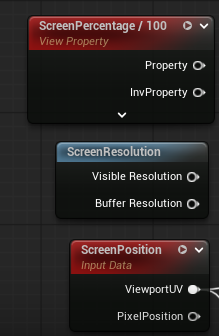
@DannyMacFinn hard to tell based on not knowing what your post material does, but ultimately you'd want to use one of these nodes for more flexibility. Your current blendable location will stomp over any color grading you attempt to do.
@games_inu Looks like it's new to 5.7 - before it was just alt + click on the wire; "Slice graph connections by alt+middle-mouse dragging in the graph editor."
@StormslayerDev@brittlehoellow Game sizes are large due to the sheer amount of assets being used. Nobody has stopped using detail textures, they have just evolved to be even more versatile since we don't use black&white bump maps anymore. Detail normals are very common, so are macro tiles for large surfaces.
@CaptainGPU No, this is absolutely not true. Modern games still use detail textures. There's a lot of value in tiling normals and roughness at varying scales to break up a surface.
@TheStingisBack looks like the window shatters as soon as his arms touch it. Likely was timed to shatter by itself as close as possible since he wasn't moving fast enough to actually break the glass