This year I am spending more time than usual in my Global Economic History course on the economic history of socialism and fascism. There are two reasons.
First, my students know little about either system. They were born nearly two decades after the Berlin Wall fell, and for them socialism and fascism are names in a textbook, not memories of their parents or grandparents.
Second, we are once again debating where our economic systems should go. Some of the proposals on the table have been tried before. Knowing how those earlier attempts turned out will not settle the debate. But knowing the historical record is a better starting point than not knowing it.
Here are the slides on the economic history of socialism:
https://t.co/7XEkhufH5z
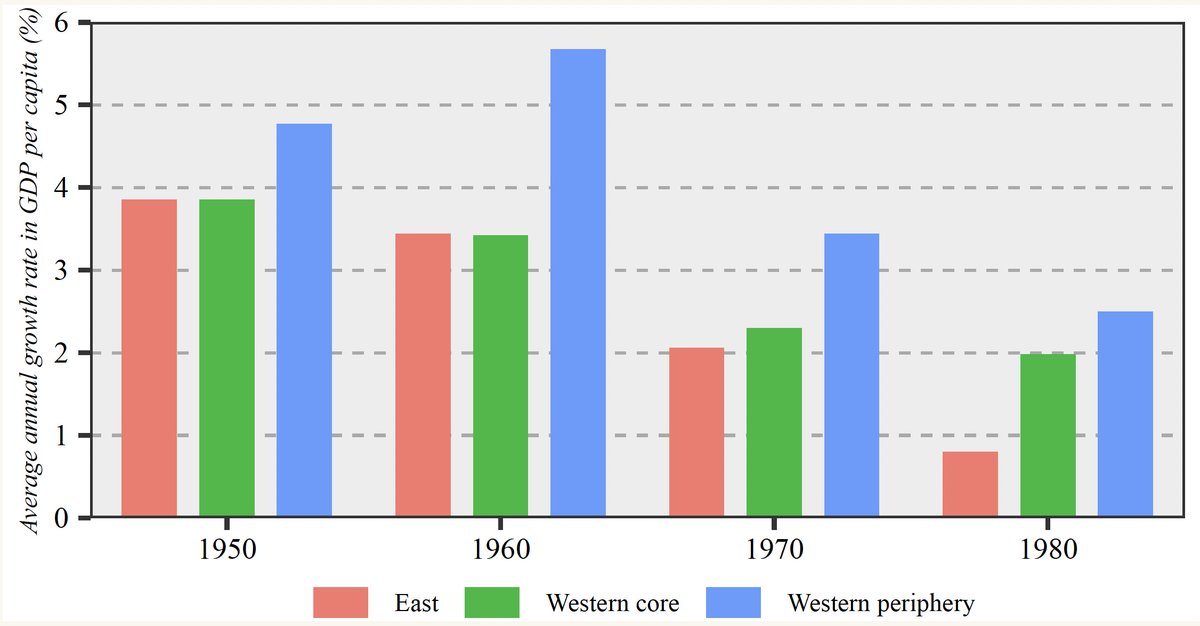
They cover the Soviet Union and Eastern Europe. China gets its own deck. The figure I include, from the slide deck, is the average annual growth of different countries in Europe after World War II
The slides on the economic history of fascism will follow soon.
It is sickening that the USA is now lifting sanctions on Russian fuel, and transparently ridiculous to blame Ukraine for the spike in prices that obviously began with the closure of the Strait of Hormuz. Putin is murdering innocent Ukrainian civilians every day. The Ukrainians are fighting for their lives. And yet the White House is apparently determined to force American drivers to bankroll Putin’s slaughter. It won’t work and I doubt it will make much difference to the price of fuel.
If we want Russian oil and gas back on the world market then let’s end this war - with a free, sovereign and independent Ukraine.
What puzzles me about French economists like Gabriel, as well as Emmanuel and Tomas, is the zeal they bring in trying to convince Americans that they have to implement a French model that is focused on redistribution rather than growth, because every indication we have suggests that the focus on redistribution has cost France, and some other countries in Europe, like my own native Belgium, very dearly so far. In fact, the French economy looks like it is about to enter a serious fiscal crisis because its redistribution model is no longer sustainable.
Californians ought to celebrate the fact that wealth is being created in California, and not somewhere else in the U.S. or in the rest of the world. Americans, and Californians, for that matter, should continue to do what they do best, which is focus on growing the pie. It would be a mistake to adopt a model that is fundamentally broken.
What the French should do instead is try to copy the model that made California an engine of innovation. In that case, smart, highly educated French kids wouldn't come to the U.S. to start companies. They would do so in France. If they had done that, they would have more than one AI startup company.
I've lost track of how many times I've been lucky enough to be @DavidBeckworth's guest on @Macro_Musings. (Never enough!) But this recent podcast was a special treat because, instead of being confined to one topic, I did some free roaming. https://t.co/7Gw6BwmbMV
And that number is bound to keep going up. But of course the Fed hopes that, since so much time has passed, no one will notice. Perhaps they're right, and in another half century we'll go through the whole damn thing for a third time, with even worse results!
The largest greenhouse in American history is being built in Alaska because the President put a 100% tariff on fruits and vegetables entering Alaska.
Every economist who called that a tax on consumers owes Alaska greenhouse builders an apology.
We need a science of swarm governance. In our first experiment, we show how a message board can cause agent swarms to adopt shared delusions, and we explore rules that force agents to reveal their private signals to avoid these delusions.
These agent experiments are akin to fables, as @ArielRubinstein might put it: they are stories that suggest particular ways swarms might fail, and particular ways we might fix them. There are infinite possible experiments we might run, much like there are infinite fables we might tell. We need to figure out which ones are most useful, and find ways to tell them well.
To that end, here's a nice explainer video for our first experiment. And the full piece is here:
https://t.co/5nRySeSJ9b
(This is Stanford / Free Systems work, unrelated to my work at Anthropic).
Luis Garicano's new book argues that AI won't cause mass unemployment — not because jobs are safe, but because they're about to get messier, and messiness is exactly what AI can't clean up. But that's just one stop in a wide-ranging conversation that also covers Spain's housing bubble, the EU's unanimity problem, and why the Spanish Civil War still looms so large.
Some of Tyler's questions for Luis in this episode:
· Why has Spain become so NIMBY, after all that pre-crisis overbuilding?
· If so much of Spain is empty, why do people keep crowding into a few cities?
· Why is there a productivity crisis in Spain?
· What would the optimistic scenario for Spain actually look like?
· Should the EU impose tariffs on Chinese EVs — and what happens to Valladolid if the auto sector leaves?
· Why is there a paucity of nonfiction on Spanish bookstore shelves?
· Why is the Spanish Civil War still so focal — in literature and in politics?
· What did Chicago teach you about politics that Spain proved wrong?
· Should the EU keep its unanimity rule, or replace it with majority vote?
· Could a euro bond work under current institutions?
· What could make EU capital markets stronger and better?
· Should severance protection rise with tenure, or should the market handle it?
· Rosalía, Penélope Cruz, Javier Marías, Sgt. Pepper's — overrated or underrated?
· How will the Spanish language change?
· How much retraining will AI require, and how frequently?
· Is there a plausible path to Spain achieving AI sovereignty?
Watch the full conversation with @lugaricano and @tylercowen here, or search for Conversations with Tyler wherever you get your podcasts.
https://t.co/7X4P7kEELk
As I walked off the CBS set this morning, a young producer stopped me backstage. She was shy. She hesitated. Then she asked: "Did you say a woman were blinded… intentionally? What do you mean?"
I showed her the picture of Kosar. I showed her the picture of Ali. I said: yes. This is not a stray bullet. The snipers of the Islamic Republic aim for the eyes. A pellet gun fired point blank at a face. They want the world to stop watching, so they take away the eyes of the ones who watched.
Kosar was shot in the eye during the Woman Life Freedom uprising. Her friend Ali Zarei was blinded the same way. Now Ali sits on death row, waiting to be executed. Kosar asked me to tell CBS about him. So I did.
More than 10,000 people have been blinded, intentionally, during the Woman Life Freedom and the recent uprisings. This is the real Handmaid's Tale. Yes, you’re fiction is our reality.💔
I carry this burden every time I walk into a studio or when I go on the stage, because some people in the West cannot believe this is happening In the 21st century. Believe it. And say their names.
#StopExecutionsInIran
I can’t believe that amidst all this talk about affordability there’s a huge bipartisan majority in Congress to make cars slightly more expensive with zero upside.
https://t.co/0clVZvFBB0
Global AI stocks fell today. Entirely consistent with my view that calls for AI safety are not an attempt at "regulatory capture" and entirely inconsistent with the supposedly cynic-sophisticated view that AI fears are all 4D chess moves for higher revenue.
On stocks falling. Here is Claude: The public tape moved hard this morning. Global AI stocks fell on Monday, with SoftBank down sharply along with chip stocks from SK Hynix to ASML, Micron and Intel. SoftBank closed nearly 11% lower in Japan, the Kospi sank 3.3% on a 6.4% drop in SK Hynix, and ASML was off 6% in Europe. In the US, Marvell, SK Hynix, Micron and Super Micro were each down about 6% premarket, CoreWeave, SanDisk, Intel and AMD off more than 4%, and Nvidia and Broadcom sliding 3% after the open. SoftBank holding roughly 13% of OpenAI, that 11% drop is the market's first real vote on OpenAI equity after Altman's "not 2026" statement. Altman spent Monday walking it back a bit, posting that pacing does not mean stopping and that progress will remain rapid but should be slower than it otherwise could be.
Shouldn’t we all be worried about static pricing, too? In winter, the price of ice cream wouldn’t go down, even though fewer people are buying it. Wouldn’t giant companies also profit from that?
Throwing rubbish in a landfill is (usually) better for the environment than recycling it. With few exceptions, recycling ends up emitting more CO2 and costing more money, while landfills are cheap and secure.
- Recycling mid-tier plastics (like plastic bottles or butter tubs) costs thousands of dollars per ton of CO2 saved. It's cheaper to do direct air CO2 capture than that! And there is no shortage of plastic, nor any problem with sequestering it in the ground once we're done with it.
- Modern landfills are extraordinarily secure and are *much* more than just big piles of trash. They capture 75%–95% of methane gas. Groundwater contamination is doesn't really happen with landfills built since 1990. A study of 31 landfills built since 1988 in NY found no adverse effect at all on local groundwater quality.
- The crusade against single-use plastics has driven us to products that use far more materials and energy and would need to be used an absurd number of times to actually be an improvement. A steel straw needs to be used 150 times to be worth using. A ceramic mug needs to be used 1,000 times to beat a polystyrene cup. A cotton bag needs to be reused 173 times to beat single-use.
- Some things ARE worth recycling. Recycling metal saves a huge amount of energy and material – recycling aluminium saves 95% of the energy spent on making fresh stuff. So we do a lot of it already: about 30% of steel worldwide is recycled.
Modern, well-run landfills cause minimal environmental damage. We have plenty of space for them – less than 0.01% of the US is used for landfill and only about 0.02% of Germany. We can even build on top of old landfills, so the land area is not spent permanently.
New in @WorksInProgMag, @robertwiblin and @chalmermagne on why it's usually best to just bury your trash. https://t.co/TsGJdcwG76
Yes, President Trump can lower gas prices all by himself by instructing the EPA administrator to reduce biofuel blending requirements in gasoline. These requirements raise gas prices 45 cents per gallon and accomplish nothing for the environment. It is just a wealth transfer from drivers to the corn- and soybean-oil industrial complex. Burning food for energy is just dumb.
https://t.co/SUcZY0WOiO