Lecture notes: "Advanced Linear Algebra with Applications - Part I (Numerical linear algebra for PDEs, machine learning, and data assimilation)" [by Victorita Dolean, Jemima Tabeart]: https://t.co/o2d87SkNIp
[note: 101 pages; code available at https://t.co/Pq727t7xqD]
This book is a gem released early this year. By Victor Eijkhout, the mind behind "The Art of HPC" book series. If you love modern c++ and HPC this is a must
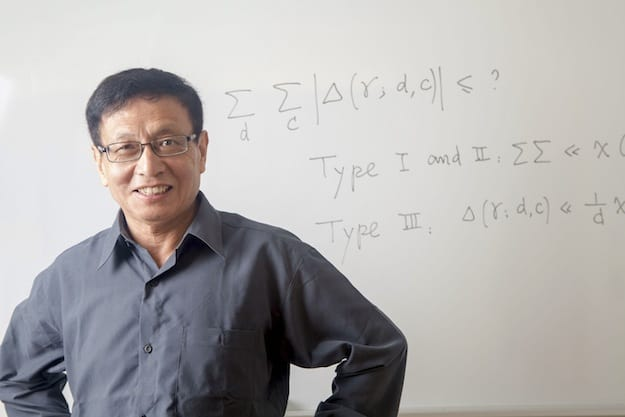
A Chinese mathematician spent 7 years making sandwiches at Subway after his PhD, and at 58 solved a 150-year-old math problem nobody thought was solvable.
His name is Yitang Zhang. The problem is called the Twin Prime Conjecture.
He was born in Shanghai in 1955 and knew he wanted to spend his life on mathematics by the time he was nine years old. That year he found his own proof of the Pythagorean theorem. Nobody taught it to him. He just worked it out.
Then the Cultural Revolution arrived and took everything.
The Chinese government closed the schools. Zhang's father had political troubles with the Communist Party, so Zhang was sent to the countryside with his mother to work in the fields. He spent 10 years as a farm laborer. No high school. No classroom. No teacher.
He read math books in the fields when he could find them.
When the revolution ended, Zhang was 23. He sat the university entrance exam and got into Peking University, one of the most competitive mathematics programs in China. He finished his bachelor's degree, then a master's. The president of Peking University personally recommended him for a full scholarship at Purdue University in the United States.
He arrived at Purdue in 1985. He earned his PhD in 1991.
Then the second wall hit.
His relationship with his doctoral advisor collapsed. The advisor did not write him letters of recommendation. Without those letters, the academic job market was closed. Zhang applied. Nothing came back. He spent the years after his PhD working as an accountant, doing delivery work, sleeping in his car during the stretches when nothing else was available.
A friend eventually opened a Subway sandwich restaurant in Kentucky and offered him a job. Zhang took it. He kept the books and made sandwiches. A man with a PhD in mathematics from Purdue, working a Subway counter because the academic world had no place for him.
He did this for seven years.
He was finally hired as a lecturer at the University of New Hampshire in 1999. Not a professor. A lecturer. The lowest rung of the academic ladder, with no research funding, no graduate students, and no institutional support. He taught calculus to undergraduates and worked on mathematics alone in whatever time was left.
Most people would have stopped believing by then.
Zhang did not stop.
The Twin Prime Conjecture is one of the oldest unsolved problems in number theory. Twin primes are pairs of prime numbers separated by exactly two: 5 and 7, 17 and 19, 41 and 43. The conjecture predicts that these pairs never stop appearing no matter how far you go along the number line. Mathematicians had believed this for over 150 years. Nobody had been able to prove it.
The deeper version of the problem asks something slightly different. Not whether twin primes are infinite, but whether there is any finite gap between prime numbers that appears infinitely often. This is called the bounded gap problem. The best mathematicians in analytic number theory had been attacking it for decades. A landmark 2005 paper by three researchers came agonizingly close and still could not close it.
Zhang worked on it alone. No collaborators. No funding. No department seminars where he could road-test his ideas. He once said he would go to a friend's house and think in the garden for hours.
In 2012, during a visit to a friend's home in Colorado, something unlocked.
He submitted his paper to the Annals of Mathematics in April 2013. The Annals is the most prestigious mathematics journal in the world. Papers sit in review for months, sometimes years. The editors read Zhang's submission and immediately knew something was different. They sent it to the leading experts in analytic number theory for review.
It was accepted in three weeks.
The paper proved that there are infinitely many pairs of prime numbers separated by a gap of less than 70 million. Not two. Not the twin prime gap specifically. But a finite gap. For the first time in history, someone had proved that prime numbers keep coming back together, that the universe of numbers never lets them drift apart forever.
Peter Sarnak, one of the most respected mathematicians at the Institute for Advanced Study, said: "He is not a fellow who had done much before. Nobody knew him. His result was spectacular."
Zhang was 58 years old.
Within a year he had the MacArthur Fellowship, the Cole Prize, the Rolf Schock Prize, and a full professorship at UC Santa Barbara. The man who spent seven years at Subway was now one of the most celebrated mathematicians alive.
He said in an interview: "I was not lucky. Maybe it is more important for a person to make himself known to the public. But that was not so easy for me."
He was not complaining. He was just being precise.
The mathematics establishment has a quiet belief that great work happens young. The Fields Medal cuts off at 40. Most mathematicians who change the field do it in their thirties. Zhang proved his most important theorem at 58, after a decade of farm labor, seven years of sandwiches, and a decade of teaching calculus to freshmen with no one watching.
He did not beat the deadline.
He proved there was no deadline to beat.
The ancient masters slept without dreams and woke up without worries. Their food was plain. Their breath came from deep inside them. They didn’t cling to life, weren’t anxious about death. They emerged without desire and reentered without resistance. They came easily; they went easily. They didn’t forget where they were from; they didn’t ask where they were going. They took everything as it came, gladly, and walked into death without fear. They accepted life as a gift, and they handed it back gratefully.
~ Chuang-Tzu
This book on high accuracy electronics is awesome.
I complied it (with permission) from the author Christopher Daykin's various PDF notes just after he sadly passed away. He wanted to share this with the world.
🫡
https://t.co/cAbrbl8OAL
HuggingFace just dropped 9 free AI courses and they’re insanely good.
LLMs, agents, vision, 3D, audio, gaming all hands-on.
All open-source. All free.
Here’s what’s inside ↓
An introduction to Software Defined Radios.
A thread for beginners on:
1. What a SDR is
2. What you can do with SDRs
3. How it plays a role in the security/hacking world
4. How it’s used in ham radio.
5. How to choose/buy one
6. Link to more reading material
0/21
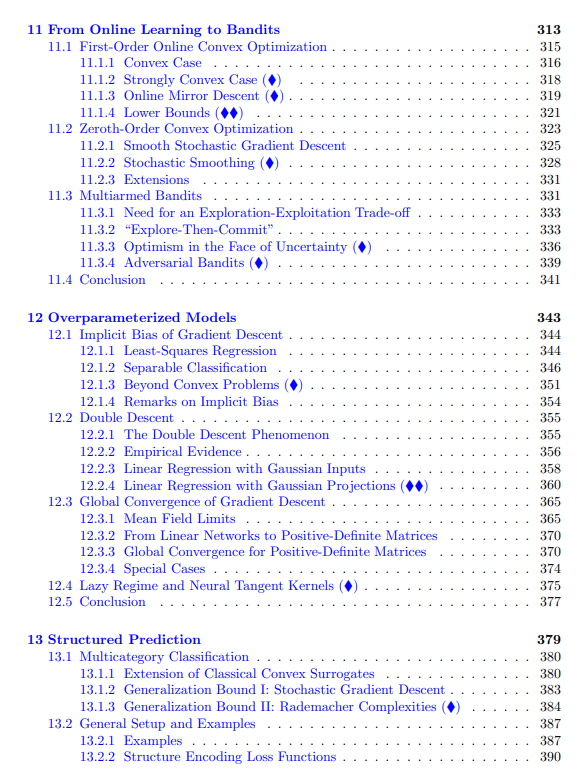
A free book: Learning Theory from First Principles by @BachFrancis
It covers a bunch of key topics from machine learning (ML) theory and practice, such as:
- Math basics
- Supervised learning
- Generalization, overfitting & adaptivity
- Tools to design learning algorithms
- Optimization in ML
- Local, Kernel and sparse methods
- Neural networks
- Ensembles
- Online learning
- Overparameterized models
and more!
The book also includes simple experiments (in MATLAB and Python), exercises, and references to more advanced material
Read it here: https://t.co/nv4sXdBGBi
I've studied happiness for over 10 years.
The shocking truth?
Everything we know about being happy is wrong.
Here's what ancient cultures knew that modern psychology forgot:
This man who heals what doctors can't:
Jiddu Krishnamurti.
It's impossible to be psychologically trapped, stressed, or anxious after understanding his teachings.
Here's his 5-step approach to unlocking mental freedom: 🧵
Comprehensive and deeply insightful, "A History of Bodies, Brains, and Minds" provides a brief history of life, the brain, and cognition, from the earliest living beings to our own species. #SfN24#OpenAccess https://t.co/b55ZUISVpv
Videos of my lectures on "asymptotics and perturbation methods" are freely available. These are ingenious mathematical methods for analyzing difficult problems by exploiting the presence of a small parameter in them. Widely used in physics, math, CS,...
https://t.co/gI5ZLonORf via @YouTube
@neohistoria_id@kumparan Menurut New York Times bom diseludupkan ke guest house di Teheran satu bulan sebelum acara pelantikan presiden baru. Begitu tahu Haniyeh tinggal di guest house itu, bom diledakan.
New book on
"Information Theory: From Coding to Learning"
600+ pages with 150+ exercises by Y. Polyanskiy and Y. Wu
Check table of contents and download book draft PDF from
👉 https://t.co/M9g5AAuAK4
Direct access 🆓 PDF: https://t.co/0iwh6iMZCn