pending Pulm and Critical Care fellow @ UAB 7/2026. HHMI med fellow alumnus. Interested in #PCCM, #allergy, #asthma, & type 2 mucosal inflammation of the 🫁
@nytimes@TheAthleticFC Headline fix: Shirt sales for Arsenal defender Gabriel increased by 350% after the centerback put in a generational defensive performance in his sides Champions League defeat on Saturday.
I can't say I've ever encountered someone who conflates elevated LDL with heart disease.
Most operate, rightly so, from the standpoint that heart disease is a probabilistic outcome influenced by numerous factors, one of which is circulating LDL / apoB concentrations.
This is entirely compatible with Nick's personal experience. Since his anecdote has zero external validity, it can rightly be ignored in favor of population-level data and mechanistic inferences when dealing with literally any person other than Nick himself.
Most importantly, is there any health benefit from maintaining higher vs lower levels? What, exactly, is the point of keeping LDL extremely elevated when it probabilistically increases disease risk?
@DrSamuelBHume So, I would be extremely curious to see the linear regression of the drugs individually to see if there is any clear pattern or its all the same. Suspect the authors dont have power to do it but not sure.
@NeilFlochMD Insurance companies have fiduciary responsibility to the business. From a financial perspective, even if the long term effects show benefit, it would be stupid to "invest" now. Its why laissez-faire econ is fundamentally incompatible with optimized health.
@DrSamuelBHume And I presume the effect is simply reversing the effect weight has on increasing BP, but I'm starting to wonder if something else is going.
@DrSamuelBHume As an anecdote, my BP was consistently 120/60, maybe 130/70, but I lost 80 lbs (which i didnt know I even had to lose) & now my BP is persistently below 110/40. While I'm asymptomatic at baseline, I definitly have developed some orthostasis.
@PulmCrit This paper implies almost the opposite in my opinion. It suggests that a small proportion of bad actors contribute disproportionately to the problem. It fits the alternate narrative: "Most doctors are good, a few bad ones create problems for the good ones."
Arsenal are simply a better football team when Martin Ødegaard is on the pitch. If you disagree, I’m sorry but you’re wrong.
On and off the ball, he’s the man that keeps it all together.
There was even a moment in the second-half when Noni Madueke made a mistake and there were slight groans from the home supporters. The Arsenal captain essentially told the fans to stop, and lift the energy.
The Emirates crowd listened and followed through until the final whistle.
How some Arsenal fans don’t appreciate Martin Ødegaard, I will never know.
Four more to go and with the captain on the pitch, we have a great chance of winning them all.
Hospitals are putting hard caps on physician compensation, sometimes as low as the 75th percentile, and calling it fraud and abuse protection.
Think about what that means. If earning above the 90th percentile is inherently suspicious, then 10 percent of every physician in every specialty must be breaking the law. At the 75th percentile, 25 percent of all physicians are apparently committing fraud. That logic falls apart the moment you say it out loud.
Health law attorney Dennis Hursh has been reviewing these clauses for years, and he says they are showing up in the majority of physician employment contracts now. Some contracts say compensation "may be reviewed" if it exceeds the threshold. Others are blunt: under no circumstances will your total compensation exceed this number.
So if you are the most productive physician in your specialty in the entire country, your pay is frozen. Every dollar you produce above that cap flows to the institution. And as Hursh puts it, the CEO's bonus is not capped.
It gets worse. Most hospitals are not giving physicians clear, timely productivity data. You might be told you produced 9,500 WRVUs, but without access to the actual benchmarks, you have no idea whether you are approaching the cap. You are flying blind while working at a pace that funds someone else's compensation growth.
There is also a downstream effect that hurts the entire profession. Compensation surveys from MGMA and SullivanCotter use reported salary and productivity data. When the highest producers have their pay artificially suppressed, it pulls benchmark numbers down for every physician in that specialty the following year. The cap does not just limit one doctor. It compresses pay across the board.
Hursh says physicians need to review contracts for this language, demand regular and transparent productivity reports, and push for independent third-party compensation reviews when they are producing at the top of their field. The hospital should not be the one deciding whether the cap is justified.
The physicians most hurt by this are exactly the ones hospitals cannot afford to lose.
Listen to the full conversation on The Podcast by KevinMD. Link in the replies.
Have you seen this cap in your own contract? #ThePodcastbyKevinMD
GPCR-biased Mu opioid agonist: If able to provide analgesia without respiratory depression, this could be a significant development.
https://t.co/up4moEJuq5
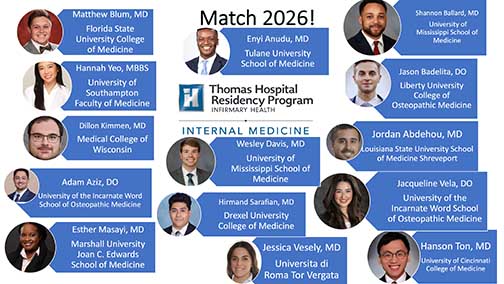
Thomas Hospital welcomed our newest Internal Medicine residents today! 👏 Match Day was filled with excitement. We revealed the names, faces, and medical schools of the talented physicians beginning the next chapter of their medical journey.
📺 Tune in to WKRG at 5 p.m. tonight.