Hyperspace: The Agentic OS Apple Should Have Built
On December 19th, 2024, we announced the world’s first Agentic Browser. What followed was a movement — a new category was born which led to many early products in this space and recently the hundreds of people lining up outside the The Agentic Browser Summit in San Francisco underscored that. Silicon Valley instinctively gets it, from students to tech executives, people can feel a revolutionary new change in computing is in the air.
Past year taught us why such a product was inevitable, a hard engineering effort, and also the last mover in the entire software world this decade if and when done right. All paths are headed in the same direction: one tool which orchestrates them all.
At Hyperspace we showed that path with essays and products we launched in earlier months: from a spatial UI of orchestrating agents, to showcasing transparent activity in how the AI system operates which leads to user trust, to presenting the software end-game, which massively improves human productivity. We also built the world’s largest AI network, drawing participation from people in almost 6000 cities around the world contributing their machines as nodes in the network. Think Uber, but for AI. That is, planetary-scale.
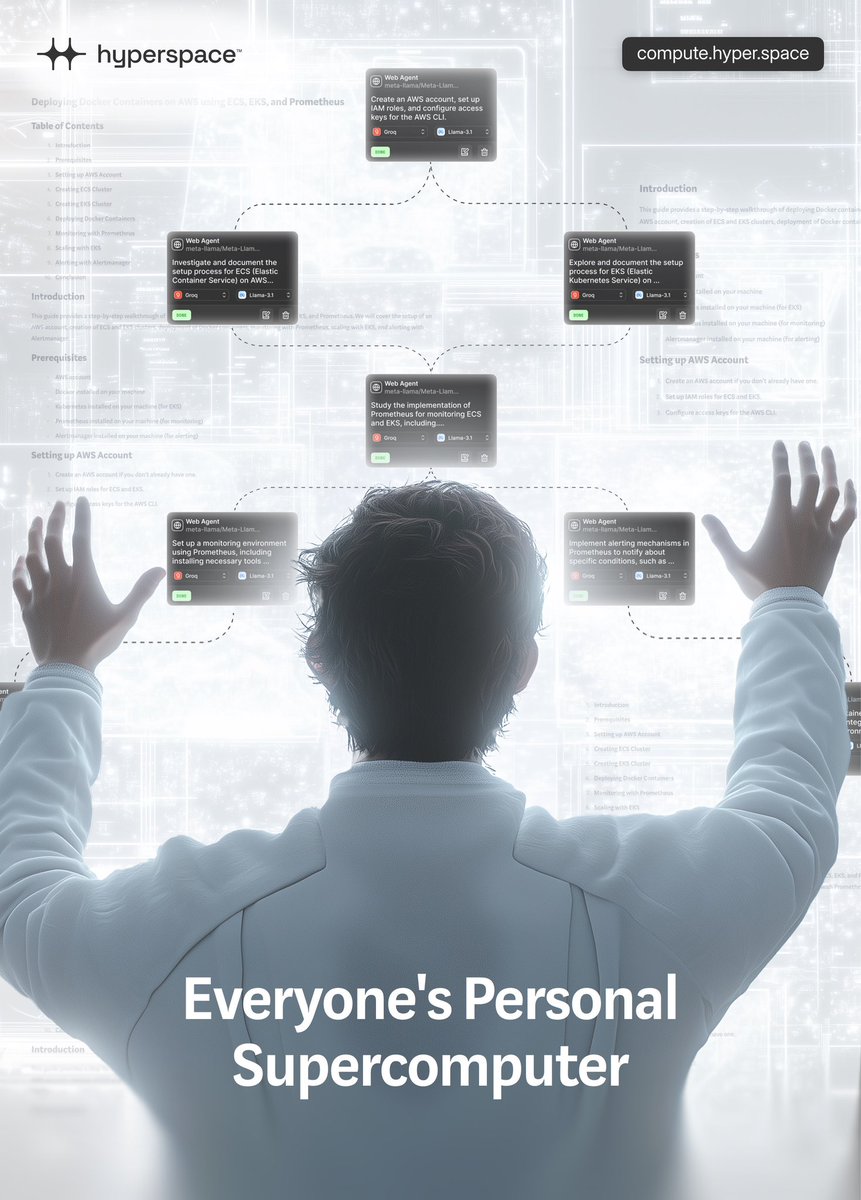
And now we are stretching this industry ambition further with our end-to-end vision of the Agentic Supercomputer, the first breakthrough new AI OS, and an effort which spans from AI research to distributed systems to inventing a new UI to inventing a new business model to complement it. All of this together helps us in serving our mission, of delivering “Everyone’s Personal Supercomputer”.
While others have built AI-native browsers, no one though has built something agentic from the ground up — with AI as the foundation, not a feature. How do you fundamentally improve the lives’ of billions around the world ? We believe that requires building a native environment for agents to be viewed, created, deployed, executed, discovered and priced in. That is a world where we move on from static apps, to dynamic agents.
But, as my 2 year old niece likes to ask: “but why ?” The issue is that the world of software today is fragmented, and everyone is sprinkling on AI as a feature and charging a subscription fees for it. From browser makers, to IDEs, to design and other productivity tools. This leads to a fragmented UX, where people have to learn to use AI in each app, their memory and other context is not shared between all these apps, and they also have to pay separately for compute for each such AI-enhanced app. Each app maker has to figure out basics such as compute, and leads to the issues we saw with Cursor pricing recently. This is not the future.
What if AI was the foundation instead of a feature ? What if Apple had built a fundamentally new AI OS from the ground up and what would it have looked like ?
At Hyperspace, that is what we did. On July 15th we introduced three breakthrough key pillars of our AI OS:
1. Agentic Browser
2. Agentic Memory
3. Agentic Payments
And we didn’t stop there.
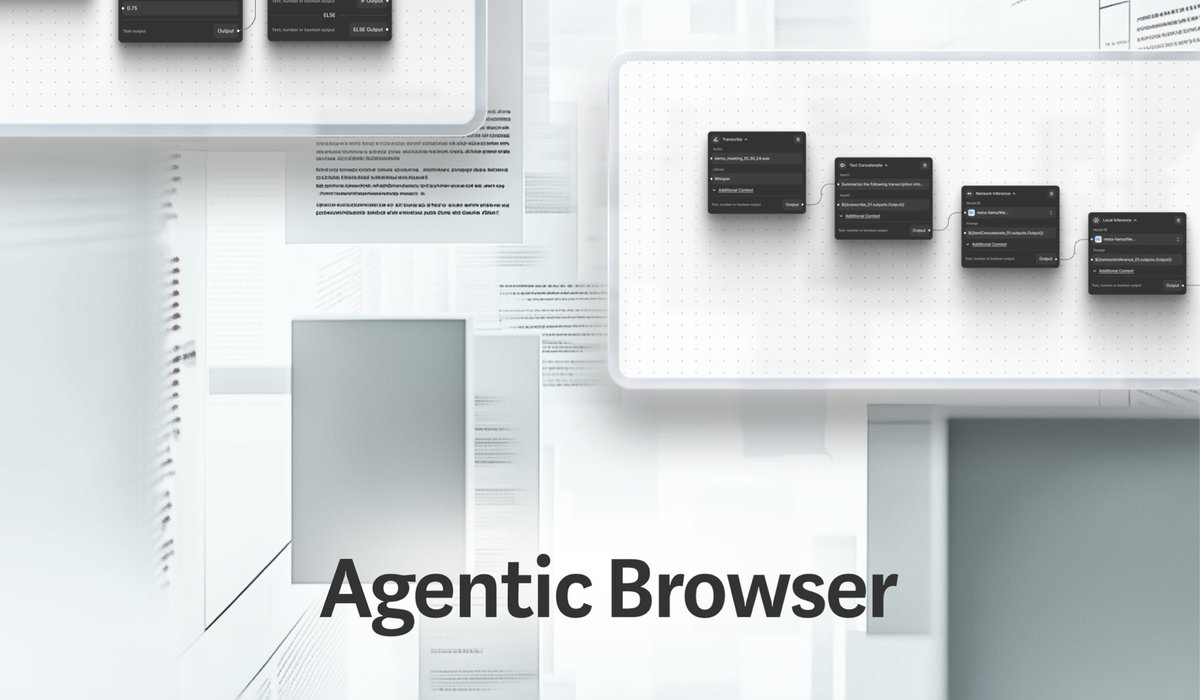
We also introduced a breakthrough new user interface called the Spatial AI which is inspired both from the spreadsheet and the HyperCard - each card is an agent, with it’s own inputs and outputs, endlessly extensible and pluggable with others, just like cells of a spreadsheet. Update one cell and all the dependents update, like a spreadsheet formula. It goes beyond a static linear workflow to being able to operate in all directions. This revolutionary new interface helps manage all of the below:
1. Multiple websites being browsed in parallel
2. Multiple desktop apps being browsed in parallel
3. Multiple server tools being used in parallel
4. Multiple smartphone apps streamed to your device or opened via an emulator
All the software which you need comes together in this one seamless, agent-native interface. This interface provides you access to the largest network of models,
vectors, agents and compute on the planet.
The Browser. The IDE. The Notepad… they are not separate products: they are all in one, the Agentic Browser. As Steve Jobs famously said at the iPhone announcement, “are you getting it ?”
And beneath this UI lies a new intelligence routing layer — leveraging both swarms of specialized models to the Hyperspace Matrix model that recalls thousands of tools in real-time, not by context window hacks, but through retrieval, ranking, and reuse.
To many, this will feel like AGI. Not one big system by one big company, but an intelligent network.
Now lets talk about privacy…
Are you comfortable with one company owning all your memory forever ? I am not. So we have invented Agentic Memory as a new open protocol which provides full power over memory to you, the user. Your memory is yours, encrypted, on your device, and portable if and how you want. Anyone can build on it without our permission, but not without your permission. This protocol, and the decentralized vector database spread out across the world, would enable apps and agents to share context and memory. Think copy-paste, but for the AI world.
It doesn’t just remember — it knows what matters. VectorRank helps your AI weigh your life’s most relevant moments over time, just like the way our minds elevate memories.
Now each time you use an agent, your experience with other agents will also continuously improve: you don’t have to keep repeating the same things about yourself, while fully preserving your privacy. Agentic Memory is accessible within the Agentic Browser to manage.
And there is one more thing…
AI as the foundation requires compute to be available at the base layer, but this base layer spans models running on your own device, to cloud APIs, to also running across the peer-to-peer distributed network. Agentic Payments provides a singular interface to all of that compute, running a spot auction clearing marketplace every second to determine the fair price of compute. This results in price transparency, and you as the user paying the lowest possible cost. If you want predictability, you can reserve compute in advance. This end-to-end system provides the most streamlined world for agents to operate in.
In order to enable this world and the world of agents being able to pay each other in sub-cent increments millions of times a second, we had to also invent a fundamentally new agentic micropayments blockchain.
All of this together would enable a world where you as a user, or the agent itself, can efficiently call and utilize other agents built by others and also pay for content which is unique and useful. This enables a move away from the current AI exploitative economy for bloggers and other content creators, to a web with a fundamental new business model. Earlier we didn’t have the right infrastructure to enable such a world.
Now, all the dots connect. The Hyperspace AI OS would give the power of a supercomputer in everyone’s hands. This isn’t a browser, or an IDE or limited to any device or cloud. It’s an entire AI operating system — with a breakthrough new spatial UI, local and distributed compute, agentic memory, agentic payments, and orchestration built into the foundation.
As a user, we move the choice back in your hands with an experience you will love and find delightful. You get to choose the level of privacy, cost, and utility you want. And while Apple should have done it, we could not wait, and we feel this just required a new level of passion and DNA which we bring here.
We are just getting started.
Thank you,
Varun Mathur
Cofounder and CEO, Hyperspace
cc @naval@pmarca@vkhosla@karpathy@sama
What started as a dream just ten months ago has become the fastest growing and the largest network of any kind recently.
People from over 4500 cities have come together to form the Hyperspace peer-to-peer AI network, which today crossed 500,000 unique nodes ever registered.
agentic browser, by hyperspace
tl;dr: answer engines are a thin-wrapper around search results and LLM APIs which don’t have data network effects; at Hyperspace we are innovating upon a new software-type: the “agentic browser”, which pokes at the idea of how do the agents rank and utilize each other in order to best serve users. we believe this compounds user utility over time.
search engines have built-in network effects: more people use the web, the smarter they (ought to) become with more credible websites “voting” for webpages in an uber-democratic real-time process. this compounds and compresses society’s knowledge.
is it true with single-shot AI answer engines which are wrapping search results ? you ask a question, get generated answer and move on - how does that feedback into making the underlying system a lot smarter over time ? what has it learnt about that page compared to other pages which fundamentally improves the experience for the Nth user ?
for example - consider the “rental car” problem.
1) enter that term in a search engine like Google, what do you get ? list of top car rental websites
2) enter it in an answer engine like Perplexity, what do you get ? you get English-ized version of (1) above. great, now you know the names of the biggest rental car companies in the US. as a user, you are basically back at (1) above.
what did you as a user *really want* ? you wanted the best rental car options for you and also things happening leading to a booking: based on your needs and preferences. so right answer for you would have been a series of actions:
- a question: which city do you need this in and approximately when ? what kind of cars do you like to drive ?
- found you these Tesla Model 3 rentals, available on these dates for this price, and booking available on these few websites and apps,
- and i will re-run this analysis every 30 mts for next 2 weeks until your travel to see if can find you a better price and negotiate behind the scenes
this, is the next society productivity unlock as this is the flow the user would have been the MOST happiest with. that is the 5 star user experience. and that’s only going to happen in the most seamless way in a software system custom-designed for this purpose, an agentic browser, which leverages AI agents (nameless processes recursively spanning and orchestrating themselves using all types of infrastructure necessary in order to satisfy the user need).
where a search engine and an answer engine “gives up” after showing rudimentary options, the agentic browser is a relentless beast of a machine which keeps on running and processing, and orchestrating many agents together into getting the job done for the user. during this time, it is learning and compounding on the nature of agents and their interactions themselves’. it is not just a standalone software, but a network, and it requires a different DNA altogether.
this is the world we are building, and it spans many components: from a revolutionary new user interface, to insanely powerful on-device capabilities, to plugging into the world’s largest distributed data and compute cluster, and using the right decentralized protocols for agent-to-agent transactions and payments to build trust in the system.
this is going to be the largest new economy built from scratch this decade.
Here is why I am excited about @DavidSacks leading up AI and Crypto policy in the US: it would mean tens of billions of $ of Bay Area long-term driven institutional capital will become available for US crypto startups to do and build the right things for society.
Until now, we have existed in a lemon market: the market has been generally driven by short-term minded token hustlers - basically they slap on a token on a piece of text on a paper and use their networks and market power to run a token valuation, and then move on to the next project - but which are generally narrative-driven market tests. Very little value for society gets created, but a lot of noise. However, this short-term mindedness is not actually capitalistic in nature.
In this new world, when the market has Bay Area capital x talent x enthusiasm x long-term product view x liquid financial markets —> that will be the real bull market, where opportunity abounds, efficiency is improved, and the builders and investors are rewarded by society for that.
So expect to see many crypto startups creating real value for society go on to be worth $10B+, with few cracking $100B+. It will be a normalized world for your AI startup to also have a crypto strategy (just like we are doing at @HyperspaceAI + @HyperspaceAGI).
The short-term bull market noise is deafening and confusing, but the market clarity coming is where the real goalpost is.
What Decentralized AI looks like
💻 10,000+ connected nodes
🌏 1,000+ unique cities
🏴☠️ 10 million+ liveness checks
🤖 500+ open source models
In 2009, you could run a simple piece of software on your machine and participate in a new type of a peer-to-peer system called Bitcoin. What you earned at the time was worthless though, the system had bugs and took a while to stabilize. But it was fair, and it didn’t matter whether you were a college student or an executive.
We are trying a similar experiment to enable a peer-to-peer world of AI agents, which require enormous compute and data.
As part of this, you can run the Hyperspace node software on your device, for completely free. Every hour we challenge your system to do an AI-related capacity verification exercise. Keeping your system online, with good models, leads to earning the system currency called “flops”. Today it is buggy, the system is in testing, but we are heading towards stabilization.
The Hyperspace peer-to-peer AI network is the largest active working P2P AI system in the world today, with over 10,000 nodes (across 1000+ cities) connected at any given point: getting and solving challenges on an hourly basis. Over the past 2 months, we have validated over 10 million such liveness checks (and this validation would be moved to a decentralized set of nodes as well).
We have worked hard to keep the system stable, honest and fair. Today we are launching a live map look at the network and the nodes. See what nodes are there at any given point, approximately in which city they are located in, how much VRAM have they committed and how many flops have they earned. The entire system runs based on the unique cryptographic identity of each node.
This system is still under active development and testing and provided on an as-is experimental basis, with more capabilities which will unlock soon (think anything an AI agent will need). But it’s the start of something new. When you request a peer node to run a model inference for you, the system works to find the right node and service that request - looping in an Uber-like way until your request is fulfilled.
Unlike other “decentralized AI marketplaces or aggregators”, we don’t own or run any servers here - the entirety of this network is community-run. All we do is match-make the nodes, and in the future, that would be fully permissionless as well.
Introducing Play - a new type of an insanely crazy AI research product which enables you to spin and share your own webs quickly around focused topics.
Built using @GroqInc x Llama3.1 open source model from @AIatMeta, combined with real-time web search and a multi-terabyte vector database composed of Wikipedia, arXiv, Reddit comments, among other sources.
No filters. No bias. No subscription fees.
You are in control. What will you create ?
If you are having technical issues with the node setup, we are available 24x7 to help you solve through them.
Please fill this form describing your issue:
https://t.co/FnG9XKf8Ws