bro created an AI job search system for Claude Code that scored 700+ job applications and actually got him a job.
AND IT'S NOW OPEN-SOURCE.
It scans multiple company career pages, rewrites your CV per job, and even fills application forms. The repo has:
> 14 skill modes (evaluate, scan, PDF, ...)
> Go terminal dashboard
> ATS-optimized PDF generation via Playwright
> 45+ companies pre-configured (Anthropic, OpenAI, ElevenLabs, Stripe...)
GitHub: https://t.co/PwrYBOAphi
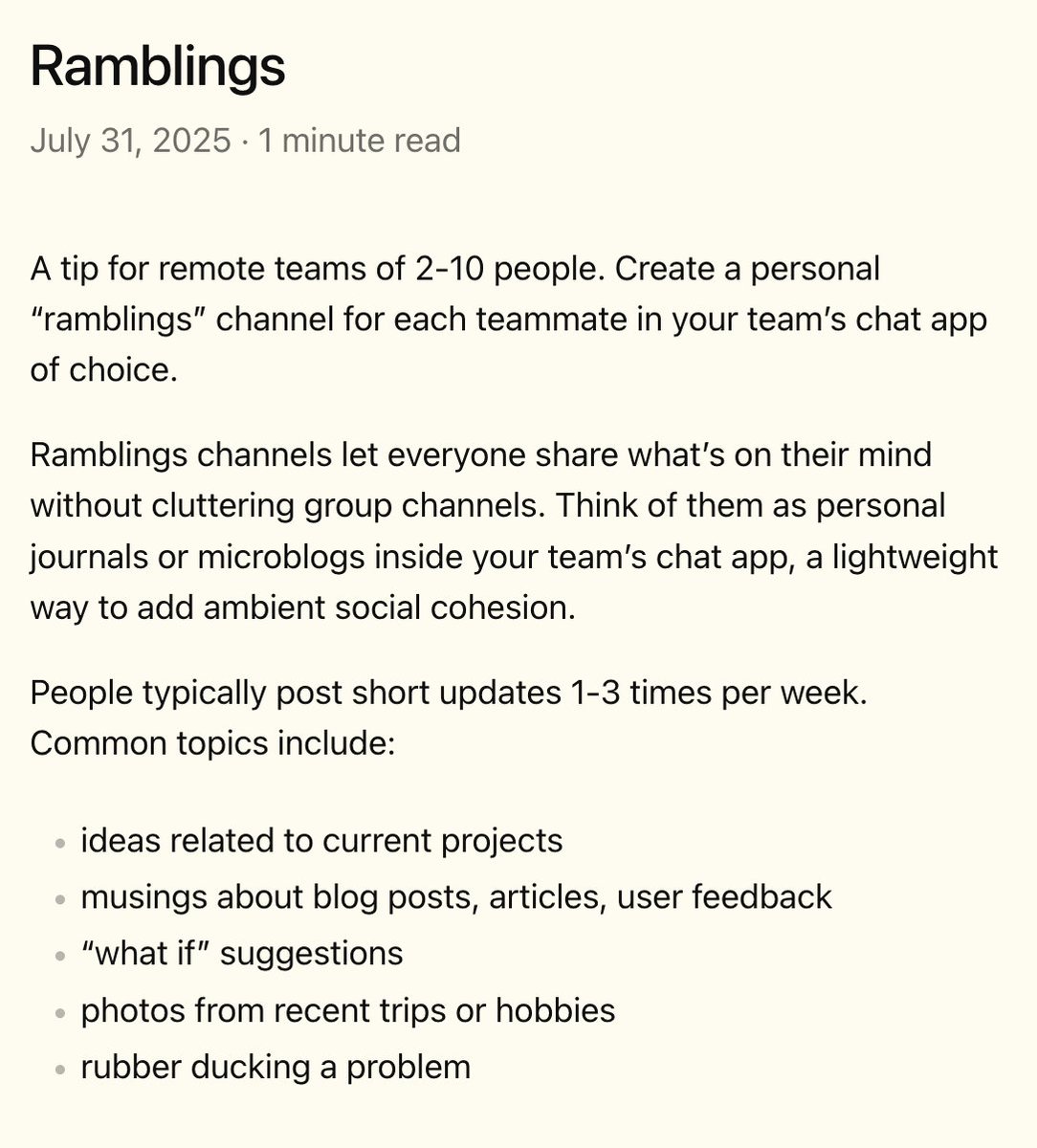
A tip for remote teams of 2-10 people. Create a personal "ramblings" channel for each teammate in your team's chat app of choice.
Ramblings channels let everyone share what’s on their mind without cluttering group channels. Think of them as personal journals or microblogs inside your team’s chat app, a lightweight way to add ambient social cohesion.
People typically post short updates 1-3 times per week. Common topics include:
- ideas related to current projects
- musings about blog posts, articles, user feedback
- "what if" suggestions
- photos from recent trips or hobbies
- rubber ducking a problem
Each ramblings channel should be named after the team member, and only that person can post top-level messages. Others can reply in threads, but not start new ones.
All the ramblings channels should be in a Ramblings section at the bottom of the channel list. They should be muted by default, with no expectation that anyone else will read them.
We started experimenting with ramblings at Obsidian two years ago, and they've been surprisingly sticky. We have no scheduled meetings, so ramblings are our equivalent of water cooler talk. We want as much deep focus time as possible, so ramblings help us stay connected while minimizing interruptions.
Because they are so free and loose, some of our best ideas emerge from ramblings. They're often the source of feature ideas, small prototypes, and creative solutions to long-standing problems.
About once a year, we do a week-long in-person meetup. Ramblings have been one successful way we keep the human connection going throughout the rest of the year.
@Vtrivedy10 Harness is just SE “code” to create an amazing “solution” for models that spit out words… like code to enhance SAP Hana/SFDC core logic. deterministic SE code w chat completion api at the end of the day
Every entrepreneur that knows how to use AI is trying to find ways to build AI native companies that completely displace incumbents.
For the incumbents, it’s the “Innovator’s AI Dilemma” If those startups get traction, and they can’t buy them, the CEOs will face multiple huge Dilemmas:
1. Do they tear down their companies and reinvent them as native AI ?
2. How do they explain it to public shareholders ?
You will know AI is having a huge impact on public companies when there are two types of lawsuits:
- Shareholders that sue the company for tearing down the company and crushing the stock price
- Shareholders that sue the company for NOT tearing down the company and crushing the stock price
I think most CEOs don’t come close to understanding AI in enough detail to even begin to consider these decisions.
Hint: Asking your AI models the best paths from where you are now, to being an AI native version that can achieve the same economics has to be one of your initial steps.
If asking your models questions doesn’t make sense to you, you are in deep shit
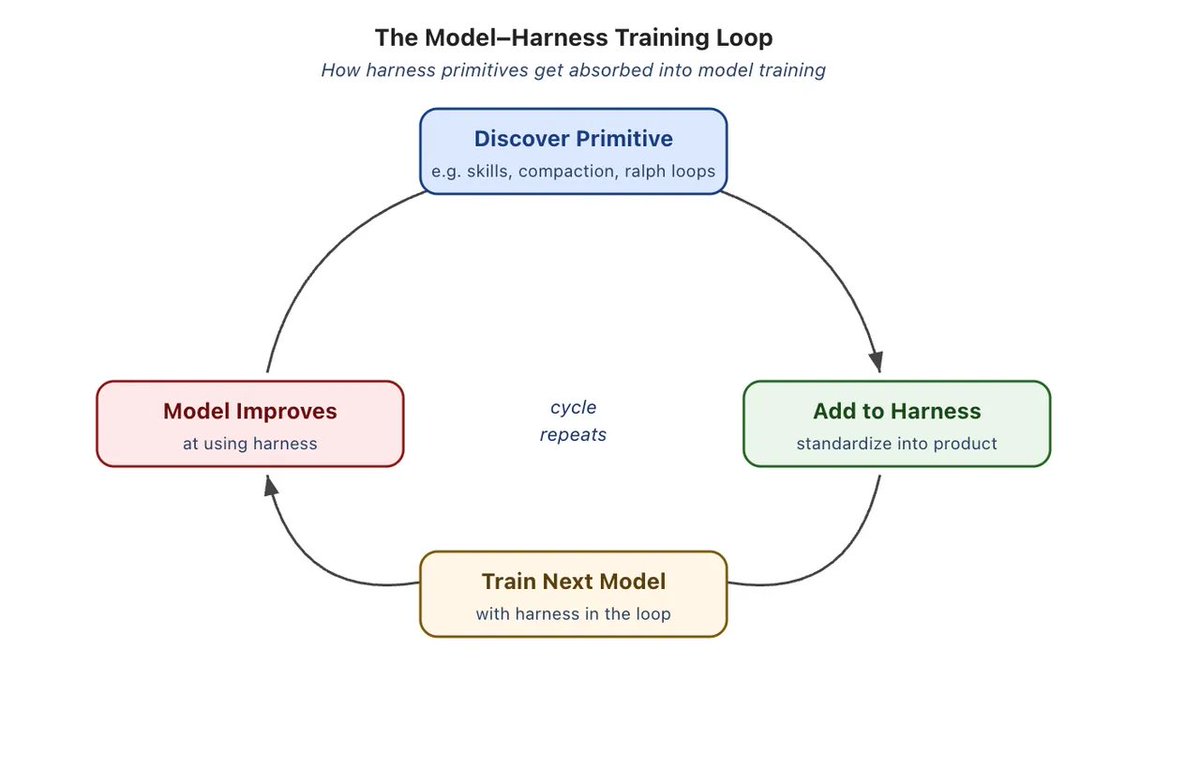
The Model-Harness Training Loop
imo every great team in the world will use some version of this loop to build the best agents for their tasks
this is now possible because:
1. Harness Engineering is becoming more democratized and accessible (we want it to be even easier)
2. Open models have crossed an intelligence threshold (ex: GLM 5)
3. We have mechanisms to collect traces and analyze them at massive scale (ex: LangSmith)
4. The infra to fine-tune models is becoming more accessible (ex: @PrimeIntellect)
Open models give every team the opportunity to try this, not just frontier labs
We’re entering a time where any obsessed team can pick a niche, understand model failure modes today, and build a killer harness that engineers around model issues to solve the task.
That might mean spending a lot of compute today.
As more data comes in, you build data moats and then train the best, most cost-efficient vertical model that improves over time
The cycle of harness engineering —> finetuning with open models is gonna give us an explosion of task specific frontier level performance at a fraction of the cost + latency that we have today by using the frontier models for everything
we’re gonna see some generational cooking at the intersection of open models & harnesses 🚀
ok hot take, who (dis)agrees? The general purpose agent/harness doesn’t exist
the best harnesses are deeply Task specific and when we use a “default harness” out-of-the-box, we’re just making a tradeoff between
- acceptable task performance
- time+money spent designing around our task(s)
that’s a totally fair tradeoff to make, maybe we’re happy with the out of box perf!
what we call a “general purpose” harness is just one that’s reasonably good at a relatively large portion of tasks
but there’s a reason why teams that want top 1% agent performance obsessively tweak the harness per Task+Model
it’s because you can squeeze out a lot by building bespoke harness tooling for a Task. For a high value task, it’s totally worth the investment
Your entire company might be predicated on that investment
this effect is pretty clear when we try to swap models
“models are non-fungible in their harness” - so the suck if we just drop in codex into the Claude Code harness
but if you use the models together in a joint harness and design around the specific problem, you can get great perf
I’ve mentioned before but i think the most exciting future is just-in-time harness creation per task
idk if that’s a very popular take vs “one model will do everything” but it’s a current mental model and exciting thing i’m messing around with
@Rick_ATL_@gettingtrumpnow@MarioNawfal its deserved.. no different w sports like boxing or basketball where opponent still score or a punch but still getting dominated.. 2 planes vs entire navy and airforce gone? … its like old basketball Dream Team - others still scored a hoop
@orelohayo @davemorin We support all models, local and cloud-ones. Not everyone has a beefy machine at home. We even have folks from @ollama on the team making sure local works great!
@steipete @orelohayo @davemorin@ollama ollama is on my plan with Claw with OpenAI.... with what happened to Anthropic, diversity of models is so important to users and enterprises
@levie agree.. i was agent engineering coding since July 2025 and ramped up in Nov working 7 days a week and now i'm burned out and just had to stop and slow down in February. I'm only doing 2 tabs at a time and use Claude mobile and life is better
@lennysan@simonw im a legit human , really… (human button) and this is one of the most interesting talks I sincerely enjoy.. its a friday and watching it like right now while munching Chik FilA
Same, I have a similar setup. A mix of Obsidian, Cursor (for md), and vibe-coded web terminals as front-end.
Since I do a podcast, the number/diversity of research interests is very large. But the knowledge-base approach has been working great.
For answers, I often have it generate dynamic html (with js) that allows me to sort/filter data and to tinker with visualizations interactively.
Another useful thing is I have the system generate a temporary focused mini-knowledge-base for a particular topic that I then load into an LLM for voice-mode interaction on a long 7-10 mile run. So it becomes an interactive podcast while I run, where I ask it questions and listen to the answers to learn more.
Anyway, heading out for a run now, thanks for the write-up 👊
@SpiceShorts @alonmichael@lennysan@simonw love the learning component of AI - including cooking .. i learned a lot of simple quick dishes w AI and felt like a superman as i feel i can learn anything in IT now
Decision traces are a big deal and now possible with 1M token context
*sneak peek: one of my projects is launching soon and will be focused on decision traces in agentic engineering