CFP|Two decades in Financial service|Passionate about Investments & Advisory|Sports,Travel,Reading|Tweets reflect personal opinion; Retweets aren't endorsements
For Indian family offices and high networth individuals who are investing more and more in PE funds (based on past returns, not so much in India but in US) the following headline is enough advice:
From Today's WSJ
Private-Equity Assets Stuck in ‘Zombie Funds’ Are at a Record High
(Funds are outliving their intended lifespans as fund managers struggle to sell the remaining assets)
Zepto : Family Offices, Domestic Funds, HNIs that earlier invested Zepto shares
A Cap Table which counts almost all the major family offices in India
- Ramdeo Aggarwal
- Motilal Oswal Family Office
- Singularity (Madhu Kela)
- Alchemy Fund
- Sachin Tendulkar
- Abhishek Bachchan
- Cipla Family Office
- Jatia Family Office (Westlife Foodworld Ltd)
- Ravi Modi Family (Manyavar Family Office)
-Polycab Family Office
-Narotam Sekhsaria Family Office (Ambuja)
- Claypond (Manipal Group)
- Mankind Family Office
- Haldiram Family Office
- Apar Industries Family Office
- GE Shipping Family Office
- Delta Corp Family Office
- Family Care Family Office
- Kalpataru Family Office
- Mastek Family Office
- Charandeep Singh (Girik Capital)
- Jaydev Mody (Delta Corp)
- Ran Ventures ( Zaggle Family Office)
- Dharampal Satypal Family Office (Rajnigandha)
- AYM Syntax Family Office
- VIP Industries Family Office
- Ajanta Family Office
- Dixon Family Office
- PN Gadgil Family Office
- JK Group Family Office
- EX CXOs of Dmart, Britannia, Dabur
Took more than 2 hrs to find beneficial owners of their investment arms to identify their family offices
Look at what Iran has been hitting since Feb. 28: radar systems, SATCOM terminals, tankers, and now an AWACS. That's not random.
It's a systematic attack on the infrastructure that makes U.S. air power function. Iran's running an asymmetric counter-air campaign. A 🧵.
What is it in the STRUCTURE of banking that makes me a nervous investor in banks...my column in Mint from June last year
The peculiarities that make banking different from other industries
When growing better than expected is not always a good thing
How a 20 something trader can single handedly bring down 200 year old Bank
Why do you have to keep dancing while the music plays
Why banking is the ultimate confidence game
Why you can never take an fully informed bet on a bank
One more reminder today!
@firstglobalsec@fghumsmallcase@livemint@WritesRavi@latha_venkatesh@_anujsinghal
#Banking #RiskManagement #BankingIndustry #investoreducation
@amittalwalkar Saw a bit of him at the fag end of his career around the late 80's. Don't remember much as I was less than 10 but remember the aura, swagger & nonchalance. Simply the King. Possibly only one man ever came close and that's the Prince...Brian Charles Lara!
Happy Birthday Sir Viv🙌
Have a break but don’t have a KitKat because
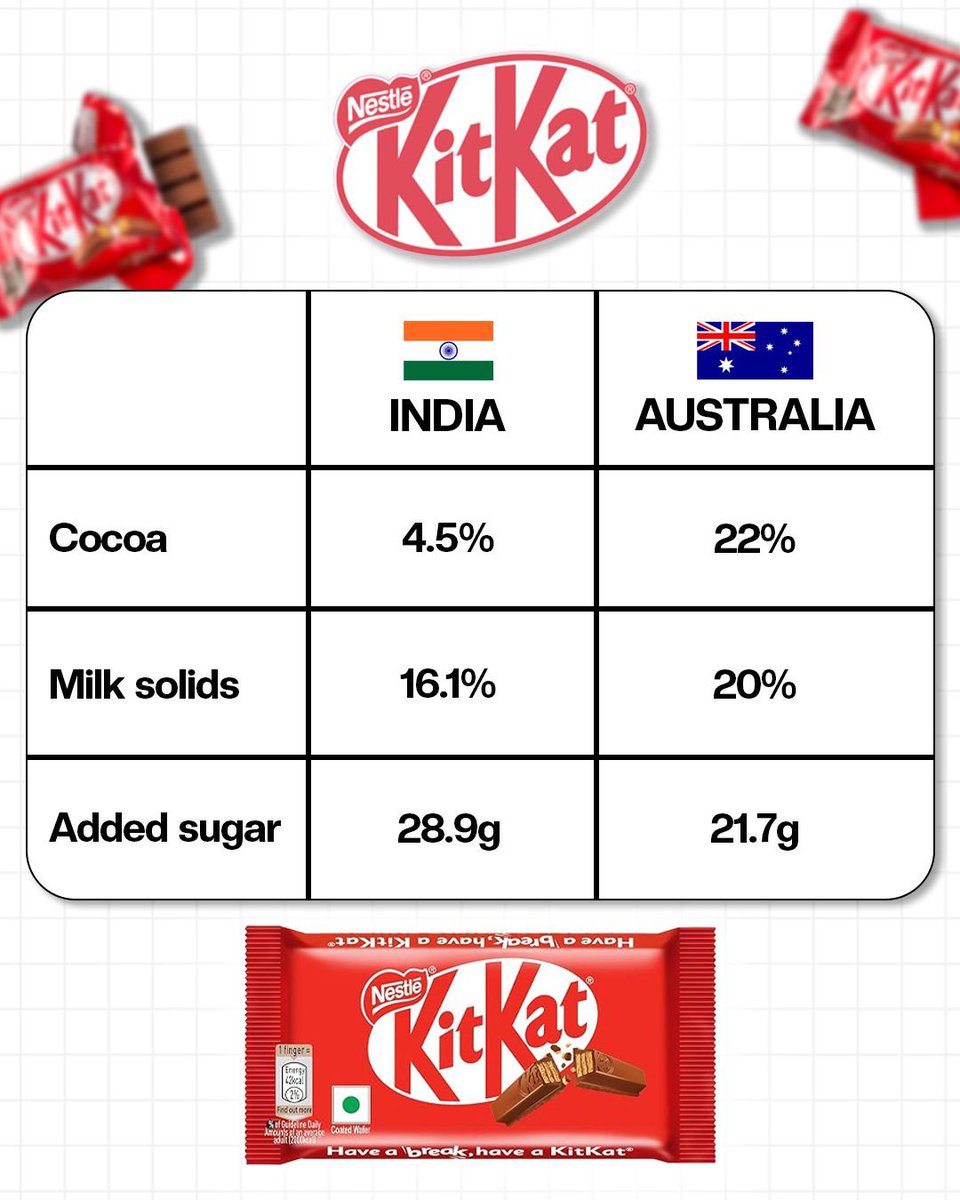
I compared a KitKat sold in Australia with one sold in India, and the numbers are sadly not surprising.
The Australian version contains:
-Milk solids – 20%
-Cocoa – 22%
-Added sugar – 21.7g
The Indian version contains:
-Milk solids – 16.1%
-Cocoa – 4.5%
-Added sugar – 28.9g
Indians are getting a significantly inferior version compared to Kit-Kat abroad. This is not just limited to the Kit-Kat but most packaged food items like Cerelac, Lays etc.
This is because of 3 reasons.
1.India is a price-sensitive country, and as a result companies put low quality ingredients. But costing alone doesn’t explain the full picture.
2.Our regulations are weak and they don’t prevent companies from giving us inferior products.
3.We as consumers do not question what we’re being served. That is exactly why I started Label Padhega India. Because unless we read and ask, nothing changes.
Companies rarely change because they feel guilty. Companies change if consumers unite and ask for it.
So it’s our responsibility, together, to speak up and make sure our voices are heard.
Let’s Make India Healthy Again.
The star hedge fund manager you have probably never heard of: Minal Bathwal
For 18 years straight, he has not had a single down year in his portfolio
If you had invested $1M with him in 2008, today that would be worth roughly $9M vs. $2.5M for most of his peers
Here is the story and some of the trades that earned him a fortune:
Just for some background, Minal Bathwal is an Indian born, Singapore based trader at Brevan Howard, one of the world's most renowned macro hedge funds
He earned his MBA from the Indian Institute of Management Calcutta, and his relevant experience before becoming an investor was in derivatives structuring at UBS
In 2007, he joined Brevan Howard's Hong Kong office as a junior trader
Trade 1
> One of his first trades that really took off was betting on South Korean interest rates during the 2008 crisis.
> The thesis was simple. South Korea was a heavily expoert dependent economy and was facing a massive liquidity crunch in the midst of the Global Financial Crisis (GFC). Bathwal made the bet that Bank of Korea would have to aggressively cut rates and provide liquidity to avoid a banking collapse
> Bathwal put on a trade that rates would be lowered at a sharp pace, and expressed his view through derivatives. He ended 2008 up +21.8%, while other hedge funds and banks collapsed
Trade 2
> In 2013, Bathwal noticed that Japan was flooding the market with Yen (weakening the currency) while US yields were set to spike. He correctly predicted that the "carry trade" where traders borrow Yen to buy higher yielding assets would become much more volatile than what the market expected
> Bathwal put on a trade on the USD / JPY currency pairs, betting that the currency spread would widen. That year, he returned nearly 30% while rest of his emerging market peers suffered losses
Trade 3
> In 2015, Bathwal had a view that China's slowing economy would force the country to devalue its currency. He expressed his view by buying out of the money put options on a basket of Asian currencies
> At the time, these puts were relatively inexpensive to purchase, but the upside potential was massive. In summary, it was a trade that had very good upside with little downside risk. When the Chinese Yuan eventully devalued, Bathwal's fund made a killing, netting roughly 21% for investors
Trade 4
> In 2020, while western markets collapsed because of COVID 19, Bathwal noticed that Asian central banks were faster to respond to the crisis
> Bathwal took a position that rates across Asian markets would stay low or drop, and used the volatility of currencies to his advantage to trade the swings in FX prices
> While Brevan's master fund was -4% during the month of March, Bathwal still managed to be +1.1% while most market participants were being burned by the turmoil
As of today, Bathwal manages a 14-person investment team, including 10 traders.
His investment philosophy:
> Be unemotional. According to him, the first "true test" of being a good trader is that your spouse or partner cannot tell whether you had a good or bad day
> Adjust position sizing as needed, but avoid over trading
> Study your own biases and how that gets in the way of good decisions
> Create option like payoffs, where relatively small costs can yield large returns
> Pay attention to which financial instruments you use to express your views, hedges and sequence different legs of a trade accordingly
> Don't be afraid to put on multiple trades around the same theme where required
From this level, the more rapidly $SLV rises, the more volatility you will experience soon after. The rate of advance is simply unsustainable. That doesn't mean the insanity can't continue - and for how long is anyone's guess. But my guess is we are within days of at least an intermediate term top, and certainly we are in for a big pickup in volatility. The alpha monster is about ready to turn into a beta beast.
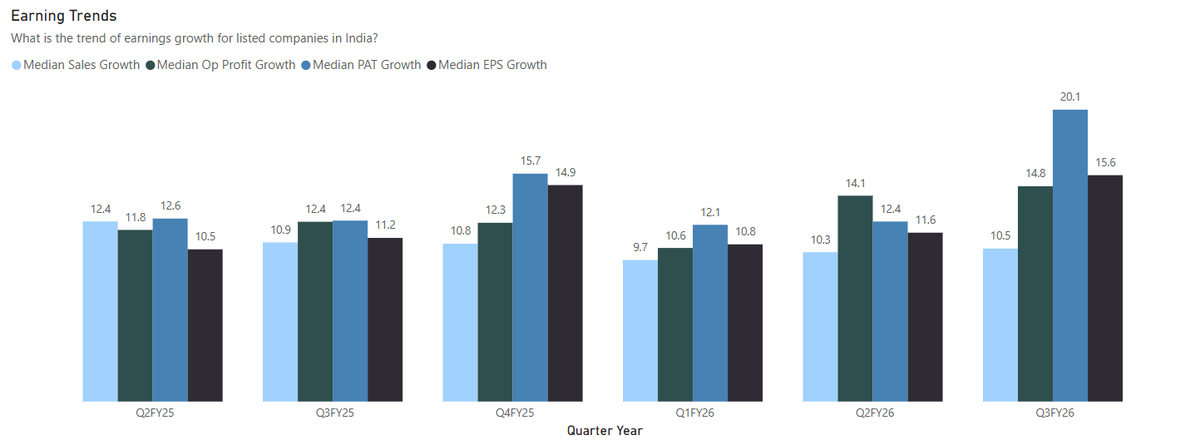
~17% of NSE 500 have declared their Q3FY26 earnings
This is what they look so far ⤵️
At the end of this earnings season, there will be two markets
One of stocks that are performing on the back of earnings - expect their multiples to maybe even inch higher
and everything else
The Supreme Court order today signals the end of "treaty shopping" & warns global investors that India will prioritize actual 'substance' over 'form'.
This is BIG.
10 points 👇
1. The SC today ruled that Tiger Global must pay capital gains tax on its 2018 exit from Flipkart.
2. Today's order reverses a 2024 High Court decision that had favored Tiger.
3. The tax demand is roughly Rs.14,500cr - this is bigger than the $1.6B Tiger Global made from the sale - due interest & penalties.
4. For decades, a TRC (tax residency certificate) from Mauritius was seen as a 'magic pass' to avoid tax. The Court has now ruled that a TRC is not enough if the company is just a 'front' for tax avoidance.
5. SC basically looked past the paperwork to find that the 'head & brain' of the ops was in the U.S. & not in Mauritius. Since the Mauritius office had no real independent decision-making power, it was labeled a 'conduit'
6. This ruling makes 'treaty shopping' - setting up shell companies in tax havens just to save money- almost impossible for future Indian exits
7. The SC used the General Anti-Avoidance Rule (GAAR) to override old treaty protections. This means even older investments (made before 2017) can be taxed if the exit structure is found to be a 'sham'
8. Even though Tiger sold shares of a Singapore company (which in turn owned Flipkart India), the SC said that since the value came from Indian assets, India has the right to tax it
9. Tax experts are calling this a complete 180-degree turn from the 2012 Vodafone case. Back then, the SC protected the investor. Now it has backed the tax dept.
10. PE/VC firms using Mauritius/Singapore structures - may now have to reassess their own holdings & prepare for potential tax audits
#stockmarket #Nifty #BankNifty #India #SupremeCourt