A timelapse of the AST SpaceMobile / 2degrees ground station being constructed in Marton, New Zealand has been published by NZ Herald.
Another piece of the infrastructure coming into place.
📡🛰️
https://t.co/jPnLNG1da1
$ASTS: 🚨 @nzherald confirms:
+ @2degreesmobile customer beta testing to begin shortly
+ INDOOR CAPABILITY verified by @AST_SpaceMobile staff on hand at the 2degrees ground station opening day: "There’s also a key difference from Starlink. AST says its satellites’ tennis court-sized arrays – with solar panels on one side and 4G and 5G antennas on the other – are powerful enough, by dint of their size, to penetrate roofs. AST staff on hand for today’s opening confirmed that capability."
+ 2degrees CEO Mark Callander promises "full-blooded voice, text and data from day one of 2degrees’ satellite-to-mobile service" in contrast to @onenzofficial's initial text-only service with Starlink Mobile in December 2024.
Full article:
https://t.co/2GHNZqWG31
$ASTS: 🚨🇳🇿 2DEGREES AND AST SPACEMOBILE TEST VOICE CALLS, VIDEO CALLS AND MOBILE BROADBAND DATA SESSIONS OVER STANDARD 4G AND 5G HANDSETS IN NEW ZEALAND DURING THE MONTH OF AUGUST
"HI MARK - IT'S MARK!" 😁
2degrees has opened a satellite ground station in Marton and completed voice-call and broadband data tests on standard smartphones through AST SpaceMobile's network.
The facility is among the first commercial AST SpaceMobile ground stations worldwide and is intended to support the rollout of direct-to-device satellite mobile services in New Zealand.
Paul Goldsmith, Minister for Media and Communications and Minister for Space, opened the site as 2degrees marked a new stage in its satellite connectivity programme. The Marton station will connect with 2degrees' core network and support voice, data and messaging services for users outside existing mobile coverage.
Engineers from 2degrees and AST SpaceMobile have been testing the system during August. The trials included voice calls, video calls and mobile data sessions using standard 4G and 5G handsets rather than dedicated satellite phones or extra hardware.
2degrees said it has invested millions in the local ground station. It also said calls, data and messages on the service are designed to originate and terminate on the 2degrees core network without passing through another country or jurisdiction.
Mark Callander, Chief Executive, 2degrees, described the project as a response to persistent coverage gaps in New Zealand.
"AST SpaceMobile approaches satellite connectivity in a unique way. The service is designed to offer voice calling, data and SMS, extending connectivity into places that have traditionally been difficult to serve. 2degrees has invested millions in building a ground station locally, providing access to advanced technology that will enable connectivity for Kiwis outside traditional coverage areas," said Mark Callander, Chief Executive, 2degrees.
2degrees has not given a launch date for customers. Further testing will continue before it confirms timings for trials and a commercial launch.
Callander also linked the timing to the pace of AST SpaceMobile's satellite deployment.
"AST SpaceMobile has a robust launch roadmap, and with each additional satellite deployed, service availability increases. We will offer the service commercially when service availability reaches a level we consider viable," said Callander.
Global push
AST SpaceMobile is building a direct-to-device satellite network through partnerships with mobile operators rather than standalone satellite handsets. It has agreements with more than 50 mobile network operators globally, including Verizon, AT&T and Rakuten, covering a combined subscriber base of nearly three billion.
That operator-led model has become a key part of the emerging race to provide mobile coverage from space. Telecom groups are exploring satellite links as a way to extend service in remote and rural areas, where conventional mobile towers are harder to justify on cost grounds or face geographic constraints.
New Zealand's terrain and dispersed population have made that challenge particularly acute in some parts of the country. For 2degrees, the Marton ground station provides domestic infrastructure as it seeks to add satellite links to its existing mobile network.
Chris Ivory, Chief Commercial Officer, AST SpaceMobile, framed the New Zealand deployment as an early commercial step in the company's international expansion.
"New Zealand's early adoption of AST SpaceMobile's technology and deployment of commercial ground infrastructure position the country at the forefront of space-based cellular broadband. Working alongside 2degrees, we are bringing a new satellite connectivity capability and advancing the integration of our networks to deliver voice, broadband data and SMS directly to everyday smartphones, without specialised devices," said Chris Ivory, Chief Commercial Officer, AST SpaceMobile.
Article: https://t.co/8qXDFt8mek
We are on the precipice. $ASTS
Rakuten + AST selected for J-LEO.
Winning Japan’s government-backed J-LEO program is a huge validation!!AST is positioning itself as critical national infrastructure
We know AST is already testing Grain’s low-band spectrum, with FCC language pointing to an existing T-Mobile relationship. More spectrum could mean a massive jump in U.S. capacity.
If AST gets access through a lease/revenue-share instead of a huge upfront purchase, that could be an extremely capital-efficient way to add nationwide spectrum.
New Glenn continues to push forward. Which means more satellites per launch.
Now today we get SpaceX saying Falcon 9 is done with Starlink launches in FL today! This means more commercial launch availability could give AST even more flexibility to accelerate deployment.
If you were wondering what that cash on hand was going to be used for…
Ready for launch 🚀
The next 6 months IMO are gonna be 🔥
$ASTS
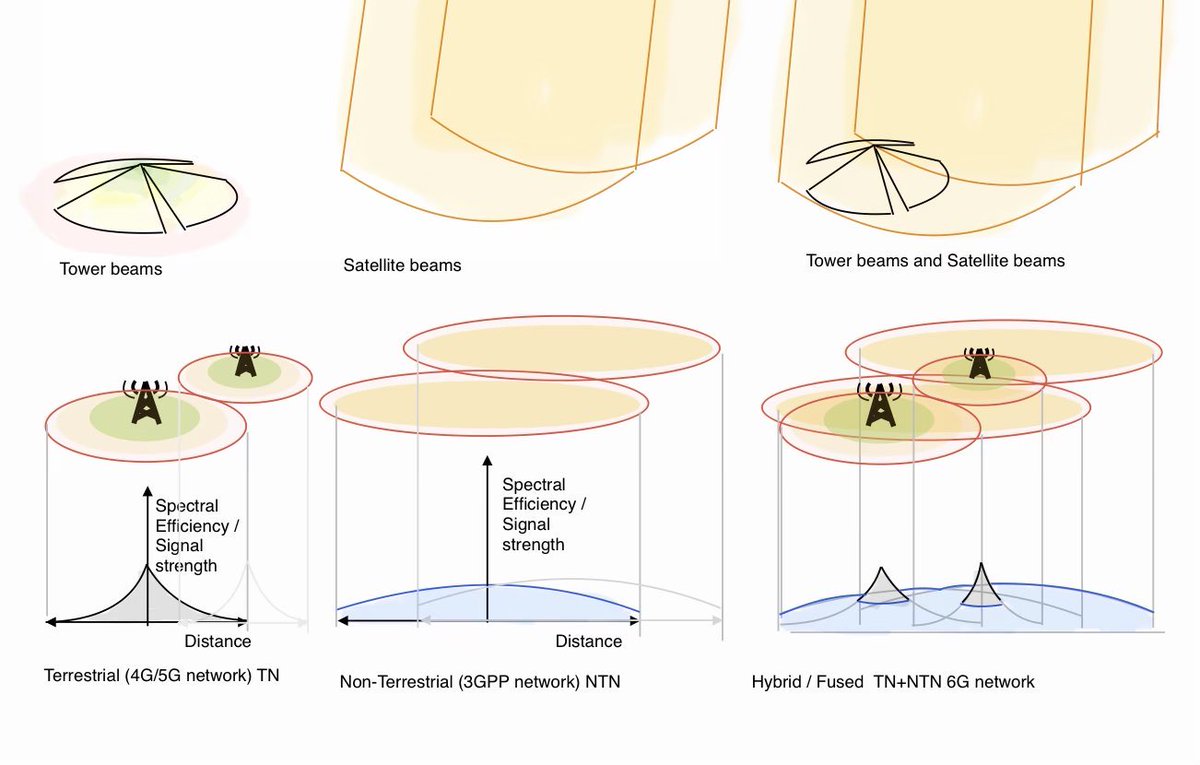
Its an underappreciated fact that the edge area of a tower is a big part of the coverage area.
A properly built 3GPP NTN system with enough spectrum allocated will outperform towers in this ”one bar land”.
And serve as a rapid and no-CapEx way to deploy more spectrum there.
$ASTS looks increasingly serious about space-based AI edge compute. They also appear to be using Claude internally. Wouldn’t be surprised if they team up with Anthropic eventually.
Govt work also getting interesting. And who named it "Bella" lol.
FN meeting this week where they authorized the FY27 budget. Notable in that they have hugely increased the amount dedicated to Reinvestment and Network Enhancement this FY year. Not sure if this means an investment in $ASTS but here is the commentary from the meeting when they discussed the budget. Part of the increase last year was to deliver a 5G SA core, which they reported 7/2026 as completed. FN FY27 starts October 1st.
"We now have an opportunity to drive coverage even farther into rural, remote, tribal, and other areas where first responders tell us they need it most to strengthen resiliency and redundancy and to take advantage of capabilities that simply were not possible when FirstNet was created.
With the recent launch of the dedicated 5G standalone core, let's think about the kind of capabilities that platform now increasingly can enable in the field. An officer securely transmitting live high-definition video from a body-worn camera. A search and rescue team using drones to give incident command real-time view of conditions responders cannot safely reach. Firefighters and hazardous materials teams drawing information from connected sensors as conditions change around them, or an EMS team using high-speed connectivity to share critical information with physicians before a patient ever reaches the hospital. Those are some examples of the kinds of capabilities we now have the opportunity to further enable and expand.
So this next generation of FirstNet is not simply about a faster network. It is about giving first responders better information, greater situational awareness, and new tools to make decisions when seconds matter."
$ASTS ✨
AT&T COO Jeff McElfresh is now publicly highlighting AST SpaceMobile and its latest FCC approval.
McElfresh:
“Last week marked another key milestone for the work underway to close America’s connectivity gaps: AST SpaceMobile received temporary FCC approval to test satellite service with everyday smartphones.”
He also made AT&T’s view of satellite connectivity very clear:
“Satellite-based internet service isn’t a replacement for advanced fiber or 5G connectivity, but rather a complementary technology we’ll use to bring AT&T customers the best possible connectivity experience — wherever they go.”
The FCC’s 30-day STA allows AST SpaceMobile to conduct testing with up to 100 commercially available devices using:
📡 817–824 MHz — Earth-to-Space
📡 862–869 MHz — Space-to-Earth
One particularly interesting detail:
The FCC grant states that testing must comply with “existing agreements between AST SpaceMobile and T-Mobile USA.”
So we now have:
AT&T → Publicly positioning AST satellite connectivity as a complementary extension of its customer network
T-Mobile → “Existing agreements” with AST referenced in the FCC authorization
Verizon → Existing AST partner
AST’s U.S. D2D strategy increasingly appears to be moving beyond technology demonstrations toward real network integration involving America’s major wireless operators.
⚠️ Important: The FCC authorization is a 30-day STA for controlled, non-commercial testing — NOT commercial service authorization.
https://t.co/p7jbeBAZMG
#ASTSpaceMobile #ATT #TMobile #D2D #Satellite
Everyone's treating the "SpaceX and $ASTS both want $6B of 800 MHz" headline as a bidding war AST loses because SpaceX has more money. That's not really what's happening. The FCC didn't set up a sale. It set up a lease and partner-selection process. Grain has to pick a D2D satellite partner by Nov 5 and file applications by Dec 4. So AST doesn't need to buy this outright, it just needs to be selected. It has ~$3.7B cash, can't write a $6B check, but can easily lease.
Also, @SpaceX and @AST_SpaceMobile are built for different spectrum. SpaceX just spent ~$19B on EchoStar's mid-band and S-band around 2 GHz, and its next-gen Direct-to-Cell satellites are designed for that. Its birds don't use low-band 800 MHz. It would have to redesign hardware to use it.
AST's satellites already support 800 MHz. 10 in orbit, 80%+ of Block 2 in production for the band, and it sits right next to the AT&T and Verizon 850 MHz AST already leases. For AST this band is core. For SpaceX it's optional.
So why would SpaceX bid on spectrum it isn't built to use? Probably to block AST, or just optionality given the balance sheet. Not because it needs it.
Realistic outcome: AST gets access through Grain's lease process, which is the path the FCC actually built, not a $6B purchase by anyone. Affordable, fits their tech, and the FCC already hinted AST is the obvious D2D partner.
Bottom line, this is better for AST than "SpaceX will outbid them" suggests. AST doesn't need to outbid. It needs to be picked. And on this band, it's the one actually built for it. 🛰️
$ASTS - Hennessy Funds also sums up AST SpaceMobile potential nicely:
"We continue to believe we are on the cusp of a new communication revolution with decades of potential growth in front of it, and believe AST will play an integral role."
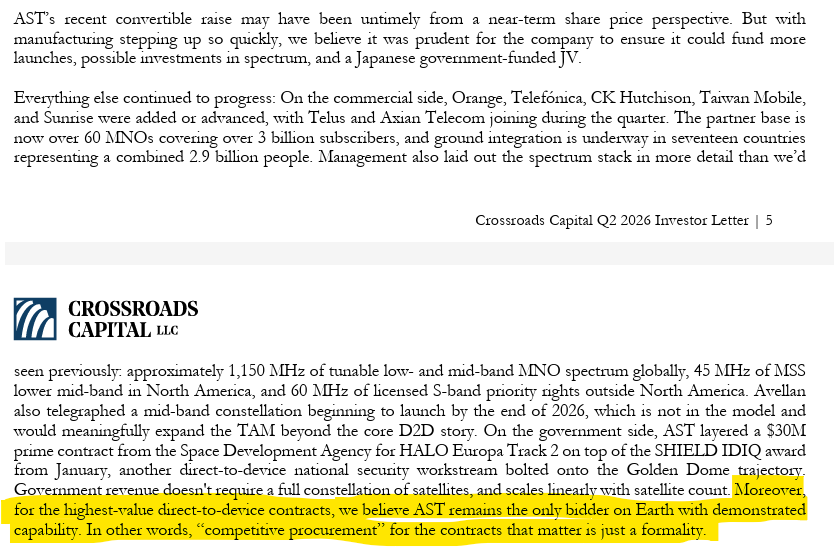
$ASTS - From Crossroads Capital Q2,26 Investor Letter:
They sum up the AST SpaceMobile thesis perfectly:
"for the highest-value direct-to-device contracts, we believe AST remains the only bidder on Earth with demonstrated capability. In other words, “competitive procurement” for the contracts that matter is just a formality."
https://t.co/B8V9HVjAYi
🚨 $ASTS TO PROVIDE INFLIGHT CONNECTIVITY VIA LIGADO MSS BANDS AT PEAK DOWNLOAD DATA RATES OF NEARLY 200 MBPS) 🚨
Heavily redacted Ex-parte presentation contains reference to a use-case at 30,000 feet. Where Commercial jet airliners (and business jets) commonly cruise.
🐾
$ASTS: AST and Ligado has met with the FCC to deliver a confidential ex-parte about the technical specs of the system. The powerpoint is largely redacted but good signs
https://t.co/O22KDi0u5X
$ASTS: 🚨@fairwinds_tech's website was recently revamped and they replaced the @AST_SpaceMobile product page with their "Aetherlink" product page, developed with AST.
AETHERLINK
Global 5G + NTN service for mission-control defense communications.
CORE CAPABILITIES
+ Seamless terrestrial and satellite handoff for persistent connectivity
+ Military-grade security with a modular architecture.
+ Supports ISR, autonomous systems, edge networking and remote access
+ Scales across disconnected and infrastructure-limited environments
STRATEGIC ADVANTAGE
+ Extends resilient connectivity across remote and infrastructure-limited environments
+ Integrates terrestrial and satellite transport for mission flexibility
BUSINESS IMPACT
+ Maintains mission continuity in disconnected environments
+ Extends secure connectivity across remote and distributed operations
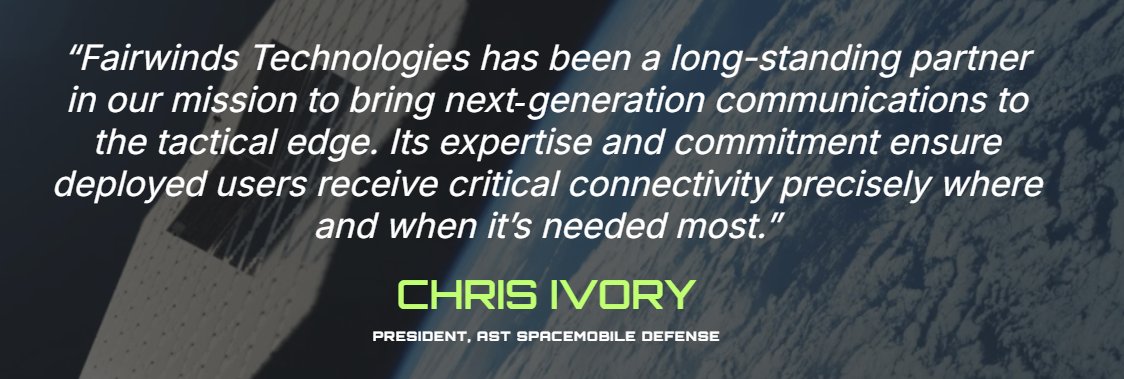
With a testimonial from Chris Ivory, President, @AST_SpaceMobile Defense 🤝
“Fairwinds Technologies has been a long-standing partner in our mission to bring next‑generation communications to the tactical edge. Its expertise and commitment ensure deployed users receive critical connectivity precisely where and when it’s needed most.”
https://t.co/XVkAsK328N
$ASTS ✨
AST SpaceMobile • Satellite Connect Europe Officially Launches
Satellite Connect Europe — the joint venture between AST SpaceMobile and Vodafone — has formally launched as an open-access D2D satellite broadband provider for European mobile network operators.
This is an important step in turning AST’s European strategy into actual infrastructure.
🇪🇺 Key points:
• Joint venture between AST SpaceMobile and Vodafone
• Headquartered in Luxembourg
• 5 European ground stations planned
• Construction already underway in Spain and the UK
• 3 additional locations are being finalized
• Ground infrastructure designed to support full European coverage
• Already working with European mobile network operators
• Standard 4G/5G smartphones — no specialized hardware, software or device upgrades required
One of the most important details:
Satellite Connect Europe says it has “exclusive European access” to AST SpaceMobile’s LEO constellation.
The structure is designed to keep network operations, data handling and service control within European jurisdiction while allowing existing MNOs to maintain their customer relationships.
In other words, AST is not simply trying to sell satellite connectivity directly to European consumers.
The model is:
🛰️ AST SpaceMobile constellation
↓
🌍 Satellite Connect Europe ground infrastructure
↓
📡 European mobile operators
↓
📱 Existing 4G/5G smartphones
Satellite Connect Europe says its goal is to complement terrestrial mobile networks and extend coverage beyond their existing limits.
The significance for $ASTS is clear:
Europe is progressing from partnerships and agreements toward physical ground infrastructure, network integration and an operator-led commercialization framework.
AST is building not just satellites in orbit — but the terrestrial infrastructure needed to connect those satellites into existing mobile networks.
https://t.co/3HbBjLa0mj
$ASTS #ASTSpaceMobile #SatelliteConnectEurope #D2D #5G #Satellite #Telecom